

Why Is Trump Rebuilding the White House Like He Plans to Stay
The scale, timing, and ambition of the new White House renovation are making some people in Washington uneasy.

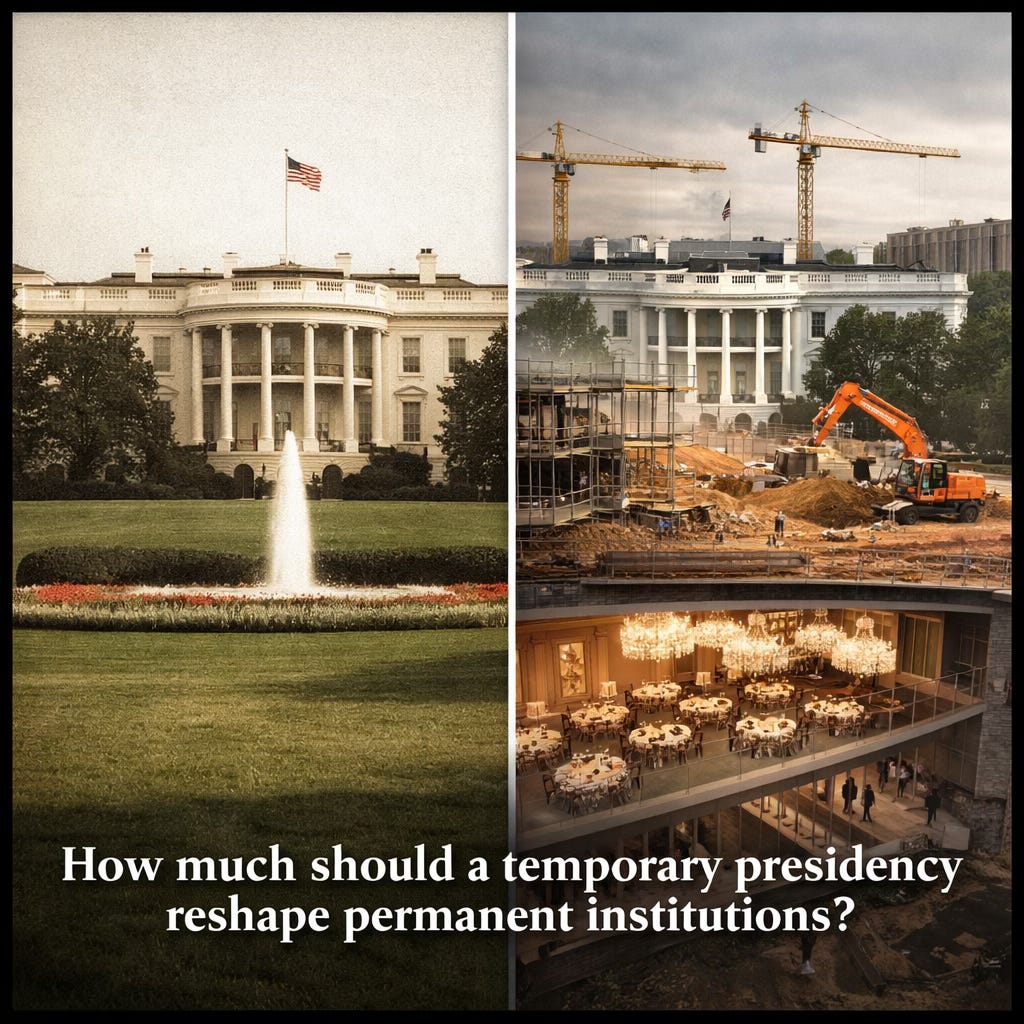
Something unusual is happening at the White House.
And almost nobody is talking about it yet.
Why Is Trump Rebuilding the White House Like He Plans to Stay
The scale, timing, and ambition of the new White House renovation are making some people in Washington uneasy.
The JackHopkins Now Newsletter #814: March 14th, 2026.
But that’s exactly why a new White House construction plan is making some people in Washington uneasy.
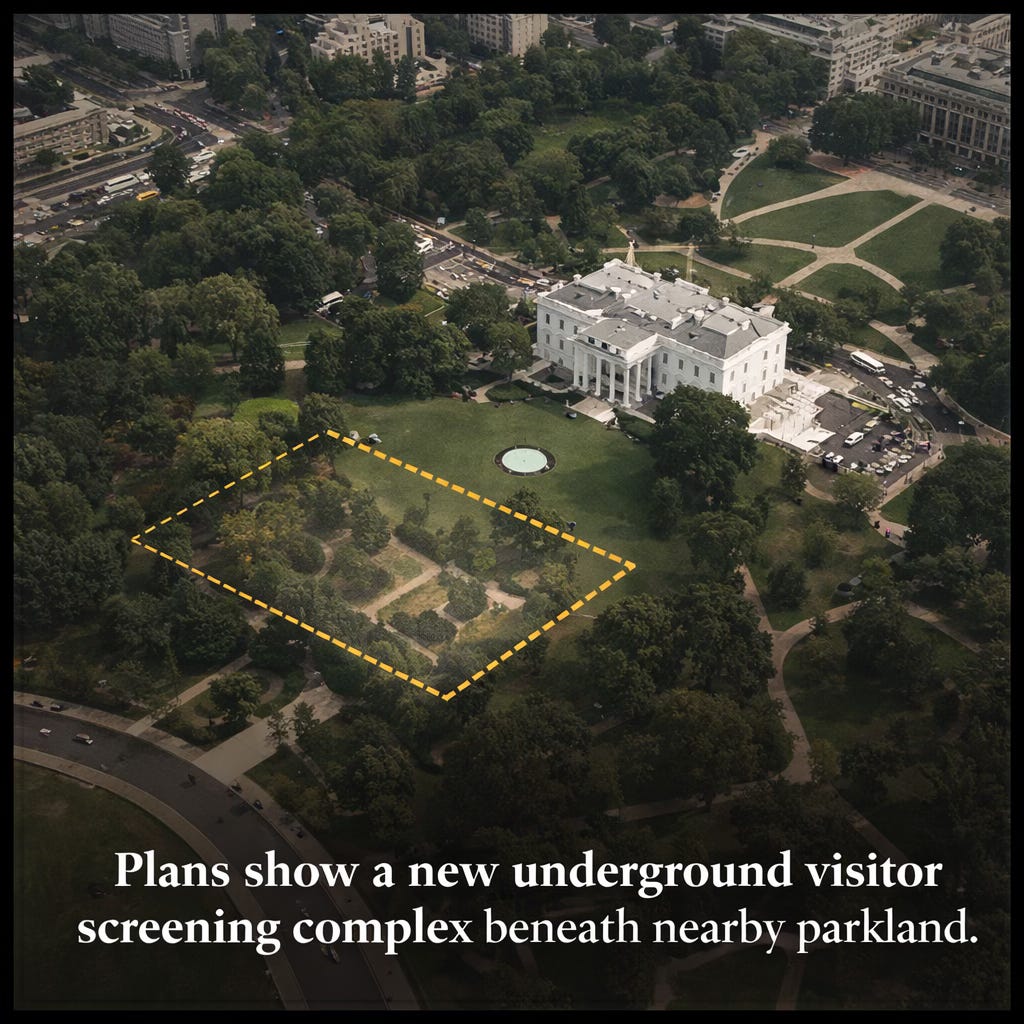
The administration is proposing a 33,000-square-foot underground security screening facility beneath parkland near the White House.
On its own, that might sound like a routine security upgrade.
Except it isn’t happening on its own.
Because at the same time…the administration is pushing forward with a 90,000-square-foot ballroom project…a massive addition that already required demolishing the East Wing last fall.
Put those together…and you’re looking at well over 120,000 square feet of new construction on the White House campus.
That’s not maintenance.
That’s a transformation.
And…it’s one of the largest physical changes proposed for the White House grounds in decades.
Which is why this story has people in Washington asking a question that sounds almost absurd when you say it out loud:
Why build like this if the White House is supposed to be temporary?
Presidents Usually Build Like Visitors
The White House is unlike any other home in America.
Every president lives there.
None of them own it.
It’s a national residence designed to pass from one administration to the next.
Which is why presidents historically tread carefully…when it comes to major construction.
Maintenance happens.
Security upgrades happen.
Occasional renovations happen.
But sweeping architectural changes are rare.
The most dramatic transformation in modern history came under President Truman… when the building had to be completely rebuilt because the structure was literally collapsing.
Since then…presidents have largely treated the complex with restraint.
Why?
Because everyone understands the same basic rule:
You don’t redesign a house you’re only borrowing.
This Project Is Different
The proposal now under discussion includes:
• a 33,000-square-foot underground visitor screening complex
• a seven-lane security entrance
• a sunken plaza to process large visitor groups
• the demolition of the East Wing to make way for a ballroom
• a 90,000-square-foot event space costing up to $400 million
The official explanation is straightforward.
Better security.
Better visitor flow.
Better facilities for hosting events.
But…projects of this size rarely exist in isolation.
Because architecture inside Washington is rarely just about buildings.
It’s about signals.
And the signal here is unmistakable:
This is not a modest renovation.
It’s a reimagining of the campus.
Quick Pause: I Want Your Instinct
Let me ask you something.
Imagine you’re a president who believes your time in the White House is temporary.
You know another administration will eventually move in.
Would you:
A) Focus on modest upgrades and preservation.
or
B) Demolish an entire wing, build a $400 million ballroom, and construct one of the largest underground facilities ever added to the White House grounds.
Drop A or B in the comments before you keep reading.
Because…that instinctive reaction…tells you a lot about why this story feels so strange to many observers.
The Timeline Raises Eyebrows
Another detail jumps out when you look at the schedule.
The administration hopes to open the underground facility in July 2028.
That’s just six months before the end of Trump’s current term.
Large federal construction projects take years.
Which means this renovation would be completed at the exact moment the presidency is supposed to be preparing for a transition.
Now, presidents do occasionally build projects that will mostly benefit their successors.
But…critics say the psychology here feels different.
When people view their role as temporary…they tend to build cautiously.
When people view their legacy as permanent…they build differently.
Bigger.
Bolder.
More personally.
That’s…why this renovation is raising eyebrows.
Then There’s the East Wing
Another detail buried in the reporting deserves attention.
The East Wing was already demolished last fall to make way for the ballroom project.
That matters.
Because in Washington construction politics, demolition is the point of no return.
Once a structure disappears, stopping the project becomes dramatically harder.
Which means the administration didn’t just propose a redesign.
It created a new reality first.
Then left the approval process to follow.
That’s not how most presidents approach changes to historic federal property.
But…it is how powerful leaders sometimes behave…when they are confident institutions will eventually fall in line.
The Donor Question
The ballroom project raises another layer of questions.
Trump has said the ballroom would be funded by private donations.
Meanwhile, the projected cost has climbed steadily:
First $200 million.
Then $300 million.
Now, estimates are approaching $400 million.
Private donors funding permanent architecture on the White House grounds is unusual.
That raises obvious questions:
Who are the donors?
Why contribute that kind of money?
And…what influence comes with financing a permanent addition to the presidential residence?
Even if everything is legal…the optics are striking.
Because historically, the White House has been treated as a public symbol…not a donor-funded legacy project.
BONUS: The Part That Makes People Say “Wait… What?”
There’s another piece of the story that deserves attention.
Because when you zoom out and look at the entire pattern, the renovation starts to feel even stranger.
Start with the East Wing demolition.
That structure housed the visitor entrance, First Lady offices, and event coordination spaces.
It stood for decades.
Then suddenly it was gone.
Cleared for a ballroom.
Now add the underground complex.
It’s 33,000 square feet, largely buried beneath nearby parkland.
Seven screening lanes.
Large underground visitor processing areas.
That’s not a small checkpoint building.
That’s a massive subterranean facility.
And underground construction around the White House always attracts attention for one simple reason.
The White House complex already sits above one of the most hardened security environments in the world.
Below ground are layers of infrastructure built over decades.
Command systems.
Emergency facilities.
Continuity-of-government protections are designed to function during national crises.
There’s no evidence this visitor facility connects to any of that.
None.
But…when you start digging new underground spaces around the White House, people familiar with that security ecosystem…inevitably start asking questions.
Because historically…underground construction near the presidency has always meant more than architecture.
The Pattern That Starts to Emerge
Now step back for a moment and look at the timeline.
Over the past several months, a series of things have happened around the physical centers of American cultural and political power.
Individually, each one has its own explanation.
But placed side by side, they start to form a pattern that’s harder to ignore.
First, the East Wing of the White House was demolished to make way for a massive ballroom project.
Then came plans for a 33,000-square-foot underground security complex beneath nearby parkland.
At the same time…Trump moved aggressively to reshape leadership at the Kennedy Center…one of the country’s most visible cultural institutions.
And…now the White House campus itself is facing one of the largest physical transformations in decades.
Again, each decision can be explained on its own.
But…taken together, they reveal something that’s easy to miss if you only follow politics through daily headlines.
Because these aren’t just policy decisions.
They’re institutional redesigns.
Changes to the physical environments where power and culture operate.
History shows that when leaders begin reshaping institutions physically…buildings, stages, cultural centers, symbols…it often reflects something deeper than policy goals.
It reflects how they see their relationship to those institutions.
Temporary steward.
Or permanent force.
And…that distinction matters.
Because democracies are built on the assumption that power passes from one administration to the next.
The buildings stay.
The occupants change.
But…when the occupant starts reshaping the buildings themselves on a massive scale…
…people naturally begin to ask whether the relationship between the person and the institution is changing too.
A Strange Pattern History Has Seen Before
There’s something historians often notice about powerful leaders.
Before political systems change dramatically, something subtle tends to happen first.
The physical environment of power begins to change.
New buildings appear.
Old structures disappear.
Ceremonial spaces expand.
Architectural symbols of authority grow larger.
You can see this pattern again and again in history.
In imperial capitals…where leaders constructed grand halls designed to project permanence.
In presidential palaces…where leaders reshaped national residences to reflect their personal image.
In governments where the physical stage of power slowly shifted from something institutional to something personal.
Now…none of that means the same thing is happening here.
History never repeats itself exactly.
But it does repeat certain rhythms.
And…one of those rhythms appears when leaders begin reshaping the architecture of the institutions they temporarily inhabit.
That’s when people start asking whether the relationship between the leader and the institution is changing.
Is the building simply a workplace?
Or…is it becoming part of the leader’s personal legacy project?
That question doesn’t answer itself overnight.
But it’s one reason stories like this…spread so quickly once people notice them.
Because architecture, more than speeches or press conferences…has a way of revealing how leaders truly see their place in history.
Why This Story Is Spreading
Maybe this renovation will turn out to be exactly what the White House says it is.
A long-overdue visitor facility.
A security upgrade.
A grand ballroom for state events.
That’s entirely possible.
But the reason the story is spreading…is because it touches something deeper.
The presidency rests on a simple idea:
No one owns it.
Every occupant is temporary.
Every administration eventually leaves.
When the physical campus of presidential power starts changing on a massive scale, people instinctively start wondering what that says about how its current occupant sees the role.
And…once that question enters the public imagination…
It’s very hard to make it disappear.
Before You Go: One More Thought
The biggest political stories rarely begin with headlines.
They begin with patterns.
Small details that don’t quite add up.
A demolition here.
A massive new structure there.
A timeline that feels oddly placed.
Individually, each detail can be explained.
But when you step back and look at the entire picture, the question shifts from:
“What is happening?”
to
“What might this pattern reveal?”
That’s what I try to do here.
Not chase the daily outrage cycle.
But…step back and connect the signals…that reveal how power is actually moving beneath the surface.
Because by the time something becomes obvious to everyone…
It’s usually too late to understand how it started.
If that kind of analysis matters to you…consider becoming a subscriber.
It’s how this work continues.
And…it’s how we keep digging into stories like this one.
One More Thing That’s Hard to Ignore
There’s something else about this renovation that people in Washington understand instinctively.
Presidents almost never get to physically reshape the White House in dramatic ways.
Not because they don’t want to.
But…because the system makes it extremely difficult.
Historic preservation boards.
Federal planning commissions.
Congressional oversight.
Security reviews.
Public comment periods.
The White House complex…is one of the most heavily scrutinized properties in the United States.
That’s why major structural changes are rare.
They usually take years of debate and often die quietly somewhere in the approval process.
In fact, proposals for underground visitor screening facilities…have circulated since after the attacks of September 11th.
And…for decades…those proposals were repeatedly blocked.
Too expensive.
Too complicated.
Too controversial.
Now, suddenly…after years of failed attempts…the largest redesign of the White House campus in modern memory is moving forward all at once.
An entire wing demolished.
A massive ballroom proposed.
A large underground complex planned.
Which raises a quiet question people in Washington know better than to say directly.
If something this difficult is happening this quickly…
…who decided the obstacles no longer matter?
Because historically, when the rules that usually slow down power suddenly stop working…
It’s rarely because the rules changed.
It’s because the person holding power…has decided they no longer apply.
If this piece made you stop and think, consider restacking it so more people see it.
Stories like this only spread when readers push them into the open.
Also, I thank you for your patience ahead of time. I’m taking my youngest daughter to see “Scream” in 4D Max this evening. She’s been begging me.
In either the wee hours of the morning, or, oater tomorrow morning, I’ll get to your comments…or most of them.
#HoldFast
Back soon.
-Jack
Jack Hopkins
Sources / Further Reading
https://apnews.com/article/25ede1c5718ca27f58210651b6e67e34
https://www.cnn.com/2026/03/14/politics/white-house-underground-security-complex
https://www.ncpc.gov/review/agenda/
https://www.whitehousehistory.org/the-east-wing
https://crsreports.congress.gov/product/pdf/IF/IF11642
The president and family are tenants. They don't get to build a new fortress. I worked for a long time in the field of historic preservation, and what happened to the East Wing makes me sick to my stomach. I hope I HOPE the commission reviewing the ballroom debacle listens to the 30,000+ comments and has the backbone to say NOT ON OUR WATCH.
Hopkins is right to treat architecture as evidence. Buildings outlast speeches. They are the physical record of how power understands itself.
The detail that matters most is not the ballroom. It is the demolition. The East Wing is already gone. You demolish first when you have decided the institutions designed to slow you down no longer apply to you.
The timeline tells you what the press conferences don’t. A facility completing six months before a scheduled transition is not being built for the next occupant. Leaders who build for permanence have stopped preparing for a successor.
The donor question matters. Private money funding permanent architecture on public presidential grounds changes the relationship between the symbol and the public. We should know who is paying. We should ask what they expect.
Political capture announces itself in buildings before it announces itself in policy. Hopkins is asking the right question: does the person in the building believe it belongs to them? Ask it now. Before the concrete sets.
#HOLDFAST