

What We Know About SEAL Team Six Admiral Frank Bradley
…and What I Think We’ll See If He’s Questioned in a Bipartisan Hearing

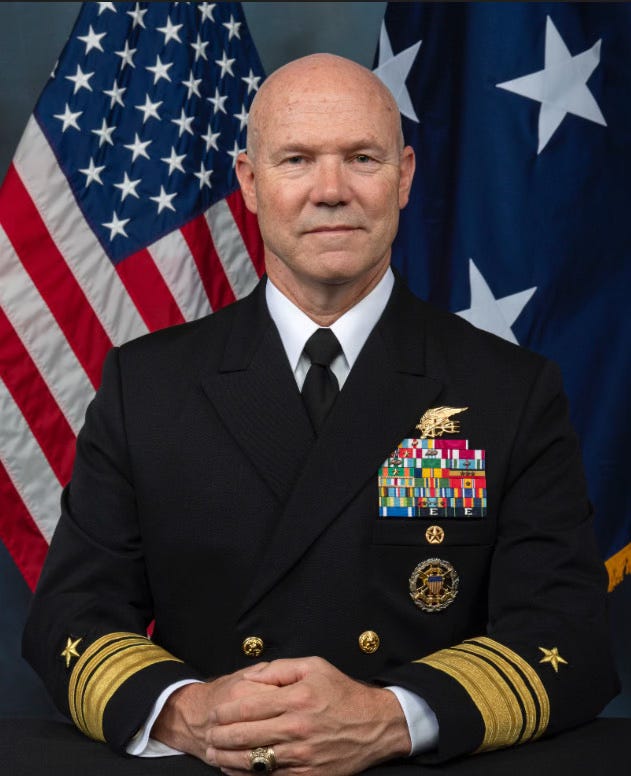
What We Know About SEAL Team Six Admiral Frank Bradley
…and What I Think We’ll See If He’s Questioned in a Bipartisan Hearing
The Jack Hopkins Now Newsletter #674: Wednesday, December 3rd, 2025
You’re living through something almost no American ever sees in real time:
A sitting four-star admiral…
A man who climbed every rung of the most elite ladder in the U.S. military…
A former SEAL Team Six commander turned SOCOM boss…
…suddenly finds his entire legacy hanging on one day…one decision…and one sentence:
“Kill them all.”
That…according to multiple reports…is what Defense Secretary Pete Hegseth ordered during the Sept. 2 strike on a suspected drug boat in the Caribbean…an order that allegedly resulted in an initial missile strike…two survivors clinging to life… and a second strike that killed them.
Legal experts are already saying…out loud…what most of Washington is trying not to say on camera:
If the second strike killed defenseless survivors…that would be a crime under U.S. and international law…war or no war.
And the White House has now confirmed that the man who called in that second strike was Admiral Frank “Mitch” Bradley.
The operation…the memo that supposedly justified it…and the chain of command that produced it are all headed toward bipartisan hearings that could reshape how Americans see their military…and their would-be strongmen.
Before that circus begins…I want you to understand exactly who Bradley is on paper…
…and what I believe you’ll see when the cameras swing to his face and someone finally puts him under oath.Because if you get this structure into your bones now…you’ll be watching those hearings with X-ray vision.
The Resume the System Fell in Love With
Let’s start with what’s undeniably true.
Frank M. Bradley is not some random political hack pulled off a cable set and dropped into a uniform.
He’s the ultimate inside man of American special operations.
Born in Eldorado, Texas.
Naval Academy grad, Class of ’91.
Physics degree. Varsity gymnast. The kind of guy who could out-think you and out-pull-up you in the same afternoon.
Earned a master’s in physics from the Naval Postgraduate School…with an award-winning thesis on next-gen semiconductor physics…not exactly coloring-book material.
He wasn’t just another SEAL officer. He was the officer you send when you want…
brains…
discipline…
and zero drama.
He went through BUD/S in 1992 (I was at BUD/S in 1995…three years later. I never met him, but did hear his name mentioned a couple times…in a positive way…both then…and years later) did the classic teams tour (SEAL Team FOUR, SDV Team TWO)…even served with Italian naval commandos…then made the jump into the inner sanctum:
Naval Special Warfare Development Group.
SEAL Team Six. “DevGru.” The unit most Americans only know from movies and bin Laden headlines.
And he didn’t just pass through it.
He commanded it.
From there, the elevator only went up:
Senior staff inside JSOC
Executive officer to the Chairman of the Joint Chiefs
SOCCENT commander
JSOC commander
And now, as of October 2025, Commander…U.S. Special Operations Command (SOCOM)…the four-star in charge of every SEAL…Ranger…Delta operator…AFSOC pilot…and MARSOC Raider in the inventory.
The rack on his chest is what you’d expect:
Multiple Defense Superior Service Medals
Legion of Merit
Multiple Bronze Stars…including for valor in combat.
To the system…this is the model officer:
Smart enough to brief the most technical intel…
Quiet enough not to upstage the civilians…
Lethal enough to be respected by the shooters…
Polished enough for the E-ring.
If you’re wondering why the Pentagon keeps throwing its body in front of him now… it’s because he is exactly the type of man they’ve spent 30+ years grooming to be the adult in the room.
Which brings us to the strike that may define his name forever.
The Night the Resume Met Reality
On September 2, 2025, U.S. forces launched a missile at a boat in the Caribbean Sea…
…suspected of carrying drugs and tied…at least in the talking points…to Venezuelan “narco-terrorists.”
First strike: nine killed.
Two people survive. They’re seen on the drone feed…wounded…shipwrecked… clinging to the wreckage.
That’s the moment where the law of war stops being abstract and becomes brutally simple:
You don’t get to kill shipwrecked survivors.
Not if you want to stay on the lawful side of history.
The Pentagon’s own law-of-war manual is crystal clear on this.
Legal experts from across the spectrum…including former military lawyers…have said that if a second strike was ordered against defenseless survivors…we are talking about a war crime under both wartime and peacetime law.
The White House now admits there was a second strike…and that it was ordered by SOCOM…meaning by Adm. Bradley in his command role at the time.
They insist:
It wasn’t about killing survivors; it was about “destroying the vessel.”
There’s a classified OLC memo saying drug boats can be treated as legitimate targets because they fund cartel violence.
Legal experts…again…are almost laughing at that argument:
You don’t get to erase the wounded by pretending you were just shooting the boat.
At the same time…reports say Hegseth had earlier conveyed a “kill them all” directive…no survivors.
You don’t have to be a lawyer…to see why this is the most radioactive second strike in recent U.S. military history.
And sitting in the middle of that blast radius?
Admiral Frank Bradley.
The Company Man’s Dilemma
Here’s where we stop just reciting biography and start reading psychology.
For over 30 years, Bradley has lived inside one rule:
You execute the mission the nation gives you…inside the laws you’re told govern it.
Special operations officers…especially at his level…are professional executors. They don’t write policy. They don’t write the OLC memos. They don’t go on Fox or MSNBC and wave their arms.
They sit in a secure room…listen to the directive…ask the lawyers if they’re covered…and then either say:
“No, that’s unlawful,”
or“Roger. We’ll execute.”
If the reporting is accurate, this is what happened instead:
A civilian political appointee with a TV host’s appetite for spectacle allegedly says some version of “no survivors.”
The lawyers in D.C. hand over a memo that acts like magic pixie dust…drug cartels are “narco-terrorists,” so killing them with missiles in international waters is fine.
The admiral in the chair…Bradley…decides that the survivors on that boat…are “legitimate targets” because they might call for help.
A second strike is ordered. They die.
That’s the moment where three decades of “perfect company man” clashes with the one question…no one at that level ever wants pointed at them:
“Why didn’t you say no?”
That question is coming. You can feel it building. Both Democrats and Republicans are already openly skeptical and demanding documents…video…and legal justifications.
Bradley is going to be called in.
He’s going to sit down.
He’s going to be sworn in.
And then?
Then you’re going to see which part of him wins:
the decorated professional who knows what the law requires…
orthe loyal executor who’s spent his life absorbing political risk so civilians don’t have to.
What I Think You’ll See When He Testifies
Let me walk you into that room ahead of time.
If you understand this structure before the first question is asked…you will…I promise you…understand the hearing better than 99% of the pundits pretending to.
1. You’ll see a man who looks…sounds…and acts like competence.
Bradley will not show up as a cartoon villain.
He’s going to be:
calm…
precise…
respectful…
deeply prepared…
lawyered-up to the eyebrows.
He knows this game. He’s sat behind the principals in these hearings before. He’s written the talking points for flag officers testifying about classified ops. I know this.
He will use phrases like:
“within the authorities provided,”
“consistent with the OLC guidance,”
“in accordance with standing rules of engagement,”
“based on the best intelligence at the time,”
“under the understanding that we were engaged in an armed conflict with narco-terrorist elements.”
He will look like the adult. The contrast with Hegseth’s TV-warrior buffoonery will be dramatic.
That’s intentional.
2. He will try to protect the operators first.
You will not hear him throw SEAL Team Six under the bus.
Not once. Not even subtly.
He will emphasize:
They acted on lawful orders.
They executed the target as tasked.
They believed the mission was fully authorized.
They did not freelance.
And…he’ll be right to do that.
The moment a nation starts hanging its front-line operators for policy-level sins…it’s over.
3. He will lean on the memo.
The classified OLC memo is going to be the magic shield.
You’ll hear, in one form or another:
“Congressman, I relied on the legal opinions provided to me by the Department of Defense and the Department of Justice. My understanding, at the time of the strike, was that the operation was lawful and within those authorities.”
He will not argue the memo himself. He’ll refer to:
“our lawyers,”
“the interagency process,”
“the Office of Legal Counsel conclusions.”
Translation: If there’s a war crime here…don’t look at me…look at the people who said the magic words first.
4. He will dance on the edge of “I don’t recall.”
There are going to be questions he flat-out won’t want to answer directly:
“Did you understand there were survivors visible on the feed?”
“Did you hear Hegseth say ‘kill them all’ in any form?”
“Did anyone in the room question the legality of a second strike?”
“Did you seek a written legal opinion before ordering the follow-up?”
Watch for phrases like:
“My recollection is…”
“I don’t have a specific memory of that phrase.”
“The characterization in that article doesn’t match my understanding.”
“I would need to refer back to the logs/transcript on that.”
This isn’t a memory problem. It’s a liability problem.
You’re watching a man try to stay between three walls:
Don’t perjure yourself.
Don’t incriminate yourself.
Don’t openly accuse your civilian chain of command on live TV.
That’s a very narrow hallway.
5. He will not say the words “war crime.”
Not about himself. Not about the operation. Not about anyone above him.
You are far more likely to hear:
“I’m not a lawyer.”
“I’ll defer to the Department of Justice on that question.”
“I can’t characterize it that way, Congressman.”
“We believed we were in a non-international armed conflict with cartel-linked entities…”
He knows that the minute he uses the phrase “war crime,” every defense attorney in the building jumps out of a window.
6. He will quietly resist being turned into the sole scapegoat.
This is the most interesting piece to watch.
Right now…Hegseth and the White House are trying to position Bradley as the guy who “had full authority” and “made the call” …while insisting nobody in a suit knew about the second strike.
Bradley has two choices:
Option A: Fall on the sword completely. Let the politicians walk. Hope the system takes care of him quietly.
Option B: Very carefully say enough to make it clear that the policy and the tone were set above him…without outright accusing anyone.
My bet?
He splits the difference.
He’ll say things like:
“The Secretary’s guidance was aggressive.”
“There was an expectation of decisive action against traffickers.”
“We understood there was a strong desire to send a message.”
All of which is code for:
“Don’t pretend this mindset started with me.”
The Questions That Would Actually Test His Integrity
If this is going to be more than political theater…there are a few questions members of Congress should ask that cut straight to the bone.
1. “Admiral, when you saw survivors on that boat, what did your training tell you the law required you to do?”
That forces him to reconcile:
decades of law-of-war training…including clear prohibitions on attacking the shipwrecked, wounded, and hors de combat…
with…his actual choice that day.
If he says, “Rescue,” the follow-up is obvious:
“So why did you order a second strike?”
If he says, “Neutralize,” then you’ve just heard a four-star SOCOM commander redefine the laws of war on camera.
2. “Did anyone in that room voice concern that the second strike might be unlawful?”
This is where integrity either shows up or disappears.
If the answer is “no one said a word,” that’s a terrifying portrait of moral inertia at the highest levels.
If the answer is “yes,” then the obvious follow-up is:
“And what did you do when that concern was raised?”
3. “Did you understand that shipwrecked survivors are protected under the law of armed conflict?”
There’s no wiggle room here. The Pentagon’s own public materials say exactly that.
If he claims ignorance…it’s not credible.
If he admits knowledge…we’re back to:
“So why did you fire?”
4. “If a junior operator had refused to execute the second strike on legal or moral grounds, what would have happened to his career?”
You want to find the truth about a system? Don’t ask what it claims to believe. Ask what it would do to the lowest-ranking person who lived out that belief under pressure.
If the honest answer is “He’d be done,” you’ve just diagnosed a culture where legality and morality are less important than obedience and optics.
Why This Matters More Than One Admiral
I want you to hear me very clearly:
This is not about hating the military.
This is about whether we are still a nation where:
illegal orders can be refused…
shipwrecked survivors aren’t burned off the map…
and career loyalty doesn’t override the most basic laws of war.
Adm. Frank Bradley’s career is…in many ways, the ideal product of the post-9/11 special operations machine:
hyper-competent
relentlessly deployed
steeped in classified missions few civilians will ever hear about
rewarded at every step for executing hard orders in gray spaces
That kind of man is extremely valuable to a country that wants problems handled quietly.
He is also extremely vulnerable to a different kind of pressure:
“Do it. The lawyers blessed it. We’ll have your back.”
The September 2 strike is where that culture smashed into the brick wall of basic law.
And now…under the hot lights of bipartisan hearings…we’re about to see whether the man at the center of it has one more gear:
The gear that says:
“I know what the memo said.
I know what the secretary wanted.
But at the end of the day, my job was to uphold the law… and in that moment, I failed.”
I don’t know if he’ll go there.
What I do know is this:
You are going to see a lot of people try to make this about “hard men doing hard things in a hard world.”
Don’t buy it.
Real hardness is the ability to say “no” when the entire system is leaning on you to say “yes.”
How to Watch the Hearing Like an Insider
When the hearing happens…and it will…here’s how to watch it:
Ignore the grandstanding speeches.
Ignore the pre-written outrage.
Ignore the culture-war bait.
Watch:
When his eyes harden. That’s when he’s hearing something he knows is true but doesn’t want to say.
When he leans on lawyers. That’s where the OLC memo is doing heavy lifting.
When he defends the operators. That’s the part of him that’s still intact.
When he refuses to use certain words. That’s where the liability lives.
And…remember:
By the time you see that man take the oath…you’ll know more about his career…his incentives…his bind…and his blind spots than most of the people interviewing him.
That’s not an accident.
That’s why I write these breakdowns.
So when the country is fed a slick narrative about “tough decisions” and “tragic necessities,” you can quietly say:
“No. I know exactly what I’m looking at.
I know who benefits.
I know who’s hiding.
And I know what questions they’re not answering.”
That clarity?
That’s your edge.
#HOLDFAST.
Back soon,
-Jack
P.S.
While I did enter SEAL training and spent time as a BUD/S trainee at the Naval Special Warfare Center in Coronado, I was never a Navy SEAL. I was medically dropped during First Phase because of a spinal injury.
A year later…a traumatic brain injury ended any possibility of returning; I could no longer pass the Navy Dive Physical.
From that point on…all involvement…communication…or interaction I ever had with SEALs was as a non-SEAL enlisted sailor…and later… as a civilian.
The bottom line…and the only part that truly matters…is this:
At no time was I ever designated a U.S. Navy SEAL.
I usually print your stuff but this one goes on top, will be converted to Excel and of course as a Bingo card. This is already and about to be as or more nuanced and complicated than I assumed when the story broke. “No one said a word,” still jumps out at me as a pivotal phrase. But I can’t quite anticipate in which direction. Echoes of My Lai resonate even still.
And wow, sorry to hear about your .. “disability”? But if not for it, we might not be able to enjoy your insight to these matters. It’s tacky to say “this is an event you were born to cover” but I seriously doubt anyone would bring to light the subtle minutiae about which most civilians would be clueless.
I am going to watch this Admiral Bradley thing a while before I make up my mind about him. They say he admires Trump which is a big red flag for me. I don't trust anybody that admires Trump! Why would we?