What If Anxiety Is Consuming the Resources You Need to Prepare?
An uncomfortable question with a surprisingly liberating answer.
The Jack Hopkins Now Newsletter #924: Wednesday, June 10th, 2026.
Below, I have created a transcript of a fictional seminar I conducted where I helped a woman with a problem that some of you might find familiar. Enjoy.
JACK HOPKINS SEMINAR: “THE DIFFERENCE BETWEEN A PROBLEM AND A REHEARSAL”
A woman raises her hand.
“I’ve been extremely anxious.”
Hopkins nods.
“About what?”
“The political situation.”
“What specifically?”
“The country.”
“And?”
“The economy.”
“And?”
“I’m worried there won’t be enough money.”
Hopkins smiles gently.
“Thank you.”
He pauses.
“How long have you been anxious?”
“A couple of years.”
“And during those two years...”
he pauses,
“...have you had enough money to eat?”
The audience chuckles softly.
“Yes.”
“Have you had a place to sleep?”
“Yes.”
“Have you continued functioning?”
“Yes.”
He nods.
“Interesting.”
Long pause.
“Then let us determine what precisely is creating the anxiety.”
He turns toward the audience.
“Notice that anxiety is not the same thing as danger.”
He writes on a flip chart.
DANGER
ANXIETY
“These are often confused.”
He circles the words.
“If a tiger enters this room, that would be danger.”
The audience laughs.
“If you imagine a tiger entering this room next Thursday...”
more laughter,
“...that would be anxiety.”
He underlines the second word.
“The distinction matters.”
He looks back toward the woman.
“Right now, at this exact moment, are you in danger?”
She looks around.
“No.”
“Yet anxiety can be present even when danger is absent.”
“How?”
He pauses.
“Because human beings possess the remarkable ability to create experiences internally.”
He taps his head.
“We can manufacture futures.”
The room becomes quiet.
“And unfortunately, many people become experts at manufacturing futures they do not want.”
The audience laughs.
He nods.
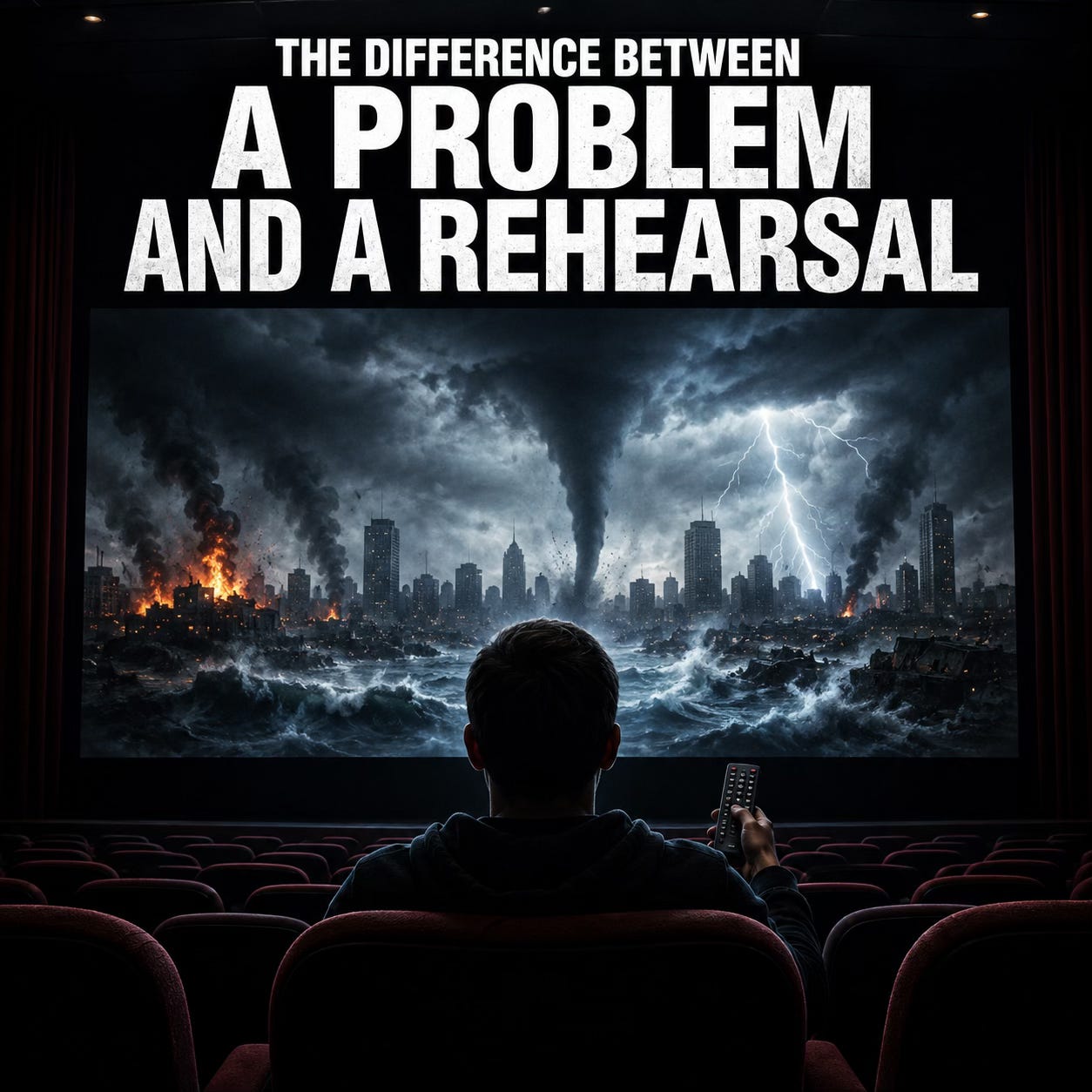
“Imagine hiring a film director whose sole job was to create catastrophe movies.”
More laughter.
“And then imagine forcing yourself to watch those films every day.”
The audience laughs again.
“Eventually you would begin to feel terrible.”
He pauses.
“Yet many people do precisely this.”
He turns back toward the woman.
“When you become anxious about the economy...”
“What happens first?”
She thinks.
“I start imagining things.”
“Excellent.”
“What things?”
“Losing money.”
“And then?”
“Things getting worse.”
“And then?”
“I imagine struggling.”
“And then?”
“I feel afraid.”
Hopkins writes:
Image
→ Prediction
→ Emotion
“There is a sequence.”
He taps the board.
“The feeling is not appearing mysteriously.”
“It is the result of a process.”
He turns toward the audience.
“Now notice something fascinating.”
He points at the first word.
“The image is imagined.”
He points at the second.
“The prediction is imagined.”
He points at the third.
“The emotion is real.”
Silence.
“Many people experience a real emotional consequence from an imagined event.”
He lets the statement sit.
Then he asks the woman:
“How often do your predictions come true exactly as imagined?”
She laughs.
“Almost never.”
The audience laughs.
“Yes.”
He smiles.
“That is one of the great inefficiencies of anxiety.”
More laughter.
“We suffer repeatedly for futures that fail to arrive.”
He begins pacing slowly.
“I would like to suggest another possibility.”
He stops.
“What if anxiety is not preparing you?”
The room grows quiet.
“What if it is consuming resources you could use to prepare?”
Silence.
He continues.
“Consider the difference.”
“One person spends three hours imagining collapse.”
“Another spends thirty minutes reviewing finances, improving skills, building relationships, and creating options.”
He shrugs.
“Which person is better prepared?”
The audience nods.
“The first person feels active.”
“The second person is active.”
A few people laugh.
“These are not the same thing.”
He turns back to the woman.
“Tell me.”
“What is actually within your influence?”
She thinks.
“My spending.”
“Good.”
“My savings.”
“Good.”
“My work.”
“Good.”
“My choices.”
“Excellent.”
He writes:
INFLUENCE
Then beside it:
SPECULATION
He circles both.
“Most anxiety occurs when attention migrates from influence into speculation.”
The audience becomes very quiet.
“One domain contains action.”
“The other contains endless imagination.”
He pauses.
“The nervous system does not always distinguish between the two.”
He looks toward the woman.
“When you imagine political catastrophe...”
“What happens to your body?”
“I tense up.”
“When you imagine financial collapse?”
“My stomach tightens.”
“And when you review the specific actions available to you this week?”
She pauses.
“I feel calmer.”
Hopkins nods.
“Of course.”
“Because one process creates helplessness.”
“The other creates agency.”
He walks slowly to the center of the stage.
“I am not suggesting you ignore reality.”
“Reality deserves attention.”
“But attention and rehearsal are different activities.”
He lets that settle.
“Reading a financial statement is attention.”
“Running disaster movies for six hours is rehearsal.”
The audience laughs.
“Following current events is attention.”
“Living emotionally inside imagined catastrophes is rehearsal.”
More laughter.
He looks around the room.
“Many intelligent people become trapped by an unconscious bargain.”
They believe:
‘If I worry enough, I will be safer.’
He shakes his head.
“Yet worry and preparation are not synonyms.”
Silence.
“Worry is an experience.”
“Preparation is a behavior.”
The room is completely still now.
He turns back to the woman.
“What would happen if every time anxiety appeared...”
“...you treated it as a signal?”
“A signal to do what?”
she asks.
He smiles.
“To ask a single question.”
The room waits.
‘What action is available right now?’
He pauses.
“And if there is no action?”
The audience leans in.
“Then perhaps the appropriate response is not anxiety.”
Long silence.
“Perhaps the appropriate response is acceptance.”
The room is still.
“Not approval.”
“Not agreement.”
“Not passivity.”
“Acceptance.”
“The recognition that reality exists whether we tense our muscles about it or not.”
He smiles gently.
“And when reality changes...”
“You will respond.”
“As human beings always have.”
He looks around the room.
“The future is uncertain.”
“It always was.”
“The economy is uncertain.”
“It always was.”
“Politics are uncertain.”
“They always were.”
He pauses.
“The mistake is believing uncertainty is a new condition.”
A few people nod.
“It is not.”
“It is the permanent condition.”
He smiles.
“The task is not to eliminate uncertainty.”
“The task is to become skillful enough that uncertainty no longer frightens you.”
Long silence.
Then he adds:
“When that happens...”
“...the world often looks exactly the same.”
He pauses.
“But you do not.”
The audience erupts into applause.
#HoldFast
-Jack
Jack Hopkins
P.S. If this article resonated with you, you’ve just experienced something paid subscribers see regularly.
A lot of political content tells you what to be worried about.
I spend much of my time helping people distinguish between what deserves attention …and…what deserves emotional rent-free space inside their heads.
That’s because surviving turbulent times isn’t just about understanding politics… economics…or current events. It’s about developing the ability to remain calm…clear… and effective…while everyone else is being pulled into fear…outrage…and endless speculation.
Paid subscribers receive more of these deeper frameworks, mental models, and orientation pieces designed to help you navigate uncertainty without becoming consumed by it.
Because information is useful.
But learning how to think when the future feels uncertain…is invaluable.


Brilliant!! So clear, so simple and so so needed right now. I practice this in principle if not exactly and it works! In addition, the usual suspects (adequate nourishing food, good sleep, love, community, etc) only help more. I love having this reminder and have restacked it.
Jack, you rock! Thank you for this.
That is bloody brilliant 🙌🏽 and so helpful!! Thank you Jack!!!
