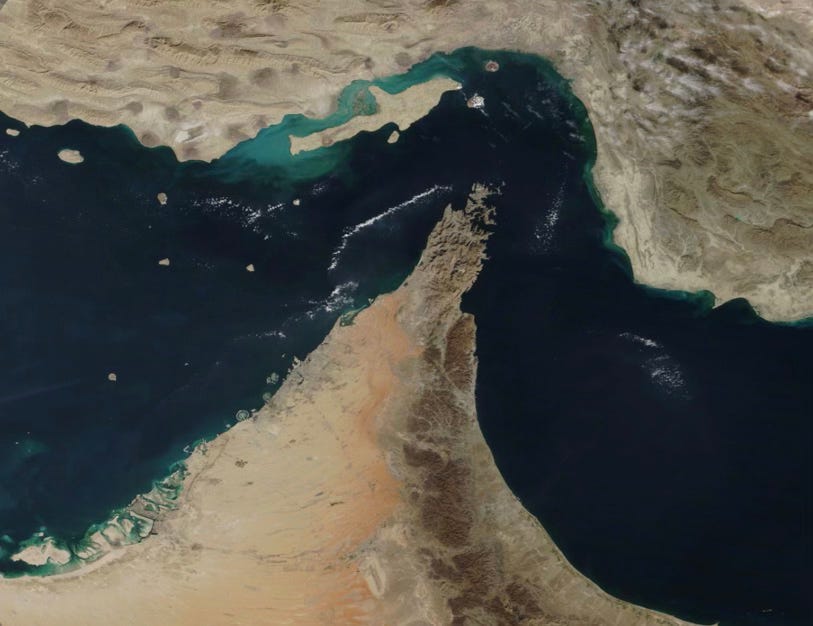
The Strait Is Not “Open.” It Is Being Managed Under Threat.
The White House keeps talking like the crisis is over. The shipping world is behaving like it’s just entering a more dangerous phase.
The Strait Is Not “Open.” It Is Being Managed Under Threat.
The White House keeps talking like the crisis is over. The shipping world is behaving like it’s just entering a more dangerous phase.
The Jack Hopkins Now Newsletter #891: Thursday, May 7th, 2026.
There is a dangerous habit in modern geopolitics.
Governments announce victory.
Markets whisper something else.
And if you want to know which one is closer to reality…watch the behavior of the systems carrying actual risk.
Right now, the behavior surrounding the Strait of Hormuz is telling a very different story than the podium.
The public is hearing phrases like:
“The ceasefire is holding.”
“Shipping lanes are reopening.”
“Iran has been degraded.”
“The Strait remains navigable.”
Technically…parts of that are true.
Operationally…the picture is far more unstable.
Because as of this week, the Strait of Hormuz is not functioning like a secure global trade corridor.
It is functioning like a heavily militarized pressure zone operating under conditional access, strategic ambiguity, and ongoing coercive leverage.
And that distinction matters enormously.
The Strait Is Not Closed. But It Is Not Free Either.
That is the first thing people need to understand.
Most Americans imagine this situation in binary terms:
Open.
Or closed.
Safe.
Or war.
But…real-world maritime pressure campaigns rarely work that way.
Iran does not need to permanently “close” the Strait to create enormous geopolitical leverage.
It only needs to create enough uncertainty…enough insurance panic… enough shipping hesitation… enough economic friction… that global behavior changes.
And…that is exactly what has happened.
Reports now indicate hundreds of ships remain bottlenecked inside the Gulf region while insurers, shipping firms, and governments continue recalculating operational risk in real time.
That matters…because the Strait of Hormuz is not some obscure regional shipping lane.
Roughly a fifth of the world’s oil historically moved through this corridor.
When uncertainty enters Hormuz…energy markets…insurance systems…military planners…and supply chains all begin reacting immediately.
The White House may be talking about deterrence.
The shipping industry…is behaving like the threat remains active.
And…here is where the story becomes much more serious than most television coverage is admitting.
Because behind the scenes…the institutions closest to actual risk appear to be behaving very differently than the public narrative suggests.
Military planners.
Shipping insurers.
Commodity traders.
Energy markets.
Intelligence agencies.
None of those systems appear to be operating as though this crisis is truly resolved.
Paid subscribers are going deeper into that later tonight…including the startling reason one successful drone strike could trigger cascading global consequences far beyond the physical damage itself…and why some analysts appear increasingly worried about prolonged instability becoming normalized inside one of the most economically sensitive chokepoints on Earth.
Because…once you look beneath the headlines…the real story becomes far more unsettling.
Iran Is Playing A Different Game Than Most Americans Realize
One of the biggest misconceptions in Western media coverage is the assumption that Iran’s goal is conventional naval dominance.
It is not.
Iran’s strategy…has long centered around something much more achievable:
Persistent disruption.
Gray-zone pressure.
Psychological uncertainty.
Escalation without triggering full-scale annihilation.
And…unfortunately for Washington…the geography of Hormuz gives Tehran enormous leverage in exactly those areas.
Iran does not need aircraft carriers to create global anxiety.
It does not need to defeat the U.S. Navy conventionally.
It only needs to convince insurers…traders…shipping companies…and regional governments that instability remains possible tomorrow morning.
That threshold is dramatically lower than television rhetoric suggests.
And…recent events indicate Iran still retains enough operational capability…to maintain that uncertainty.
To be clear: the Strait is not fully closed, and U.S. naval operations have successfully escorted some vessels through the corridor. But restoring limited passage is not the same thing as restoring normalized commercial confidence.
The Ceasefire Looks Increasingly Fragile
This week’s reports of renewed exchanges between U.S. and Iranian forces are especially important.
Not necessarily because they indicate immediate regional collapse.
But…because they expose the contradiction…at the heart of the current narrative.
If the conflict has truly stabilized…
Why are military exchanges still occurring around the Strait?
Why are shipping markets still behaving defensively?
Why are insurers still pricing for instability?
Why are naval escorts still expanding?
Why are commercial operators…still acting as though escalation risk remains alive?
Because beneath the political messaging…the underlying structure remains unresolved.
That is the part many headlines are still avoiding.
The “ceasefire” increasingly resembles what geopolitical analysts sometimes call an armed pause.
Not resolution.
An armed pause.
And those…are very different things.
Watch The Ships, Not The Speeches
This remains one of the most important rules in modern geopolitics.
Do not just listen to what governments say.
Watch what systems do.
Shipping behavior.
Insurance behavior.
Military positioning.
Commodity pricing.
Supply chain rerouting.
Those systems…often reveal operational truth…long before official narratives catch up.
And…right now, those systems are still behaving as though…Hormuz remains unstable.
Not collapsed.
Not fully controlled.
Not normalized.
Unstable.
That distinction is where reality lives.
But…the deeper question now is not whether the Strait is unstable.
The deeper question…is what happens if instability itself…becomes the new normal.
Because that possibility carries implications most media discussions are still barely touching:
prolonged energy volatility
systemic insurance repricing
permanent military escalation cycles
fragile global supply chains
chronic inflationary pressure
and the quiet normalization of gray-zone maritime coercion in one of the world’s most important economic arteries
That is the deeper layer of the story.
And…frankly…it is the layer institutions closest to actual risk…appear far more focused on than the television narrative currently suggests.
Why This Matters Beyond Iran
The real lesson here extends far beyond the Strait itself.
This is increasingly how modern geopolitical power operates.
Not through permanent conquest.
Not through clean military victories.
But through pressure.
Narrative management.
Economic leverage.
Controlled instability.
Strategic ambiguity.
The public keeps waiting for clean endings.
But…the modern world…increasingly produces managed volatility instead.
And…people who understand that early…tend to experience events very differently than people relying entirely on headlines.
Because once you understand the structure…later developments stop feeling shocking.
You start recognizing the pattern underneath the noise.
That is the difference between consuming information…and developing orientation.
And…right now, the Strait of Hormuz is teaching that lesson in real time.
#HoldFast
Back soon.
-Jack
Jack Hopkins
P.S.
Here is the part that should probably concern people the most.
The systems closest to actual risk do not appear to believe this situation is fully stabilized.
Not the insurers.
Not the shipping firms.
Not the military posture.
Not the intelligence assessments.
Not the commodity markets.
Their behavior keeps signaling the same thing:
The threat environment remains active.
And…if that is true…then the public conversation may still be several layers behind what institutions managing actual operational risk already understand.
Paid subscribers are getting the deeper breakdown tonight:
what intelligence assessments reportedly still say Iran retains
why shipping insurers may be more important to watch than politicians
the hidden vulnerability inside global energy markets
why one successful strike could trigger disproportionate economic consequences
and the disturbing possibility that prolonged instability…not total war…may be the real long-term danger emerging inside Hormuz
Because once you begin watching the systems…instead of the speeches…the entire picture starts changing.


As Todd alluded to, I don’t trust a thing the Trump regime says. I’ll watch the systems and yes… I’d believe Iran over Washington if those were the only two choices… they aren’t the only things to pay attention to though.
It’s disturbing that we’d believe Iran over our own government but it’s where we are.
I look forward to the paid piece later tonight.
Thanks, Jack!
#Holdfast
~Susan
File the date: May 7, 2026. The U.S. Navy is escorting commercial vessels through a strait the White House says is open.
Note which things coexist in the same week: a declared ceasefire and active exchanges between U.S. and Iranian forces near Hormuz. Note which institutions are still pricing for instability — the insurers, the shipping firms, the commodity desks. Note which ones have accepted the official narrative. There are not many.
Jack is correct that this is how modern pressure campaigns work. Iran does not need to close the Strait. It needs to keep the question open. The Ottoman Empire spent decades doing precisely that in the Bosphorus — not blocking passage but controlling the terms of it. The leverage was in the uncertainty, not the closure.
Jack is correct that the public is several layers behind. The systems managing actual risk learned this lesson earlier. History records that gap, too — the distance between what governments announced and what institutions already knew. That distance is measurable. It shows up later in the documents.
The reader can decide what it means that the ships are still rerouting.
#HOLDFAST