

The ICE Gold Rush
How America Turned Detention Into a Business Model

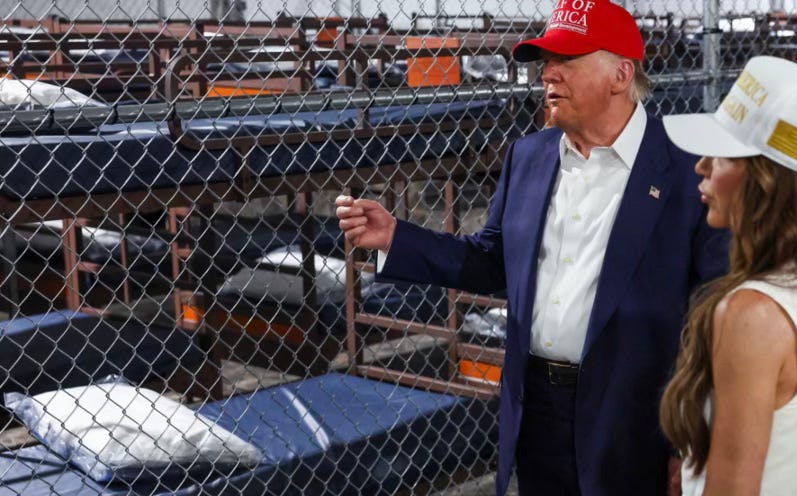
The ICE Gold Rush
How America Turned Detention Into a Business Model
The Jack Hopkins Now Newsletter #693: Thursday, December 18th, 2025.
There is a mistake most Americans make when they think about authoritarian crackdowns.
They imagine uniforms.
They imagine shouting.
They imagine dramatic raids and chaotic scenes on television.
What they don’t imagine are invoices.
Because modern authoritarianism…doesn’t arrive with tanks rolling down Main Street.
It arrives with contracts…renewals…no-bid procurement…quiet contract modifications…and expanded line items…buried inside federal budgets.
And nowhere is that clearer…right now…than in the Trump–ICE–private detention pipeline.
This is not a story about immigration policy in the abstract.
It is a story about how enforcement becomes infrastructure…how fear becomes a revenue stream…and how once that system is built…it begins to operate according to business logic…not moral urgency.
The Myth of “Border Security”
Let’s strip away the rhetoric.
Trump’s immigration posture has never been primarily about borders.
Borders are finite.
Fear is not.
What Trump has consistently understood is that immigration enforcement is a uniquely powerful political lever because it sits at the intersection of:
National identity
Racial anxiety
Economic insecurity
Executive authority
Emergency justification
But beneath the slogans is a logistical reality that rarely gets discussed:
You cannot scale mass detention and deportation without private infrastructure.
ICE does not own enough facilities.
The federal government does not staff enough detention beds.
Public prisons cannot be expanded fast enough to meet sudden enforcement surges.
Which means any serious expansion must rely on contractors.
And once enforcement is outsourced…profit enters the system.
From that moment on…incentives change.
The Private Detention Backbone
Most people recognize the names:
GEO Group
CoreCivic
But those companies are only the visible pillars.
Behind them is a broader ecosystem:
Real-estate holding entities
Transportation contractors
Medical service providers
Food service vendors
Surveillance and monitoring firms
Maintenance and staffing subcontractors
“Temporary” facility operators
This is not a simple prison system.
It functions more like a vertically layered supply chain.
Each detained person represents multiple billable categories:
A per-diem bed rate
Transportation costs
Medical services
Food and maintenance
Staffing and security
Facility operations
Detention is not merely an expense.
It is a structured revenue stack.
How the Blueprint Was Built
During Trump’s first term, detention did not expand because Congress debated and approved a sweeping new architecture.
It expanded because existing authorities were interpreted aggressively, and contracting mechanisms were normalized.
Key patterns emerged:
Increased reliance on “temporary” facilities that became semi-permanent
Expanded use of contract detention rather than government-run beds
Accelerated procurement timelines
Broad discretion granted to ICE field offices
Reduced practical oversight as capacity grew
None of this required sweeping new legislation.
It required reinterpretation.
And reinterpretation is where executive power quietly scales.
By the time Trump left office the first time…the detention infrastructure was no longer experimental.
It was ready to be reactivated.
Trump’s Second Term and the Reactivation Phase
One of the clearest indicators of policy direction is not rhetoric…but procurement behavior.
In 2025, ICE moved to expand detention capacity through:
No-bid and sole-source contracts
Contract modifications rather than new approvals
Reactivation of previously shuttered facilities
One example illustrates the pattern clearly.
In June 2025, GEO Group announced that ICE executed a contract modification activating the 1,868-bed D. Ray James facility in Georgia under an existing intergovernmental structure.
No new detention law was passed.
No national debate occurred.
Capacity simply came online.
That is how modern expansion happens.
Quietly.
Procedurally.
Legally.
Why Detention Capacity Creates Escalation Pressure
Here is a reality that often makes people uncomfortable, but must be stated carefully:
A detention system built around paid capacity creates incentives to sustain high utilization.
Beds must be justified.
Facilities must be renewed.
Contracts must be extended.
Operators must demonstrate operational “need.”
This does not require malice or conspiracy.
It is basic institutional behavior.
When enforcement becomes contractual…the system is no longer neutral about outcomes. It does not merely respond to violations.
It responds to capacity.
And capacity…once built…exerts gravitational pull.
The Language That Makes It All Palatable
One of the most effective features of this system is how it is described.
Instead of saying:
“We are punishing immigrants.”
The system says:
“We are processing cases.”
Instead of saying:
“We are building detention camps.”
The system says:
“We are expanding capacity.”
Instead of saying:
“People are being held for long periods.”
The system says:
“Cases are awaiting adjudication.”
This language matters.
Because once coercion is proceduralized…resistance sounds unreasonable.
Objections can be dismissed as emotional…ideological…or uninformed.
And policy continues…unchallenged…inside spreadsheets.
Follow the Paper, Not the Speeches
If you want to understand what is actually happening, stop watching press conferences.
Watch:
ICE contract awards and renewals
Sole-source and emergency procurement justifications
Bed-capacity language
Facility inspection waivers
Subcontractor relationships
Lobbying disclosures
Campaign donations
Revolving-door employment
Patterns emerge quickly.
Not smoking guns…pressure gradients.
And pressure gradients tell you where a system is moving next.
Why This Is an Authoritarian Risk, Not a Policy Dispute
Authoritarian systems rarely begin with mass arrests.
They begin with normalized detention.
They teach the public…slowly…that:
Some people do not receive full due process
Some people can be held for extended periods
Some people exist in legal gray zones
Some people are “processed,” not protected
Once that logic is accepted for one group…history shows it does not remain confined.
This is not alarmism.
It is pattern recognition.
Courts, Delay, and Cost Accumulation
Immigration courts are under enormous pressure.
Caseloads are high.
Backlogs are severe.
Outcomes vary widely by judge and jurisdiction.
Data shows high denial rates in many courts…with significant disparities.
And detention costs accrue…day by day.
This creates a system where:
Delay increases total cost
Long timelines increase contractor revenue
Individuals remain detained while cases move slowly
No single actor…has to intend harm…for the outcome to be harmful.
The structure…produces it.
(Remember, I live and die by structure…patterns…and translating complexity…into simplicity)
Why This Story Matters Right Now
As of December 18th, 2025, three forces are converging:
A second Trump administration emphasizing aggressive enforcement
A detention sector already primed for rapid expansion
A legal and procurement ecosystem that allows speed with limited visibility
That combination is volatile.
Not because of what has already happened.
But because of how quickly things can scale.
Speed is the authoritarian advantage.
And the infrastructure is already in place.
Why This Investigation Is Hard to Dismiss
This story is not dangerous because it is emotional.
It is dangerous because it is document-based.
Invoices.
Memos.
Contract modifications.
Procurement notices.
Capacity figures.
You cannot dismiss those as hysteria.
You cannot rebut them…with slogans.
Paper…does not argue.
It records.
The Question That Actually Matters
The most important question is not:
“Do I support immigration enforcement?”
It is:
“Who profits when enforcement expands?”
Because once fear becomes a business model…it must be sustained.
And the people sustaining it are not the ones being detained.
Final Word
America does not collapse overnight.
It gets leased…contracted…renewed…and billed monthly.
The ICE–private detention pipeline is not a side story.
It is a template.
And the most unsettling truth is this:
The machine does not care who is president.
It only cares…that the beds stay full.
#HoldFast
Back soon,
-Jack
Jack Hopkins
Receipt Index: Key Documents, Data & Reporting
(All sources reflect publicly available reporting and disclosures relevant as of December 17, 2025.)
ICE Detention Expansion & Contracting
Associated Press: No-Bid & Emergency Contracting
AP reporting documents ICE’s use of no-bid and sole-source contracts to rapidly expand immigration detention capacity under Trump-era enforcement priorities.
Coverage highlights oversight concerns and the speed at which detention capacity can be brought online through procurement mechanisms rather than legislation.
Associated Press: Politically Connected Contract Awards
AP investigations detail detention-related contracts awarded to companies with political ties, raising transparency and accountability questions in immigration enforcement procurement.
Private Prison Operators & Facility Reactivation
GEO Group: Contract Modification Announcement (June 2025)
GEO Group publicly disclosed that ICE executed a contract modification effective June 6, 2025, activating the 1,868-bed D. Ray James Detention Facility in Georgia under an existing intergovernmental framework.
Demonstrates how capacity can be expanded without new legislation or public debate.
CoreCivic: Investor Filings & Earnings Calls
CoreCivic SEC filings and investor presentations identify ICE as a major revenue source and describe facility activations and reactivations tied to federal detention demand.
Confirms detention operates through per-diem, capacity-driven contracts.
For-Profit Dominance in ICE Detention
TRAC (Transactional Records Access Clearinghouse), Syracuse University
TRAC data consistently shows that a majority of ICE detainees are held in for-profit or privately operated facilities.
Facility-level reports document detention capacity, average daily population, and operator identity.
Demonstrates the structural reliance on private detention infrastructure.
Detention Capacity, Bed Utilization & Cost Structure
ICE Detention Facility Data (via TRAC & DHS disclosures)
Shows detention operates through contractual bed capacity, with daily costs accruing per detainee.
Supports analysis that detention costs increase with longer confinement periods.
Immigration Court Outcomes & System Pressure
TRAC Immigration Court Data
Judge-by-judge and court-by-court data shows high asylum denial rates in many jurisdictions and wide disparities.
Documents extensive backlogs and prolonged case timelines.
Roll Call / Congressional Reporting
Reporting on immigration court backlog pressures and administrative strain under expanded enforcement priorities.
Procurement & Expansion Signals
Federal Procurement Records & Public Contract Notices
ICE procurement actions, including:
sole-source justifications
contract renewals
contract modifications
These records illustrate how detention capacity expands procedurally rather than legislatively.
How to Use This Index (For Readers & Researchers)
This index is not exhaustive. It is a starting map.
Readers who want to go deeper should:
Search SAM.gov for ICE detention contracts and modifications
Review SEC filings (10-Ks, 8-Ks) from GEO Group and CoreCivic
Use TRAC’s facility-level detention tools
Monitor local government IGSA agreements
Track AP and investigative outlet updates on detention procurement
The story of detention expansion lives in paperwork, not press releases.
Editorial Note
This investigation focuses on structures, incentives, and documented mechanisms, not individual intent.
All conclusions are drawn from publicly available data, reporting, and disclosed contractual practices.
Detention for profit has never been right nor good. No way, no how. The mere concept makes me fightin’ mad, which of course, doesn’t help anyone.
I’m simply aghast at the arrogance.
From Nov 2024 ABCNews:
Private prison firms contributed more than $1M to Trump's reelection. Now they expect a business boom
One company estimated a potential $400 million annual revenue increase.
By Peter Charalambous and Laura Romero
November 20, 2024, 6:20 PM
https://abcnews.go.com/US/private-prison-firms-contributed-1m-trumps-reelection-now/story?id=116046776
From January 2025 ABCNews:
Private prison firm CoreCivic gave $500K to Trump's inauguration, highlighting industry's support
Total contributions to the committee surpassed $150 million to set a new record.
By Laura Romero, Peter Charalambous, and Soo Rin Kim
January 29, 2025, 10:43 AM
https://abcnews.go.com/US/private-prison-firm-corecivic-gave-500k-trumps-inauguration/story?id=118218707
Jack, I imagine all of us accept, to greater and lesser degrees, that politics is dirty business. I guess I have just never seen that on display as much as now. If you have time sometime, can you post on the relationship, if any, between shame and honor?
Over the past few years, I have begun to wonder if operating with a sense of honor is a guaranteed loss, when up against a challenger who gets as much of a kick out of operating (flagrantly) outside of the rules as accomplishing whatever the goal is.
Early yesterday evening, I tuned into an interview on NPR. I believe the person being interviewed was journalist Chris Whipple. During one of his many interviews with Susie Wiles, he asked about the public’s reaction to tearing down the east wing. He relayed Susie Wiles’ response as the public’s opinion will change when they see the bigger picture. He then asked if there was more to come and reportedly Susie Wiles said yes but would not give details.
Can there be a business model that is simply do whatever you want without regard to those who ultimately pay for the action and/or without regard to the expressed sentiments of the majority against the action?