

SNAP: When “Health Policy” Is Really About Control
The psychology behind SNAP restrictions-and why they were inevitable

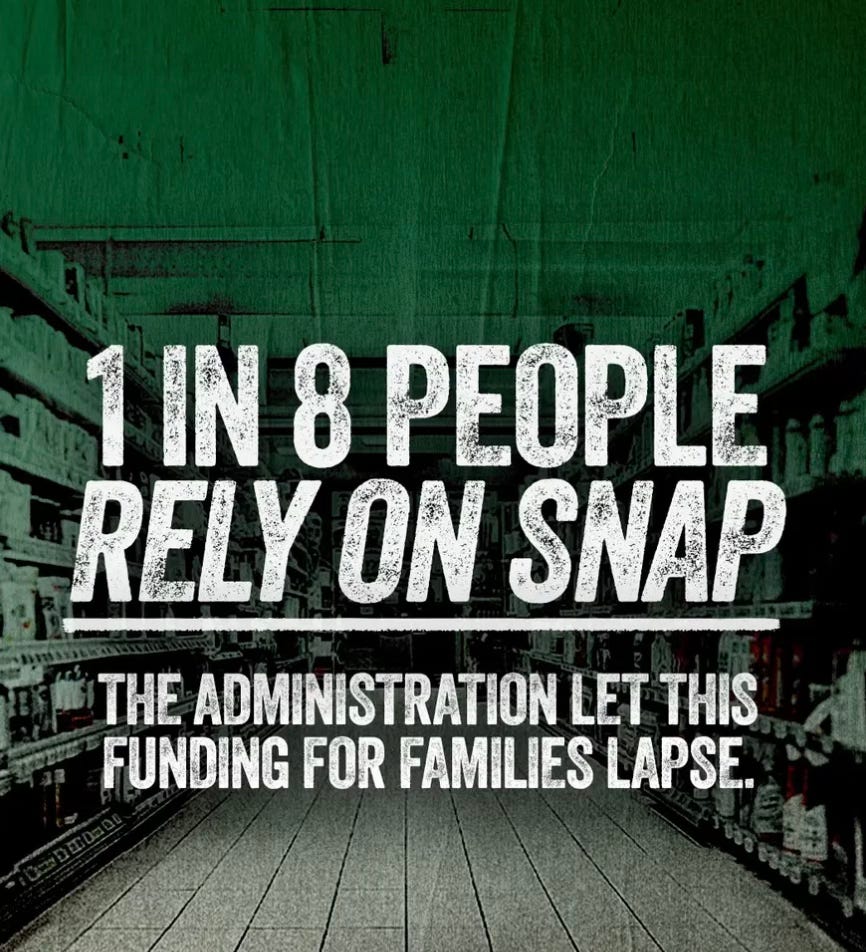
SNAP: When “Health Policy” Is Really About Control
The psychology behind SNAP restrictions-and why they were inevitable
The Jack Hopkins Now Newsletter #709: Wednesday, December 31st, 2025.
Let’s begin with the concession you’re expected to make.
Yes-if you squint hard enough…you can dress the new SNAP food restrictions up as “science-based public health.”
Sugar is linked to chronic disease.
Ultra-processed food is bad for you.
Diet matters.
All of that is true.
And yet.
If you look at this decision psychologically…not nutritionally…something else becomes obvious very quickly:
This policy is not about improving health.
It’s about how power thinks about poor people.
Moral Judgment, Rebranded as Medicine
One of the oldest psychological maneuvers in governance is this:
Take a moral judgment.
Repackage it as a health intervention.
Call dissent “anti-science.”
That’s what’s happening here.
There is no strong…settled evidence that banning specific foods from SNAP meaningfully improves long-term health outcomes. There is not. Even many public-health researchers quietly acknowledge that the data is thin…mixed…or inconclusive.
But the psychology driving the policy….doesn’t require strong evidence.
It requires something else entirely:
The belief that struggling people are struggling because they make bad choices- and bad choices must be corrected.
That’s not public health logic.
That’s moral psychology.
The Just-World Bias Doing Quiet Damage
We have a name for this instinct: the Just World Hypothesis.
It’s the deeply ingrained belief that:
good outcomes happen to good people
bad outcomes happen to bad people
When applied to poverty, it produces a corrosive shortcut:
If they’re poor…they must be irresponsible.
Once that belief takes hold…policy shifts.
Assistance becomes conditional.
Support becomes supervision.
Help becomes discipline.
SNAP restrictions fit this mindset perfectly. They allow policymakers to say “we’re helping” while signaling “we don’t trust you.”
Why Control Feels Like Competence
There’s another psychological force at work here: action bias.
When leaders face complex, systemic problems-obesity…chronic illness…food insecurity…they feel pressure to do something.
But real solutions are:
slow
expensive
structural
politically unrewarding
So instead…they choose symbolic action.
Banning soda feels decisive.
Restricting candy looks responsible.
Policing purchases signals authority.
Never mind that:
access hasn’t improved
affordability hasn’t changed
food deserts still exist
nutrition education has been cut
Control…creates the illusion of competence.
Psychologically…that’s often enough.
Why Only the Poor Get “Health Restrictions”
Here’s the tell you can’t unsee.
If this were genuinely about health, we’d see:
universal incentives
subsidies for healthy food
regulation of food manufacturers
pricing reform
Instead…we see behavioral restrictions applied only to people receiving assistance.
Middle-class families can buy soda without commentary.
Corporations can sell junk without scrutiny.
But SNAP recipients?
They get rules.
That asymmetry reveals the core belief:
Some people deserve autonomy. Others deserve oversight.
That’s not health policy.
That’s hierarchy, dressed up as care.
Stigma Is Baked In-Whether Anyone Admits It or Not
Supporters will say no one is trying to shame anyone.
Intent doesn’t matter.
Structure does.
Checkout denials.
Public confusion.
Cashier intervention.
“You can’t buy that” moments.
These experiences deliver a quiet psychological message:
You are being watched.
You are being judged.
You are not trusted.
Stigma doesn’t need cruelty.
It only needs systems…designed without dignity in mind.
The Displacement Nobody Wants to Name
There’s an uncomfortable projection happening here.
The same political actors pushing these restrictions often oppose:
higher wages
universal healthcare
corporate food regulation
accountability for manufacturers
So ask yourself:
If they won’t regulate the systems that produce unhealthy food-
why are they so eager to regulate the people forced to consume it?
Psychology calls this displacement.
It’s easier to control individuals…than confront corporations.
Easier to moralize consumption…than address inequality.
Easier to punish the powerless…than challenge the powerful.
Why This Will Fail-Even on Its Own Terms
Behavioral science is clear about one thing:
Autonomy matters.
People make healthier…more sustainable choices when they feel respected-not policed.
Restrictions without support:
increase stress
reduce trust
encourage workarounds
undermine institutional legitimacy
Even if the goal were improved health outcomes…this is one of the least effective psychological paths to get there.
Which tells you something important.
Effectiveness was never the point.
What This Policy Actually Accomplishes
Psychologically, the SNAP restrictions do four things very well:
Reassure the comfortable that someone is “in charge”
Signal moral authority without confronting power
Reinforce hierarchy under the guise of care
Shift responsibility from systems to individuals
That’s why the policy persists…despite weak evidence.
It satisfies emotional needs…not public health ones.
The Real Danger Isn’t Soda
The danger is precedent.
Once assistance is framed as something that must be earned through obedience…the line keeps moving.
Food today.
Housing tomorrow.
Healthcare next.
The psychology doesn’t stop…where the policy starts.
Bottom Line
This decision can be framed as science.
But psychologically…it’s something else entirely.
It’s mistrust disguised as care.
Control mistaken for competence.
Moral judgment wearing a lab coat.
And history is very clear…about where that road leads.
Not to better health…
but to quieter cruelty…deeper division…and the comforting illusion that punishing the powerless counts as progress.
BONUS: The Conditioning Effect Nobody Is Talking About
There’s a deeper psychological consequence of the SNAP restrictions that hasn’t been named yet-and it’s arguably more important than soda…sugar…or nutrition labels.
Conditioning.
Not in the cartoonish…conspiracy-theory sense.
In the slow…behavioral…entirely predictable sense.
Behavioral scientists have long understood that the most effective way to normalize control isn’t through force…it’s through routine. Through systems that quietly train people…to accept limits as normal…inevitable…and deserved.
That’s what policies like this do over time.
They don’t just restrict purchases.
They reshape expectations.
The lesson being taught isn’t “eat healthier.”
The lesson is: your autonomy is conditional.
And once that lesson sinks in…it generalizes.
People begin to internalize ideas like:
Assistance comes with obedience
Help means surveillance
Support requires compliance
That internalization matters…because it changes how people relate to institutions… and to themselves.
Instead of seeing public programs…as shared infrastructure…people begin to see them as probation.
Why This Matters Beyond SNAP
Behavioral psychology is very clear on one point:
People adapt to the rules they live under-even unjust ones.
Once conditionality becomes normal in one domain…it becomes easier to extend it to others.
Food choices today.
Housing eligibility tomorrow.
Healthcare compliance next.
Not because there’s a grand master plan…but because precedent lowers resistance.
Each new rule feels smaller once the last one has been accepted.
And importantly: this conditioning doesn’t just affect recipients.
It affects everyone watching.
The public begins to absorb a quiet but powerful message:
Some people deserve freedom. Others deserve management.
That belief doesn’t stay neatly contained.
It seeps into debates about protest…speech…immigration…healthcare…homelessness …anywhere “deservingness” can be argued.
The False Comfort of “They’ll Get Used to It”
Supporters of restrictive policies often say some version of:
“People will adjust.”
That’s exactly the problem.
Adjustment is not the same as improvement.
People adjust to:
surveillance
stigma
reduced autonomy
being treated as untrustworthy
They adjust because humans are adaptive…not because the system is humane.
And when adjustment is mistaken for success…policymakers confuse compliance with wellbeing.
From a psychological standpoint…that’s dangerous.
Because long-term compliance achieved through constraint doesn’t produce healthier citizens.
It produces:
disengagement
resentment
learned helplessness
and declining trust in institutions
Those outcomes don’t show up on nutrition charts…but they show up everywhere else.
The Quiet Trade Being Made
At its core, this policy trades something intangible for something measurable.
It trades:
dignity
autonomy
trust
for:
optics
moral reassurance
political signaling
That trade almost always looks “reasonable” in isolation.
It’s only when you zoom out…and look at the psychological pattern…that the cost becomes clear.
Healthy societies…don’t just care about outcomes.
They care about how outcomes are achieved.
Because methods…shape minds.
The Line Worth Watching
The most important question raised by the SNAP restrictions isn’t:
“Is soda unhealthy?”
It’s this:
At what point did we decide that managing the poor was a substitute for fixing the systems that keep people poor?
That question has nothing to do with nutrition.
And everything to do with the kind of society we’re quietly training ourselves to accept.
#HoldFast
I’ve thoroughly enjoyed writing for, and interacting with you in the wild year of 2025. I look forward to doing so…for years to come.
May you meet the new year with hope, gratitude…and resilience.
Back soon,
-Jack
Jack Hopkins
P.S.
There’s one line I confront people on every time I hear it spoken out loud.
“Well, you know damn well who pays to feed these lazy bastards… WE do!”
Bullshit.
You don’t “know” that.
You’ve been taught to repeat it.
Because here’s the part that should embarrass anyone who says it.
Recent IRS filing data show that SNAP costs the average actual income tax payer between $60-$70 a year. That’s between $1.15 and $1.34 a week. About the cost of one medium soft drink per week from McDonald's.
So, tell me again, “WE pay for those lazy bastards to eat!” That’s someone talking out of their arse.
Maybe they should try feeding their family on less than $1.40 per week. They’d find out…pronto…just how damn little of the life sustaining food in the SNAP program that “WE” pay for.
SNAP is one of the most tightly monitored…most accurate federal programs in existence. Year after year…government audits show that over 90% of SNAP dollars are spent correctly…by eligible households…on eligible food…exactly as intended.
Actual fraud? A tiny sliver. So small it wouldn’t even make the front page if we were being honest about it.
Meanwhile, we lose orders of magnitude more money to:
corporate tax avoidance
defense contractor overruns
financial fraud at the top
bailouts quietly labeled “liquidity”
But no one pounds the table over that.
So when someone sneers about “lazy bastards” eating on SNAP…what they’re really admitting is this:
They’re not angry about waste…they’re angry about who they’ve been told deserves dignity.
And repeating that line doesn’t make you informed.
It makes you useful…to people stealing far more…far higher up the ladder.
Just something to keep in mind the next time some clown opens their pie hole…so confidently wrong.
The real issue: Why do so many people need SNAP benefits? The corporations this regime supports doesn’t pay a living wage. Thanks, Jack 👹
Excellent!! Once again, you hit this nail on so many heads! This is one issue that makes my lips purse of their own volition when brought up by some ignorant asshole.
WHO decides which kids get birthday treats?? DON’T get me started!
#HoldFast
Jack,
I do hope you know what a difference it makes for US knowing that you care enough to share all of your rich, deep resources to help us understand the roots of what goes on around us that could easily be missed and/or misunderstood. It matters.
You are sincerely appreciated.
Here’s to a happy, healthy 2026 (Lordy, do you BELIEVE it?) for all of us!
~Rae