

Iran Isn’t a Target-It’s a System: Why Strikes Rarely Produce Regime Change

Iran Isn’t a Target-It’s a System: Why Strikes Rarely Produce Regime Change
Not maybe. Not if the bombs are precise enough. Not if the leadership is “decapitated.” Not if the West declares victory…at a podium.
Iran will survive.
And…if that sentence irritates you, good. Because irritation means you’re still thinking emotionally about a system that operates structurally.
You don’t have to like Iran. You don’t have to sympathize with its regime. You don’t have to excuse its behavior.
But…if you want to understand what happens next…you need to understand one brutal fact:
You can bomb a country and still lose the strategic war.
Iran Is Not a Man. It’s a Machine.
Western commentary always looks for a villain with a face. One leader. One tyrant. One “head of the snake.”
That’s comforting. Because if there’s one head, you imagine you can cut it off.
Iran isn’t built that way.
Its ruling class is not a single personality cult. It is layered, redundant, and institutional. Thousands of clerics. Interlocking councils. Security organs. Parallel power centers. The Revolutionary Guard. Religious authorities. Bureaucratic structures that don’t depend on one charismatic figure.
You can kill ministers. You can kill generals. You can even eliminate senior figures.
What you cannot do is erase the architecture.
This is not a startup with a founder you can remove and watch the company implode.
It’s a regime engineered for continuity.
And continuity, not charisma…is what makes a system durable.
Four Thousand Years Is a Different Time Horizon
Iran, Persia in older forms, has existed in some civilizational continuity for more than four millennia.
Empires have invaded it. Greeks, Arabs, Mongols, Ottomans…Russians…British. Regimes have fallen. Borders have shifted. Dynasties have risen and collapsed.
Iran remained.
That matters.
Because states that have repeatedly survived invasion build an internal psychology around endurance. Survival becomes identity.
The United States thinks in election cycles.
Israel thinks in immediate survival cycles.
Iran thinks in generational cycles.
That difference changes everything.
Democracies cannot politically absorb prolonged pain. Casualties translate into headlines. Headlines translate into pressure. Pressure translates into policy reversals.
Iran’s system is built to absorb punishment in ways open societies struggle to tolerate.
It does not need to win quickly.
It needs to outlast the outrage.
And history suggests it can.
Geography Is Not Neutral
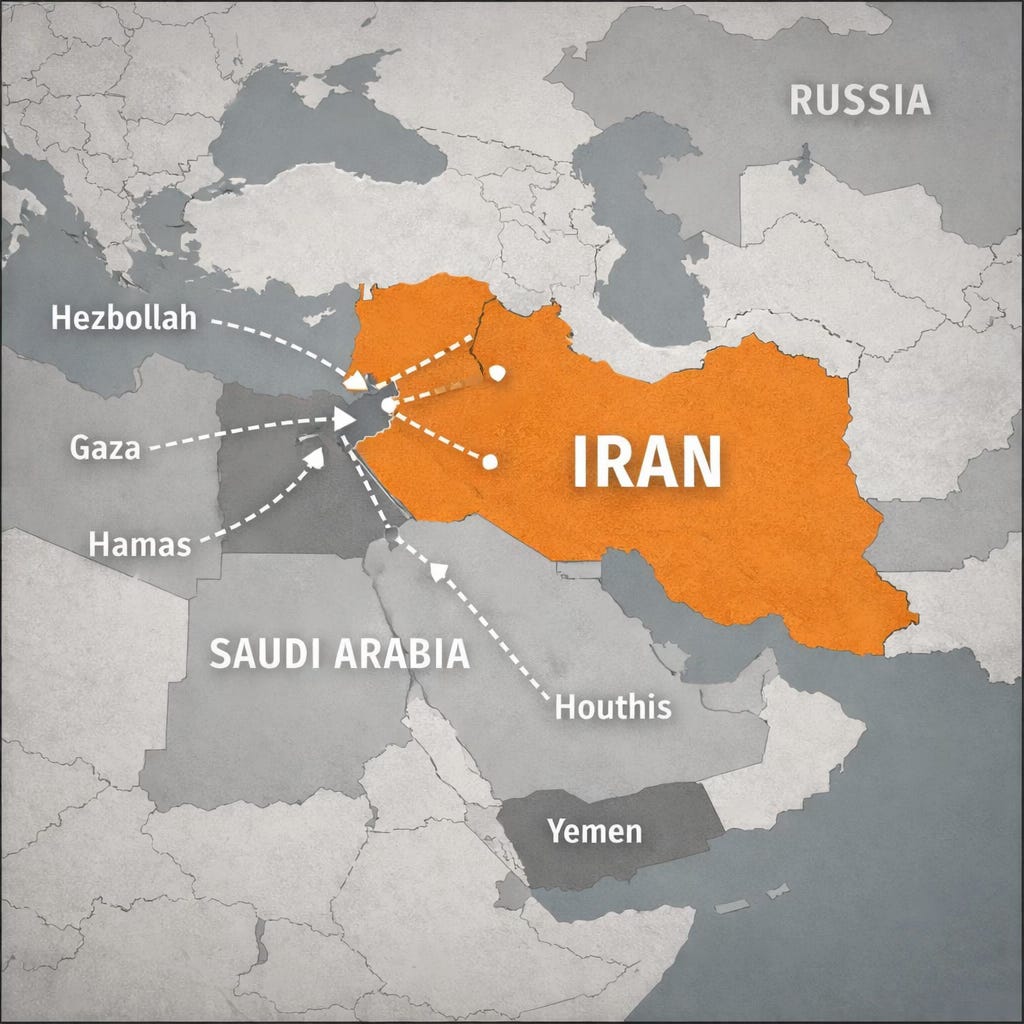
Look at a map.
Iran is not a small, flat strip of land. It is massive. Mountainous. Compartmentalized. Difficult.
Mountains are not scenery. They are fortifications.
They protect infrastructure. They complicate air campaigns. They make ground invasion nightmarish. They fragment supply lines. They create natural redoubts for insurgency or state defense alike.
You can degrade missile stockpiles.
You can destroy radar arrays.
You can strike air bases.
What you cannot do without extraordinary escalation…is “defeat” Iran in the conventional sense.
Unless someone is preparing for a ground war…real ground war…this is about degrading capabilities…not eliminating the state.
And degraded states can still endure.
Decapitation Does Not Equal Collapse
There is a fantasy embedded in modern warfare: remove enough leaders and the system implodes.
That might work in personality-driven regimes.
It does not work as cleanly in systems with distributed authority.
Iran’s political-religious structure is not dependent on a single supreme executive personality the way some other governments are.
Even the most aggressive assassination campaign cannot eliminate thousands of mid-level authorities who are ideologically aligned and structurally empowered.
You can create disruption.
You can create succession struggles.
You can create temporary instability.
But collapse? That requires internal fragmentation at scale.
And…historically, external pressure tends to consolidate Iranian factions…not dissolve them.
Calls for “uprisings” from outside actors have often produced the opposite effect:
Nationalist consolidation in the face of foreign aggression.
Iran’s Alliances Are Tools, Not Friendships
Now let’s talk about the regional chessboard.
People like to bundle Iran together with Hamas, Hezbollah, Russia, China…as though this is some coherent ideological super-bloc.
That’s lazy thinking.
Iran is Shia Persian.
Hamas is Sunni Arab.
Theologically, they consider each other apostates; those who renounce a religious faith, political party, or previously held principle…often viewed as a traitor to their former cause.
They cooperate…because it is strategically useful.
That’s it.
From Iran’s perspective, Hamas is not a sacred ally. It is an instrument.
If Hamas can inflame tensions, disrupt regional normalization…and complicate Israeli-Saudi alignment…then Hamas serves a purpose.
If Hamas burns out? Iran recalibrates.
If Hezbollah is more useful tomorrow? Iran leans there.
If an entirely new proxy emerges next year? Iran adapts.
Durable systems do not marry tactics.
They use them.
That flexibility is power.
The Real Battlefield May Be Riyadh
In the short term, the more interesting question may not even be Tehran.
It may be Riyadh.
If normalization between Israel and Saudi Arabia fractures under pressure, Iran wins strategically…even if it absorbs tactical damage.
If internal Saudi generational divides widen…older factions prioritizing Palestinian identity politics, younger factions prioritizing power alignment…that tension becomes part of the regional equation.
Iran understands this.
It does not need battlefield dominance to influence outcomes.
It needs friction….between its adversaries.
And…if it has played any role…directly or indirectly…in shaping events that create that friction, then from its perspective, there is limited downside.
Even failed operations…can succeed strategically…if they destabilize opposing coalitions.
Nuclear Ambiguity Is a Leverage Tool
For decades, Iran’s nuclear posture has been described as “breakout potential.”
Not a weapon. Not open weaponization.
The capacity to assemble one quickly if deemed necessary.
That ambiguity is leverage.
If pressure intensifies…incentives shift.
States under existential threat behave differently from states under sanction.
And…if Iran concludes that survival requires deterrence at a higher level…the calculus changes.
You cannot bomb knowledge out of existence.
You cannot strike engineering capacity out of memory.
Once a nation acquires technical capability, the question is political will…not intellectual possibility.
Durable Does Not Mean Dominant
None of this means Iran will thrive.
Its economy is constrained. Oil exports are limited. Infrastructure is aging. Youth dissatisfaction is real. Brain drain exists.
Durable does not equal prosperous.
It means survivable.
Iran may emerge weaker.
It may emerge economically strained.
It may face internal turbulence.
But extinction? Regime vaporization? State disappearance?
Those are fantasies…unless escalation reaches levels few actors appear prepared to accept.
The Hard Truth
Iran survives.
Not because it is morally right.
Not because it is militarily unbeatable.
Not because it is beloved by its people.
But…because it is structured to endure pressure in ways its adversaries often underestimate.
If policymakers treat Iran like a target…instead of a system…they will miscalculate.
If they confuse damage with destruction…they will be surprised.
Because when this phase ends…however it ends…Iran will still be there.
Altered…perhaps.
Bruised…certainly.
But present.
And…in geopolitics, survival is the first victory.
Everything else…comes later.
A Quick Word About How I Analyze This
People tell me this kind of writing sounds like I have inside access. Like I’m sitting on a classified brief.
I’m not.
While I do have a handful of former high-level sources with whom I sometimes discuss things, they’re certainly not giving me classified information or anything remotely close to that. In fact, I’m fairly certain they no longer have access to it. (Although I really don’t know. I’ve never asked.)
I don’t get war room memos. I don’t know what’s in anyone’s secure channel.
My expertise is human behavior…psychology, sociology, power dynamics…applied to publicly available political information.
That’s the whole method.
And…it’s also why this analysis often lands harder than TV commentary.
Most political analysis is event-chasing.
It treats war like a chess match:
Move, countermove, statement, response.
But…wars aren’t chess.
They’re human systems under stress.
So instead of obsessing over the latest headline, I look at what actually decides outcomes:
Incentives
Identity
Legitimacy
Elite cohesion
Fear and pride
Institutional self-preservation
The “rally around the flag” reflex
The blowback and martyr effects
The sunk-cost trap (“we’ve come this far”)
Cable panels argue about what leaders said.
I watch what populations and institutions do when threatened.
That’s why bombing campaigns so often fail to produce regime change. They can destroy assets. They rarely destroy the glue: compliance…legitimacy…enforcement loyalty…and collective identity.
You don’t need classified intel to see that.
You need pattern recognition…and the discipline to follow it even when the talking heads are selling a simpler story.
Over the last couple of years, many of you have told me this newsletter’s analysis beats what you hear on TV.
I won’t argue.
Not because I know secrets.
Because I’m watching the engine…not the headlights.
#HoldFast
Back soon.
-Jack
Jack Hopkins
P.S. If you’re waiting for cable news to tell you how this ends, you’ll always be late. They analyze noise. We analyze structure. And structure…is what survives when the smoke clears.
Sources / Further Reading
Report to Congress: Iran—Background and U.S. Policy (CRS via USNI)
UN nuclear watchdog says it can’t verify Iran has suspended enrichment (AP)
Iran has increased enriched uranium by 50%, IAEA report says (Financial Times)
Iran upped near weapons-grade uranium stock before Israel attack: IAEA (Defense News)
Saudi Arabia’s New Approach to Israel and the Normalization Process (INSS)
Saudi media takes an anti-Israel turn (Wall Street Journal)
Saudi Arabia may have uranium enrichment under proposed deal with US, experts warn (AP)
You’re right Jack — and this piece says what most people are either too scared or too uninformed to say out loud. Iran is not some rogue regime you can knock over like a chess piece and walk away from. It is a country with thousands of years of history, a government deliberately built to survive pressure, and a population that has watched foreign powers come for them over and over again. And every single time, Iran is still there when the dust settles. That’s not a defense of the mullahs — that’s just paying attention to how the world actually works. You’re right that the people who ordered this war from a golf resort clearly haven’t been.
What keeps me up at night — and you’re right to raise it Jack — is what happens next with their nuclear program. You can blow up a building. You can’t blow up what the engineers already know. And when a country genuinely believes it is fighting for its survival, it starts making decisions it wouldn’t otherwise make. We may have just given Iran every reason to cross a line they’ve been careful not to cross for years. Dubai, Doha, Manama, Haifa, Cyprus, Pakistan — none of this stayed contained because it was never going to stay contained. Nobody sitting at that Mar-a-Lago dinner the night the bombs dropped was thinking about what Iran would do next. They were thinking about the fundraiser. And now the rest of us are paying for it.
#HOLDFAST
"and in the end, they won the war, after losing every battle"...B Dylan...