Democrats Keep Asking the Wrong Question
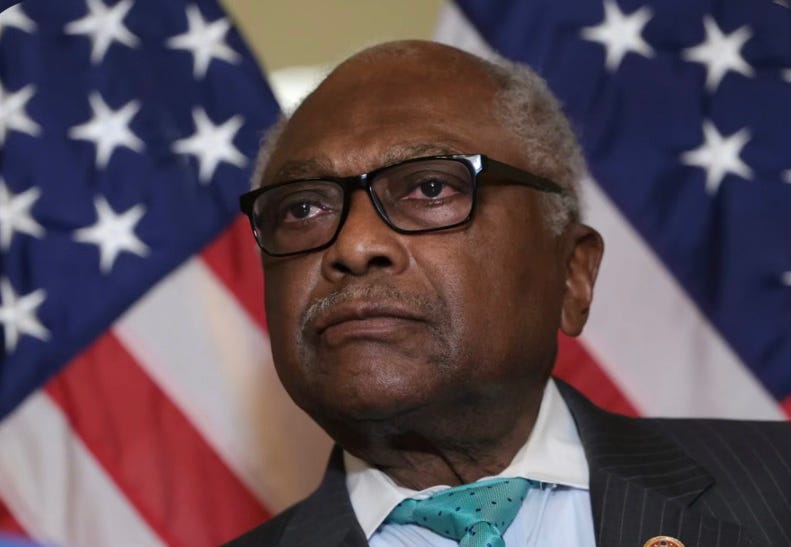
James Clyburn Just Diagnosed a Disease Most Democrats Don’t Want to Admit They Have
Democrats Keep Asking the Wrong Question
James Clyburn Just Diagnosed a Disease Most Democrats Don’t Want to Admit They Have
The Jack Hopkins Now Newletter #914: Sunday, May 31st, 2026
The problem isn’t that voters don’t understand Democrats. The problem is that Democrats don’t understand voters.
And James Clyburn just said it out loud.
Not exactly in those words.
Politicians almost never speak that directly.
But…if you strip away the diplomatic language…the congressional etiquette…and the careful phrasing…that comes with spending decades in Washington…that’s the essence of what the 85-year-old South Carolina congressman is warning about.
The Democratic Party is talking to itself.
And that’s…a dangerous habit for any political organization.
Especially one trying to stop an authoritarian movement…that has mastered the art of speaking directly to people’s fears, frustrations, and identities.
Here’s The Brutal Truth
Every organization eventually develops a fatal weakness.
Companies do it.
Religions do it.
Movements do it.
Political parties do it.
They start listening to the people who are closest to them…instead of the people they’re trying to reach.
The voices become louder.
The language becomes more specialized.
The conversations become more insular.
Everyone starts believing they’re hearing “the public” when they’re really hearing a tiny slice of highly engaged insiders talking to each other.
And…then one day…they discover they’ve been living inside an echo chamber.
Not because they’re stupid.
Because it’s human nature.
Democrats Have A Listening Problem
If you’ve spent any time around Democratic politics over the past several years, you’ve probably noticed something strange.
The conversations that dominate activist circles…often sound nothing like the conversations happening at kitchen tables.
Online political spaces obsess over ideological debates.
Normal voters obsess over grocery bills.
Activists debate terminology.
Parents worry about housing costs.
Party insiders argue about messaging frameworks.
Workers wonder whether they’ll still have a job next year.
These aren’t the same conversations.
And when they’re not the same conversations…something important happens.
Trust begins to erode.
Because voters start feeling like the people asking for their support…aren’t actually listening.
What Clyburn Is Really Saying
Most commentators are framing Clyburn’s comments as an argument about strategy.
I don’t think that’s what this is.
I think it’s an argument about reality.
There’s a huge difference.
Strategy asks:
“How do we win?”
Reality asks:
“What game are we actually playing?”
Clyburn appears to be warning Democrats…that they’re answering the first question before honestly confronting the second.
Because if your understanding of voters is wrong...
Then every strategy built on top of that understanding becomes wrong, too.
The best message in the world won’t work…if it’s answering questions voters aren’t asking.
The Most Dangerous Delusion In Politics
Every political party eventually falls victim to a seductive fantasy.
The fantasy goes like this:
“If people understood what we understand, they’d agree with us.”
It’s an incredibly comforting belief.
It’s also usually wrong.
People don’t make decisions based solely on information.
They make decisions based on identity.
Emotion.
Trust.
Experience.
Fear.
Hope.
Belonging.
Meaning.
Most importantly...
They make decisions based on what feels immediately relevant to their lives.
You can have the strongest policy argument in human history.
It won’t matter if voters are worried about something else.
And…that appears to be the gap Clyburn sees.
Why This Matters More Than Democrats Realize
Because the political environment has changed.
The old model assumed voters received information from a relatively small number of gatekeepers.
Newspapers.
Television.
Party organizations.
That world no longer exists.
Today’s voters live inside thousands of competing information ecosystems.
Everyone gets a different reality.
Everyone gets a different set of priorities.
Everyone gets a different villain.
Everyone gets a different hero.
That means…political success increasingly depends on understanding what people care about…before you try persuading them.
Not after.
Before.
And that requires listening.
Actual listening.
Not polling.
Not focus groups.
Not consultant memos.
Listening.
The South Carolina Lesson Nobody Wants To Talk About
There is another layer to Clyburn’s warning that deserves attention.
The Democratic establishment often treats Southern Black voters as reliable supporters.
But Clyburn…has spent years arguing something much bigger.
He believes they’re also among the party’s most important reality testers.
Because…unlike many activist bubbles…Southern Black voters have long operated inside brutally competitive political environments.
They’ve had to think about electability.
Coalition building.
Power.
Pragmatism.
Winning.
Not just expressing preferences.
Winning.
That’s a different mindset.
And…whether you agree with Clyburn or not…it’s impossible to ignore the fact that he was one of the earliest major Democratic leaders to recognize Biden’s viability in 2020 while much of the political class was writing him off.
That wasn’t luck.
That was…a different understanding of voters.
Here’s Where The Analysis Gets Uncomfortable
Because Clyburn’s critique doesn’t only apply to Democrats.
It applies to everyone.
The Left.
The Right.
Media organizations.
Political influencers.
Newsletter writers.
Podcast hosts.
You.
Me.
All of us.
The internet has created a machine that rewards attention.
Not understanding.
Outrage.
Not listening.
Performance.
Not curiosity.
The loudest voices rise.
The most nuanced voices disappear.
And…eventually…entire movements begin mistaking engagement…for persuasion.
Those are not the same thing.
Not even close.
The Hidden Risk Democrats Face
Most Democratic strategists are currently focused on one question:
“How do we beat Trumpism?”
Reasonable question.
But…Clyburn appears to be asking a different one:
“Do we still understand the people we’re trying to persuade?”
That’s the deeper issue.
Because political movements…rarely collapse because their opponents become stronger.
They usually collapse because they become disconnected from reality.
They start believing their own narratives.
They stop testing assumptions.
They stop listening.
And then reality arrives…all at once.
Usually on Election Day.
The Hardest Thing For Any Movement To Do
Is admit that some of its assumptions might be wrong.
Not morally wrong.
Not factually wrong.
Strategically wrong.
That’s harder.
Because it requires humility.
It requires acknowledging that voters aren’t obligated to care about the things you care about.
It requires accepting that persuasion begins with understanding…not lecturing.
And…it requires recognizing that winning coalitions…are built from people who don’t agree on everything.
They never have been.
They never will be.
What Clyburn May Actually Be Warning About
I don’t think he’s worried about a single election.
I think he’s worried about a habit.
A habit that has quietly infected modern politics.
The habit of talking more than listening.
The habit of assuming instead of learning.
The habit of building messages around what insiders think voters should care about…rather than what voters already care about.
That habit destroys movements.
Slowly at first.
Then suddenly.
And…history is littered with organizations that discovered the difference too late.
Final Thought
The most powerful sentence hidden inside Clyburn’s argument isn’t about South Carolina.
Or primaries.
Or Democratic messaging.
It’s this:
The people closest to a movement are often the least representative of the people it needs to persuade.
That’s true in politics.
It’s true in business.
It’s true in media.
It’s true in life.
The moment you stop listening is the moment reality starts moving away from you.
And reality always wins.
Always.
#HoldFast
Back soon.
-Jack
Jack Hopkins
P.S. One of the most dangerous mistakes any movement can make is assuming that disagreement is proof people are uninformed.
Sometimes disagreement is information.
Sometimes it’s a signal that voters are worried about something you’ve stopped paying attention to.
And…sometimes…it’s a warning that you’ve become so immersed in your own conversations…that you no longer recognize the concerns of the people whose support you need.
James Clyburn’s warning isn’t really about Democrats.
It’s about what happens when any organization starts listening to itself more than it listens to reality.
The organizations that survive…are the ones willing to hear things they don’t want to hear.
The ones that don’t?
History remembers them as cautionary tales.
SOURCES & FURTHER READING: The Psychology Behind Clyburn’s Warning
This piece rests on James Clyburn’s own recent remarks plus a body of work from political science and psychology on how voters actually decide, how organizations lose touch with reality, and why information alone rarely persuades. Sources are grouped by the point they support.
1. What Clyburn Actually Said
The news peg — his critique of the “consulting class,” the “conversion” framing, and his argument that the party misidentifies its own base.
James Clyburn Says Democrats Are Misreading Their Own Base. Here’s His Fix. (MS NOW): https://www.ms.now/news/news-analysis/james-clyburn-says-democrats-are-misreading-their-own-base-heres-his-fix
Clyburn Takes Practical Approach After Surviving Redistricting Fight (MS NOW): https://www.ms.now/news/clyburn-takes-practical-approach-after-surviving-redistricting-fight
Rep. James Clyburn Urges Democrats to Energize Voters Over ‘Conversion’ Tactics (ABC News 4): https://abcnews4.com/news/local/rep-clyburn-urges-democrats-to-energize-voters-over-conversion-tactics-midterm-elections-donald-trump-redistricting-congressional-maps
2. Organizations That Start Talking to Themselves — Echo Chambers & Insularity
The core thesis: groups drift toward listening to insiders rather than the people they need to reach, and that insularity deepens polarization.
The Polarizing Effect of Partisan Echo Chambers (American Political Science Review, Cambridge): https://www.cambridge.org/core/journals/american-political-science-review/article/polarizing-effect-of-partisan-echo-chambers/5044B63A13A458A97CA747E9DCA07228
Echo Chambers, Filter Bubbles, and Polarisation: A Literature Review (Reuters Institute, Oxford): https://reutersinstitute.politics.ox.ac.uk/echo-chambers-filter-bubbles-and-polarisation-literature-review
Political Polarization and Its Echo Chambers (Princeton): https://www.princeton.edu/news/2021/12/09/political-polarization-and-its-echo-chambers-surprising-new-cross-disciplinary
3. Identity, Not Information, Drives the Vote
Why “if people understood what we understand, they’d agree” is a fantasy — voters choose on identity and group loyalty more than policy detail.
Democracy for Realists: Why Elections Do Not Produce Responsive Government — Achen & Bartels (Princeton University Press): https://press.princeton.edu/books/hardcover/9780691169446/democracy-for-realists
Politicians’ Theories of Voting Behavior (American Political Science Review, Cambridge): https://www.cambridge.org/core/journals/american-political-science-review/article/politicians-theories-of-voting-behavior/E73E1B173B30EC11DFB413FA3E3160D1
4. Why Facts Don’t Change Minds — Motivated Reasoning
The psychology behind the gap: people weigh evidence to protect identity and belonging, so a stronger argument often fails to move them.
Why We Believe Alternative Facts (American Psychological Association): https://www.apa.org/monitor/2017/05/alternative-facts
From Political Polarization to Bridging Divides (Psychology Today): https://www.psychologytoday.com/us/blog/human-rights-defenders/202603/from-political-polarization-to-bridging-divides
Closely Held Political Beliefs Often Immune to Conflicting Information (UCLA Anderson Review): https://anderson-review.ucla.edu/closely-held-political-beliefs-often-immune-to-conflicting-information-even-from-trusted-sources/
5. Everyone Gets a Different Reality — The Fragmented Media Ecosystem
The claim that the old gatekeeper model is gone and voters now live inside thousands of competing information worlds.
How a High-Choice Media Environment Leads to Greater Selectivity, Fragmentation and Polarization (Gnovis Journal, Georgetown): https://gnovisjournal.georgetown.edu/journal/media-fragmentation-and-political-polarization-how-high-choice-media-environment-leads-great/
Selective Exposure in Different Political Information Environments (Sage): https://journals.sagepub.com/doi/10.1177/02673231211012141
6. Engagement Is Not Persuasion — The Attention Machine
The uncomfortable part: the internet rewards outrage and performance over listening and curiosity, so movements mistake engagement for persuasion.
Emotion Shapes the Diffusion of Moralized Content in Social Networks (PNAS, Brady et al.): https://www.pnas.org/doi/10.1073/pnas.1618923114
The Echo Chamber Effect (EBSCO Research Starters): https://www.ebsco.com/research-starters/communication-and-mass-media/echo-chamber-effect
7. Clyburn’s Track Record — The 2020 Biden Call
Context for the claim that Clyburn read voters correctly when much of the political class didn’t.
Firing Line: Rep. Jim Clyburn (PBS): https://www.pbs.org/video/rep-jim-clyburn-igupxm/
Sources selected for the political and psychological claims in this issue. Primary reporting and original research are favored where available; explanatory pieces are included where they make a dense idea legible.


Your right, Jack, messaging has been a problem for the Democratic party for the last few elections. I'm in total agreement with you here. We need to get together on Bullet Point messages,in language folks can relate to, and hammer it home. No more " Republicans did this" and argue Their point. To me it's a waste of time and to be honest, boring 😴. Good message tonight,as always, Thank you and will reStack ASAP 💯👍
I think this is more powerful coming from a person of his age rather than a younger whippersnapper.
