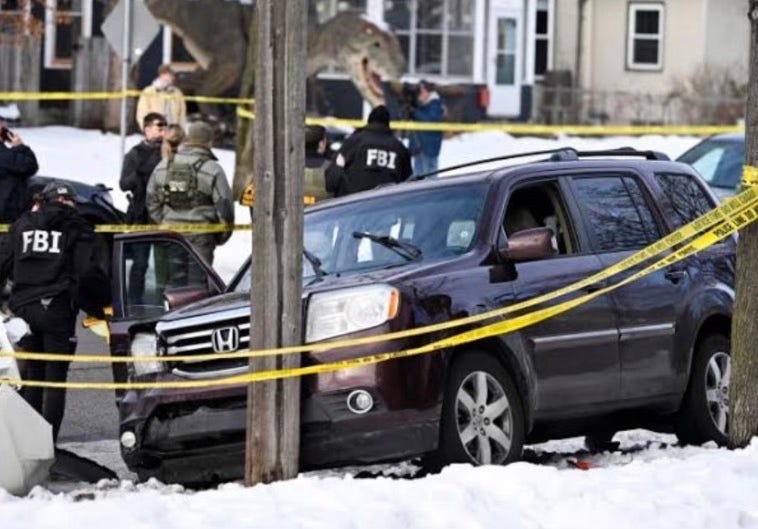
A Woman is DEAD: The ICE Presence Problem
Why These Deaths Are Not Just Tragic-But Predictable Outcomes
A Woman is DEAD: The ICE Presence Problem
Why These Deaths Are Not Just Tragic- But Predictable Outcomes
The Jack Hopkins Now Newsletter #722: Wednesday, January 7th, 2026.
Author’s Note
You should know this from the start:
As I wrote what follows, I hovered more than once on the edge of stopping entirely and typing nothing but “F*CK YOU”-directed at Tom Homan…Donald Trump…Kristy Noem…and a short list of others who don’t deserve the courtesy of being misunderstood.
That urge was real. It came from anger…grief…and the kind of moral disgust that flares when preventable harm keeps repeating itself…while people in power shrug and move on.
But…that’s not what you’re about to read. (If you pay attention…you might be able to catch me posting THAT…on X.)
What you’ll find…instead…is what I produced while actively managing my emotions…keeping my thinking brain online…resisting the pull toward something more primitive…more reactive…and frankly…less effective.
That wasn’t about politeness.
It was about not surrendering intelligence to rage.
There is a version of this moment where we vent…explode…and feel briefly satisfied…and then hand our opponents exactly what they want: chaos…caricature…and a loss of credibility…that lets them keep doing damage unchallenged.
I chose not to write that version.
What follows…is an attempt to stay in the part of the mind capable of pattern recognition…systems thinking…and clear-eyed accountability…because those are the tools that actually change outcomes.
Anger is justified.
Losing control to it is…optional.
This piece is written from the space where outrage is disciplined into analysis… because that’s where pressure becomes leverage…and where democracies are defended…not just mourned.
Read it in that spirit.
Let’s begin…
Every time something like this happens, we’re told the same story.
It was unfortunate.
It was chaotic.
It was a split-second decision.
It was an isolated incident.
And if you listen closely, there’s always an unspoken subtext:
Nothing could have been done to prevent this.
That claim is comforting.
It’s also false. Wait…as Minneapolis Mayor Jacob Frey, said this morning, “It’s BULLSHIT.”
Because when a system repeatedly produces the same kind of tragedy across different cities…different years…different officers…and different victims…the problem is not the moment.
The problem is the environment.
And the hypothesis we need to confront-honestly…unemotionally…and without political theater-is this:
The way ICE is being deployed creates conditions where lethal outcomes become dramatically more likely…regardless of intent…policy justifications…or individual officer behavior.
Not because every agent is malicious.
Not because every operation is illegal.
But because the structure itself amplifies fear…misinterpretation…escalation…and irreversible decisions.
That’s not ideology.
That’s systems analysis.
And…if we refuse to look at it that way…these deaths will continue…followed by the same excuses…the same press releases…and the same G’damn funerals.
Start With a Rule Every Engineer Knows
Here’s a rule from aviation, nuclear safety, and industrial design:
If a system fails catastrophically under stress…the system is defective-no matter how well-trained the operators are.
You don’t blame pilots for bad cockpit design.
You don’t blame technicians for faulty alarms.
You redesign the system.
Yet when it comes to ICE…we do the opposite.
We analyze the last second endlessly:
Who moved first
Who perceived what
Who felt threatened
But we refuse to analyze the conditions that made threat perception inevitable.
That’s convenient.
And deadly.
What Makes ICE Deployment Uniquely Volatile
ICE does not operate like local policing.
It does not operate like federal law enforcement in controlled settings.
Its deployment model combines four ingredients that, together, create a perfect storm:
1. Ambiguous Authority in Civilian Spaces
ICE agents often operate:
In unmarked vehicles
In plain clothes or tactical gear without clear identification
In residential neighborhoods
During early morning or high-confusion hours
To a civilian…this can look indistinguishable from:
Kidnapping
Criminal impersonation
Vigilante action
Especially for:
Immigrants
Mixed-status families
Citizens who know ICE has no jurisdiction over them
When civilians cannot immediately identify who is confronting them…or why…their stress response spikes.
That’s not political.
That’s neuroscience.
2. Operations Built on Surprise, Speed, and Fear
ICE enforcement relies heavily on:
Surprise
Rapid confrontation
Psychological dominance
Those tactics are designed to overwhelm decision-making.
But here’s the catch:
Tactics meant to induce compliance also induce panic.
And panic does not produce rational behavior.
It produces:
Flight responses
Misinterpretation of commands
Sudden movements
Attempts to escape
Now put a firearm into that environment.
This is not a mystery.
This is a formula.
3. Civilians Who Believe-Correctly or Not-that They Are in Immediate Danger
When a civilian believes:
They may be detained indefinitely
Separated from family
Deported without recourse
Their risk tolerance changes instantly.
Actions that seem irrational from the outside…driving away…refusing commands… screaming…freezing…become psychologically predictable.
And when agents interpret those actions through a threat-first lens…escalation becomes almost automatic.
Again: system, not sentiment.
4. Agents Operating Under Constant Threat Framing
ICE agents are trained to expect:
Resistance
Deception
Sudden violence
That training may be understandable.
But…it means that ambiguity…is resolved in favor of force. Under this administration, that’s a very dangerous thing, because Trump appears to revels in creating the very ambiguity that leads to opportunities to use force.
There’s too much of an opportunity for ICE to make the following interpretations:
A car becomes a weapon.
Movement becomes aggression.
Hesitation becomes defiance.
And once lethal force is introduced…the margin for error disappears.
Why These Incidents Cluster-Not Randomly Occur
Here’s the key insight most commentary misses:
If these were isolated incidents…they would not cluster around the same conditions.
But…they do.
They cluster around:
Enforcement surges
Heightened political rhetoric
Neighborhood-based operations
Unmarked or unclear identification
Vehicle-related encounters
That tells us something important.
This isn’t about one bad day.
It’s about deployment architecture.
The Myth of “Following Orders”
Whenever someone dies, the fallback defense appears:
“The agents followed protocol.”
That may be true.
Which raises a far more disturbing possibility:
What if the protocol itself is the risk factor?
In systems engineering…this is known as a normal accident…an outcome that emerges naturally…from the system’s design under stress.
Not because someone broke the rules.
But because they followed them.
Why Local Leaders Are Right to Be Alarmed
When city officials say ICE should leave “for everyone’s safety,”
…critics frame it as political grandstanding.
It’s not.
Local leaders understand something federal agencies often ignore:
They are the ones who deal with the aftermath.
They manage:
Community unrest
Emergency response
Mistrust between residents and law enforcement
Escalation risks
And they see the pattern forming…long before Washington does.
The “Split-Second Decision” Lie
There is no such thing as a split-second decision without minutes…
…hours…or years of setup.
Every “split second” is shaped by:
Training
Deployment choices
Operational goals
Political pressure
Environmental stress
Blaming the moment…is a way to avoid accountability for the structure.
The Incentive Problem Nobody Talks About
ICE operates under:
Arrest quotas (formal or informal)
Political pressure to “be visible”
Public messaging incentives
Visibility increases encounters.
Encounters increase friction.
Friction increases probability of force.
This is not controversial.
It’s math.
What a Safer System Would Look Like (And Why It’s Not Being Used)
A system designed to reduce lethal risk would:
Use clearly marked agents
Avoid surprise tactics in dense civilian areas
De-escalate rather than dominate
Coordinate with local authorities transparently
Reduce vehicle-based confrontations
These aren’t radical ideas.
They’re standard risk mitigation.
So why aren’t they implemented?
Because fear…is not a bug of the current system.
It’s a feature.
The Real Cost Isn’t Just Lives Lost
Each incident produces:
Trauma
Radicalization
Deepened mistrust
Increased resistance next time
Which makes the next deployment more dangerous…not less.
That’s how feedback loops work.
The Hypothesis, Restated Clearly
Let’s state it cleanly:
ICE’s current deployment model increases the likelihood of deadly outcomes by creating environments of extreme ambiguity, fear, and rapid escalation—making tragedy not an exception, but an expected risk.
If you reject that hypothesis, you must explain:
Why incidents cluster
Why civilians repeatedly misinterpret encounters
Why agents repeatedly perceive lethal threats
Why the same defenses are used every time
So far…no one has.
The Question That Actually Matters
The question is not:
“Did the agent feel threatened?”
The question is:
“Why are we deploying agents in ways that predictably produce threat perception on both sides?”
Until that question is answered…and acted on…statements of regret are meaningless.
Because regret…without redesign…is just rehearsal.
Final Thought
This isn’t about abolishing anything.
It’s about acknowledging reality.
When a system repeatedly creates deadly outcomes…the moral failure is not refusing to defend it.
The moral failure is refusing to change it.
And until we confront that…we’ll keep calling the inevitable unfortunate…
…right up until the next body hits the ground.
BONUS: Why I Really Like Mayor Jacob Frey-And Why His Leadership Matters Right Now
Let me say this plainly, because people often misread clarity as calculation:
I don’t admire Mayor Jacob Frey because he’s perfect.
I admire him…because he’s willing to stand in the line of fire when it would be easier to duck.
That distinction matters.
In moments like this…when federal force…public fear…media distortion…and raw emotion collide…you learn very quickly who is operating from conviction and who is operating from career preservation.
Jacob Frey has shown…repeatedly…that he understands something too many elected officials don’t:
Leadership isn’t about managing optics. It’s about assuming responsibility when responsibility is dangerous.
He Understands Jurisdiction-And Still Speaks Anyway
Here’s the easy out most mayors take:
“This is a federal matter.”
“My hands are tied.”
“We’re monitoring the situation.”
That language is designed to sound prudent….while doing absolutely nothing.
Frey could hide behind jurisdictional limits all day long. Minneapolis is not in charge of ICE. He knows that. Everyone knows that.
And yet…he speaks.
Why?
Because he understands that moral authority doesn’t require legal control.
When a federal agency operates inside a city…in a way that destabilizes neighborhoods…endangers residents…and escalates risk…a mayor who stays silent is not being cautious.
He’s being complicit.
Frey has chosen a harder path: naming the danger…even when he lacks the power to unilaterally stop it.
That takes spine.
He Thinks in Systems, Not Soundbites
What impressed me most wasn’t outrage.
It was pattern recognition.
Frey doesn’t talk like someone reacting to a single tragic moment. He talks like someone who understands environments.
(And, Mayor Frey…if you…or your people happen to see this, I’m willing and ready to offer myself to you in any way I can be of assistance.)
He recognizes that:
Federal deployment strategies affect local safety
Surprise operations create panic
Panic increases the probability of irreversible outcomes
Cities absorb the blowback…every time
That’s not activism.
That’s executive thinking.
Most politicians speak in isolated incidents…because it lets them avoid systemic responsibility.
Frey does the opposite. He connects dots.
He’s Willing to Be Attacked From Both Sides
This is the part people underestimate.
When a mayor criticizes ICE deployment, he doesn’t just get attacked by one camp. He gets hit from all directions:
Accused of being “soft”
Accused of being “reckless”
Accused of endangering officers
Accused of politicizing tragedy
The safe move is silence.
The career-safe move…is a condolence statement and a promise to “await the investigation.”
Frey doesn’t do that.
He accepts the political cost because he understands something fundamental:
If leadership doesn’t cost you anything…you’re probably not leading.
He Knows Cities Are the Real Front Lines
Here’s a truth Washington often forgets:
Federal policy is abstract.
City consequences are concrete.
When something goes wrong, it’s not federal agencies dealing with:
Community trauma
Protests
Escalation risk
Long-term mistrust
It’s mayors.
It’s city councils.
It’s local responders.
Frey speaks from that reality.
He understands that Minneapolis isn’t a chessboard. It’s a living system. And injecting high-risk, federal operations…into that system…without regard for local dynamics is not “law and order.”
It’s negligence.
He Doesn’t Hide Behind “Process” When Safety Is at Stake
One of the most corrosive habits in modern governance is the worship of process over outcomes.
Process says:
“We followed protocol.”
“An investigation is underway.”
“All procedures were adhered to.”
Leadership asks:
“Is this making people safer?”
“Is this increasing risk?”
“Would I deploy this way if I were accountable for the aftermath?”
Frey asks the second set of questions.
That’s why his statements land differently. They aren’t scripted for distance. They’re rooted in accountability.
He Understands That Fear Is Not a Neutral Tool
Many politicians pretend fear is incidental.
Frey understands it’s structural.
He recognizes…that when armed agents operate in ways that confuse…alarm…or intimidate civilian populations…fear becomes an accelerant…not a deterrent.
And once fear enters the equation:
Misinterpretation skyrockets
Split-second decisions become fatal
Control evaporates
Calling that out is not anti-law enforcement.
It’s pro-reality.
He’s Not Posturing for a National Audience
This matters more than people realize.
There’s a difference between:
Leaders performing for cable news
Leaders speaking to protect their city
Frey’s comments don’t read like audition tapes. They read like warnings.
Warnings…issued by someone who knows what comes next…if escalation continues.
The Quality Most Leaders Lack: Moral Clarity Under Pressure
Moral clarity is not moralizing.
It’s the ability to say:
“This is dangerous. This is unacceptable. This must change.”
Without hedging.
Without outsourcing blame.
Without hiding behind committees.
Frey has demonstrated that quality repeatedly…and it’s rare.
Final Thought
You don’t have to agree with Mayor Jacob Frey on everything to recognize this:
He understands that public safety is not achieved by pretending risk doesn’t exist.
He understands that silence in moments like this is not neutrality…it’s abdication.
And…he understands…that leadership sometimes means saying the thing that makes powerful people uncomfortable…because the alternative is watching preventable tragedies repeat themselves.
That’s why I respect him.
That’s why I’m impressed by him.
And that’s why…his voice matters right now.
In moments like this…courage doesn’t look like shouting.
It looks like standing firm…naming the danger…and refusing to look away.
#HoldFast
Back soon,
-Jack
Jack Hopkins
P.S.
On a personal level…I’m going to be honest with you…I’m furious. Not performative outrage. Not social-media anger. The kind that sits in your chest and makes your jaw tighten…because you know something is deeply…structurally wrong.
Like many of you, I’m f*cking pissed.
ICE, as an institution…is poorly trained for the environments it’s being deployed into…and worse…it’s being used in ways that all but guarantee more needless deaths.
This isn’t speculation. It’s systems logic. When you combine fear-based tactics… ambiguity…civilian spaces…and lethal force…tragedy stops being an accident and starts being a statistical outcome.
And…yes…that pisses me off on a level I haven’t felt in a while.
But…here’s the part that matters more than my anger…or yours:
Unchanneled rage is exactly what autocrat-inspired goons want.
They want us reckless.
They want us reactive.
They want us to burn credibility…fracture coalitions…and hand them justification wrapped in emotion.
We don’t get that luxury.
If we’re serious about preserving democracy…and protecting each other…we have to do the harder thing: convert anger into clarity, and clarity into strategy.
That means:
Naming the system, not just the incident
Demanding redesign, not symbolic regret
Applying pressure where it actually changes behavior
Refusing to become the caricature they need us to be
Anger is fuel.
But fuel…without direction…just burns the house down.
So feel it. I do.
Then…discipline it.
Because the future won’t be saved by people who feel the most…it’ll be saved by people who think clearly under fire and refuse to play the role assigned to them.
That’s how we protect democracy.
And that’s….how we protect each other.


Thank you for this. I really have run out of words to describe that sorry excuse of protoplasma that is residing in the White House and the disgusting fact of him sitting behind the storied Resolute Desk. I agree with all you have said. I will channel the anger and keep as clear of head that I can.
For those not familiar with Minneapolis, this incident happened in the same area where George Floyd was murdered. It's a powder-keg under the best of circumstances and the riots are still fresh in our memories. I hope MPD is involved and I hope the Hennepin County Attorney charges the shooter with murder. I saw pictures with FBI present that's another WTF moment ... they've got no business there unless requested my MPD or Mayor Frye.
