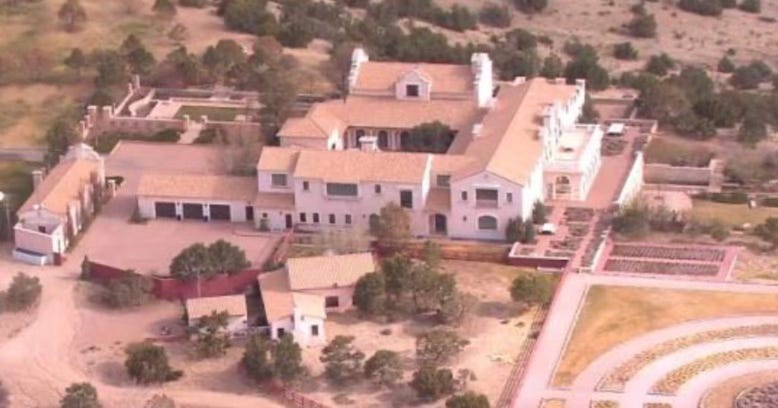
Zorro Ranch: What Forensic Science Says About Time, Land, and the Persistence of Crime Scenes
Could Evidence Still Be There?
Zorro Ranch: What Forensic Science Says About Time, Land, and the Persistence of Crime Scenes
Could Evidence Still Be There?
The Jack Hopkins Now Newsletter #778: Monday, February 16th, 2026.
For years, people have shrugged and said:
“It’s too late. If anything happened there, it’s long gone.”
That’s not how forensics works.
Time erases the obvious.
It does not erase everything.
And…if serious crimes occurred at Zorro Ranch…sexual/physical assaults…killings…burials…it is entirely realistic that meaningful forensic evidence could still exist today.
Not fantasy evidence.
Not TV evidence.
Real-world evidence.
Let’s break this down calmly and clearly.
The Hard Truth About “Old” Crime Scenes
In older cases, investigators don’t rely on pristine DNA sitting on a countertop.
They rely on:
Land memory
Burial context
Microtrace in protected environments
Documentary and geospatial corroboration
In many cold cases, those are the very things that end up cracking them open.
1. If There Were Burials
This is the most important category.
If anyone was killed and buried on that property, bones and teeth can persist for decades. Even when soft tissue is gone, skeletal remains can reveal:
Blunt force trauma
Sharp-force injuries
Projectile damage
Dismemberment patterns
Bindings or associated materials
Burial staging
Even more critical: burial context.
Soil layers don’t lie easily.
Stratigraphy doesn’t politely reset itself.
Disturbed earth…inconsistent fill…compaction differences…subsidence…land holds physical receipts.
Forensic archaeologists are trained specifically to detect that.
Time does not make clandestine graves magically disappear.
2. The Land Itself Remembers
Large rural properties leave patterns.
If earth was moved repeatedly, if trenches were dug, if specific areas were regraded, poured over, or altered…those changes can be detected through:
Soil comparison
Compaction analysis
Vegetation anomalies
Historical satellite imagery
Drainage pattern shifts
This is where geospatial review becomes powerful.
Before-and-after imagery across years can reveal unnatural disturbance events.
That’s not speculation. That’s method.
3. Indoor Trace Evidence (The Overlooked Category)
Buildings are different from open fields.
Inside structures, micro-evidence can survive in protected voids:
Blood absorbed into subflooring
Trace trapped under baseboards or trim
Fibers embedded in carpet tack strips
Residue in HVAC returns
Staining beneath replaced flooring
Direct biological fluids degrade over time…especially if cleaned. That’s true.
But…absorbed material in porous surfaces and low-disturbance areas can persist much longer than people assume.
Older sexual assault investigations often succeed on corroborative trace + pattern… not a single “perfect” sample.
4. Dump Features and Concealment Areas
Properties like this often contain:
Burn pits
Informal trash pits
Septic systems
Outbuildings
Arroyos or culverts
Remote corners rarely disturbed
Attempts at destruction rarely eliminate all diagnostic traces.
Fire leaves signatures.
Burial leaves signatures.
Improvised disposal leaves signatures.
5. The Forensics Stack That Applies
If this were ever properly examined, the relevant disciplines would include:
Forensic archaeology
Forensic anthropology
Crime scene processing
Trace and materials analysis
Forensic biology (where viable)
Geospatial time-series imagery analysis
Documentary and contractor record review
That last category is often underestimated.
Work orders.
Concrete pours.
Grading invoices.
Sudden construction.
Travel logs.
Visitor patterns.
Paper and movement often confirm what the ground suggests.
What Is Realistic…and What Isn’t
Let’s be grounded.
More likely to persist:
Skeletal remains and burial context
Soil disturbance evidence
Concealed indoor trace
Documentary + imagery corroboration
Less likely (but not impossible):
Exposed biological fluids outdoors
Heavily cleaned open surfaces
This is not about fantasy CSI expectations.
It’s about whether a professional, lawful, methodical forensic review could still uncover probative evidence.
The answer to that is yes.
The Only Way This Matters
There is one non-negotiable:
Any serious forensic re-examination must be conducted by credentialed professionals under lawful authority.
No amateur excavation.
No contamination.
No spectacle.
Chain of custody is everything.
If accountability is the goal…professionalism is the only path.
Two Real Life Examples of Accountability Long After the Fact
Case #1: A Cold Case That Refused to Stay Buried
In 1984, the body of 9-year-old Christine Jessop was found in a rural field in Ontario.
For decades, the case sat unresolved.
An innocent man was convicted.
He served years in prison.
He was eventually exonerated.
But the real killer?
He was never charged.
Why?
Because at the time, the biological evidence collected from the victim’s clothing couldn’t be fully interpreted. The technology simply wasn’t there yet.
Fast forward more than 35 years.
Investigators re-examined preserved biological samples using advanced DNA testing and forensic genealogy…techniques that didn’t exist in the 1980s.
The result?
They identified the true perpetrator through genetic lineage matching.
He had died years earlier.
But the case was solved.
Not because someone confessed.
Not because a new witness appeared.
Not because the crime scene was fresh.
It was solved because:
Evidence had been preserved.
Professionals re-examined it.
Technology advanced.
Investigators were willing to reopen what others assumed was dead.
That case wasn’t cracked by drama.
It was cracked by patient forensic method.
And it’s not an anomaly.
The Golden State Killer case…solved more than 40 years after the crimes…followed the same arc: preserved evidence, new analytical tools, lawful process.
Cold does not mean erased.
Old does not mean gone.
Sometimes it means waiting for the right tools…and the right will.
Case #2: The Ground Gave It Back
In 1979, 6-year-old Etan Patz disappeared in New York City.
For decades, the case haunted investigators. No body. No confirmed burial site. No physical closure.
More than 30 years later…detectives reopened the case with fresh eyes.
They focused not on rumors…but on place.
Specifically, a basement connected to a suspect’s workplace.
The structure had been renovated. Concrete had been poured. Time had passed.
But forensic teams didn’t assume that meant nothing remained.
They used ground-penetrating radar and structural analysis to examine anomalies in the foundation. They cored through sections of concrete where disturbance signatures were detected.
They did not recover remains.
But…what they did recover was something equally powerful: proof of prior excavation and altered substrate inconsistent with the original construction timeline.
It corroborated witness statements.
It supported a confession.
It anchored the narrative in physical reality.
The land didn’t yield a skeleton.
It yielded disturbance.
And that disturbance helped secure accountability…more than three decades after the crime.
This pattern repeats in cold cases involving clandestine burials:
Soil stratigraphy reveals prior digging.
Compaction differences expose refilled trenches.
Remote sensing identifies altered ground long after vegetation regrows.
Construction records confirm suspicious grading or concrete pours.
Time doesn’t smooth everything back to neutral.
Earth remembers.
Structures remember.
And when professionals go looking…methodically…lawfully…scientifically…decades-old concealment efforts can still unravel.
The Calm Conclusion
Here’s the bottom line:
Time alone does not guarantee erasure.
Land remembers.
Structures preserve.
Paper trails linger.
And in major exploitation cases, it is often the combination of physical context + documentary corroboration that becomes decisive.
The question is not whether evidence could still exist.
The question is whether anyone with authority will look. I’ve yet to find sufficient reason to cease believing that someone in that category…will.
#HoldFast
Back soon.
-Jack
Jack Hopkins
P.S.
This piece answered one narrow question: Could evidence still exist?
In the paid article, I’m going much deeper.
We’ll walk through:
the specific structural features of Zorro Ranch that matter most
what a professional re-examination would realistically prioritize
where land disturbance patterns would be most probative
how construction timelines and contractor records could intersect with forensic review
and what oversight bodies would need, legally and procedurally, to do this right
No theatrics.
No internet rumor loops.
Just a sober, methodical look at what accountability would actually require.
If you want the full analysis…and not just the surface layer…that’s inside the paid tier.
Sources / Further Reading
National Institute of Justice – Forensic Archaeology
National Institute of Justice – Crime Scene Investigation
National Institute of Justice – Biological Evidence Preservation
National Institute of Justice – Postmortem DNA Testing
FBI – Forensic Science Communications / Crime Scene Processing
National Institute of Justice – Detecting Clandestine Graves
American Academy of Forensic Sciences
National Institute of Standards and Technology – Forensic Science Resources
NASA Earth Observatory – Detecting Land Change with Satellite Imagery
U.S. Geological Survey – Remote Sensing and Land Surface Monitoring
How Toronto police found the suspect in Christine Jessop’s murder (Global News)
Who was Calvin Hoover? The man Toronto police say killed 9-year-old Christine Jessop (Global News)
After 36 Years, Christine Jessop’s Killer Is Identified (DNASolves / Othram)
Golden State Killer suspect Joseph James DeAngelo arrested (CBS News, April 2018)
The Creepy Genetics Behind the Golden State Killer Case (WIRED)
Golden State Killer: ex-cop arrested after decades-long case (The Guardian)
FBI story page referencing the East Area Rapist / Golden State Killer arrest (FBI)
Etan Patz case: modern forensics used in 2012 basement search (ABC News)
Investigators comb through basement dirt for Etan Patz (NBC New York)
FBI, NYPD continue search for Etan Patz’s body at 127 Prince Street (NYPR)
Basement excavation under way in Etan Patz case (CBS News)


Hopkins is correct: when a property is tied to years of serious allegations, it is not just land — it is potential evidence. Zorro Ranch should be treated as a forensic question, not a political inconvenience. Warrants, preservation orders, ground-penetrating radar, documented chain of custody — that is how serious investigations are conducted. Anything less invites doubt.
He is also correct that half-measures erode trust. History shows accountability fails not because evidence never existed, but because it was never fully pursued. When power enters the equation, hesitation follows — and hesitation is where credibility dies.
Forensics does not presume guilt. It establishes fact. If institutions want the public to move on, the only way forward is through exhaustive, transparent investigation. On that point, Hopkins is absolutely right: science, not secrecy, is how you close a chapter like this.
#HOLDFAST
Our home was built over a century ago. Before we moved in we tore out all the old carpet and in the one bedroom there was a linoleum covering. And under that an area that could only be blood. Nothing nefarious as far as we know. It took days of scrubbing the pine floor. But if anybody ever wanted evidence, all they have to do is cut out a portion of the floor. I have no doubt blood evidence still exists.
Sometimes you just have to dig deeper.
#HoldFast'Jack.
Sue
