


You're Tougher Than Your Fear Thinks You Are
Seven tools for staying steady when the world feels like it's coming apart.
The Jack Hopkins Now Newsletter #1,044: Sunday, October 4th, 2026.
In the late 1930s, British officials sat down to plan for war, and they were terrified.
Not only of bombs. Of their own people.
Their experts predicted that if German planes hit London, civilians would break. They expected psychiatric casualties in the millions, outnumbering physical injuries by a wide margin.
They drew up plans for emergency mental hospitals. Officials worried that crowds would stampede the countryside and the city would stop working.
Then the Blitz came. Months of nightly bombing. Tens of thousands of people killed. Homes reduced to rubble.
And the mass panic never showed up.
People went to work. They made tea in shelters. They dug neighbors out of collapsed buildings and went home and slept. The psychiatric wards built for the flood stayed largely empty.
Researchers who studied it afterward found something surprising: the waiting…the dread…the not-knowing…had been harder on people than the bombs themselves.
Read that again. The anticipation was worse than the event.
I’ve been writing about bunkers, pathogens, and fragile supply chains. Those are real problems, and I’ll keep writing about them. But if your stomach knots up every time you open the news, I want you to know something those Londoners learned the hard way.
You are a lot tougher than your fear thinks you are.
You Already Know the Standard Advice
Turn off the news. Stock the pantry. Call a friend. Get some sleep.
Good advice. You’ve heard it from me. You’ve heard it from everyone.
And…you’re still scared.
That’s not because you’re doing it wrong. It’s because the standard advice treats fear like a scheduling problem: watch less, worry less.
But fear isn’t just a TV habit. It’s a body response, a thinking pattern, and a social habit, all tangled together. To loosen its grip, you have to work on all three.
So…today…no recycled tips. Here are seven tools you probably haven’t tried…with stories to help them stick.
Fear Is a Smoke Alarm With a Bad Sensor
Fear exists to keep you alive. It’s the alarm that gets you out of a burning house.
The problem is that the alarm can’t tell a house fire from burnt toast. A headline about unrest on another continent…trips the same wiring as smoke in your hallway.
Your heart rate climbs…your sleep gets choppy…and your mind keeps scanning for danger. Meanwhile…nothing in your actual kitchen is on fire.
You can’t rip the alarm off the ceiling…and…you shouldn’t. You need it. What you can do…is recalibrate the sensor.
Here’s how.
Tool #1: Make the Fear Specific
Vice Admiral James Stockdale spent more than seven years as a prisoner of war in Hanoi.
He was tortured repeatedly. He had no idea whether he’d ever go home.
Years later, business author Jim Collins asked him which prisoners didn’t make it.
Stockdale’s answer surprised him: the optimists.
They were the ones who said, “We’ll be out by Christmas.” Then Christmas came and went. Then Easter. Then Thanksgiving. Then Christmas again. Each deadline that passed…broke something inside them.
Stockdale survived by doing two things at once. He never lost faith that he would prevail in the end. And…he never once lied to himself about how bad things were right now.
That’s the difference between vague fear…and specific fear. Vague fear is a fog. It has no edges, so you can’t fight it. Specific fear has a shape…and a shape can be handled.
So write your fear in one plain sentence, such as “The power goes out for a month.” Then answer three questions: What would I do on day one? On day seven? Who would I call?
Most people find they have more of an answer than they expected. The parts they don’t…have become a short to-do list. The monster under the bed shrinks the second you turn on the light.
Tool #2: Give Your Worry an Appointment
Picture a woman. Call her Ruth.
Ruth is a retired schoolteacher, and she worries for a living now. She worries at breakfast. She worries in the checkout line. She lies awake at 2 a.m. running scenarios about her grandkids…her savings…and the next election.
One day her doctor gives her an odd prescription. “Ruth, I want you to worry every day. Hard. But only from 6:00 to 6:15 in the evening.”
She thinks he’s joking. He isn’t.
When a worry shows up at 10 a.m….Ruth writes it on a notepad by the coffee maker and tells it, “Not now. You’re scheduled for six.” At six…she sits down with the pad and worries on purpose.
The first week…the list is long. By the third week…something strange happens. She gets to six o’clock, looks at the morning’s worries…and half of them don’t feel urgent anymore. Some she can’t even remember why she wrote down.
This is called this worry postponement…and studies have found it reduces how much people worry overall. Worry, it turns out, is a lot like a toddler. It screams loudest when it thinks it’ll never get your attention. Give it a scheduled time…and it settles down.
Tool #3: Run the 30-Day Test
Before you click, share, or stew over a headline, ask two questions.
Will this affect my life in 30 days?
Does it change anything I’ll do this week?
If both answers are no…it isn’t information for you. It’s entertainment…wearing a serious face.
Here’s a way to see it. Think back to the story that consumed you exactly one year ago. The one you couldn’t stop refreshing. The one you argued about at dinner.
Can you even remember what it was?
Most people can’t. That’s not because it didn’t matter to anyone. It’s because it didn’t change what they did on Tuesday. The 30-day test lets you skip the year of anxiety and land straight at the shrug.
Tool #4: Breathe Like a Sigh
On January 15, 2009, a flock of geese took out both engines of a passenger jet climbing out of LaGuardia Airport.
One hundred fifty-five people were on board. Captain Chesley “Sully” Sullenberger had a few minutes to make a decision no pilot ever wants to make.
Listen to the cockpit recordings and the most striking thing isn’t the drama. It’s the voice. Calm. Flat. Almost conversational. He told air traffic control, “We’re gonna be in the Hudson,” the way you’d tell a cashier you’d like a bag.
Everyone on board survived.
You don’t have to land a jet on a river. But you can borrow a piece of that calm…and it starts with your breath.
Take two inhales through your nose, the second one topping off the first. Then let out one long…slow…exhale…through your mouth.
Stanford researchers found that five minutes a day of this “cyclic sighing” improved mood and reduced anxiety more than an equal amount of mindfulness meditation.
Here’s why it works. A long exhale signals your nervous system to slow your heart down. Your body is basically being told, “We’re not running from a lion right now.”
It takes thirty seconds. It works in a traffic jam…a waiting room…or at 3 a.m. when the ceiling won’t stop staring back.
Tool #5: Stop Co-Ruminating
This one stings, so brace yourself.
Picture two sisters. Call them Linda and Carol. They talk on the phone every night at eight. It’s been their ritual for years.
Lately the calls have changed. Linda says, “Did you see what happened today?” Carol says, “I know, it’s terrifying.” They go over every detail. Then…they go over it again. An hour later…they hang up feeling closer than ever.
And neither of them sleeps.
Psychologists who study “co-rumination” have found exactly this pattern. Endlessly rehashing problems with someone strengthens the friendship…and…deepens the anxiety at the same time. You hang up more connected…and more frightened.
Keep the sister. Change the script.
Give the bad news five minutes. Then one of you asks, “So what are we going to do?” Or…you talk about the grandkids…the garden…the terrible movie you watched. The love in the call stays. The fear stops getting fed.
Tool #6: Go Find Something Enormous
1968 was one of the worst years in modern American memory.
Martin Luther King Jr. was assassinated in April. Robert Kennedy was killed in June. The war in Vietnam was raging. Cities burned. The political conventions turned violent. Plenty of people genuinely believed the country was coming apart.
Then, on Christmas Eve…three astronauts orbiting the moon looked out the window of Apollo 8 and saw the Earth rising over the lunar horizon. Bill Anders grabbed a camera.
That photograph, “Earthrise,” showed the whole planet as a small blue marble hanging in black space. No borders. No headlines. Just home.
After the mission, one person sent the crew a telegram that summed it up in a few words: “Thank you Apollo 8. You saved 1968.”
Astronauts have a name for what happens when they see Earth from space. They call it the overview effect…a sudden shift in perspective that makes ordinary conflicts look very small.
Back on the ground, research by Berkeley psychologist Dacher Keltner and others shows that everyday awe does something similar. It shrinks our sense of self…in a good way…and our worries shrink with it.
You don’t need a rocket. Go outside on a clear night and look up. Watch a thunderstorm roll across open country.
Stand by a river at flood stage. It’s hard to stay locked on a news cycle…while looking at starlight that left its source before anyone you’ve ever known in your life…was born.
Tool #7: Pick Your Role Before the Crisis Picks It for You
Rick Rescorla was head of security for Morgan Stanley at the World Trade Center.
After the 1993 bombing there…he became convinced the towers would be attacked again.
So he made thousands of employees practice evacuating. Over and over. Stairwell drills. Timed exercises. People grumbled. Executives rolled their eyes.
On September 11, 2001, after the first plane hit the North Tower…an announcement told people in the South Tower to stay at their desks.
Rescorla ignored it. He grabbed a bullhorn and began moving his people down the stairs…the way they’d practiced. Witnesses say he sang to keep them calm.
Nearly all of the roughly 2,700 Morgan Stanley employees in the towers survived. Rescorla went back in to look for stragglers. He did not come out.
Here’s what his story teaches.
Panic comes from not knowing what to do. People who already have a job in an emergency…stay steadier than people who don’t. Rescorla’s coworkers weren’t braver than anyone else that morning. They simply knew where to go.
Fred Rogers used to tell a story about his mother. When frightening news came on, she told young Fred to “look for the helpers.” There are always people helping.
So…here’s your assignment: become one of them on purpose.
Decide now…what your role will be. Are you the one who checks on the elderly couple down the road? The one with the generator and the extension cords? The one who can stop bleeding?
Then get the skill. The American College of Surgeons’ Stop the Bleed course takes about an hour and is often free. So are many CPR and first aid classes. A ham radio license is a weekend of study.
Competence…is the most reliable antidote to fear I know…because it turns you from a spectator…into a participant.
Write the Ending First
One last tool, and it might be the most powerful.
Decision researchers have a technique called prospective hindsight. Instead of asking, “What might happen?”, you imagine it has already happened…and look back.
Try it.
It’s two years from now. The hard times came. Maybe they were the ones I’ve written about…and maybe they were ones nobody saw coming. And you came through. You stayed steady. You were useful. Your people are okay.
Now ask yourself: what did I start doing this fall that made that possible?
Maybe you took the Stop the Bleed class. Maybe you changed the script with your sister. Maybe you started worrying at six o’clock and sleeping at ten. Maybe you went outside and looked at the stars more often.
Write the answer down. That’s your plan. It was written by the calmest…most capable version of you…the one standing on the far side of the storm.
Hands on the Rope
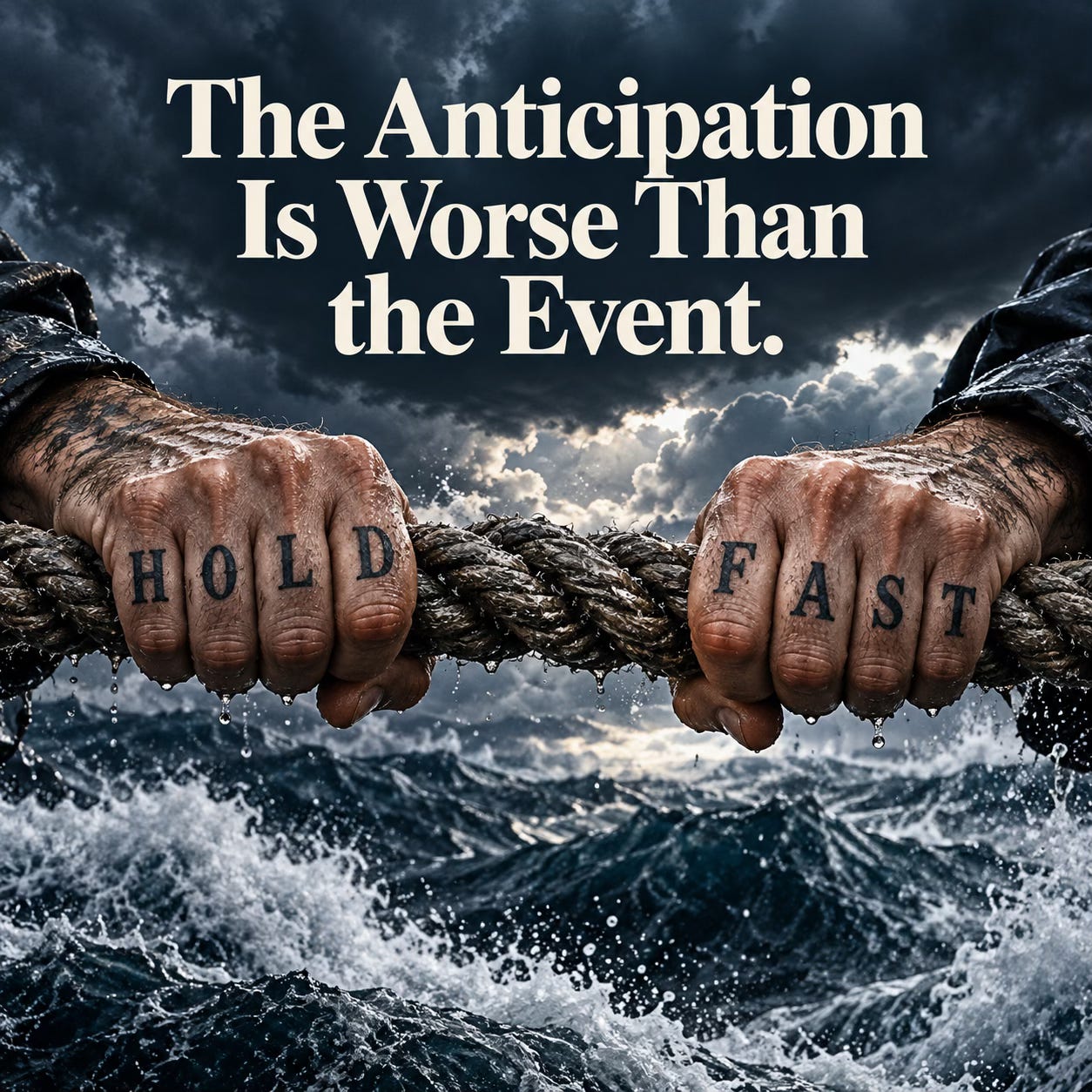
Sailors once tattooed HOLD FAST across their knuckles.
It was never a promise…that the storm wouldn’t come. It was a reminder…to have your hands already on the rope when the wave hits.
Those Londoners in the Blitz had their hands on the rope. So did Stockdale in his cell, Sully in his cockpit, and Rescorla in that stairwell. None of them were fearless. They were ready…and…being ready…gave them something to do with the fear.
Every tool in this article is a way of getting your grip set early. Name the fear. Schedule it. Filter it. Breathe through it. Stop feeding it with friends. Shrink it with something bigger. Give yourself a job.
I’ll keep asking the hard questions about what’s broken…because somebody has to. But…fear was never meant to be a place you live. It’s a signal to get ready. Once you’re ready…you get to put it down.
#HoldFast.
Back soon.
-Jack
Jack Hopkins
Remember, Jack's got your back.
P.S. Try the sigh right now…before you close this page. Two breaths in through the nose…one long breath out. Then…hit reply and tell me which of the seven tools will be hardest for you. My guess is number five.
Sources
The Panic That Never Came (The Blitz)
Jones, Woolven, Durodié & Wessely, “Civilian Morale During the Second World War: Responses to Air Raids Re-examined,” Social History of Medicine (2004). The authors found little evidence that admissions for mental illness rose appreciably, and concluded civilians proved more resilient than planners predicted, partly because planners underestimated their adaptability and resourcefulness. durodie
Jones et al., “Public Panic and Morale: Second World War Civilian Responses Re-examined,” Journal of Risk Research (2006). A study of restricted government investigations and intelligence reports showing panic was rare and arose only in specific circumstances. repec
Edgar Jones, “Air raids and the crowd: Citizens at war,” The Psychologist (British Psychological Society). Explores how British people responded to air raids and what that reveals about coping under extreme stress. bps
“Citizens at war: Air raids, terrorism and the crowd,” The Psychologist. Reports that psychiatrists at the outbreak of the war proposed special psychiatric hospitals outside cities to handle an expected influx of patients. bps
Tool #1: Make the Fear Specific (Admiral Stockdale)
Jim Collins, “The Stockdale Paradox,” JimCollins.com. Collins’s own explanation of the concept from Good to Great: keep unwavering faith that you’ll prevail while confronting the brutal facts of your current reality. jimcollins
Jim Collins, “The Stockdale Paradox” (audio transcript). Collins describes preparing to meet Stockdale and asking him how he avoided being beaten down by his circumstances. jimcollins
Tool #2: Give Your Worry an Appointment
McGowan, “The Efficacy of Stimulus Control for Worry,” University of Illinois Chicago. Participants assigned a daily 30-minute worry period did better than a control group on measures of worry, anxiety, negative mood, and insomnia. uic
Leiden University meta-analysis, “Effects of Worry Postponement on Daily Worry”. A review pooling studies of the technique, also known as stimulus control. universiteitleiden
Worry Postponement From the Metacognitive Perspective: A Randomized Waitlist-Controlled Trial (2024). Summarizes earlier promising results in children and students, and notes that one study of patients with generalized anxiety disorder found no effect. nih
Tool #4: Breathe Like a Sigh (Sully and Cyclic Sighing)
Balban et al., “Brief structured respiration practices enhance mood and reduce physiological arousal,” Cell Reports Medicine (2023). The Stanford study found breathwork, especially exhale-focused cyclic sighing, improved mood more than mindfulness meditation, and suggested daily five-minute cyclic sighing as a stress management exercise. nih
NTSB, “Loss of Thrust in Both Engines… and Subsequent Ditching on the Hudson River”. The official investigation of the January 15, 2009 accident, in which the jet lost nearly all thrust in both engines after hitting a flock of birds. ntsb
NTSB Aircraft Accident Report AAR-10/03 (full PDF). The complete final report on Flight 1549.
“Three Minutes to the Hudson,” MigFlug. A narrative account including the cockpit and radio audio, and the line “We’re gonna be in the Hudson.” migflug
Tool #5: Stop Co-Ruminating
University of Missouri news release on Amanda Rose’s co-rumination study (2007). Rose’s six-month study of 813 students found co-rumination was linked to increased depression and anxiety, and also to closer friendships. missouri
“Rehashing your problems with friends can turn into a bad habit,” Psyche. An accessible overview noting that Rose coined the term in 2002 and that co-rumination is unusual because it also boosts intimacy. psyche
Schwartz-Mette & Rose, “Co-rumination mediates contagion of internalizing symptoms within youths’ friendships”. Defines co-rumination as extensive problem talk, including rehashing problems, speculating about them, and focusing on negative feelings. nih
Tool #6: Go Find Something Enormous (Apollo 8 and Awe)
NPR, “1968: When Apollo 8 First Orbited The Moon And Saw The Earth Rise In Space” (2018). Bill Anders recalls that the one telegram he remembers from the thousands they received said, “Thank you Apollo 8 you saved 1968.” NPR
NASA Science, “1968: Earthrise (Apollo 8)”. NASA’s page on the Christmas Eve broadcast from lunar orbit, during which the crew showed photos of Earth and the Moon. nasa
Big Think, “The most common source of awe”. Summarizes Keltner’s research, including a 2021 finding that awe can reduce daily stress and boost life satisfaction. bigthink
Frontiers/PMC review citing Bai, Keltner et al. (2017) on the “small self”. Explains the small-self concept introduced by Keltner and colleagues, meaning reduced self-focus, and notes research consistently shows awe produces it. nih
Greater Good Science Center, Awe Quiz (UC Berkeley). A quiz from the center Keltner directs that measures how much awe you experience and offers tips for experiencing more. This could make a fun reader link. berkeley
Tool #7: Pick Your Role (Rescorla, Mr. Rogers, Stop the Bleed)
9/11 Memorial & Museum collection: Morgan Stanley evacuation. Rescorla, a retired Army colonel, drilled the firm’s employees for emergencies, and all but eight employees and five contractors survived. 911memorial
9/11 Memorial & Museum collection: Richard Rescorla’s dog tag. Notes that he sang “God Bless America” and songs from his native England while directing the evacuation, and that he and several colleagues died returning to help. 911memorial
American Bar Association, “Rick Rescorla Was a Hero of the Highest Magnitude” (2026). Describes how he ignored the announcement telling people to stay put and used his bullhorn to begin evacuating. americanbar
Notre Dame Church Life Journal, “When Nothing Helps”. Discusses how Fred Rogers shared his mother’s advice during national crises. nd
ACS Stop the Bleed (official site). The American College of Surgeons program, which teaches three basic actions to control severe bleeding and has trained more than 5 million people. You can find classes and online training here. stopthebleed
Mille Lacs Health, “Stop The Bleed - Save a Life”. Notes the free ACS course has an online version that takes about 25 minutes, which has been helpful in rural areas. mlhealth
Write the Ending First (Prospective Hindsight)
Gary Klein, “Performing a Project Premortem,” Harvard Business Review (2007). Cites 1989 research by Mitchell, Russo, and Pennington on prospective hindsight, which means imagining that an event has already occurred. oreilly
Gary Klein, “The Pre-Mortem Method,” Psychology Today. Klein’s own account of the method, which he says is now used in boardrooms, wildland firefighting, Army programs, and on Wall Street. psychologytoday
Hands on the Rope (HOLD FAST)
“History of the ‘Hold Fast’ Knuckle Tattoo,” Walnut Studiolo, drawing on the Columbia River Maritime Museum. Explains that the knuckle tattoo marked a deckhand’s career and was said to give the grip needed for the ship’s lines and rigging. walnutstudiolo
Old Salt Blog, “Sailor’s Tattoos”. A retired ship’s captain recalled that young deckhands got the tattoo so they wouldn’t fall when climbing aloft. oldsaltblog
Jack, thank you, as always, you give us what we need when we need it most. It's been a bad 10 days personally, nothing huge, not a crocodile bite, just a thousand mosquito-sized bites, and my resilience is at rock bottom. SO, the breathing exercise is one I used to teach to my Army soldier/students back in the 80s. And now, I want to take the Stop the Bleed course, so that's a positive, right? Hardest thing? I think it's actually #1, until this regime is out of gas, there will always be something to fear, I fear. Ok, time to work on #6. Thank you, I needed this. #HoldingFastAGAIN
Jack,
Thanks for the inspiring words…we all need them!!! The KEEP CALM AND CARRY ON motivational poster from the British Ministry of Information is something we should all take to heart…and practice each and every day! Just keep moving forward, prepare the best we can by stocking our pantries, and realizing that this isn’t going to end tomorrow…it’s going to be long haul slog trying to save our country from this regime. I’m not saying fear isn’t part of what we are all facing…the anxiety of what this insane man, along with his cabal of obsequious underlings will do to maintain their control should not be underestimated, but as you mentioned the Londoners who lived through the Blitz, we must somehow develop that “Bliltz Spirit” in ourselves..it’s the only way we can keep going! Our determination, being constant in our resistance is so vital…as Churchill said “NEVER GIVE UP!”
Take Care Jack…and thanks for being here!
PS. I knew someone who survived the Blitz in London as a schoolgirl…and as she said to me, you have to just keep going!!