

You Can’t Gaslight a Grocery Receipt
Why Trump’s “Perception Reset” Will Work on Some Brains-and Bounce Off Others

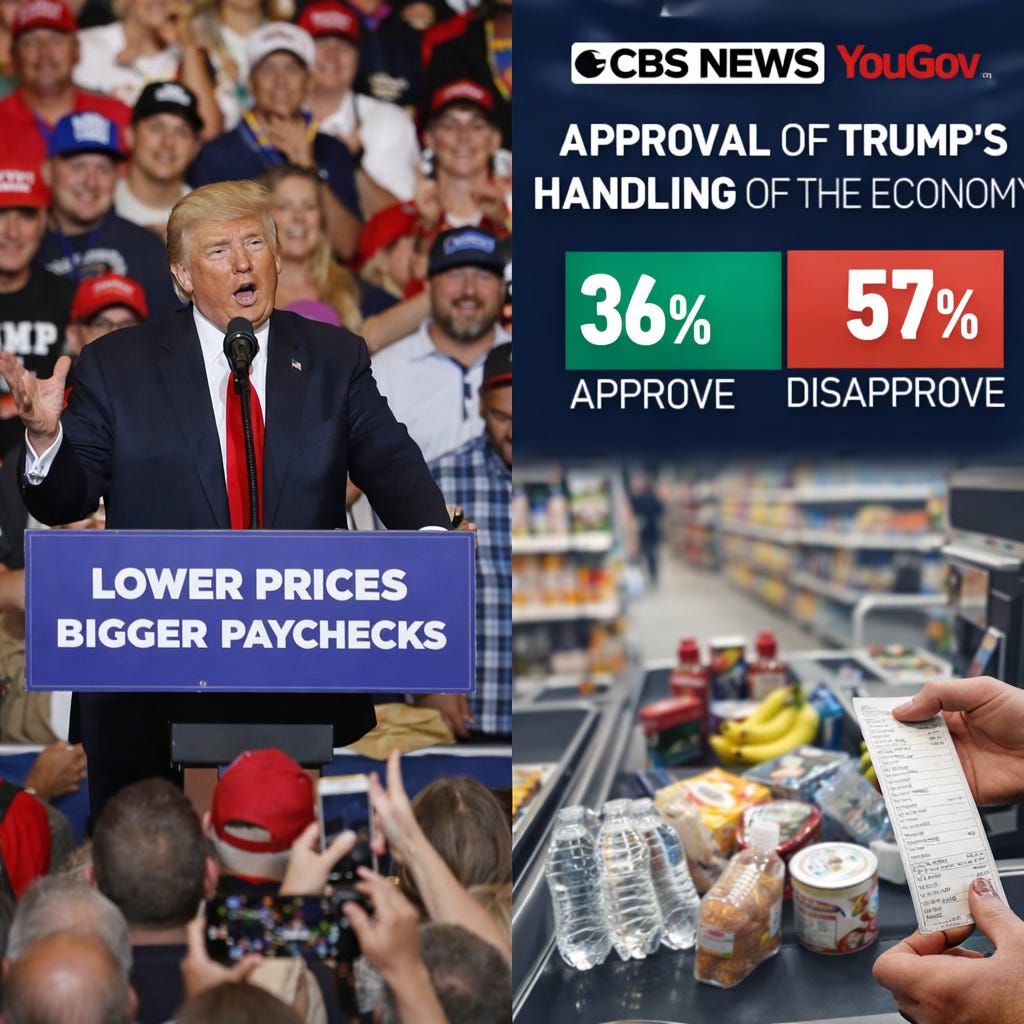
You Can’t Gaslight a Grocery Receipt
Why Trump’s “Perception Reset” Will Work on Some Brains-and Bounce Off Others
The Jack Hopkins Now Newsletter #696: Saturday, December 20th, 2025.
Let’s get something straight right up front.
This is not about whether the economy is technically improving.
This is not about charts…or whether economists are nodding approvingly on cable news.
This is about human psychology.
Because voters do not experience “the economy.”
They experience rent.
They experience groceries.
They experience the quiet, low-grade anxiety of swiping a card and bracing for the total.
And no amount of shouting “GOLDEN AGE!” at a lectern can override that experience…unless very specific psychological conditions are met.
Donald Trump knows this…instinctively, if not intellectually. That’s why he’s suddenly trying to change perceptions rather than defend policy specifics. That’s why we’re getting campaign-style rallies…primetime addresses…and carefully chosen “wins” like drug pricing announcements.
This is not accidental.
It’s a late-stage persuasion maneuver.
The question isn’t what he’s saying.
The question is whose brains are wired to accept it…and whose brains are immune.
Let’s break that down.
The Core Strategy: Narrative Override
Trump’s Rocky Mount speech…and others like it…are attempts at what are known in the field of psychology call narrative replacement.
The existing narrative in the public mind is this:
“Things still feel expensive, and I’m not sure anyone is actually fixing it.”
Trump’s counter-narrative is:
“Things were destroyed before I arrived, and now they are rapidly getting better, so if you’re still unhappy, just wait.”
That’s not an economic argument.
That’s a temporal reframing strategy.
He’s asking voters to mentally relocate themselves from present pain into future relief…while emotionally crediting him for the relief before it’s actually felt.
This tactic works…
…but only on certain psychological profiles.
Who This WILL Influence (and Why)
1. The Identity-Anchored Voter
(a.k.a. the “I already decided” crowd)
These voters don’t evaluate information.
They filter it.
Their political identity is already fused with Trump, so every message he delivers isn’t judged on truth…it’s judged on alignment.
Psychologically, this is motivated reasoning at work.
They don’t ask:
“Is this claim accurate?”
They ask:
“Does this claim help my team feel justified?”
For these voters, the “golden age” rhetoric doesn’t need to be proven. It simply needs to be plausible enough to relieve cognitive dissonance.
And Trump is excellent at providing permission structures:
“Drug prices are coming down.”
“Foreign leaders are backing off.”
“We inherited disaster.”
That’s enough for them to emotionally exhale and say, “See? I knew it.”
Effectiveness:
Extremely high
Risk:
Zero
Net impact:
Locks in turnout, suppresses doubt
2. The Low-Information, High-Repetition Voter
(the most dangerous group in modern politics)
These are voters who:
Don’t follow politics closely
Don’t track policy details
Rely on headlines, slogans, and vibes
Their opinions are shaped less by facts than by frequency.
Say something often enough, confidently enough…and emotionally enough…and it becomes familiar.
Familiar feels true.
Trump’s “Lower Prices, Bigger Paychecks” signage isn’t messaging…it’s neurological imprinting.
Pair that with:
One or two cherry-picked examples (drug prices, gas dips)
A confident authority figure
Constant repetition
…and you get what we call the illusory truth effect.
They may not feel immediate relief…but they begin to assume relief is happening somewhere, and that assumption slowly reshapes blame.
Effectiveness:
Moderate
Risk:
Medium (falls apart if reality sharply contradicts it)
Net impact:
Softens dissatisfaction…reduces protest voting
3. The Soft Republican Who Wants Reassurance
(“Please tell me this wasn’t a mistake”)
This group is quietly important.
They’re Republicans who are:
Tired
Uneasy
Not thrilled…but not ready to defect
Trump’s messaging gives them a psychological off-ramp from regret.
It allows them to say:
“It’s early. These things take time. He’s trying.”
That’s not persuasion.
That’s emotional maintenance.
And from a turnout perspective, that’s gold.
Who This Will NOT Influence (No Matter How Loud He Gets)
1. Persuadable Independents
(the people who actually decide midterms)
Independents don’t process politics as identity.
They process it as trust + competence.
Here’s the problem for Trump:
When a voter hears:
“Prices are coming down”
followed by 30 minutes of unrelated insults…grievances…and cultural detours
…the brain doesn’t say, “Wow, what a multitasker.”
It says:
“This person is distracted.”
Distraction kills credibility.
For independents, focus = seriousness.
And Trump’s stream-of-consciousness style…actively undercuts the affordability message.
Result:
Low persuasion…high skepticism
2. Cost-Burdened Voters
(renters, parents, younger households)
These voters live inside monthly math.
They don’t care about:
Pharmaceutical negotiations in Paris
Future-oriented promises
Macro improvements that don’t touch rent…insurance…or childcare
Their brains are calibrated to immediate threat detection.
If the threat hasn’t receded, the messaging doesn’t land…it irritates.
This is where gaslighting accusations emerge, even if unintentionally.
You cannot tell someone their pain is imaginary while they’re paying it.
3. Anti-Trump Voters
(self-explanatory)
This messaging doesn’t convert them.
It mobilizes them.
The Hidden Weakness in Trump’s Strategy
Here’s the part most commentators miss:
Trump is trying to run a brand campaign…in a performance environment.
Brand campaigns work when:
The product isn’t used daily
The downside is abstract
The promise is aspirational
But the economy is used…every day.
Which means his message…must pass what I call the Checkout Line Test.
If the message collapses at the grocery store…it collapses everywhere.
What Democrats Should Be Hammering-Starting Yesterday
Now let’s flip the lens.
Because Democrats have an opportunity here…but only if they avoid their usual mistakes.
Mistake #1: Defending Metrics
Nobody wants a spreadsheet.
Mistake #2: Saying “It’s Complicated”
That’s a surrender.
The Correct Psychological Frame
Democrats need to run a Validation + Contrast strategy.
Step 1: Validate lived experience
Step 2: Contrast focus and priorities
Step 3: Localize accountability
The Core Democratic Message (Psychologically Correct Version)
“If things still feel expensive, you’re not crazy.
And if someone tells you it’s a ‘golden age’ while you’re still struggling, that tells you what they’re paying attention to…and what they’re not.”
That sentence alone…does more work than ten policy briefings.
Why?
Because it restores epistemic trust.
It tells voters:
“Your experience is real. Your instincts are valid.”
Once you do that…they’ll listen to anything else.
The Three Lines Democrats Should Repeat Relentlessly
1. “Talking About Lower Prices Is Not the Same as Delivering Them.”
Simple. True. Devastating.
2. “If It’s a Golden Age, Why Does It Still Feel Like a Squeeze?”
That forces cognitive reconciliation.
3. “Focus Is Policy.”
This reframes Trump’s chaos as incompetence…not entertainment.
The Strategic Goal for 2026
Democrats do not need to prove Trump is lying.
They need to prove he is out of sync.
Out of sync with:
Daily costs
Household stress
What economic relief actually feels like
If voters conclude:
“He’s telling me I’m fine while I’m still bracing every time I check out”
…the persuasion attempt collapses under its own weight.
Final Verdict
Trump’s perception campaign will:
✅ Energize his base
✅ Calm soft Republicans
⚠️ Slightly blur dissatisfaction among low-information voters
❌ Fail to persuade independents at scale
❌ Collapse if affordability doesn’t feel better by mid-2026
You can bend perception.
You can delay judgment.
But…you cannot permanently override lived experience.
And eventually…every persuasion campaign runs headlong into reality.
The grocery receipt…always wins.
#HoldFast
Back soon,
-Jack
Jack Hopkins
P.S.
The most dangerous lie in politics isn’t the obvious one.
It’s the one that almost feels true…until the bill comes due.
And in 2026…a lot of voters are going to be opening envelopes.
Every issue of The Jack Hopkins Now Newsletter includes a complete, full-length article for everyone to read; no partials, no mid-article paywalls.
At least a couple times each week, there’s a clearly labeled Paid Expansion at the end for subscribers who want deeper analysis. Paid-only articles will always be marked Paid Article EXCLUSIVE in the subject line. Clarity…consistency…and respect for your time.
“You Can’t Gaslight a Grocery Receipt” nails it: no talking point can erase what people feel at the register. Reality > spin. Hopkins cuts through the noise and shows why lived experience always wins.
The grocery receipt is among the purest forms of honesty. God help us.