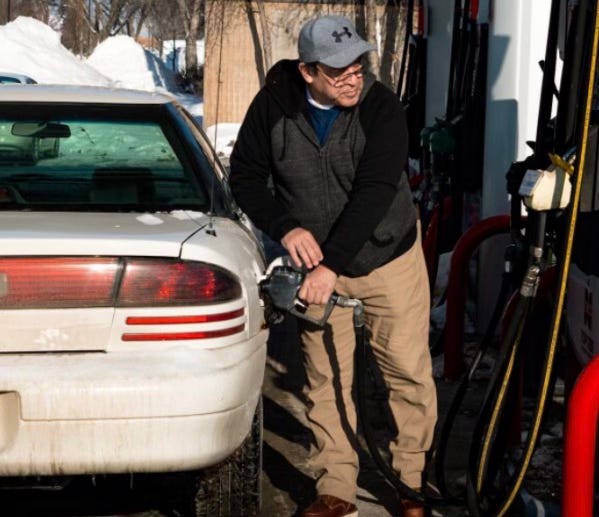
When You Feel the Pain at the Gas Pump, Remember: They Told You It Was Worth It
The Jack Hopkins Now Newsletter #809: Monday, March 9th, 2026.
Let’s stop playing dumb.
Not hysterical.
Not reckless.
Not conspiratorial.
Just honest.
Because there comes a point when the safest, smartest…most adult thing you can do is look at a pattern and call it what it probably is.
And this…is one of those moments.
No, I’m not saying we have a signed memo proving somebody sat in a room and said, “Let’s create an energy crisis for the American people.”
That is the childish version of this argument, and it is easy to knock down.
The serious version is tougher. Colder. More plausible.
It is this:
If decision-makers are repeatedly signaling that an energy shock is acceptable…
If they are pursuing a war path that predictably raises that risk…
If they are publicly minimizing the pain…
If they are slow-walking the most obvious steps to suppress the spike…
If the shock happens to strengthen their geopolitical hand and their domestic energy agenda…
…then at some point, you do not get to keep calling it an unfortunate side effect.
At some point…you have to admit they may see it as part of the package.
Maybe not the whole point.
But…part of the point.
If it quacks like a duck, walks like a duck, and keeps laying duck eggs right in front of you…you are not “being responsible” by calling it a squirrel.
You are just refusing to look.
Start with the obvious
Oil jumps above $100.
Shipping is disrupted.
Production is threatened.
The Strait of Hormuz becomes a global choke point again.
Gas prices rise.
Consumers get hit.
None of that is surprising.
None of that is mysterious.
None of that qualifies as a black swan.
This is the most predictable consequence in the world when you escalate conflict around one of the most important energy corridors on the planet.
So…if the administration acts shocked, that would be insulting.
But…they are not acting shocked.
That is the point.
They are acting like this is a burden worth bearing.
That matters more than people realize.
Because when leaders do not treat a harmful consequence like a policy failure, they are telling you something. They are telling you it falls within their acceptable range of outcomes.
That, alone…should sharpen the discussion.
They are not saying, “This must be stopped.”
They are saying, in effect, “This is the price.”
That is not a small distinction.
That is the distinction.
When officials publicly describe the oil spike and the energy pain as temporary, manageable…and worth it…they are not talking like people blindsided by a dangerous unintended consequence.
They are talking like people who have already incorporated that consequence into the cost of doing business.
Read that again.
Because…once you accept that, the rest of the picture changes.
This stops being a conversation about whether they “wanted Americans to suffer.”
That is weak framing.
The real question is whether they judged the suffering…the price spike…and the volatility to be strategically useful enough…or…at least strategically tolerable enough …to proceed anyway.
That is a much more serious charge.
And…right now, it is also…the one their own behavior supports.
The war does not just create pressure. It creates leverage.
You do not threaten Iranian flows, unsettle the Gulf, and rattle Hormuz without knowing exactly what kind of market pressure follows.
That pressure is not random.
It does things.
It raises costs.
It tightens choices.
It disciplines allies.
It increases dependence on U.S. power.
It gives Gulf-aligned producers and Washington more influence over what comes next.
So…let’s not act like a temporary energy shock is geopolitically useless.
It is not.
It is leverage.
If you are trying to force a harder regional reset, a dose of controlled chaos can serve a purpose. It can make governments more pliable. It can make security guarantees more valuable. It can make the postwar order easier to shape.
That does not mean they want endless disorder. (But, it doesn’t mean they don’t, either.)
It means short-term disorder may be viewed as a highly functional tool by this administration.
Again: duck.
The domestic upside is staring you in the face, too
This administration has built a huge part of its argument around American “energy dominance.”
Not efficiency.
Not resilience.
Not consumer insulation.
Dominance.
So what happens when global supply is threatened…and prices rise?
Their preferred model suddenly looks indispensable.
Domestic production becomes more politically valuable.
More drilling sounds more urgent.
More infrastructure sounds more necessary.
More indulgence toward oil and gas interests sounds more justified.
This is not complicated.
A foreign energy shock makes their domestic energy doctrine look stronger.
That does not prove they engineered the shock for that purpose.
But…it absolutely means the shock creates one of the most useful possible political and policy outcomes for the Trump administration.
And when the same event both advances the war posture…and…flatters the home-front doctrine, grown-ups are supposed to notice.
Look at what they are doing, not what their defenders say
This is where the whole thing gets harder to wave away.
Because if immediate consumer relief were the real top priority, you would see that reflected in action.
Fast action.
Loud action.
Visible action.
You would see a full-court press to crush the spike. Strategic reserve talk would dominate. International coordination would be immediate. Every ounce of public messaging would scream one thing: we are moving heaven and earth to get these prices down now.
But that is not the posture.
Instead, the posture is restraint, minimization, and moral framing.
Yes, it hurts.
Yes, it is temporary.
Yes, it is worth it.
That is not the language of emergency price suppression.
That…is the language of strategic acceptance.
And…once you see that, pretending otherwise starts to look less like prudence and more like denial.
They may think America can absorb the hit better than others
This is another reason the “it’s all just accidental fallout” story is too neat.
The United States is one of the world’s largest energy producers. A lot of allies and rivals are more exposed to Gulf disruptions than we are.
So…from a cold strategic point of view, an energy shock is not just pain.
It is uneven pain.
Pain that may land harder elsewhere.
Pain that may destabilize import-dependent economies first.
Pain that may strengthen the relative position of a producer nation that thinks in terms of dominance.
In other words, Trump may not view this as “America walking into a wall.”
He may view it…as America taking a punch it can survive…while others stagger harder.
(Another possible option exists; he hasn’t thought about it in detail…at all. Plausible? I can’t say with certainty. Possible? Absolutely.)
That is not a humanitarian calculation.
It is a power calculation.
And…it fits the pattern…far better than the fairy tale that nobody saw any of this coming.
Stop giving the benefit of the doubt where the facts do not earn it
Now, to stay honest…there are limits to the claim.
Maybe they expected a shorter conflict.
Maybe they expected markets to calm faster.
Maybe some of this is just arrogance, overconfidence…and bad planning.
Fine.
That is possible.
But…notice what that fallback argument requires you to believe: that the same people who understood enough to launch and justify this confrontation…somehow failed to understand the most obvious energy consequences of conflict around Iran.
Possible?
Sure.
Convincing?
Not especially.
And even if that were true in the opening moments…we are past that point now.
Now they know.
Now the consequences are visible.
Now the price shock is real.
Now the public messaging is clear.
So…even from the most cautious and responsible approach when examining this…from this point forward…continued acceptance becomes a choice.
And that…is the heart of the piece.
Maybe they did not begin with a master plan to trigger energy pain. (Though, I think most of you know how I feel about that. I think most of you also likely know…that I know…how you likely feel about that.)
But…if they keep treating that pain as strategically useful, politically manageable…and publicly saleable…then the distinction starts to matter less and less.
Because…whether you planned the fire in advance…or…simply decided to use it once it started, the result for the public is not all that different. In fact, it’s pretty much the same.
Here is the hard-nosed bottom line
The strongest argument is not that there is proven evidence of a secret plan to impose an energy crisis on Americans.
The strongest argument is tougher than that…because it requires less speculation.
It is that this administration is telling you, in public…that energy pain is a price worth paying.
Their broader doctrine benefits from the shock.
Their geopolitical posture benefits from the pressure.
Their domestic energy agenda benefits from the fear.
And…their response does not look like the response of people desperate to stop the damage immediately.
That is not proof beyond all doubt.
But…it is a pattern.
And intelligent adults…are allowed to recognize patterns without waiting for a confession.
So…no…do not say they “definitely wanted Americans to suffer.”
Say something stronger because it is more precise:
They have decided that an energy shock was not a failure to avoid…but a condition to exploit.
And…if they keep talking that way…acting that way…and benefiting that way…then sooner or later, the burden shifts.
No, not onto you…to prove it is a duck.
Onto them…to explain why it keeps quacking.
BONUS:
What makes this look less like fallout and more like policy
Here is the part nobody should let them wriggle away from.
You do not get to repeatedly accept a predictable consequence, minimize a predictable consequence, benefit from a predictable consequence…and then keep calling it an accident with a straight face.
That is not how serious people analyze power.
Serious people ask a much simpler question:
When the smoke clears, who got more leverage?
If the war drives up energy prices…
and the administration says the pain is worth it…
and that pain strengthens the case for more domestic oil and gas production…
and it pressures allies and rivals in ways that expand U.S. leverage…
and it creates a political climate where sacrifice can be moralized…and dissent can be brushed aside…
…then you are no longer looking at a mere side effect.
You are looking at a consequence…that is doing real work for them.
And…once a consequence is doing that much work for the people in charge…it stops mattering whether they wrote it into the first draft…or…simply recognized its value once it arrived.
Either way, they are using it.
That is the point.
Washington has always had people who know how to convert a crisis into permission. Permission for more control. Permission for more deference. Permission for more “trust us now, questions later.” And an energy shock tied to war…is one of the cleanest ways to do it…because it feels external…unavoidable…and patriotic all at once.
That is why this deserves a harder read.
Not: Did they secretly want Americans to suffer?
But: Did they recognize that a certain amount of suffering would increase their leverage, strengthen their doctrine, and make their larger goals easier to sell?
That is the real question.
And if the answer is even partly yes…then the public is not just paying a price.
The public is being used to pay one.
#HoldFast
Back soon.
-Jack
Jack Hopkins
P.S. The people in charge do not need to openly admit they see your pain as acceptable. They already told you enough. They told you it was temporary. They told you it was worth it. They told you the larger objective matters more.
So…the next time you’re standing at the pump watching the numbers climb, remember this: sometimes the clearest evidence is not what power confesses…it is what power is perfectly willing to make you absorb.


I find it interesting that Putin, Netanyahu, and Big Oil are the main beneficiaries of this action in Iran, and they are the primary parties to which he listens the most closely.
What keeps occurring to me is that the people making these decisions are never the people who are most affected - in a real world, what might happen if every member of Congress, the president and the cabinet had a son or daughter of draft age, if they had to pump their own gas with a credit card limit, pay for their own insurance, shop for groceries before the social security deposit goes in??? And of course, sadly, it's a question without a satisfying answer.
Thank you for your clarity, Jack - it goes a long way toward keeping on paddling, one stroke at a time.
