


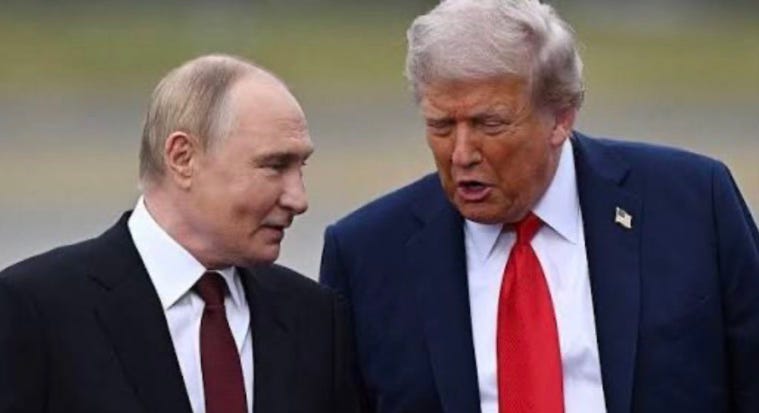
Vladimir Putin and Donald Trump: two men who have arguably caused more worldwide destabilization than any other two men in recent history.
What Tuskegee, Watergate, and Big Tobacco Have in Common With Trump and Putin
Each one was “just a conspiracy theory” until somebody did the work.
The Jack Hopkins Now Newsletter #1,053: Monday, October 12th, 2026.
Sometime in the 1300s, an English friar named William of Ockham wrote down a rule of thumb that has been doing damage ever since.
The rule is simple. When you have two explanations for the same set of facts, prefer the one that requires fewer assumptions.
The cookies are gone. One theory: a ring of neighborhood kids picked the lock, took the cookies, and relocked the door. Other theory: the dog ate them. The dog is sitting right there with crumbs on his nose. Go with the dog.
People call this Occam’s Razor.
It “shaves off” the extra assumptions. And…as far as it goes, it’s good advice. Most of the time…the boring explanation is the right one.
But…notice what the rule actually says. It says when two explanations fit the facts equally well. It’s a tiebreaker. A tool you reach for after you’ve gathered the evidence …and…both stories still hold up.
That is not how most people use it.
Most people use it as a permission slip to stop thinking. Somebody raises an uncomfortable possibility. Somebody with letters after their name sighs, says “Occam’s Razor,” and the room relaxes. The simplest explanation is usually right. Case closed. Everybody go home.
Except the simplest explanation is only “usually” right…in a world where nobody is trying to deceive you.
The moment you add a motivated actor…with something to hide…the simple explanation becomes the designed explanation. It’s simple…because somebody made it simple for you. The dog has crumbs on his nose…because somebody put them there.
The Razor can’t tell the difference. Only investigation can.
And…American history is one long…embarrassing record…of what happens when serious people forget that.
The Case Files
Let’s open a few.
The government is spying on peace activists and civil rights leaders.
Through the 1960s, that was a paranoid fantasy. Dr. King’s people said it. Antiwar groups said it. The response from respectable America was a patient smile.
Then…in March 1971…a handful of activists broke into an FBI field office in Media, Pennsylvania…and walked out with the files. COINTELPRO was real.
The Bureau had been infiltrating…smearing…and sabotaging domestic political groups for fifteen years. The Church Committee followed…and the rules governing American intelligence agencies…were rewritten because of it.
The CIA is drugging people without their consent.
Lunatic stuff. Until 1975, when the Rockefeller Commission and the Church Committee confirmed MKUltra: the agency (CIA) had dosed unwitting Americans with LSD…some of them in safe houses with two-way mirrors.
One scientist, Frank Olson…went out a hotel window. The files had been ordered destroyed in 1973. We only know what we know…because a records clerk misfiled a box.
Doctors are letting Black men die of a curable disease to see what happens.
For forty years, this was the kind of thing you’d hear in a barbershop and dismiss. In 1972…a whistleblower named Peter Buxtun…finally got a reporter to listen.
The Tuskegee syphilis study had withheld penicillin from hundreds of men since 1932. Wives were infected. Children were born with it.
The study ended…the men’s families were compensated…and modern informed-consent law exists…because somebody refused to stop asking.
Tobacco companies know cigarettes cause cancer and are hiding it.
Big Tobacco spent four decades calling that a conspiracy theory. They funded “independent” research institutes to say so. In 1994…a paralegal named Merrell Williams…leaked internal Brown & Williamson documents.
The companies had known since the 1950s. They’d known nicotine was addictive and had engineered for it. The 1998 Master Settlement Agreement that followed…is the largest civil settlement in American history…and the collapse in smoking rates since has saved lives by the millions.
The President is personally directing a cover-up.
In the summer of 1972, the White House called the Watergate break-in…a third-rate burglary. The press secretary mocked the Washington Post.
Two young reporters…a dogged federal judge…and a Senate committee kept pulling the thread anyway. The tapes existed. Nixon resigned. The system worked…only because a few people…refused to accept the simple explanation.
The White House is secretly selling arms to Iran and funneling the money to Nicaraguan rebels.
That’s the kind of sentence that gets you labeled a crank. A Lebanese magazine broke it in November 1986. Iran-Contra was real…fourteen people were charged…and the question of what a president can do without telling Congress has never been the same.
A wealthy financier is running a trafficking operation with the protection of powerful people.
Epstein’s victims said it for years. A Florida prosecutor cut him a sweetheart deal in 2008…and sealed it. Serious people rolled their eyes right up until the Miami Herald’s 2018 investigation…the 2019 arrest…and the documents that keep coming out to this day.
Seven cases. Seven “conspiracy theories.” Seven times the Razor would have shaved off the truth.
What the Razor Would Have Cost Us
Now run the counterfactual.
Imagine that in every one of those cases, everybody had done the “reasonable” thing. Imagine they’d nodded along…when the credentialed expert said, that’s just conspiracy bunk.
The FBI keeps a file on every pastor who says the wrong thing from the pulpit. No Church Committee…no FISA court…no oversight at all.
The CIA keeps its drug program…and we never learn Frank Olson’s name.
The Tuskegee men keep dying…and “informed consent” stays a phrase in an ethics textbook nobody reads.
Your parents keep smoking Camels…because the Tobacco Institute says the science isn’t settled.
Nixon finishes his term. The lesson the next president learns…is that it works.
Notice the pattern.
In every case…the investigation that changed the world…did not start with an investigator. It started with somebody outside the institution…who believed something the institution found ridiculous…and who kept asking.
The reporters…the committees…the courts came second. They’re the engine. The “conspiracy theorist” is the ignition.
That’s not a defense of every crank with a YouTube channel. Most conspiracy theories are wrong. That’s the whole reason this matters. The job of a serious person…is not to sort claims by how crazy they sound. It’s to sort them by whether the evidence…when you go and get it…holds up.
And, frankly…a lot of people fail miserably at that.
The Razor doesn’t do that work. It excuses you from it.
Which Brings Us to Trump
For nine years, the claim that Donald Trump’s relationship with Vladimir Putin was something other than ordinary diplomacy has been filed under “conspiracy theory.”
And…not just by Republicans.
Plenty of elected Democrats did it too. They called it a distraction. They said the base was obsessed.
They said it was time to move on…talk about kitchen-table issues…stop sounding like the people with the string and the corkboard. Pundits who would never say so on camera…said it at dinner parties: the Russia thing is overblown.
Funny thing about the record, though. It never went away. It just kept accumulating.
The Mueller Report documented that Russia interfered in the 2016 election in a sweeping and systematic fashion…and laid out ten episodes of potential obstruction it declined to charge because of Justice Department policy on sitting presidents.
The Republican-led Senate Intelligence Committee went further in 2020. Its bipartisan report found that Trump’s campaign chairman…Paul Manafort…handed internal polling data to Konstantin Kilimnik, whom the committee identified as a Russian intelligence officer.
That is not a theory. That is a finding, signed off by Marco Rubio.
Then came Helsinki…where an American president stood next to Putin and sided with him over his own intelligence agencies.
Then came the second term: the red carpet in Alaska for a man under an International Criminal Court arrest warrant…the phone calls that keep happening while European allies get cut out…the ceasefire deals announced from Washington that Moscow doesn’t seem to have agreed to.
Then came September. ProPublica reported that Umar Kremlev…a Russian oligarch close to Putin…quietly paid hundreds of thousands of dollars for the private-island rental and fireworks at Donald Trump Jr.’s Bahamas wedding celebration in May.
Putin had just given Kremlev the Order of Friendship…and Kremlev had traveled with Putin to China days before the party.
The president said he had no idea who Kremlev was…then four days later defended the arrangement as common, said “a lot of people have parties,” and claimed…without elaborating…that his son had paid the money back.
Don Jr. and his wife called it an “extraordinarily generous gift” from a “dear friend.” A retired senior FBI counterintelligence official put it more plainly to ProPublica: if someone pays for your wedding, eventually you owe them something.
Anyone with a 2nd grade “graduation” certificate…knows that.
Three weeks after that…Trump told reporters he had a call set up with Putin on October 7…and reminded them it was Putin’s birthday.
The Kremlin later said no call took place that day…but that there were “no delays” in arranging one.
This is the same president who…a month earlier…spoke with Putin by phone about the results of his envoys Steve Witkoff and Jared Kushner’s trips to Moscow and Kyiv. Kushner…you’ll recall…was a guest at the wedding the oligarch paid for.
A Putin ally bankrolls the president’s son. The president shrugs. The president schedules a birthday call. Explain all of that with “he just admires strongmen” and see how much shaving the Razor has to do.
Remember the rule. The simple explanation wins only when it fits the facts as well as the complicated one. “He just admires strongmen” fit the facts in 2016. Does it fit them now? Does it explain the polling data…the summit…the calls…the pattern?
The honest answer is: it stopped fitting a while ago. The Razor flipped sides years back. The people still swinging it…just haven’t noticed.
The Question That Matters
So here’s the only question a serious person should ever ask about a so-called conspiracy theory.
Not does this sound crazy? Everything on the list above sounded crazy.
Not would a reasonable expert dismiss this? Reasonable experts dismissed all of it.
The question is: What would the evidence look like if it were true…and has anyone actually gone and checked?
If nobody has checked…the Razor isn’t a verdict. It’s an excuse. And…the people who hide behind it…don’t get to act surprised…when the box of misfiled files turns up.
The Tuskegee men didn’t need a smarter theory. They needed one person to stop smiling politely…and start asking questions.
So did we. So do we.
Q&A: The Conspiracy Theory That Wasn’t
1. Aren’t you just telling people to believe conspiracy theories?
No. I’m telling people to stop using “that sounds crazy” as a substitute for checking. Most conspiracy theories are wrong. The seven in the piece were right. The only way to tell the difference…is to look at the evidence…and the Razor lets people skip that step.
2. What is Occam’s Razor, in one sentence?
When two explanations fit the facts equally well, prefer the one with fewer assumptions. The key words are equally well. It’s a tiebreaker, not a verdict.
3. Why pick those seven cases? Aren’t they cherry-picked?
Of course they are. That’s the point. The question isn’t how many conspiracy theories turn out true. It’s what it costs when a true one gets dismissed. Tuskegee ran for forty years. Big Tobacco bought four decades. The cost of a false negative is measured in lives…not in embarrassment.
4. Weren’t these cracked by journalists and whistleblowers, not “conspiracy theorists”?
Yes, and that’s exactly the pattern. Someone outside the institution believes something ridiculous…and won’t drop it. Then a reporter listens…then a committee convenes. The theorist is the ignition; the institutions are the engine. Remove the ignition…and the engine never turns over.
5. What’s the difference between a crank and a legitimate skeptic?
A crank starts from the conclusion…and hunts for evidence. A skeptic starts from a question…and goes where the evidence leads…including away from the theory. The difference isn’t how wild the claim sounds. It’s what happens when the facts come back.
6. Why bring Trump into a piece about history?
Because the dismissal pattern is running in real time. For nine years, “the Russia thing” has been treated as an obsession of the unserious.
Meanwhile the record accumulated: Mueller…the bipartisan Senate findings on Manafort…Helsinki…Alaska…and now a Putin ally bankrolling the president’s son’s wedding. At some point the “simple” explanation stops being simple.
7. Why call out Democrats? Aren’t Republicans the ones defending Trump
Republicans have a political reason to look away. Democrats who did it had no excuse. They called it a distraction because it polled badly…which is a strategy…not an analysis. The piece is about analytical cowardice…and it isn’t partisan.
8. Isn’t “Trump is compromised by Russia” itself a conspiracy theory?
It’s a claim. Claims get tested. The Senate Intelligence Committee…led by Republicans…found a campaign chairman passing polling data to a Russian intelligence officer. That’s not a theory on a corkboard. That’s a finding in a government report. The question is why the finding got less attention than the mockery.
9. What’s the practical takeaway for a reader?
Replace one question with another. Stop asking “does this sound crazy?” Start asking “what would the evidence look like if this were true, and has anyone checked?” If no one has checked…you don’t have a verdict. You have an untested claim and a reason to be curious.
10. What would change your mind about Trump and Putin?
A full accounting. Financial records, the content of the calls, the explanation for why a sanctioned oligarch pays for a wedding and gets a shrug. If all of that came out and it was boring, I’d say so. That’s the deal: I’ll accept the dog with crumbs on his nose…but only after someone checks the dog.
William of Ockham never said the simple answer is true.
He said that when you can’t tell…bet on simple.
Every case in this piece is a case where someone could tell…and chose not to look.
The files were in a drawer in Media, Pennsylvania. The penicillin was in the pharmacy. The tapes were in the Oval Office. The oligarch’s name is in the wedding photos. None of it required a theory. It required somebody to stop being embarrassed about asking.
So that’s the deal I’m offering. Hand me the simple explanation…and I’ll take it… gladly…the moment it survives contact with the evidence.
Until then, “that’s just a conspiracy theory” isn’t an argument. It’s a request that I stop looking. And…the whole history of this country says the people who stopped looking were wrong at the exact moments it mattered most.
#HoldFast
Back soon.
-Jack
Jack Hopkins
Remember, Jack’s got your back.
P.S. Somebody on social media is going to read this and say, “So you believe every conspiracy theory now?” No. I believe in checking. The difference between a crank and a citizen is not what they suspect. It’s what they do about it.
The crank repeats. The citizen files the FOIA request, reads the 900-page Senate report, pulls the wedding photos. If that sounds like too much work, fine. But then don’t tell me the question was stupid. Tell me you didn’t want to do the work.
P.P.S. One more thing about the dog with crumbs on his nose. Nobody ever got in trouble for blaming the dog. That’s why the simple explanation is so popular: it’s safe.
You never look foolish going with the obvious answer…even when it’s wrong. The people in this piece who were right…all looked foolish first. Every one of them. If you’re waiting for the version of this where you get to be right and comfortable…it doesn’t exist. Pick one.
Sources
Primary documents:
Senate Intelligence Committee, Volume 5: Counterintelligence Threats and Vulnerabilities (2020)
The Master Settlement Agreement (National Association of Attorneys General)
Jack,
Thank you for Occam's Razor. Almost no one uses it, and fewer still read it closely enough to see that it is a tiebreaker, one that only works when nobody is arranging the evidence.
The Razor, misused, becomes what Timothy Snyder calls the politics of inevitability. Nothing needs examining, the obvious answer is the safe one, and the room relaxes. Your closing postscript names the cost: nobody gets in trouble for blaming the dog.
The cases in your file show the alternative. Media, Pennsylvania. Peter Buxtun. Merrell Williams. A misfiled box. Each began with one person who would not stop asking, and the institutions followed. Facts do not gather themselves.
Katyn belongs in your file. In 1940, Soviet police shot some twenty thousand Polish officers and officials. Moscow blamed the Germans, and for nearly fifty years the simple story held. The Soviet government acknowledged the truth in 1990.
Here is how to tell a valid suspicion from a conspiracy theory. A valid claim names the evidence that would prove it wrong. A conspiracy theory absorbs every contradiction as further proof. Your final Q&A answer, the one about what would change your mind, applies this test to your own claim.
Snyder also describes implausible deniability: a denial so thin that it is meant to be seen through. The point is to show that the truth no longer binds the powerful. Hold your readers to the question you ask in the piece, what would the evidence look like if it were true, and has anyone checked? That question is the remedy.
Snyder writes that post-truth is pre-fascism. Once we stop asking what is true, someone else decides for us. You are doing what a citizen does, which is to ask the question and then go and check.
#HOLDFAST
Well done