

What Trump’s Warning to Greene Reveals About Power and the Epstein Files
The quiet admission that reputational damage matters more than justice

Author’s Note:
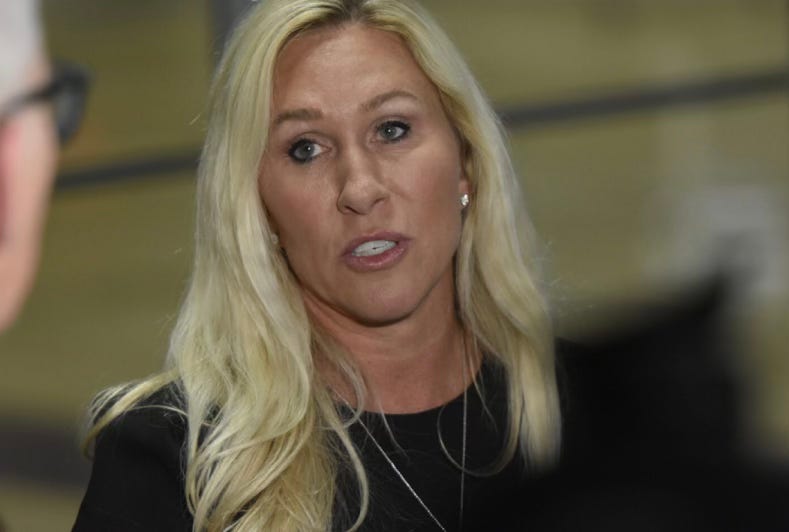
Earlier today, a report circulated describing remarks by Marjorie Taylor Greene in which she said Donald Trump privately warned her…that pushing for the release of the Epstein files would “hurt people,” specifically people he knows.
On its face…that might sound like just another ugly Trump–Greene rupture. It isn’t.
I want readers to understand upfront why I’m treating this as a signal…not a soundbite.
What matters here isn’t the feud…the personalities…or even Greene herself. It’s the instinct behind the warning…what it reveals about how power reacts when transparency moves from abstract principle…to real exposure.
This piece is about that instinct. About what powerful people fear most. And about why moments like this quietly tell us more about how the system actually works than months of speeches ever do.
Read the article with that frame in mind.
What Trump’s Warning to Greene Reveals About Power and the Epstein Files
The quiet admission that reputational damage matters more than justice
The Jack Hopkins Now Newsletter #707: Monday, December 29th, 2025
There are moments in politics when the mask doesn’t fall off all at once.
It slips…just enough for you to glimpse what’s underneath.
This was one of those moments.
According to Marjorie Taylor Greene, Donald Trump warned her in a private conversation that releasing the Epstein files would “hurt people.” Not enemies. Not political rivals.
His friends.
If that sentence made you pause…it should have.
Because buried inside it is an admission most powerful people never make out loud:
that the real danger of transparency isn’t injustice being exposed…it’s reputation being damaged.
And once you understand that…a lot of what hasn’t made sense suddenly does.
Why This Wasn’t Just an Offhand Comment
Trump didn’t say the files were false.
He didn’t say they were irrelevant.
He didn’t say the victims were mistaken.
He said they would hurt people he knows.
That’s not a legal argument.
That’s not even a political one.
That’s a protection instinct.
And it tells you exactly where the line is….the line that can’t be crossed without consequences.
Because in Washington, and in elite circles more broadly, there is an unspoken hierarchy:
Crimes can be reframed
Accusations can be delayed
Accountability can be negotiated
But reputational exposure is radioactive.
Once names are attached to documents…once patterns are visible…once the public can connect dots for themselves…control is gone.
That’s what Trump was reacting to.
Not truth.
Not justice.
Loss of control.
Why Greene’s Break Actually Matters
It would be easy to dismiss this as just another Trump–Greene feud.
That would be a mistake.
Greene didn’t just disagree with Trump. She crossed a boundary: she sided with forced transparency over voluntary loyalty.
And when she did, the reaction was immediate:
Anger
Personal condemnation
Attempts to delegitimize her motives
That’s not how movements react to harmless dissent.
That’s how systems react when someone threatens to pull back the curtain.
If you’ve ever wondered why so many politicians talk about accountability…but freeze when it comes time to name names…this is your answer.
Because accountability is abstract.
Transparency is personal.
The Part Most Coverage Is Missing
The most important detail in this story is not the Epstein files themselves.
It’s what Trump’s warning assumes:
That there are people close enough…exposed enough…and powerful enough that their reputations must be protected…even at the cost of public trust.
That assumption only exists if:
The circle is real
The exposure is plausible
And the fallout would be severe
You don’t warn people about imaginary danger.
You warn them when the threat is credible.
This Is the Pattern-Not the Exception
If this feels familiar, that’s because you’ve seen it before.
Whenever transparency threatens the wrong people:
The conversation shifts from justice to “timing”
From victims to “political consequences”
From truth to “what this would do to the country”
Those arguments always sound responsible.
They’re not.
They are the language of reputation management…not moral concern.
And once you learn to recognize that language…you start seeing it…everywhere.
Here’s the Part That Should Actually Make You Uncomfortable
Trump didn’t warn Greene that releasing the files would hurt the movement.
He warned her it would hurt his friends.
That distinction matters.
Because it tells you who is really being protected…and who never was.
If you’re still clinging to the idea that power resists transparency out of principle…this moment should disabuse you of it.
Power resists transparency because sunlight doesn’t just expose crimes…it redistributes leverage.
And leverage…once lost…doesn’t come back.
What Comes Next-And Why This Isn’t Over
This wasn’t a closing chapter.
It was a signal.
Signals like this tell you:
Where the pressure points are
What topics trigger defensive reflexes
And which stories will be delayed…diluted…or buried if possible
That doesn’t mean the truth won’t emerge.
It means it will be fought.
Quietly.
Procedurally.
Behind language that sounds reasonable…until you realize what it’s shielding.
Read This Carefully Before You Move On
If this story unsettled you…it’s because you just saw how power actually behaves when accountability gets close.
Not with denial.
Not with outrage.
But with warnings.
And once you’ve seen that…once you’ve heard the sentence that slipped through… you don’t get to unhear it.
This wasn’t a mistake.
It was a glimpse.
And it tells you far more about what matters in Washington than a hundred speeches ever could.
BONUS: The Most Important Thing Trump Didn’t Say
Everyone is fixated on what Trump warned about.
But the real tell is what he didn’t say.
He didn’t say:
“That’s not true.”
“Those files are nonsense.”
“They’ll clear a lot of people.”
Not even privately.
Think about that.
When someone is innocent…or confident that the truth exonerates them…their instinct is denial…dismissal…or ridicule.
When someone is afraid of what documents contain…their instinct is prevention.
That’s a different psychological posture entirely.
And once you recognize that posture…you can’t mistake it for anything else.
Here’s the “Holy Shit” Part
Trump didn’t try to argue Greene out of supporting transparency.
He tried to stop the process altogether.
That tells you something critical:
The danger isn’t how the Epstein files are interpreted.
The danger is that people will be allowed to read them at all.
Because once documents are public…narrative control is gone.
No spin.
No surrogate talking points.
No selective leaks.
Just records.
That’s the moment power loses its grip.
Why This Changes the Story You Thought You Were Reading
This isn’t a story about guilt or innocence.
It’s a story about who is allowed to see what.
And that’s a much more destabilizing question.
Because if transparency itself is the threat…then the system isn’t designed to protect justice…it’s designed to manage exposure.
That realization should make you stop.
Because it means the fight isn’t over what’s true.
It’s over…who gets to know.
One Last Reframe
If the Epstein files were harmless…no one would fear them.
If they were irrelevant…no one would resist them.
The resistance itself is the signal.
And once you start reading politics that way…not by what’s said…but by what’s blocked…you’ll never read another “controversy” the same way again.
#HoldFast
Back soon,
-Jack
Jack Hopkins
Trump didn’t just scold Greene — he warned her that exposing Epstein files would “hurt people he knows.” That’s not about justice — it’s a transparent defense of power, reputation, and protecting elites. When transparency threatens the powerful, they don’t deny truth — they try to bury it. #AccountabilityMatters
i also find it an interesting choice of hers to give the nytimes the interview. i think she knows that is the “newspaper” that trump respects the most. it felt intentional.