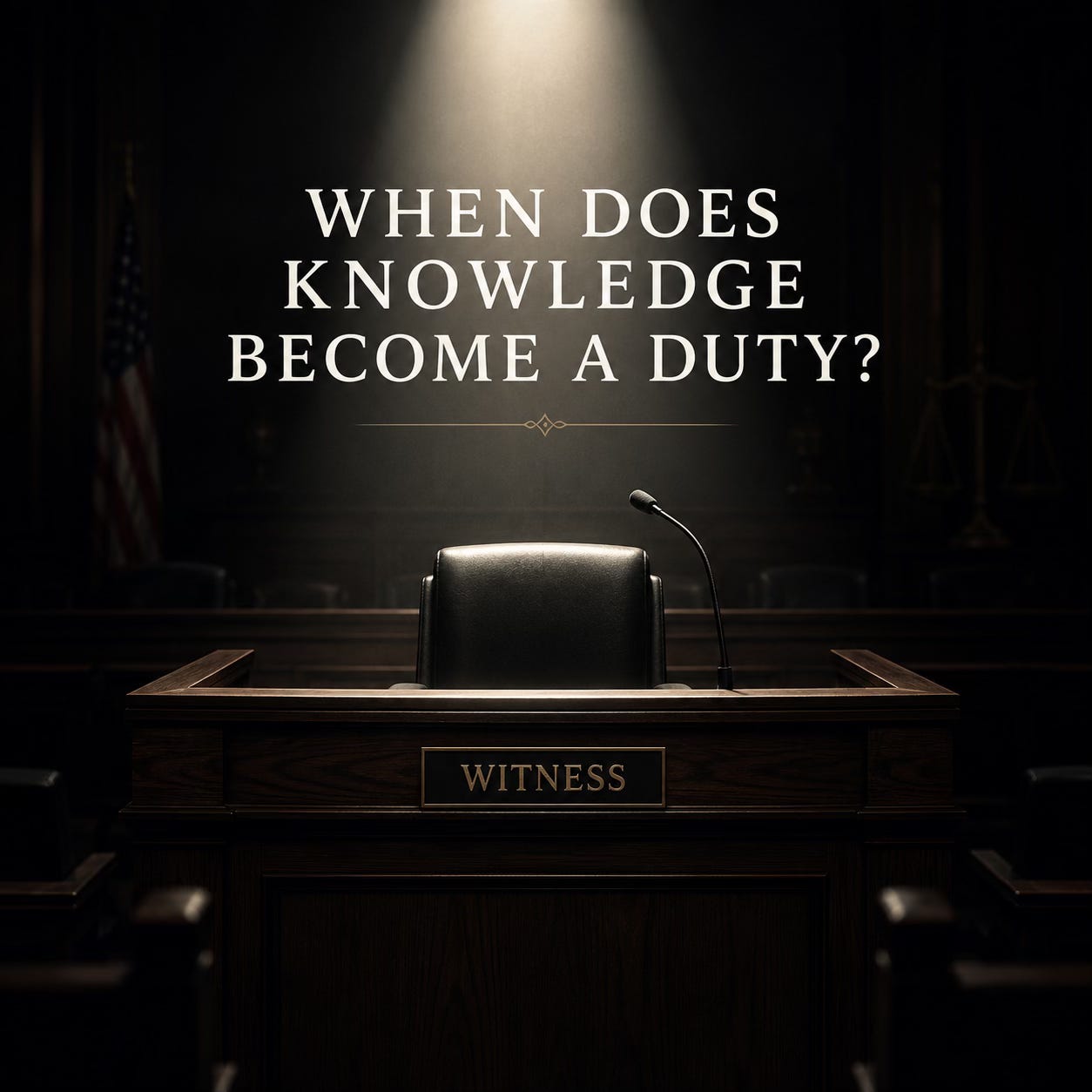
Victims Are Not Responsible for Achieving Justice. But They May Still Have a Duty to Help Make It Possible.
Author’s Note
I’ve never been particularly interested in writing about topics everyone already agrees on.
The subjects that interest me most are usually the controversial ones.
Not because controversy itself is valuable…but…because controversy is often where our thinking is tested most severely.
When people become highly emotional about a topic…and few subjects generate stronger emotions than crime…trauma…victimhood…justice…politics…religion…or identity…there is a natural human tendency to allow emotion to take the driver’s seat while logic…nuance…and analytical thinking are pushed into the back seat.
We’ve all done it.
I’ve done it.
You’ve done it.
Human beings are not naturally objective creatures when discussing subjects that trigger strong emotional reactions.
The problem is that very little useful thinking is produced when emotion becomes the sole lens…through which we examine difficult questions.
Strong emotions can help us identify that something matters.
They are often terrible…at helping us determine what is true.
That’s why I believe controversial topics deserve more discussion, not less.
Not because I expect everyone to agree.
Not because I think I have all the answers.
But because difficult questions rarely become easier when society collectively decides they are too uncomfortable to examine.
This particular topic is one I’ve intended to write about for quite some time.
Not because it is easy.
Not because it is popular.
And…certainly not because it is risk-free.
I wanted to write about it because I believe it has implications that extend far beyond the Epstein case itself.
At its core…this discussion is really about the messages we are sending to future generations of men and women.
It is about duty.
Responsibility.
Victimhood.
Agency.
Justice.
Accountability.
Compassion.
And…how those concepts interact when they inevitably come into conflict.
The framework we build today will not remain confined to one case…one scandal…or one generation.
It will influence how future men and women…think about their obligations to each other…their obligations to society…and their obligations to the pursuit of truth when difficult circumstances arise.
That is precisely why the conversation matters.
And it is also why so many people are reluctant to have it.
The moment a subject becomes emotionally charged…there is enormous pressure to choose a side…defend a tribe…repeat familiar slogans…and avoid asking questions that make people uncomfortable.
I have never found that approach particularly useful.
My goal here…is not to tell anyone what they must believe.
My goal is to examine an argument that many people have accepted without much scrutiny…and ask whether it holds up under closer examination.
You may ultimately agree with my conclusions.
You may reject them entirely.
Either outcome is fine.
But if this article encourages even a few people to think more carefully…more deeply… and more analytically…about a difficult issue…then it has served its purpose.
Because controversial questions are rarely settled by emotion alone.
And they are almost never improved by refusing to discuss them.
Victims Are Not Responsible for Achieving Justice. But They May Still Have a Duty to Help Make It Possible.
The Jack Hopkins Now Newsletter #928: Friday, June 12th, 2026.
There is a phrase that sounds compassionate, humane, and morally enlightened:
“The victims have done enough.”
In the case of Jeffrey Epstein’s victims…it is hard to argue with the emotional force behind that statement.
These women were abused.
Manipulated.
Exploited.
Many spent years being ignored…dismissed…attacked…or disbelieved.
Some…have already testified.
Some…have already spoken publicly.
Some…have already endured legal proceedings…media attention…and public scrutiny that most people cannot imagine.
If anyone has earned the right to say, “I don’t want to do this anymore,” it is them.
That much is obvious.
But…there is another claim…that often hides inside the first one.
A claim that receives far less scrutiny.
It goes something like this:
“The victims have done enough. Therefore they should not be expected to do anything further to help achieve accountability.”
That conclusion is far less obvious.
In fact…it may be deeply flawed.
Not because victims owe the public unlimited access to their pain.
Not because trauma is unimportant.
Not because survivors should be forced into endless cycles of testimony and retraumatization.
But…because it ignores a principle we accept almost everywhere else:
When people possess unique knowledge that may be necessary to stop wrongdoing or expose criminals…that knowledge can create moral responsibilities.
And victimhood…does not automatically erase those responsibilities.
That is the difficult truth many people want to avoid.
The Question Most People Are Actually Arguing About
Notice what this debate is not about.
It is not about whether victims deserve compassion.
They do.
It is not about whether victims deserve privacy.
They do.
It is not about whether victims deserve protection.
They do.
It is not about whether trauma is real.
It is.
The real question is much narrower.
The question is this:
If a victim possesses information that may be essential to exposing criminals… identifying accomplices…uncovering enablers…or preventing future harm…does that victim have any moral obligation to help make accountability possible?
Many people instinctively answer no.
But…that answer becomes surprisingly difficult to defend…once we move away from emotionally charged labels and examine the underlying principle.
Because the principle applies far beyond Epstein.
Imagine a person knows where a kidnapped child is being held.
Imagine a person witnessed a murder.
Imagine a person possesses documents proving a massive corruption scheme.
Imagine a person knows the identity of a serial predator who remains free.
Would we say that person has any obligation whatsoever to come forward?
Most people would say yes.
Why?
Because knowledge matters.
Because truth matters.
Because the ability to prevent harm matters.
Because people who possess information that nobody else possesses…often have responsibilities that others do not.
This principle is not controversial.
It is one of the foundations of civilization.
The controversy…emerges only when the person possessing the information…is also a victim.
And that…is where the discussion becomes morally complicated.
Victimhood Does Not Eliminate Moral Agency
One unintended consequence of modern discussions about trauma is that victims are sometimes treated as if they are no longer moral agents.
They become objects of sympathy.
Objects of concern.
Objects of protection.
But not fully functioning moral actors.
That is a mistake.
Victims are not fragile objects.
Victims are not merely recipients of compassion.
They are human beings with agency.
And agency…always includes both rights and responsibilities.
In fact, there is something oddly patronizing about the claim that victims…should never be expected to do difficult things.
The implication is that because they have suffered…they should no longer be regarded as capable of carrying moral obligations.
That is not respect.
That is a subtle form of diminishment.
A victim can deserve compassion…and still possess responsibilities.
A victim can deserve support…and still possess duties.
A victim can be harmed…and still be a citizen.
These ideas are not contradictory.
They coexist every day.
Victims testify in court.
Victims identify perpetrators.
Victims participate in investigations.
Victims submit evidence.
Victims cooperate with prosecutors.
Victims help expose wrongdoing.
And…society generally recognizes that these actions…while painful…serve an important public purpose.
The reason is simple.
Victimhood changes what can reasonably be demanded.
It does not necessarily eliminate all demands.
The Principle of Unique Knowledge
One of the strongest ethical arguments in favor of victim participation comes from a principle that philosophers, legal scholars, and ordinary people have recognized for centuries:
Unique knowledge creates unique responsibility.
If you know something important that nobody else knows…your responsibilities are different from those of everyone else.
A witness to a crime…has responsibilities that non-witnesses do not possess.
A doctor who discovers abuse…has responsibilities others do not possess.
A whistleblower who uncovers corruption…has responsibilities others do not possess.
Someone who knows where danger exists…has responsibilities others do not possess.
The reason is obvious.
Knowledge creates power.
And power…creates responsibility.
If a person possesses information capable of preventing harm…exposing wrongdoing…or protecting others…that information is not morally neutral.
The person now occupies a position that other people do not occupy.
This does not mean the person becomes responsible for everything that happens next.
But…it does mean…their choices carry consequences.
That is why silence is sometimes morally significant.
Not because speaking is easy.
But because remaining silent…may allow preventable harm to continue.
Now…apply that principle to a situation involving trafficking…sexual abuse… exploitation…or powerful offenders.
A victim may know names.
A victim may know locations.
A victim may know patterns.
A victim may know recruiters.
A victim may know facilitators.
A victim may know people who have never been publicly identified.
A victim may know facts that no document can reveal.
If those facts could materially contribute to accountability…then it becomes difficult to argue that no responsibility exists whatsoever.
The Problem With “They’ve Done Enough”
The phrase sounds compassionate because it focuses entirely on past suffering.
But accountability concerns both the past and the future.
The phrase asks:
“What has already happened to the victim?”
It rarely asks:
“What may happen if crucial information remains hidden?”
That distinction matters.
Because every accountability system depends on information.
Courts depend on information.
Investigators depend on information.
Journalists depend on information.
Prosecutors depend on information.
The public depends on information.
Without information…there is no accountability.
There is only speculation.
And when information remains hidden…powerful people benefit.
Not always.
But often.
History is filled with examples of predators…corrupt officials…criminal enterprises…and abusive institutions…surviving because the people who knew the truth remained silent.
Sometimes that silence was understandable.
Sometimes it was understandable and tragic.
But…the fact that silence is understandable…does not automatically make it morally neutral.
Those are different questions.
One concerns empathy.
The other concerns ethics.
Future Victims Matter Too
This is perhaps the strongest argument of all.
When discussions focus exclusively on current victims…they often ignore future victims.
Imagine that a survivor possesses information that could materially increase the likelihood of exposing an offender…accomplice…recruiter…or facilitator.
Now…imagine that information remains hidden.
What are the consequences?
The answer is not limited to the survivor.
Potential future victims are affected as well.
This is where the moral landscape changes.
Because now…the decision is no longer entirely private.
Other people have stakes in the outcome.
Future victims have interests.
Future families have interests.
Future communities have interests.
The public has interests.
This does not mean survivors must destroy themselves in pursuit of accountability.
No reasonable person should demand that.
But…it does mean the interests of future victims deserve consideration.
And once those interests enter the equation…the simplistic claim that victims have no remaining obligations becomes harder to sustain.
Compassion Is Not the Same Thing as Exemption
One of the biggest mistakes in this conversation is treating compassion and exemption as if they are identical.
They are not.
Compassion means understanding suffering.
Compassion means reducing unnecessary harm.
Compassion means offering support.
Compassion means providing protection.
Compassion means acknowledging trauma.
Exemption means removing responsibility.
Those are different concepts.
A person can deserve immense compassion…while still possessing responsibilities.
A firefighter may deserve compassion after suffering injury.
That does not eliminate every future duty.
A soldier may deserve compassion after experiencing trauma.
That does not eliminate every future responsibility.
A witness may deserve compassion after observing horrific events.
That does not eliminate every obligation to testify.
Likewise, a victim may deserve profound compassion…while still possessing some obligation to help expose serious wrongdoing.
The existence of suffering does not automatically eliminate responsibility.
If it did…many essential functions of justice would become impossible.
The Reciprocal Duty of Society
Of course, if society expects victims to help make justice possible, society incurs obligations of its own.
This point is crucial.
You cannot demand cooperation…while refusing protection.
You cannot request testimony…while abandoning people to harassment.
You cannot ask survivors to participate…while treating them as disposable.
If victims possess obligations…institutions possess obligations too.
Those obligations include:
Protecting privacy.
Providing security.
Offering legal support.
Using trauma-informed procedures.
Punishing intimidation.
Minimizing unnecessary exposure.
Ensuring that participation serves legitimate accountability goals rather than public spectacle.
The survivor’s obligation and society’s obligation are linked.
One cannot exist…without the other.
If we expect courage…we must provide protection.
If we expect participation…we must provide support.
If we expect accountability…we must build systems worthy of trust.
Accountability Is Impossible Without Witnesses
There is a reason criminals fear witnesses.
Witnesses transform rumors into facts.
Witnesses transform suspicions into evidence.
Witnesses transform allegations into cases.
Witnesses transform secrecy into accountability.
Powerful offenders understand this.
Predators understand this.
Corrupt institutions understand this.
The witness is often the bridge between wrongdoing and consequence.
This is especially true when the wrongdoing occurred behind closed doors.
Without witnesses…many crimes become nearly impossible to prove.
Without witnesses…denial flourishes.
Without witnesses…uncertainty grows.
Without witnesses…accountability collapses.
This reality is unfair.
It places enormous burdens on people who never asked for them.
But unfairness…does not change reality.
And reality is…that accountability often depends on people willing to bear witness.
The Better Standard
The strongest position is not that victims owe unlimited sacrifice.
That position is unreasonable.
The strongest position is not that victims owe nothing at all.
That position is equally problematic.
The strongest position lies in between.
It is this:
Victims are not responsible for achieving justice.
They are not responsible for fixing institutions.
They are not responsible for carrying the entire burden of accountability.
But…when they possess unique information that may be necessary to expose serious wrongdoing…prevent future harm…or hold dangerous people accountable…they may still possess a moral obligation to help make justice possible.
That obligation should be limited.
It should be reasonable.
It should account for trauma.
It should account for risk.
It should be accompanied by protection and support.
But it exists.
Because truth matters.
Because future victims matter.
Because accountability matters.
And…because the possession of unique knowledge…has always carried unique responsibilities.
The Hard Truth
The hard truth is that these two statements can both be true at the same time:
The victims have suffered enough.
And justice may still require something from them.
Those statements are not contradictory.
They are tragic.
A person can deserve peace…while still possessing responsibilities.
A person can deserve privacy…while still possess information that matters.
A person can deserve protection…while still be uniquely positioned to help expose the truth.
That reality is uncomfortable.
Most serious moral truths are.
But discomfort…is not an argument.
The question is not whether the burden is unfair.
It is.
The question…is whether the existence of unfairness…erases all responsibility.
And…the answer…in nearly every area of human life, is no.
The better principle is straightforward:
Victims are not responsible for achieving justice.
But when they possess unique information necessary for justice…they may still have a moral obligation to help make justice possible.
Not because society owns them.
Not because trauma does not matter.
Not because they caused the crime.
But because truth…accountability…and the protection of future victims…sometimes depend upon people who know things that nobody else knows.
And knowledge has always carried responsibilities.
Why Getting This Right Matters
This is not only about one case.
It is about the framework we leave behind.
Because the way we talk about this now will shape what future victims…future witnesses…future citizens…future prosecutors…future journalists…and future jurors believe justice requires of them.
If we get the framework wrong, we may teach future generations a very dangerous lesson.
We may teach them that suffering cancels responsibility.
We may teach them that if a person has already endured enough pain…the truth they carry no longer has any obligation attached to it.
We may teach them that compassion means releasing people not only from exploitation and cruelty…but from every difficult responsibility connected to accountability.
And if that becomes the lesson…then the people who commit horrible crimes will learn it too.
They will learn that silence can be manufactured through fear.
They will learn that delay can become protection.
They will learn that trauma can be turned into a shield.
They will learn that if they harm people deeply enough…intimidate them effectively enough…and exhaust them thoroughly enough…society may eventually decide that asking for the truth is too uncomfortable.
That cannot be the lesson.
The better lesson is harder…but far more necessary.
We should teach future men and women that victims are never responsible for the crimes committed against them.
We should teach them that survivors deserve protection…dignity…privacy…and care.
We should teach them that no one should be exploited…harassed…or forced to perform their trauma for public consumption.
But we should also teach them that truth still matters.
That justice still matters.
That future victims still matter.
That knowledge carries responsibility.
And that when a person possesses information that may be necessary to hold dangerous people accountable…helping make justice possible may be one of the most important moral duties they will ever face.
That is not an easy message.
But it is a mature one.
A society that cannot ask hard things of people with crucial knowledge will struggle to hold powerful criminals accountable.
A society that treats every painful obligation as cruelty…will eventually find itself unable to distinguish compassion from surrender.
And a society that allows emotion…to replace moral reasoning…will leave future victims less protected, not more.
This is why the distinction matters so much.
Victims are not responsible for achieving justice.
But…justice often cannot be achieved without people who know the truth being willing to help reveal it.
If we want future men and women to live in a world where horrible crimes are investigated…exposed…prosecuted…and punished…then we have to preserve that principle now.
We have to say, clearly and carefully:
Compassion is essential.
Protection is essential.
Support is essential.
But…accountability is essential too.
And when terrible crimes are committed…the truth cannot become optional simply because telling it is painful.
That is the framework worth defending.
Not because it is comfortable.
But because without it…justice becomes easier to demand than to deliver.
#HoldFast
Back soon.
-Jack
Jack Hopkins
P.S. Before you fire off an angry comment, ask yourself a simple question:
What part of the argument are you actually disagreeing with?
Am I saying victims caused the crimes committed against them? No.
Am I saying victims owe unlimited sacrifice to society? No.
Am I saying trauma is unimportant? No.
The argument is much narrower than that.
The argument is that when someone possesses unique information that may be necessary to expose criminals…identify accomplices…prevent future victims…or make accountability possible…that knowledge may carry responsibilities…even when the person holding it is also a victim.
If you disagree with that principle, that’s your right.
But…be careful.
Because the alternative principle is not merely one that applies to Epstein.
It applies everywhere.
It applies to corruption.
It applies to trafficking.
It applies to child abuse.
It applies to organized crime.
It applies to fraud.
It applies to every future case where the people who know the truth…are also the people who suffered from the wrongdoing.
The question isn’t whether this framework feels compassionate today.
The question is whether it still produces justice…tomorrow.
That’s the question I hope you’ll spend some time thinking about.


Great analysis. It struck a chord with me, as I have worked my whole life where I was a mandated reporter. It is not a comfortable position to be in. This is 4especially true when a student comes to you and there is a suspicion of abuse. The law states that you are legally obligated to report. The reporting is not the difficult part is the knowledge of what the victim will face. Protective services that are stretched thin, lack of meaningful support. Victims should absolutely come forward. It should be incumbent on our legal system not to further victimize them. It also becomes our moral duty to not to ignore the message they are telling us
I cannot imagine what happened to those victims, but I do know this. If someone did those awful things to me or to my family, I'd sure as hell want them to pay for the crime. And yes, I know that victims suffer all over again when they relive the abuse, but what about those who are still being abused? What if some of the earliest victims had spoken out? I don't know what the solution is, but I fear we will never see justice for them all.
