


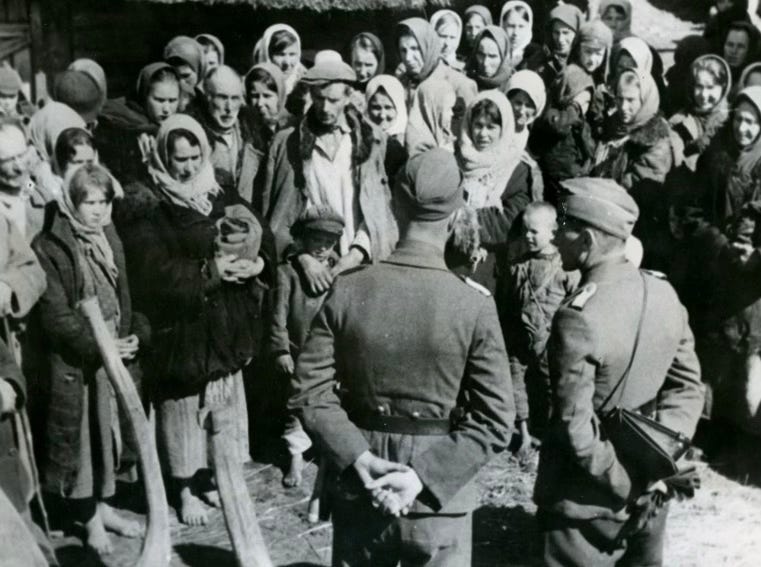
Two Gestapo. Forty villagers. The math only works if the villagers do the watching.
Trump Just Put a Price on Your Neighbor’s Head. It’s $30,000.
The new fraud.gov tip line pays citizens to inform. Germany tried this in 1938. The files still exist.
The Jack Hopkins Newsletter #1,061: Tuesday, October 20th, 2026.
Trump and Vance just put $25 million on the table to get you to report your neighbor.
Not a bank. Not a cartel. Not a hospital chain billing phantom patients. Your neighbor. The guy down the street with the lawn service and the new truck. The woman at church who got a disability check and still walked the dog. The daycare that had more kids on paper than you ever saw in the parking lot.
That is who a public tip line reaches. Big fraud gets caught by auditors, subpoenas and forensic accountants. Small fraud…or something that merely looks like fraud from across the fence…gets caught by a citizen with a grudge and a web form.
I want to be fair about what this actually is.
It is called the Fraud Whistleblower Incentive Program. WHIP, for short, and somebody in the White House was proud of that.
You go to fraud.gov, you file a tip…and if it leads to a conviction or what the Justice Department decides is a significant enforcement action…you can collect up to $30,000.
Trump described the math as a one percent commission on whatever fraud your tip uncovers. He also said that when two people claim credit for the same tip, he will personally decide who gets paid. His words from the Oval Office: he will be the arbitrator of all these decisions.
Sit with that for a second. The president of the United States…personally deciding which informant gets the check.
I am not against catching thieves. Nobody who pays taxes is. If someone stole from the Medicaid program that keeps my father in his home, I want them caught, and…I want the money back.
But…I have been doing this long enough to know that when a government stops asking its own investigators to find crime…and starts asking the public to find it for a cut of the take, something has changed. Not the crime. The relationship between the citizen…and the state.
And there is a well-documented place to look at where that road ends.
The Gestapo was tiny. The neighbors were not.
Here is the fact that surprises everyone the first time they hear it.
The Gestapo, the secret police of the Third Reich, was small. Historians who have gone through the surviving files put it at a few dozen officers for a city of hundreds of thousands.
Robert Gellately, who spent years in the records of Würzburg and Düsseldorf…found that the office covering Lower Franconia, a region of roughly a million people…never had more than about thirty officers at a time.
Thirty men cannot surveil a million people. They did not have to.
Gellately found that the majority of cases the Gestapo opened began…not with police work…but with a denunciation from an ordinary German. A neighbor. A coworker. A landlady. A spouse in a bad marriage.
The files are full of them: the tenant reported for listening to foreign radio…the competitor reported for a joke about the Führer, the husband turned in by a wife who wanted him gone.
The state did not need an army of spies. It needed a mailbox…and a reason for people to use it.
What was the reason? Sometimes ideology. More often…it was something smaller and more human. A business rival got removed. A debt got cancelled when the creditor was arrested. A promotion opened up. An apartment became available.
The regime made informing pay, in cash, in property, in favors, in the simple relief of being seen as loyal when loyalty was the only insurance anyone had.
And…the regime learned something the files make plain: most denunciations were about trivial things, and a good share were false. People reported what annoyed them and called it crime.
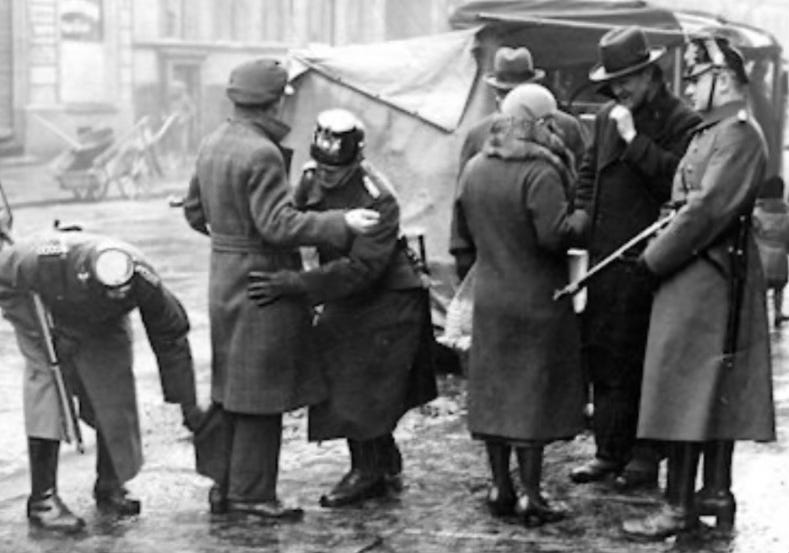
German police search civilians in the street, 1930s. The men doing the searching wore uniforms. The men who told them whom to search did not.
The Gestapo complained about it in internal memos. They still opened every file. A state that has invited its citizens to inform…cannot afford to be seen ignoring them.
It was never about the ideology. It was about the incentive.
I am not telling you Trump is Hitler or that Vance is running a secret police. That is lazy, and lazy arguments lose. The comparison that matters is not the men. It is the mechanism.
Strip the swastikas off the Gestapo files…and what you have is a business model.
The state wanted information it could not afford to collect.
It outsourced collection to the public. It paid in whatever currency the public valued. And…it got exactly what every commission-based operation gets: volume over quality…easy targets over hard ones…and a workforce that quickly figures out the system can be used to settle scores.
Now look at what was announced just about thirty-minutes after lunch today.
A pool of reward money. A public portal. A commission. A president who says he will settle disputes over who gets paid. A vice president who has said, on the record…that his fraud hunt will focus on states run by the other party.
And…at the event itself, a $10,000 check handed to an influencer whose video about Somali daycares in Minnesota started this whole thing. The first payout under the program went to a man with a camera…not a man with a ledger.
Every piece of that is an incentive…and incentives do not care about anyone’s intentions.
Think about who actually sits down and fills out that form. Not the CFO who knows where the bodies are buried. He has a lawyer and a confidentiality agreement.
It is the ex-wife. The fired employee. The neighbor who has watched someone’s life go better than his own…and finally has a government-approved way to do something about it.
Some of those tips will be real. Some will be revenge wearing the costume of civic duty. And…every one of them…will land on a desk inside an administration…that has told the country, in advance, which side it expects the fraud to be on.
That is not a crime-fighting program. That is a market, and markets deliver what they pay for.
What I would watch, and what I would do.
Here is how you will know whether this is a fraud program or an informant program. Watch three numbers.
First, the share of payouts that go to insiders versus bystanders.
Real whistleblower programs, the SEC’s and the IRS’s, pay mostly to people who were inside the operation. If this one pays mostly to people who were across the street, it is not catching fraud. It is harvesting grievances.
Second, the dismissal rate.
If eight out of ten tips go nowhere, you are looking at the Gestapo’s inbox: a pile of petty complaints the state has to pretend to take seriously.
Third, the map.
If the enforcement follows the political map more closely than the fraud data…you have your answer.
And what should you do? Do not become the guy with the web form. If you know of theft, firsthand, report it the way you would have last year. Do not report what you suspect because there is a check at the end of it.
The Germans who sent in those letters in 1938 mostly thought they were good citizens helping their country clean house. Most of them never saw a Gestapo officer in their lives. They did not need to. The state…had found something cheaper than police.
It had found them.
#HoldFast
Back soon.
-Jack
Jack Hopkins
P.S. The thing about the Gestapo files that stays with me isn’t the cruelty. It’s the handwriting. Thousands of letters, in careful script, from people who believed they were doing the right thing.
Nobody who filed one thought of himself as an informant. He thought of himself as a good citizen. That’s the part to remember the next time a government tells you there’s money in doing your civic duty. The word “informant” is never on the form. It only shows up in the history books.
P.P.S. I write these because somebody has to say it before it’s settled history, and I’d rather it be someone who doesn’t take a check from either side. That only works because readers like you keep the lights on. If this one was worth your time, you already know what to do, and I’m grateful either way.
Sources
Trump and Vance announce $25M whistleblower program to encourage public to report alleged fraud — Associated Press via WRAL, October 20, 2026. The $30,000 per-tip cap, the one percent commission, the Justice Department as administrator, and the “arbitrator” quote.
Trump and Vance announce $25M whistleblower program — Washington Post, October 20, 2026.
Live: Trump, Vance announce $25M program encouraging public to report fraud — NewsNation, October 20, 2026. The 1:30 p.m. EDT event time, the fraud.gov portal, and the $10,000 check to Nick Shirley.
Watch live: Trump, Vance announce Fraud Whistleblower Incentive Program — The Hill, October 20, 2026.
Trump launches anti-fraud task force to be led by Vance — AllSides, March 17, 2026. The executive order creating the task force.
Vance tapped as ‘fraud czar’ as Trump targets blue states over taxpayer theft — Fox News, April 2026. Trump’s statement that the effort would focus primarily on Democratic-run states.
Robert Gellately, The Gestapo and German Society: Enforcing Racial Policy 1933–1945 (Oxford: Clarendon Press, 1990). The Würzburg and Düsseldorf case files, the size of the Lower Franconia office, and the share of cases that began with civilian denunciations. Publisher listing · Review and summary, Institute of Historical Research
Dear Fraud Program;
I am anAmerican citizen and I would like to report fraud that one person has been creating. He has seized Venezuelan oil and we have no idea hwere the $ went, he has spent government dollars on his children's companies, his son in law negotiates with foreign dictators for his enrichment. I could go on but you get the point. Please arrest and imprison Donald Trump as soon as possible before he defrauds the country for more.
Thank you ver much.
Yours in Truth Telling,
Hoffman
PS His kids are in on the grift as well!
This is so NAZI, I can’t stand it! America is without any due respect now.