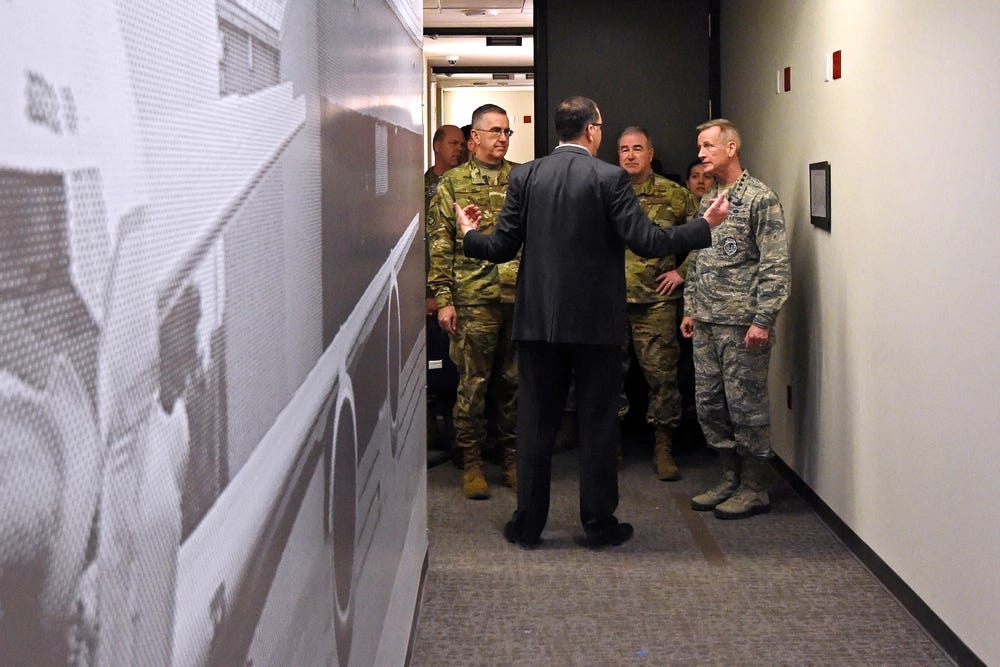
U.S. Strategic Command’s Command and Control Facility at Offutt Air Force Base, Nebraska–the nerve center of America’s nuclear command system. U.S. Air Force photo by Staff Sgt. Ian Hoachlander/DVIDS. Public domain.
They’re Trying to Make Nuclear War Sound Reasonable
The most dangerous word coming out of the Pentagon isn’t “nuclear.” It’s “limited.”
The Jack Hopkins Now Newsletter #1,012: Sunday, August 30th, 2026
Let me tell you how the unthinkable becomes thinkable.
You don’t announce it with sirens.
You don’t drag the president in front of the cameras and have him declare that America is preparing to launch a nuclear weapon.
That would frighten people.
That would wake them up.
Instead, you hold meetings.
You commission a review.
You invite military planners…policy experts and administration officials into rooms most Americans will never see.
And…then you begin using a harmless little word.
Options.
That is the word coming out of the Pentagon.
The Pentagon is reviewing America’s nuclear strategy…with the stated goal of giving the president more “options” during a war involving Russia or China.
Not more ways to avoid nuclear war.
Not more ways to stop escalation.
More ways to climb the ladder.
More ways to make the use of a nuclear weapon appear limited…proportionate…and “rational.”
That is not speculation.
Undersecretary of Defense for Policy Elbridge Colby…told attendees at a Strategic Command conference that the United States needs to provide the president and defense secretary with “credible, rational nuclear options.”
Read those three words again:
Rational nuclear options.
That phrase should bring a kind of clarity and focus in your mind that you rarely experience.
Because nuclear weapons…have helped prevent direct war between major powers for one fundamental reason: everybody understands that once the first one is used… nobody can confidently control what happens next.
The terror is the deterrent.
The insanity is the guardrail.
But…now…somebody is trying to sand the rough edges off insanity.
The Sales Pitch
Here is how they are selling it.
Russia and China possess smaller…lower-yield nuclear weapons designed for battlefield or regional use. If one of them uses a smaller nuclear weapon…the argument goes…the American president could be trapped between two terrible choices:
Do nothing.
Or…respond with a massive strategic weapon capable of killing hundreds of thousands of people and triggering an all-out nuclear exchange.
Therefore, the Pentagon wants more choices between surrender…and Armageddon.
Sounds reasonable, doesn’t it?
That is precisely what makes it so dangerous.
Because the moment you create a nuclear weapon that political leaders believe they can actually use…you have changed what that weapon is for.
It is no longer merely a deterrent.
It is now a battlefield instrument.
A tool.
An option on a menu.
The language does the laundering.
A nuclear weapon becomes “tactical.”
A nuclear exchange becomes “limited.”
Planning to cross the nuclear threshold becomes “escalation maneuver.”
And…the incineration of human beings becomes “employment.”
Nobody in these rooms says:
What if we vaporize a few thousand people and discover that the other side refuses to follow our carefully prepared script?
They say:
How do we preserve decision space?
That is how bureaucracies make horror…sound like management.
There Is No Small Nuclear War
A tactical nuclear weapon may carry a smaller explosive yield than the warheads designed to destroy entire cities.
That does not make it small.
It does not make it clean.
And…it sure as hell does not make it controllable.
The bomb dropped on Hiroshima…had an explosive yield of roughly 15 kilotons. It killed tens of thousands of people immediately…and many more from burns…injuries and radiation.
Today, Hiroshima is routinely described as a “small” nuclear weapon by comparison.
That is the trick being played here.
Small…compared with what?
The end of civilization?
Once a nuclear weapon is detonated in war…the enemy must decide what happened… who launched it…whether more are coming…and…whether its own nuclear forces are about to be destroyed.
And…it may have minutes to decide.
Not days.
Not hours.
Minutes.
The Pentagon may build a beautiful escalation ladder on paper. It may label every rung. It may assign probabilities…create response packages and rehearse every move.
But Russia…and China…are not required to climb that ladder according to our plan.
They have ladders of their own.
And…they have human beings making decisions under terror…confusion…incomplete information and unbearable time pressure.
One misread radar screen.
One severed communication line.
One commander believing he must launch…before his weapons are destroyed.
That is all it takes for “limited” to become everything.
This Is Not Just Routine Planning
Now, let’s be precise.
Military planners have considered nuclear scenarios for decades. Planning for a possibility does not mean the president has ordered it… approved it… or intends to do it.
This is not evidence that a launch is imminent.
But…that does not make this meaningless.
According to reporting about the review…and audio from the Strategic Command conference that was not publicly broadcast…the Pentagon is reconsidering nuclear-employment guidance and emphasizing additional regional options.
Strategic Command’s commander spoke openly about a spectrum running from non-kinetic capabilities…to conventional weapons…to a “limited nuclear exchange”…and then to higher escalation.
That is a policy vocabulary…being built…in real time.
And…once a government begins designing “usable” nuclear options…those options start exerting pressure of their own.
They require funding.
Weapons.
Delivery systems.
Training.
Deployment.
Doctrine.
War games.
Command procedures.
Eventually…thousands of people have careers…budgets and institutional reputations invested in making the option appear credible.
And…an option that nobody believes could ever be exercised…is not considered credible.
Do you see the trap?
To strengthen deterrence…they must convince the enemy that we might actually use the weapon.
To convince the enemy…they must convince themselves.
The Man Who May Receive These Options
There is another part of this story that cannot be separated from the rest.
These “options” are being prepared for the president.
Not an imaginary president.
Not some calm…disciplined…philosopher-king…who carefully absorbs conflicting intelligence…questions his own assumptions…and thinks six moves ahead.
Donald Trump.
A man who treats unpredictability…as strength.
A man who publicly threatens countries in the language of personal vengeance.
A man who believes domination…is the same thing as strategy.
The Pentagon’s answer…is to hand that man…additional nuclear choices…designed to look more usable…than the weapons already available to him.
They will tell us this gives him “flexibility.”
I would argue…that when the man holding the match is impulsive…the last thing you do is…give him a wider selection of gasoline.
Watch the Words
This is how nuclear war moves closer without anybody announcing that nuclear war has moved closer.
Not through one dramatic decision.
Through vocabulary.
Through reviews.
Through war games.
Through weapons described as smaller…cleaner…tactical…and proportional.
Through officials…assuring us that making nuclear weapons easier to use…will somehow make their use less likely.
Perhaps they believe that.
Perhaps they are right…that adversaries must believe America can answer nuclear escalation at every level.
But…history is filled with intelligent men…constructing systems they believed they could control…right up until the systems began controlling them.
So when you hear the words “limited nuclear exchange,” do not imagine something limited.
Imagine the first nuclear detonation since 1945.
Imagine the other side trying to determine whether it is the first strike of a larger attack.
Imagine commanders opening sealed plans.
Imagine submarines receiving coded messages.
Imagine presidents being told they have six minutes to decide.
Then…ask yourself the only question that matters:
What happens when the other side refuses to behave rationally inside our definition of rational?
The Pentagon says it wants to give the president more options.
That is supposed to make us feel safer.
It doesn’t.
Because for eighty years…the most important feature of nuclear weapons…was that using one was almost impossible to imagine.
Now…they are working on the imagination.
What to Watch Going Forward
Don’t wait for somebody to announce that America has adopted a more aggressive nuclear doctrine.
They probably won’t.
Watch what moves quietly through the machinery.
First, watch for the Pentagon’s revised nuclear-employment guidance.
Congress is legally entitled to receive a report before major changes are implemented…but…much of the actual guidance may remain classified.
Pay attention to which members of Congress demand hearings…and…which ones seem perfectly comfortable learning almost nothing.
Second…watch the budget.
Doctrine is talk until money begins moving.
Look for requests involving new tactical warheads…nuclear-capable cruise missiles… modified delivery systems…and the deployment of additional nuclear weapons closer to Russia or China.
Third…watch for a change in language.
“Flexible response.”
“Proportionate options.”
“Regional deterrence.”
“Escalation management.”
“Limited employment.”
Every one of those phrases can conceal the same idea: making the first American use of a nuclear weapon easier to contemplate.
Fourth…watch Europe and Asia.
If allies begin publicly questioning American nuclear policy…or…quietly resisting the deployment of new weapons on their territory…that will tell us they see something in the emerging strategy that frightens them.
Finally…watch for a manufactured sense of inevitability.
The most dangerous sentence will not be, “We have decided to use nuclear weapons.”
It will be:
“We have no other choice.”
By the time officials begin saying that…the choices may have been narrowed deliberately for months.
What Can You Do?
You cannot personally rewrite the Pentagon’s nuclear-employment guidance.
But…you can refuse to let this happen invisibly.
Call your senators and House member…and ask one specific question:
Will you demand public hearings on any change that expands the circumstances under which the United States might use a nuclear weapon first?
Don’t send a general message about peace.
Make them answer that question.
Ask whether they will require the administration to provide Congress with a clear explanation…of any new tactical nuclear weapons…delivery systems…or changes in first-use policy…before funding them.
Support organizations that investigate nuclear policy…track weapons spending…and translate classified-sounding jargon…into language ordinary people can understand.
And when you see the phrase “limited nuclear war,” challenge it.
Every time.
There is no such thing as a “limited nuclear war” for the people standing beneath the weapon.
There is no guarantee that the other nuclear power…will accept our definition of “limited.”
And…there is no laboratory in which these theories can be tested…before somebody bets civilization on them.
The first political battle is not over launching a weapon.
It is over whether the public…can be trained to think of launching one…as reasonable.
That battle has already begun.
#HoldFast
Back soon.
-Jack
Jack Hopkins
Sources
Primary reporting on the nuclear strategy review:
Pentagon drafting a new U.S. nuclear strategy in case of regional war with China or Russia — NBC News, August 5, 2026. The original story, sourced to five people familiar with the plans. Establishes that the classified effort is overseen by Elbridge Colby and would revise the nuclear-response options presented to the president during a crisis.
Pentagon wants ‘expanding options’ for nuclear weapons, officials say — Breaking Defense, August 7, 2026. Reported from an audio file of Colby’s remarks at the closed-door Strategic Command deterrence symposium in Omaha on August 5. Source of the “rational nuclear options” quote, and of Colby’s comment that what he fears more than a mass attack on the US is a regional war with local nuclear employment that escalates from there. Also covers Adm. Richard Correll’s press call, in which he said the department is looking at “expanding options” for the president and providing “decision space for any conceivable escalation scenario,” while emphasizing that declaratory policy has not changed.
Pentagon reviewing plans for low-level nuclear war — Washington Times, August 18, 2026. Colby describes the effort as “a review or sort of relook at the employment guidance,” conducted with Adm. Correll, covering the STRATCOM commander’s responsibilities, Secretary Hegseth’s authorities, and presidential guidance. Also the best source for the hardware specifics: the W76-2 8-kiloton warhead on Trident II submarine-launched missiles, the adjustable-yield B61-12 gravity bomb, and the Long-Range Standoff cruise missile.


To our misfortune, the ones considering this are not our best experts.
In an episode of the TV series “24”, a nuclear bomb was detonated in rural California. The hero, Jack, survived, from a distance, hiding behind a rock (or so as I recall). A quickly forgotten plot device used by script writers but, evidently, influential enough that such a scenario is today seriously being considered by real people in real life. More than likely, Trump and Hegseth will drop a nuclear bomb on a remote island or isolated land in Asia. Then they’ll declare it a warning. Ha! By sunup the next day, a similar warning will come from (you name it) somewhere in North America. Boy, will Trump be mad! Fun times ahead.
