


They Just Cancelled Your Disaster Insurance. Nobody Sent You the Letter.
What FEMA’s boss told 50 state emergency chiefs behind closed doors Tuesday–and why you’ll pay for it the next time the river comes up.
The Jack Hopkins Now Newsletter #1,063: Thursday, October 22st, 2026.
I’m going to tell you something that happened in a hotel conference room in Little Rock, Arkansas, on Tuesday. You weren’t invited. Your governor’s disaster chief was. And what he heard should make you pick up the phone.
The administrator of FEMA, Cameron Hamilton, stood in front of the National Emergency Management Association and told every state in the room, in plain words: build your own financial reserves, build your own recovery capability, and plan to handle most disasters without federal help.
His stated goal is fewer federal disaster declarations. Not fewer disasters. Fewer declarations.
Fewer checks.
He said the changes could start within six months. He did not hold a press conference. POLITICO obtained a recording. That is how this is meant to be done: quietly…after the election…with no fingerprints.
Here’s why this matters to you…not to Washington…not to “the states,” to you, sitting in your house with a mortgage on it.
When the water comes, who pays?
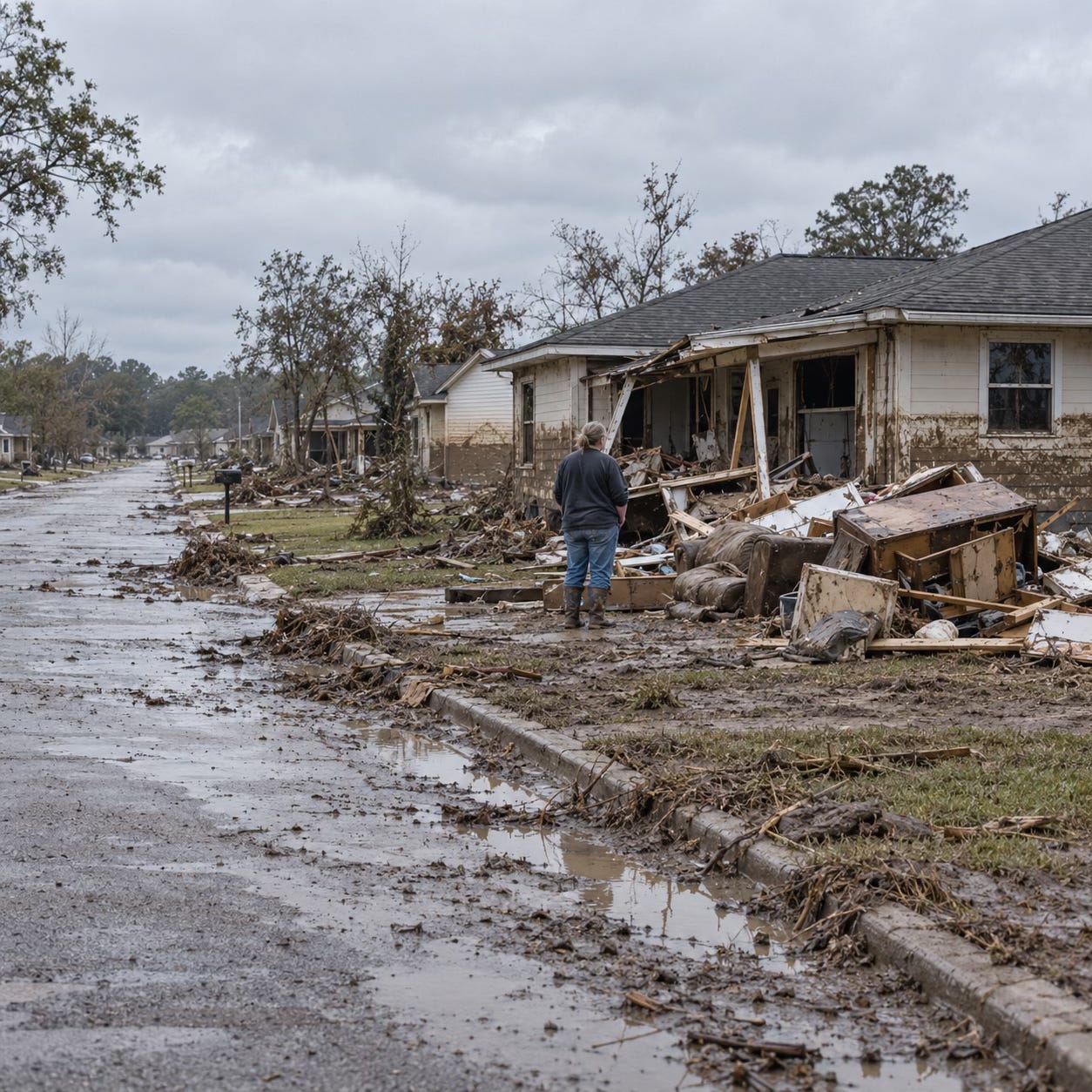
Right now, when a hurricane, flood, tornado, or wildfire wrecks your county, the president signs a declaration and federal money starts flowing.
It is slow. It is bureaucratic. It is also the only reason most states can rebuild at all.
FEMA’s own report…released last Friday, by Hamilton’s own agency…says state disaster offices are typically understaffed and underfunded, and many of them run on federal money.
So the plan, in one sentence: hand the job to the people FEMA just certified cannot do the job.
Four reasons this is a bill with your name on it
1. “Financial reserves” means your money.
Your state legislature has to park hundreds of millions of dollars for a disaster that may not come for ten years.
There are exactly three ways to get that money: raise your taxes, cut your schools and roads and Medicaid, or don’t do it and rebuild slower, worse, or never.
Eric Holdeman, who ran emergency management for King County, Washington, put key words in all caps on LinkedIn…states with slim rainy-day funds have no way to replace lost federal money without raising taxes. He also called the plan impossible to implement. He’s spent a career in this. Believe him.
2. “National mutual aid” is a slogan, not a plan.
Hamilton wants states to rescue each other. That works fine for a tornado in one county. It is a joke for the kind of disaster that actually needs a federal government… a hurricane that hits Louisiana, Mississippi, and Alabama on the same afternoon. Who’s bailing out whom?
3. “Waiving environmental reviews” means you rebuild in the floodplain.
Hamilton wants to strip the environmental and historical-preservation checks on FEMA-funded rebuilding. Yes, you’ll rebuild faster. You’ll flood again faster too…and next time…there’s no federal check.
4. The president keeps the pen.
This is the part nobody in Little Rock wanted to say out loud. A disaster declaration is a presidential decision. Hamilton can’t change that. So after every state has been told to fend for itself…but the president still decides who gets a declaration…what do you have?
Discretion. The governor who plays ball gets the money. The governor who doesn’t gets a speech about self-reliance. Both outcomes are now “policy.” Disaster aid stops being a program and becomes a favor.
Does this look familiar? It should.
You watched the same architecture get unveiled in the Oval Office this week. A federal fraud tip line. Cash rewards. And a president who says he personally decides who gets paid.
Fraud money…one man decides. Disaster money…one man decides. This is not “smaller government.” This is government where help flows to whoever the man at the top likes.
“But they haven’t changed anything yet.”
Correct. No formal announcement. Aid is still being approved for storms. Hamilton said “the next six months.”
Count the months. Six months lands you comfortably past the midterms. The memo went out October 15. The speech was October 20. The election is in less than two weeks. The rollout is after.
Ask yourself one question: if this policy were popular, wouldn’t they be running ads on it?
They know what they’re doing. They’re betting you won’t find out until the water is in your living room.
Here’s what I want you to do. Today.
Not next week. Today, while this is fresh and before the six-month clock runs out.
First:
Forward this to three people in a state that gets hit…Florida, Texas, North Carolina, Oklahoma, California, anywhere a river or a coast or a fault line runs. They are the ones who will pay first…and most of them have no idea this conversation happened.
Second:
Call your governor’s office and ask one question: What is this state’s disaster reserve, and what is your plan if the federal declaration doesn’t come? You will learn a lot from how long the silence lasts.
Third:
If you want this kind of reporting on the things they do in private rooms, every day, before it hits you…subscribe.
I read the memos, the leaks, and the recordings so you don’t have to, and I tell you what they mean for your wallet, your vote, and your house.
The next disaster doesn’t care who you voted for. Apparently…the federal response is about to.
10 Questions the Article Doesn’t Answer
1. Can FEMA actually do this without Congress?
Only partway. The Stafford Act gives the president discretion to grant or deny a major disaster declaration, so “fewer declarations” is achievable by executive choice alone.
But the aid programs themselves…Public Assistance, Individual Assistance, Hazard Mitigation…are written into law, with a federal cost share (normally 75% federal, 25% state/local) that Congress sets. Hamilton can’t change the formula; he can only make the trigger harder to pull.
Watch for a push to raise the per-capita damage threshold that determines whether a state “qualifies” …that’s the lever the FEMA Review Council recommended, and it’s where this gets done quietly.
2. Doesn’t “mutual aid” between states already exist?
Yes. The Emergency Management Assistance Compact (EMAC) has let states share crews, equipment, and personnel since the 1990s, and it’s ratified by all 50 states.
What EMAC does not do is move money for rebuilding. “National mutual aid” as Hamilton describes it is either a rebrand of EMAC or an attempt to stretch a personnel-sharing system into a financial one. The article doesn’t say which, and neither did Hamilton.
3. How much would a state actually need in reserves?
Nobody has put a number on it, which is the tell. For scale: a single major hurricane can generate billions in federal Public Assistance obligations for one state.
Most state rainy-day funds are sized for recessions, not catastrophes, and many are legally restricted to budget shortfalls…a governor can’t just raid them for debris removal. Expect states to ask for a required figure…and expect the administration not to give one.
4. What about the counties and towns, not the states?
This is the hole in the plan. FEMA’s own October study surveyed local agencies and found them typically understaffed and underfunded…the quote everyone’s citing is about local offices.
A state with a healthy reserve still has to get money down to a county with a two-person emergency office. The plan says “state-led.” It says nothing about how a rural county gets its bridges back.
5. Hasn’t the administration already been denying aid to some states?
There’s data on this. A POLITICO analysis published in March found Democratic-led states had roughly 23% of their disaster funding requests approved compared to about 89% for Republican-led states.
Sen. Gary Peters raised that figure at Hamilton’s confirmation hearing; Hamilton denied a red-state/blue-state split. The point: discretionary declarations are not a hypothetical future risk. There’s a track record.
6. Didn’t Trump try to abolish FEMA outright? What happened?
He said in January 2025 he’d recommend FEMA “go away.” Hamilton himself, then acting administrator, told Congress in May 2025 that eliminating FEMA wasn’t in the best interest of the American people... and was pushed out the next day.
He was later nominated and confirmed as the permanent administrator in 2026. The abolition plan became a “review council,” the council recommended shifting costs to states…and now…the man who once warned against gutting FEMA…is implementing the softer version. That arc is a story in itself.
7. What happens to homeowners, not just governments?
Individual Assistance…the grants that go directly to people for temporary housing and repairs…is also tied to the presidential declaration. No declaration, no IA.
Hamilton’s remarks were about state capacity; nothing in them addresses what replaces direct aid to families.
Private flood insurance is scarce…the National Flood Insurance Program is still federal…and homeowners’ policies generally exclude flooding. Fewer declarations means more uninsured households absorbing losses alone.
8. Is FEMA even staffed to “build state capacity”?
A GAO audit in August found FEMA cut its workforce through 2025–26 without assessing mission needs…roughly 17% of its workforce gone in a single year.
An agency that’s shed its experienced people is now promising to mentor 50 states.
Also worth noting: BRIC, the main pre-disaster mitigation grant program…the very thing “reducing risk” would run through…was cancelled in 2025. Some funds were later restored under court pressure..but…the pipeline was broken.
9. Who’s actually in favor of this, besides the White House?
Some Republican governors and county officials have long complained that FEMA is slow and bureaucratic…and there’s a real bipartisan constituency for faster…simpler aid. Hamilton’s speed argument isn’t invented.
The split is over who pays…not whether the process stinks. The National Association of Counties has warned that Review Council-style changes would hit small and rural counties hardest…and those are overwhelmingly red.
10. What should readers watch for in the next six months?
Four signals.
One: a Federal Register notice or policy memo raising the damage threshold for declarations.
Two: the first high-profile denial of a declaration to a state that plainly qualifies under current standards.
Three: a formal “national mutual aid” framework with no funding attached.
Four: the administration’s budget request for FY2028…due early next year…if “capacity building” is real…there’s a line item. If it isn’t…there’s a speech.
VOTE.
#HoldFast
Back soon.
-Jack
Jack Hopkins
P.S. Trump wanted to abolish FEMA outright at the start of this term. Republican governors in hurricane states shouted him down. So FEMA isn’t being abolished.
It’s being hollowed…a grant office that preaches self-reliance while the president keeps the one power that counts: deciding who gets rescued.
You will not see that on a bumper sticker. You’ll see it the first time a Category 4 hits a state that voted the wrong way…and the declaration takes three extra weeks for reasons nobody will put in writing. Forward this now.
Sources
POLITICO (via Yahoo News): “FEMA tells states to handle disasters on their own” — Thomas Frank, Oct. 20, 2026 — Hamilton’s Little Rock remarks, the Oct. 15 memo, the six-month timeline, and Eric Holdeman’s LinkedIn response
FEMA press release: “First-of-its-Kind Study Provides Insights into Challenges Facing Emergency Management Agencies” — Oct. 16, 2026 — the agency’s own report finding emergency management agencies are typically understaffed and underfunded
WKYT: “First-of-its-kind FEMA-funded study highlights funding, staffing challenges” — Oct. 20, 2026 — 73% of state EM directors report insufficient staff, 70% report lack of funding
Yahoo News: “FEMA Chief Urges States: Build Reserves Amid WH Push for Aid Changes” — Oct. 20, 2026 — background on FEMA staffing cuts, the Argonne study’s scope, and Trump’s earlier calls to phase out FEMA
GAO-26-108427: “FEMA Workforce: Staff Reductions and Lack of Planning May Impact Mission Readiness” — Aug. 2026 — independent audit of FEMA’s 2025–26 workforce cuts
Denver Gazette: “Trump’s current FEMA leader says agency should not be eliminated” — May 2025 — Trump’s “FEMA go away” remark and Hamilton’s earlier testimony against abolishing the agency
The Hill: “Trump launches $25 million whistleblower incentive program” — Oct. 20, 2026 — Trump saying he’ll be sole arbiter of fraud payouts, referenced in the “same architecture” section
Forbes: “Trump Suggests Huge Potential Payouts For Americans Reporting Fraud” — Oct. 20, 2026 — the $30,000 vs. “no limit” discrepancy
Why are we required to pay Federal taxes if we aren’t getting anything for it? well, aside from a ballroom, an arch, the conversion of the reflecting pool into a swamp, and bands of armed thugs roaming the streets kidnapping and killing people.
I can tell you one price tag from Hurricane Harvey in Texas, 1.6 Billion dollars in Direct Housing Assistance. In addition to this were funds for Public Assistance and Hazard Mitigation efforts.
I know because I was there.
States are not capable to carry these burdens by themselves, it would tax residents into oblivion.
My two cents....
#HoldFast and #VoteBlue