


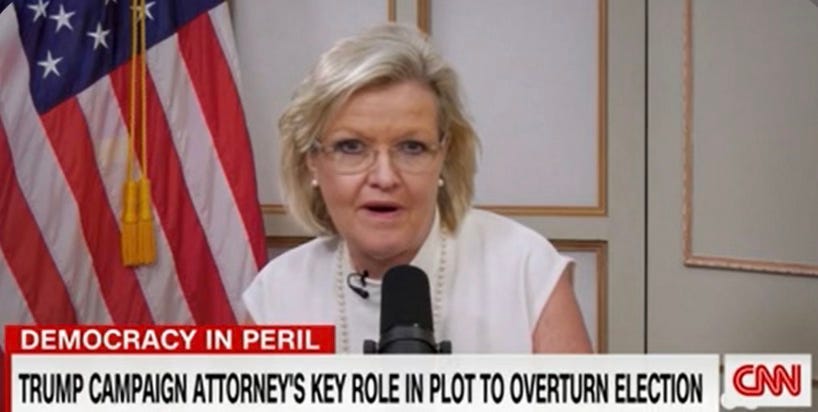
Cleta Mitchell, 2023: "Bring me the proof." Three years later, nobody has. The plan now is to skip that step.
They Couldn't Prove the Machines Were Rigged. So They're Going to Take Them.
How a lawyer with no evidence and a clerk with a nine-year sentence are pitching Howard Lutnick on the midterms.
The Jack Hopkins Now Newsletter #1,049: Wednesday, October 7th, 2026.
Marc Elias dropped this on X Wednesday afternoon: GOP lawyer Cleta Mitchell and convicted ex-clerk Tina Peters are pushing a plan to have Commerce Secretary Howard Lutnick seize voting machines ahead of the midterms.
Read that again. Not “audit.” Not “inspect.” Seize.
I’ve spent my career in the influence business, and I tell every client the same thing: I don’t care how the problem sounds. I care what’s in the file. So let’s do what nobody on cable will do tonight. Let’s open the file.
Meet the sales team
Cleta Mitchell is the Republican election lawyer who was on the line when Trump asked Georgia’s secretary of state to “find” the votes in January 2021.
Two years later, at an RNC donor retreat…she was recorded admitting she never saw evidence of Dominion machine fraud in Georgia….which is exactly why she left the machines out of her lawsuit. Her words to the room: “Bring me the proof. I’m a lawyer.”
Hold onto that line. It is the entire damn case.
Tina Peters is the former Mesa County, Colorado clerk who let an unauthorized outsider into a secure update of her county’s voting system in 2021…trying to prove the 2020 election was rigged.
A jury convicted her on seven counts. A judge gave her nine years…and told her from the bench…that her lies were well documented. Her own experts…never showed the machines did anything wrong.
So…the two people now selling “the machines are compromised” are (a) the lawyer who admitted on tape she had no proof, and (b) the clerk who went to prison trying to manufacture some.
In business, that’s not a sales team. That’s a warning label.
How the scheme actually works
Here’s the mechanism, and it’s clever the way bad ideas usually are.
Commerce has authority to screen technology supply chains for foreign national-security risks.
The pitch: declare the components inside voting machines a foreign-adversary threat…and the Secretary can effectively pull them from service…without a single state legislature, court, or election board voting on it.
This isn’t hypothetical.
Reuters reported in May…that Trump’s election-security adviser, Kurt Olsen, asked Commerce last year to declare Dominion components national-security risks.
Those machines are used in more than half the states. Commerce staff actually went looking for legal grounds. The effort stalled for one reason: Olsen’s team never produced evidence to justify it.
CNN has since reported…that administration allies are still pressuring Lutnick to act on voting machines before November…on precisely that theory…and that his team drafted the postal rules election officials now say they can’t implement in time.
A Commerce spokesperson says Lutnick never engaged on election-integrity issues. Note what that is: a denial about a meeting…not a denial about the plan.
Now the names attached to the push are Mitchell and Peters. Same product…new sales reps.
Three things that tell you this is a con
I’ve spent enough years watching men sell bad ideas to good people to know the pattern cold. This is a pitch. Here’s how you read it.
1. Watch the verb.
Every con sells with big, foggy verbs: “secure,” “protect,” “restore confidence.” Bad outcomes hide inside them. “Seize” is the honest verb here…and…it’s the one they’d never put in the press release.
When the verb in the private memo….doesn’t match the verb in the public statement… the private memo is what you’re actually buying.
2. Urgency without evidence is manipulation.
When a man can’t prove his claim, he manufactures a deadline. “Before the midterms” is the deadline.
The proof is the thing Mitchell asked for in 2023 and…by every public account…still doesn’t have. Three years. A friendly administration. Unlimited subpoena power. Still nothing. Nobody who has the goods needs you to hurry.
3. Follow who gets paid.
Not always in money. In power. Who decides which machines are “safe”? Who certifies replacements five weeks out from an election? Who benefits when a county can’t count on time and the result gets disputed? A pitch that never names its beneficiary is hiding him on purpose.
Any one of these should stop you cold. This one trips all three.
The other side’s best argument, and why it doesn’t hold
Fair is fair.
The strongest case for the plan goes like this: voting equipment is critical infrastructure…foreign supply chains are a real concern…and Commerce already screens routers…telecom gear…and chips for exactly this.
If there’s a risk, somebody should have the authority to act before voters are harmed, not after.
I’d take that argument seriously. I’d take it tomorrow…if the people pushing it had ever produced the risk.
They haven’t. Reuters’ sources say the Olsen effort collapsed on the evidence question. A Colorado jury…with sworn witnesses and cross-examination…found Peters’ claims didn’t hold.
Mitchell said on tape she had nothing. Every room that requires proof has returned the same verdict.
A national-security power invoked on a claim no court has ever credited isn’t security. It’s a pretext with a letterhead.
And the timing gives it away: a real supply-chain finding gets made in February…with a replacement plan attached. A political one…gets made in October with none.
What you do with this
Doing nothing is a decision. Here’s the alternative, and it takes twenty minutes.
Call your county clerk or state election director.
Ask one question: “If federal action targets our equipment before November, what’s the contingency?” If they don’t have an answer, you just gave them a reason to get one.
Forward this to five people who vote in a county that uses Dominion.
That’s more than half the states. The scheme depends on nobody noticing until it’s done.
Follow the reporters…not the pundits.
Reuters and CNN broke the Commerce angle. Elias flagged the names. Pay attention to who keeps the receipts.
I don’t ask you to trust me. I ask you to do what I’d do with any pitch that lands on my desk: check the verb…check the deadline…check who gets paid. Then decide.
#HoldFast
Back soon.
-Jack
Jack Hopkins
Remember, Jack’s got your back.
P.S. The next time anyone tells you the machines are rigged, ask one question: what changed since the day Cleta Mitchell said “bring me the proof”? If the only honest answer is “the midterms,” you already have yours.
Sources
Marc E. Elias on X (@marceelias) — the October 7, 2026 post reporting the Mitchell/Peters push
Reuters: Trump official tried to ban voting machines used by half of U.S. (via Global News) — Kurt Olsen’s request that Commerce declare Dominion components a national-security risk
CNN reporting on Lutnick and the midterms (via Raw Story) — pressure on Lutnick to act on voting machines; Commerce’s role in the postal rules
AJC: Top Trump lawyer never saw proof of Dominion fraud claims (via Election Law Blog) — Cleta Mitchell’s recorded “bring me the proof” remarks at the 2023 RNC retreat
NPR/KUNC: Former Colorado county clerk sentenced to prison — Tina Peters’ conviction and nine-year sentence
Inquirer/AP: Tina Peters sentenced to 9 years — sentencing details
I am AMAZED at how much top quality journalism comes out of ONE person. You've been working your ass off & you are WEARING ME OUT! Keep it up & I'll have to hire staff to read it all.❤️
Dear Jack,
I read this several times and I think I will take a different approach this time. You asked who benefits. I'd like to add a few questions, since nobody in this plan seems to have asked who owns the machines.
Whose Machines Are They, Anyway?
Cleta Mitchell asked for proof in 2023, and by every public account nobody has produced it. So the plan is to skip the proof and send a federal official after the equipment. I have read that sentence about ten times now, and it still sounds like satire.
Jack asked the right questions, so I'll answer them. Who decides which machines are safe? Under this plan, one Cabinet secretary, using a supply chain statute written to screen routers and telecom gear. Who certifies the replacements five weeks out? Nobody, because there is no replacement plan. Who benefits when a county can't count on time and the result lands in dispute? Anyone who needed a disputed result in the first place. That answers the question Jack closed on, too. Between "bring me the proof" and today, the only thing that changed is the calendar.
Now I have a few of my own, and they go to the people who own this problem.
Who owns the machines? Counties and states bought them, leased them, or contracted for them, and the answer varies by jurisdiction. Does Washington hold title to a single one? If not, on what authority does it pull them?
Who runs elections in this country? The Constitution hands that job to the states, with Congress allowed to adjust the rules. I do not see a Commerce Department in that sentence. Has any state attorney general been asked whether a federal declaration can override a county's lawful equipment?
Who certifies voting systems? There is already a federal process through the Election Assistance Commission, with testing and public record. Why would anyone bypass it in October?
Who pays? A county election office in a rural state runs on a budget that wouldn't cover the secretary's lunch. Who writes the check for new equipment, the training, the logic and accuracy testing, and the poll workers who have to learn a new system in a few weeks?
Who has the chain of custody? If equipment is pulled from service, what happens to the ballots, the memory cards, and the logs? Who is liable if something goes missing in federal hands?
Who has a contingency plan? Every secretary of state and county clerk in a Dominion state should be able to answer that this week. If your governor or election director can't, pick up the phone and ask why.
Notice that every one of those questions is boring. They are about titles, budgets, statutes, and paperwork. That is what real election administration looks like. The fraud story always lives in the thrilling version, with the midnight ballots and the secret software, and the thrilling version has lost in every courtroom where somebody had to swear to it. The people pushing it now have found a duller route, a regulatory one, because the exciting route keeps getting them laughed out of court.
I want the supply chain risk examined if it exists. Bring it to the states, bring it with evidence, bring it with a replacement plan, and bring it in February. A security finding that arrives in October with no evidence and no plan is a pretext, and anyone paying attention can read it.
So read it. Call your county clerk. Call your secretary of state. Ask who owns the machines, who answers for them, and what happens if somebody in Washington decides to take them.
If the answer is "we hadn't thought about it," you just found the real vulnerability.
#HOLDFAST