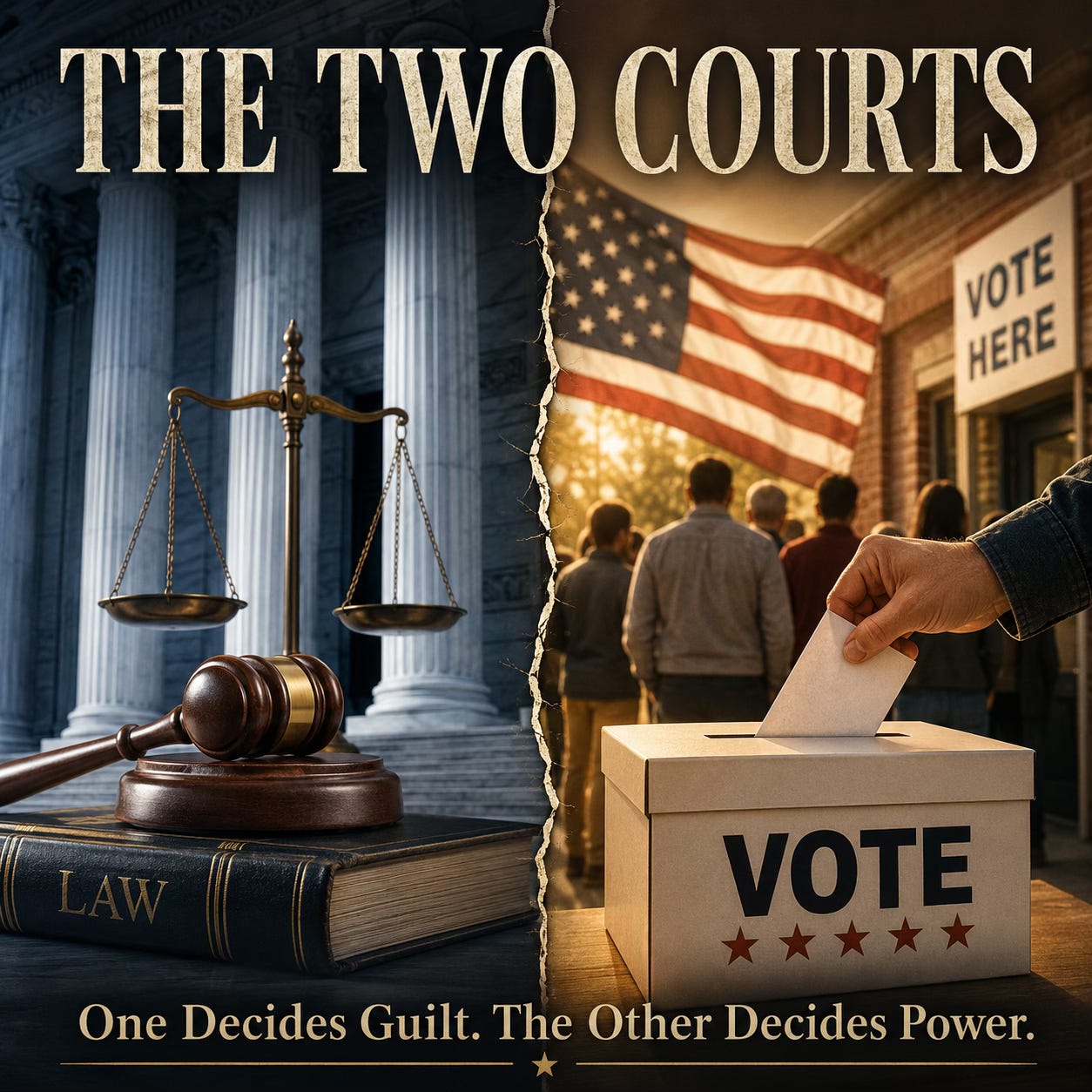
The Two Courts Every Candidate Faces...And Only One Decides Who Gets Power
The Constitution decides guilt. Voters decide power. Confusing the two changes everything.
The Two Courts Every Candidate Faces...And Only One Decides Who Gets Power
The Constitution decides guilt. Voters decide power. Confusing the two changes everything.
The Jack Hopkins Now Newsletter #960: Tuesday, July 7th, 2026
Every election season, someone says it.
“Innocent until proven guilty.”
They’re right.
In a courtroom.
They’re wrong…if they’re talking about politics.
That distinction isn’t just important. It’s everything.
Because I keep hearing people insist that Democrats are somehow being hypocritical if they conclude a candidate’s political career is over after credible allegations surface…even before a criminal conviction.
No.
They’re recognizing the reality of politics.
Politics Runs on Trust, Not Verdicts
The Constitution gives every American the presumption of innocence in criminal court.
It does not guarantee anyone the presidency.
Or a Senate seat.
Or a Cabinet position.
Or the confidence of millions of voters.
Those are positions of trust.
Trust has a much lower threshold than criminal guilt.
Always has.
A CEO can lose a company over allegations.
A military officer can lose a security clearance.
A minister can lose a congregation.
A candidate can lose an election.
None of those require a criminal conviction.
They require lost confidence.
And confidence…is exactly what elections are about.
Democrats Didn’t Suddenly Invent This Standard
I’ve seen people argue that Democrats are “eating their own.”
History says otherwise.
Democrats have repeatedly pressured members of their own party to resign or withdraw after allegations involving sexual misconduct or ethical misconduct…from Al Franken to Andrew Cuomo…from Katie Hill to Eric Schneiderman.
Whether you agreed with those decisions…or not…the pattern is clear: many Democratic leaders concluded the political damage itself had become disqualifying.
Even today, we’re watching it happen again.
Within hours of allegations against Democratic Senate candidate Graham Platner becoming public…prominent Democratic senators…organizations…and the Maine Democratic Party…publicly urged him to withdraw because they believed the accusations had made the race unwinnable.
Notice what happened.
Most weren’t claiming a jury had spoken.
They were acknowledging that voters would.
Republicans Aren’t Immune Either
The idea that only Democrats react this way isn’t true either.
Some Republicans have spent years criticizing Donald Trump’s conduct.
Some left the party.
Others endorsed Democrats.
Still others…continue supporting conservative policies while openly condemning Trump’s behavior.
They’re a minority inside today’s Republican Party.
But…they exist.
And they’re still outraged.
Polling consistently shows Trump’s support among Republicans remains strong…but that doesn’t erase the existence of Republicans who believe his conduct has crossed ethical or legal lines.
This Isn’t About Whether Trump Is Guilty
Here’s the part people often miss.
You don’t have to prove every allegation beyond a reasonable doubt to understand its political consequences.
Politics isn’t asking:
“Did this happen beyond all reasonable doubt?”
It’s asking:
“Do enough voters believe it happened…or believe the candidate exercised poor judgment…that they no longer trust that person with power?”
Those are entirely different questions.
One is legal.
The other is electoral.
Confusing the two…creates endless bad arguments.
Perception Is a Political Fact
One of the hardest truths I’ve learned watching politics is this:
Facts matter.
But perceptions…often matter more.
You can hate that.
I hate it.
But…pretending otherwise…doesn’t change reality.
Campaign professionals know this better than anyone.
That’s why opposition research exists.
That’s why campaigns spend millions defining opponents before opponents define themselves.
That’s why allegation…whether ultimately proven or disproven…can instantly reshape an election.
Because elections are decided by human beings.
And human beings vote based on what they believe.
Not what a jury might someday conclude.
The Double Standard People Argue About
Now comes the uncomfortable part.
Many Democrats believe their own party applies stricter standards to its candidates than Republicans currently apply to theirs.
Whether that’s wise or politically self-defeating is a legitimate debate.
Reasonable people disagree.
But…it is not evidence that Democrats suddenly forgot about due process.
It reflects a different calculation:
“Can this candidate still earn enough public trust to win?”
That’s a political question…not a legal one.
The Wrong Argument
When someone says,
“He’s innocent until proven guilty.”
My answer is simple.
Yes.
Legally.
Absolutely.
Protect that principle with everything we’ve got.
But…don’t confuse a constitutional protection with a campaign strategy.
No voter is required to suspend judgment until after years of investigations, appeals, and possible trials.
No political party is required to nominate someone the public no longer trusts.
And no election…has ever been decided inside a courtroom. (Okay, maybe 2000)
They’re decided in the court of public opinion.
Fairly or unfairly.
That’s the system we’ve always had.
Ignoring that reality doesn’t protect democracy.
It just guarantees…you’ll be surprised by the outcome.
#HoldFast
Back soon.
-Jack
Jack Hopkins
P.S. If you’re trying to understand American politics through the lens of legal standards…you’re going to miss what actually moves elections. Politics is powered by trust, emotion, perception, and narrative. The law decides guilt. Voters decide power. Those are two very different courts…and confusing them is one of the biggest mistakes people make.
Sources
The receipts, so you can check my work—primary reporting first, plain-language references for the history:
The Platner withdrawal calls (the case study happening right now)
Top Democrats call on Graham Platner to drop out as sexual assault allegation emerges — CBS News, July 6, 2026, including the Schumer/Gillibrand joint statement and the DSCC’s refusal to invest if he stays
Democrats begin pulling Platner endorsements — PBS News/AP, documenting Khanna, Gallego, Warren, DNC chair Ken Martin, and Maine party leadership
Democrats call on Platner to step down as he denies sexual assault allegation — Roll Call, with the Maine Democratic Party’s full statement and the July 13 replacement deadline under Maine law
Maine Senate candidate Platner urged to drop out — The Hill, including Senate Majority PAC’s decision to redirect resources
Graham Platner denies sex assault claim as Democrats urge him to quit — CNBC, with Platner’s denial and his “reflect on the best path forward” statement
Note the language throughout those statements: “lost the trust,” “can defeat Susan Collins,” “a candidate who can earn voters’ trust.” Not one demands a verdict first. That’s the article’s thesis, written by the party itself in real time.
The historical pattern (Democrats applying the political standard to their own)
Al Franken’s resignation — resigned January 2018 after allegations and pressure from Democratic colleagues, without any legal proceeding
Andrew Cuomo’s resignation — resigned August 2021 following the state attorney general’s report; no criminal conviction
Katie Hill’s resignation — resigned October 2019 amid an ethics inquiry
Eric Schneiderman’s resignation — resigned as New York AG within hours of the New Yorker’s report, May 2018
The legal principle itself
Presumption of innocence — Cornell Law School Legal Information Institute — what the standard actually is and where it applies: criminal proceedings, not employment, elections, or public trust
Trust-based removal outside politics (the CEO/officer/minister parallel)
Security clearance adjudicative guidelines — clearances are revoked on the “whole person” trust standard, no conviction required
Corporate examples are legion; McDonald’s firing of CEO Steve Easterbrook (2019, no charges ever filed) is the cleanest illustration


You really boiled it down to the bare essence of the arguments against Platner, or any candidate. Perception is everything! Those that consume an exclusive diet of right wing punditry may, to this day, not be aware of Trump's statement about women, his grift and that of his family, his Epstein connections, the list is endless. Their perception of Trump is far more positive then people that balance their news consumption. Perception wins in the court of public opinion. Platner, Swalwell, and whoever else stands accused deserve their day in court. They do not necessarily deserve to ask us for our trust. #Holdfast
GREAT WRITING!