


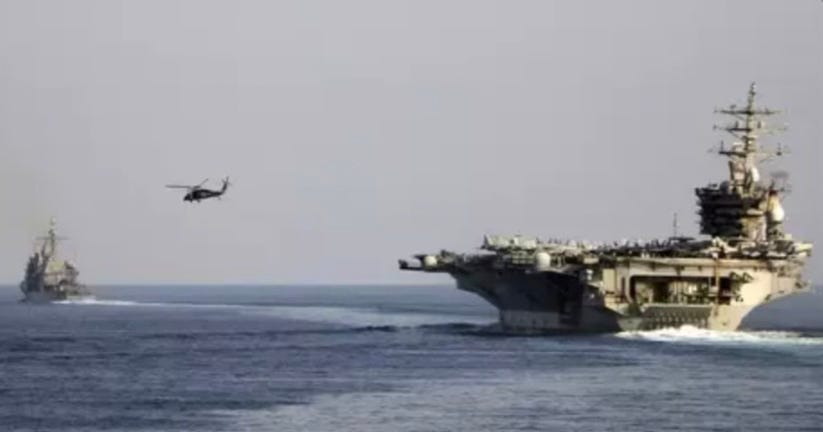
The Strait Is Being Quietly Militarized In Ways The Public Still Doesn’t Understand
What intelligence officials, shipping insurers, military planners, and energy markets appear to understand…that most television coverage is still barely discussing.
The Jack Hopkins Now Newsletter, Paid Expansion #892: Thursday, May 7th, 2026.
The public conversation about the Strait of Hormuz is still operating several layers behind reality.
Most television coverage remains trapped inside a simplistic framework:
Did America “win”?
Did Iran “lose”?
Is the ceasefire “holding”?
Is the Strait “open”?
But the systems closest to actual risk…are behaving as though something much more dangerous is unfolding underneath the surface.
And…once you begin connecting the pieces together…the picture becomes far more serious than the public narrative suggests.
Because the real story is not whether Iran can defeat the United States conventionally.
It cannot.
The real story is whether Iran still retains enough asymmetric capability to trigger cascading systemic consequences that nobody fully controls once they begin.
And based on the behavior of military systems…insurers…intelligence assessments, and shipping markets…
The answer increasingly appears to be yes.
The Most Dangerous Word In Modern Geopolitics: “Manageable”
One of the quiet assumptions driving current Western policy appears to be this:
That Hormuz instability can remain controlled.
Managed.
Contained.
Limited.
But…history is filled with crises…that leaders initially believed were manageable…right until cascading systems started interacting with each other.
And the Strait of Hormuz is one of the most systemically sensitive chokepoints on Earth.
This is not merely about ships.
Hormuz connects directly into:
Global energy pricing
Insurance markets
Derivatives exposure
Shipping timelines
Food transport
Manufacturing chains
Military logistics
Sovereign debt stress
Inflation expectations
Political stability
That means relatively small operational disruptions…can create disproportionately large secondary consequences.
And that is exactly the kind of pressure asymmetric doctrine is designed to exploit.
The Public Still Does Not Understand Iran’s Real Leverage
Most Americans continue imagining naval power in World War II terms.
Aircraft carriers.
Battleships.
Fleet destruction.
But modern asymmetric maritime pressure…works differently.
Iran’s leverage does not depend on defeating the U.S. Navy.
It depends…on raising uncertainty…faster than global systems can comfortably absorb it.
That is a completely different objective.
And according to current reporting, intelligence assessments still indicate Iran retains:
Large drone inventories
Missile capability
Decentralized asymmetric naval assets
Proxy integration capacity
Dispersed launch infrastructure
Gray-zone operational capability
That matters because modern global systems are extraordinarily sensitive to uncertainty.
One successful strike against a major tanker…
One mining event…
One mass casualty shipping incident…
One temporary insurance withdrawal…
Could trigger massive secondary consequences far beyond the physical damage itself.
And behind closed doors…many institutional actors appear to understand that.
