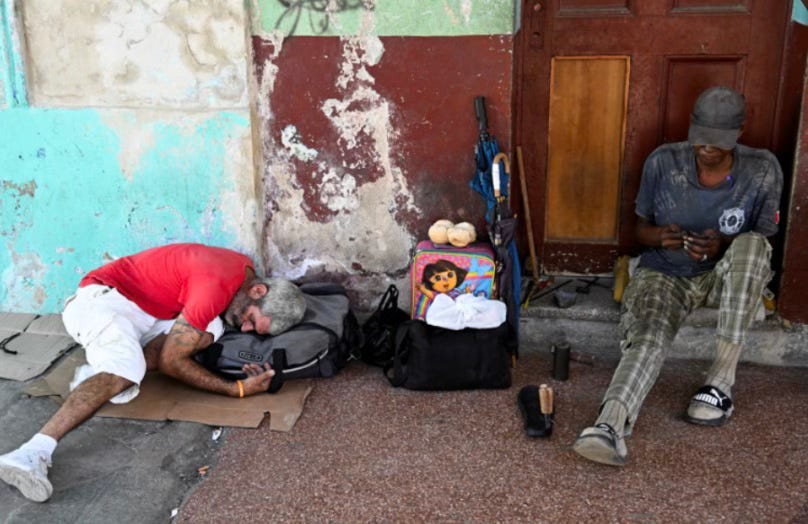
The Slow Strangling of Cuba (And Why Americans Who Care About Democracy Should Be Paying Attention)
The Jack Hopkins Now Newsletter #795: Wednesday, February 25th, 2026.
There is a fantasy many Americans like to tell themselves about sanctions.
It goes like this:
We’re not hurting the people. We’re pressuring the regime.
It sounds clean. Surgical. Strategic.
It isn’t.
What is happening in Cuba right now is not a surgical strike on power. It is a slow, grinding choke on daily life…electricity, fuel, food, medicine…and the people absorbing that impact are not party elites.
They are families.
And if you care about democracy…real democracy, not slogan democracy…you need to understand exactly what is being done in your name.
The New Pressure Strategy: Not Symbolic… Structural
Recent U.S. policy has tightened the vise in three critical ways:
Aggressive fuel targeting: discouraging or penalizing third countries that supply oil to Cuba.
Expanded transaction restrictions: making banks, shipping companies, insurers, and intermediaries too nervous to touch anything connected to Cuba.
Enforcement actions against oil shipments linked to Venezuela and Cuba: signaling that the risk is real, not theoretical.
This isn’t rhetorical pressure. It’s logistical warfare.
When you target oil flows to an island economy, you are not “sending a message.”
You are flipping switches.
And the lights go out.
What That Looks Like on the Ground
Let’s strip away ideology and talk mechanics.
When fuel is scarce:
Power plants cannot operate reliably.
Blackouts multiply.
Water pumping systems fail intermittently.
Refrigeration collapses.
Transportation systems stall.
Hospitals ration energy.
Food rots before it reaches markets.
Electricity is not a luxury in a modern society. It is the circulatory system.
Cuba is experiencing rolling blackouts that stretch for hours at a time. That means spoiled food. It means elevators stuck. It means small businesses shutting doors. It means insulin losing potency in warm refrigerators.
Fuel shortages ripple outward:
Public buses reduce service.
Farmers struggle to transport crops.
Ambulances face delays.
Garbage collection falters.
Airlines are warned that jet fuel may not be available.
This is not abstract. It is daily life under constraint.
Now here’s the uncomfortable truth:
The Cuban leadership is not standing in grocery lines.
The Myth That Sanctions Empower Democracy
There is a persistent belief in Washington that economic pain creates political reform.
History suggests something very different.
Broad-based economic pressure in authoritarian systems tends to:
Strengthen hardliners.
Provide the regime with a permanent external enemy.
Justify repression as “national defense.”
Push citizens into survival mode instead of civic engagement.
Democracy does not bloom when people are preoccupied with keeping food from spoiling during blackouts.
It shrinks.
Because civic action requires bandwidth.
And sanctions are bandwidth destroyers.
Why This Should Matter to Americans Who Care About Democracy
You might be thinking:
“This is foreign policy. It’s complicated.”
It’s not that complicated.
When a democratic government deploys tools that predictably create humanitarian strain, two questions become unavoidable:
Is the policy achieving its stated political objective?
Is the collateral damage consistent with democratic values?
Right now, the evidence suggests:
The Cuban government remains in power.
The Cuban people are experiencing worsening hardship.
International aid is being mobilized to fill gaps created by fuel scarcity.
The regime has fresh propaganda material blaming the United States.
That is not a strategic victory. It is a reputational one…and not in our favor.
Democracy is not just about elections at home. It is about the ethical architecture of power.
If we claim moral leadership…globally…while knowingly engineering policies that restrict electricity, water access, and medical reliability for millions of civilians, credibility erodes.
And credibility is a strategic asset.
The Quiet Cost: Migration Pressure
There is another dimension Americans ignore at their peril.
Economic destabilization does not stay contained.
When daily life becomes unpredictable…when food systems strain and infrastructure falters…migration increases.
That pressure lands at borders.
Which then fuels domestic political crisis.
Which then gets weaponized in election cycles.
So…the same policy that is supposed to demonstrate strength abroad…can boomerang into instability at home.
That is not a partisan observation.
It is a systems observation.
The Ethical Tension We Don’t Want to Admit
Sanctions are politically convenient.
They create the appearance of action…without the risk of boots on the ground.
They signal toughness.
They satisfy domestic constituencies.
But they allow policymakers to outsource pain.
The public rarely sees:
The parent trying to keep medicine cold during rolling outages.
The hospital administrator rationing generator hours.
The small shop owner watching inventory spoil.
The farmer unable to move produce due to fuel rationing.
Democracy requires citizens to understand cause and effect.
When fuel flows are constricted…infrastructure fails.
When infrastructure fails…human stress rises.
When human stress rises…authoritarian narratives strengthen.
The Strategic Question No One Wants to Ask
If the objective is regime change or reform, where is the evidence that this approach works?
Decades of embargo history suggest durability of leadership…not collapse.
If the objective is deterrence…what exactly is being deterred?
If the objective is punishment…then we should at least be honest that punishment is being distributed widely.
A democratic society does not get to claim innocence…simply because the suffering happens offshore.
Why This Is a Democracy Issue and Not Just a Cuba Issue
There is a deeper principle at stake.
When the United States uses economic instruments…that have predictable humanitarian spillover…the American public has a responsibility to scrutinize outcomes, not slogans.
Because democracy without scrutiny…becomes branding.
And…branding…without accountability…becomes power theater.
You can believe the Cuban government is repressive.
You can believe sanctions are justified.
But…you cannot look at fuel targeting and blackouts…and claim civilian impact is incidental.
It is structural.
The Information Gap Is the Real Danger
Most Americans are unaware of the mechanics.
They hear “sanctions” and think “pressure on leaders.”
They do not think:
Electricity grids,
Food distribution chains,
Medical refrigeration,
Aviation fuel supply.
But…that is where the policy lands.
Democracy weakens when citizens are shielded from the downstream effects of their government’s actions.
And…democracy strengthens when citizens demand clarity.
What Responsible Citizenship Looks Like
This is not a call for reflexive opposition.
It is a call for serious inquiry.
If you care about democracy:
Demand outcome data.
Demand humanitarian impact assessments.
Demand transparency about goals versus results.
Demand debate…not reflexive applause.
A democracy worthy of the name…does not operate on autopilot punishment.
It measures.
It recalibrates.
It admits…when tools create more instability…than reform.
The Uncomfortable Conclusion
The current U.S. pressure strategy on Cuba is intensifying fuel scarcity.
Fuel scarcity is intensifying blackouts.
Blackouts are intensifying strain on food, water, transport, and health systems.
And…that strain is borne by civilians.
You can support pressure.
You can oppose pressure.
But…you cannot pretend the pressure is abstract.
It is concrete.
It hums…or fails to hum…in generators.
It flickers in apartment lights.
It sits unrefrigerated in pharmacies.
And…if Americans who claim to care about democracy are unwilling to examine policies that create predictable civilian hardship…then the word “democracy” becomes a marketing line rather than a principle.
Foreign policy is not separate from democratic character.
It reveals it.
The question…is whether we are willing to look.
#HoldFast
Back soon.
-Jack
Jack Hopkins
Facts & Receipts: Reported Hardships in Cuba (2025–2026)
Below is a documented snapshot of conditions reported by international media and U.N. sources.
1. Blackouts Lasting Up to 18 Hours
A U.N. Special Rapporteur reported in November 2025 that Cubans were experiencing blackouts lasting up to 18 hours per day, citing infrastructure strain and difficulty obtaining spare parts and fuel.
Associated Press reporting in early 2026 described the crisis as among the most severe fuel shortages and power blackouts in years, with national events postponed due to electricity shortages.
Additional AP-distributed reporting noted outages lasting up to 10 hours at a time for many residents.
2. Water Access Reduced to Once Every Several Days…or Worse
The same U.N. preliminary findings reported that some communities receive clean water only once every several days…and in some cases once every 30 days.
Fuel shortages have limited the ability to operate water-pumping systems and tanker deliveries.
3. Transportation System Strain and Fuel Lines
Reuters reporting (via El País) described “massive blackouts and a collapsed transportation system” amid deepening fuel shortages.
Residents reported waiting 12–15 hours…and in one case 26 hours…to purchase 40 liters of gasoline.
Fuel was reported to be sold exclusively in dollars, with strict caps per buyer.
4. Aviation Fuel Shortage and Flight Disruptions
Cuba issued notices warning that jet fuel would not be available at nine airports, including Havana, beginning February 2026 through March 11.
Airlines responded by suspending flights, rerouting aircraft, or adding refueling stopovers in other countries.
Air Canada suspended certain routes, and other carriers adjusted schedules.
5. Healthcare System Under Severe Stress
An AP report in February 2026 stated that Cuban officials warned the health system was being pushed toward collapse.
Reports cited ambulances struggling to obtain fuel and hospitals operating under persistent electricity interruptions.
Officials said 5 million people with chronic illnesses could see treatments affected, including:
16,000 cancer patients requiring radiotherapy
12,400 patients undergoing chemotherapy
6. 69% of Medicines Reported Unavailable
The U.N. Special Rapporteur reported a “widespread inaccessibility of 69% of medicines,” including treatments for:
Cancer
Heart disease
Infectious diseases such as dengue
Lack of reagents, spare parts, and equipment has disrupted domestic pharmaceutical production and medical diagnostics.
7. Food Insecurity and International Aid
On February 25, 2026, AP reported that Canada committed C$8 million (US$6.7 million) in food aid, delivered through U.N. agencies rather than the Cuban government.
Canadian travel advisories have warned for more than a year of widespread shortages of food, medicine, and fuel across much of the island.
8. Emergency Measures Affecting Daily Life
Reports cited:
Reduced bank hours
Suspension of cultural events
Conservation measures in tourism, including closing some hotels and relocating guests to save electricity
Gasoline sales restricted to foreign currency with tight per-person limits
Sources / Further Reading
https://www.ohchr.org/sites/default/files/statements/20251121-eom-stm-cuba-sr-negative-impact-unilateral-en.pdf
https://apnews.com/article/cuba-cigars-us-blackouts-embargo-a244cacc499be0c29e1b905ed811436b
https://apnews.com/article/9a39a7a29744aca40edab10f15663652
https://english.elpais.com/international/2026-02-06/cubas-growing-fuel-shortages-this-feels-apocalyptic.html
https://www.gulfcoastnewsnow.com/article/cuba-jet-fuel-shortage-airlines/70292926
https://abcnews.com/Health/wireStory/cubas-health-care-system-pushed-brink-us-fuel-130351270
https://apnews.com/article/canada-cuba-aid-embargo-5a85ec96af31c787b51c0f8b9720f968


@Jack, thank you for writing about this. It's truly being underreported.
It is almost like a trial run for us here in the US. It reads of what he is having ice do to people. I have never know anyone so hateful in my life. I only read about this kind of hate with dictators in other countries growing up but this has that same feel . It is all trickle down affect. This regime in the white house reeks of hatred.
Teri
