


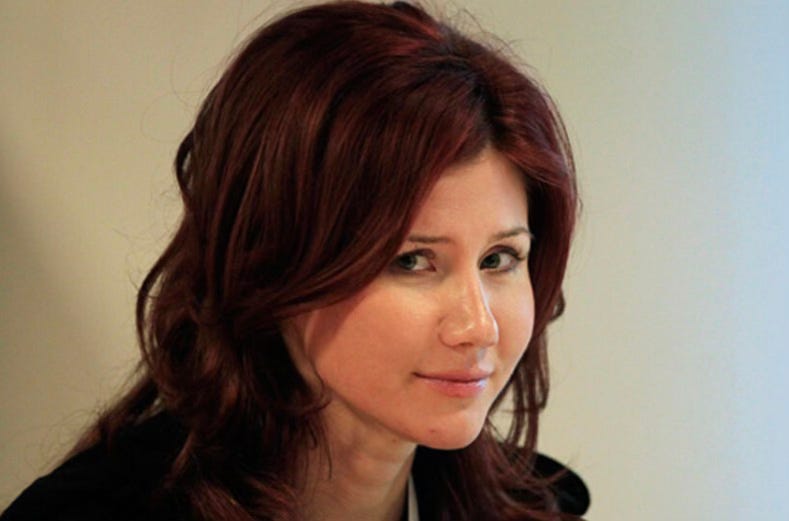
Anna Chapman, arrested in 2010 as part of a Russian “Illegals” ring that had operated in the U.S. for a decade. The FBI caught her because a counterintelligence squad spent years watching.
The Russian Spies Are Still Here. The Spy-Catchers Aren’t.
Inside the quiet gutting of America’s counterintelligence– and what Russia is doing with the opening.
The Jack Hopkins Now Newsletter #1,067: Tuesday, October 27th, 2026.
Somewhere in Washington tonight, a Russian intelligence officer will be sleeping better than he has in years.
Not because he got smarter. Not because his tradecraft improved. Because the man who used to sit across the street watching him... got reassigned.
Here’s a disturbing fact: in many of the FBI’s 56 field offices…the counterintelligence squads…the people whose entire job is catching foreign spies…are running at 50 to 60 percent staffing. Some offices have cut their spy-hunting squads in half.
That’s not a rumor. That’s five people familiar with the matter, on the record with NPR, three weeks ago.
Now put that next to this: the last FBI director to speak plainly about it, Christopher Wray, said the number of Russian intelligence officers (spies) inside the United States was “way too big.” He said it in 2023, before the cuts.
So do the math. Same number of spies. Half the number of spy-catchers.
What do you suppose happens next?
The quiet gutting nobody announced
Here’s what makes this story dangerous: nobody signed an order.
There was no memo from Director Kash Patel saying “stop hunting spies.” If there had been, there’d be hearings. Instead, the Bureau’s leadership made violent crime and immigration the top priorities…and the rest took care of itself.
Field offices pulled agents and analysts off counterintelligence and put them on the priority work. When those seats emptied…the special agents in charge didn’t refill them. New hires went to gangs and the border. Counterintelligence slid down the ladder…one unfilled desk at a time.
It’s the oldest trick in management: you don’t have to cancel a program. You just stop feeding it.
Stack the other blows on top:
May 2025: FBI agents who had worked the Russia investigations were reassigned to border and immigration duties.
More than 1,500 special agents have left the Bureau since January 2025, leaving it with over 650 fewer agents than it had when the administration took office. The ones walking out the door are disproportionately the experienced ones…the people who know what a Russian recruitment approach looks like from across a hotel bar.
March 2026: Patel fired a dozen agents and staff who specialized in counterespionage, including the Bureau’s Iran experts. Two members of Congress wrote to ask why. They’re still waiting.
And here’s the detail that rocks many people back on their heels: In 2025, the administration unilaterally invited Russia to ramp up staffing at its embassy in Washington…the single most important base for Russian espionage in the United States.
More Russian officers coming in. Fewer American officers watching them. At the same time.
You couldn’t design it better if you were sitting in Moscow.
What they’re doing while nobody’s looking
Forget the trench coats.
Here’s the real job description of a Russian intelligence officer in America in 2026, straight from indictments and federal warnings issued this year:
They’re in your phone.
In March, the FBI and CISA warned that Russian intelligence was breaking into the messaging accounts of U.S. government officials…military personnel…and journalists… using fake “support” messages to trick people into handing over access.
Thousands of accounts compromised. In June, an update: now they’re after your backup recovery keys…so they can read your history and come back any time they like.
They’re in your router.
The GRU, Russian military intelligence, has been exploiting vulnerable home and office routers to siphon sensitive information. The Justice Department had to run a court-authorized operation just to neutralize a DNS-hijacking network a GRU unit was running inside the U.S.
They’re buying parts for the war.
In August, a Russian national living in Florida was convicted of illegally exporting aircraft parts to Russia. He’s one. How many haven’t been caught?
They’re recruiting killers.
This is the one that should end the debate. In September, the Justice Department charged five people tied to Russian intelligence with conspiring to finance terrorism and, for some, to commit murder: recruiting locals to surveil and kill Russian dissidents on American soil, one for as little as $1,000.
The Soufan Center called it “unprecedented” and “a clear escalation.” Russia has used these “disposable agents” across Europe for years. Now…they’re trying it here.
Do you think they’ve killed American citizens who speak out against Putin on U.S. soil?
The honest bottom line: Russia has a long, well-documented record of killing critics abroad (Litvinenko, Skripal, Kuzminov in Spain, the artist shot dead in Poland this summer), and until recently…it was generally assumed that Moscow avoided such operations on American soil.
The 2026 indictment ended that assumption.
Dan Rapoport was a Latvian-American investor, financial executive, and outspoken critic of Vladimir Putin who was found on the pavement outside an apartment building in Washington on August 14, 2022. He had publicly condemned the invasion of Ukraine and supported Navalny.
D.C. police said there were no signs of anyone else being involved, and the medical examiner listed the cause as trauma from a fall…but…recorded the manner of death as “undetermined.” That ambiguity is what highlights the whole damn story. His widow denied it was suicide.
The Russians are still doing the old job, too.
When the FBI rolled up the ten “Illegals” in 2010, Moscow’s intercepted orders told them to penetrate policymaking circles and report on nuclear weapons…arms control.. Iran,,,the CIA, Congress, and the political parties.
That shopping list hasn’t changed. Wray noted Russia now works through cut-outs, intermediaries who never touch the embassy, so the real footprint is bigger than anyone can count.
Every one of those operations has one thing in common: it gets caught by a counterintelligence squad, or it doesn’t get caught at all.
The damage you’ll never see on the news
Here’s the cruel thing about counterintelligence: its failures are invisible for years.
When a bank gets robbed, there’s a police report that afternoon. When a Russian officer recruits a defense contractor in Huntsville, nobody knows for a decade.
Aldrich Ames worked for Moscow for nine years. Robert Hanssen, twenty-two. By the time you read the headline, the damage…was done long ago.
So…nobody can show you a spreadsheet of what’s been lost since the squads were hollowed out. That’s the point. But…ask any veteran of this work what happens…when you pull half the watchers off the street…and they’ll tell you exactly what’s happening right now:
Approaches that go unobserved.
A Russian officer meets a Hill staffer for coffee. Twice. Three times. Nobody’s running surveillance…because the surveillance team is on an immigration detail.
Sources that go dormant.
Counterintelligence runs on human relationships, the retired engineer who tips off an agent, the émigré who recognizes a face. When the agent is reassigned…that relationship dies.
Dissidents who are alone.
The September murder plot was caught. The one that follows the same playbook with a squad at half strength? Yeah. Not so much.
Secrets that walk.
The messaging-app campaign specifically targets people of “high intelligence value.” Every unwatched account..is a window into a policy debate…a troop movement…a negotiation.
The FBI says it arrested more spies this year than ever. Fine. Arrests count the ones you caught. Counterintelligence is about the ones you didn’t. Experts told NPR the arrest number isn’t even the most important metric in this business.
A locked door doesn’t make the news. A missing lock doesn’t either. Until it does.
The other side, and the bottom line
In fairness, the Bureau’s answer deserves a hearing.
An FBI spokesperson called the staffing story “false” and says the Bureau runs a “robust” counterintelligence operation, with task forces expanded to more than 1,500 personnel across agencies.
Patel told the Senate that fiscal 2026 brought 72 counterintelligence arrests, up 9 percent, and 80 suspected foreign intelligence threats removed from the country, up 125 percent.
Supporters argue violent crime and the border are what voters asked for, and that task forces with partner agencies can cover what dedicated squads once did.
Maybe. But…five insiders say the squads are half-empty, Congress says the experts were fired…and the Russians have just tried to hire hitmen in Washington.
You can believe the press release. Or…you can believe the empty desks.
The spies are still here. The question is who’s still watching them.
Before You Dismiss This: Ten Questions
1. Who actually runs Russian spying in the U.S.? Is it one agency?
Three. The SVR is foreign intelligence, the rough equivalent of the CIA, and runs most classic recruitment of Americans.
The GRU is military intelligence, more aggressive, responsible for the 2016 DNC hack and the Skripal poisoning.
The FSB is the domestic security service but has increasingly operated abroad, including in the 2026 murder-for-hire indictment. They compete with each other, which is one reason Russian operations sometimes look reckless.
2. What’s the difference between a spy under “diplomatic cover” and an “illegal”?
A diplomatic-cover officer works out of the embassy or a consulate with an official title, has immunity, and if caught is simply expelled.
An “illegal” has no diplomatic protection at all: a false identity, a fake backstory, often a real job and family, built up over years. Anna Chapman and the 2010 ring were illegals. They’re far rarer, far more expensive to run…and far harder to find.
3. How does a Russian officer actually recruit an American?
Slowly. The old training acronym is MICE: Money, Ideology, Coercion, Ego. First contact is usually innocent, a conference, a LinkedIn message, a consulting offer. Then small favors for small payments.
By the time the target realizes what they’re part of, they’ve already crossed a line that can be used against them. The whole process can take years, which is exactly why it takes years of surveillance to see it.
4. Why does expelling diplomats matter if Russia just sends more?
Because experience doesn’t transfer. An officer who’s spent six years in Washington knows the city, has a network of contacts, and has sources in development. Expel him and his replacement starts from zero.
The 2018 expulsion of 60 officers after the Skripal attack set Russian operations back years, by the FBI’s own account. Inviting more embassy staff in does the reverse.
5. What happened to the 2010 “Illegals” after the swap?
On July 9, 2010, they were traded in Vienna for four Russians Moscow had jailed, three of them for spying for the West: Sergei Skripal, who was later poisoned in England; Igor Sutyagin; Gennady Vasilenko; and Alexander Zaporozhsky, a former SVR colonel believed to have helped expose both Aldrich Ames and Robert Hanssen.
Chapman became a TV host. The others mostly vanished into Russian state employment. Two of their Toronto-born sons were stripped of Canadian citizenship and fought for nearly a decade to get it back, winning at Canada’s Supreme Court in 2019.
6. Who were the worst Russian moles in U.S. history, and how were they caught
Aldrich Ames at CIA and Robert Hanssen at FBI, whose betrayals got roughly ten U.S. sources inside Russia arrested, most of them executed, including GRU general Dmitri Polyakov, whom a former CIA director called the jewel in the crown.
Neither was caught by a clever gadget. Ames was caught because colleagues finally noticed he was living far above his salary. Hanssen was caught because the U.S. obtained his KGB file from a Russian source.
Both cases took years of dedicated counterintelligence work…and a handful of people who refused to let it go.
7. Isn’t counterterrorism the same thing as counterintelligence?
No, and conflating them is how counterintelligence gets starved. Counterterrorism is about stopping an attack…so it’s urgent, visible, and rewarded.
Counterintelligence is about stopping a slow bleed of secrets, often with no arrest at the end…because sometimes the smartest move…is to leave a known spy in place and feed him garbage. It needs patient people and a leadership that values work nobody will ever see.
8. Where does the money for these operations come from?
Russian intelligence has increasingly used oligarch wealth and shell companies rather than embassy accounts…which are easier to monitor. Sanctions have made this harder…but…also pushed more of it through third countries, cryptocurrency, and cash. One of the quietest jobs of a counterintelligence squad is following that money.
9. What has Britain’s experience taught about ignoring this?
Litvinenko was poisoned with polonium in London in 2006. The British response was muted, and Russia drew a conclusion.
Twelve years later the GRU used a nerve agent in Salisbury, poisoning Skripal, his daughter, and a police officer, and killing a local woman who found the discarded container. The lesson British officials now state openly: a weak response to the first operation is an invitation to the second.
10. What can an ordinary reader actually do about any of this?
Three things. Treat unsolicited “support” messages and odd contact requests as what they probably are…especially if you work anywhere near government or defense.
Write to your member of Congress and ask a specific question, such as what the counterintelligence staffing levels are at your state’s FBI field office. And…notice when a Russian critic dies “accidentally” in an American city, because the quieter that story is, the more useful the silence is to Moscow.
#HoldFast
Back soon.
-Jack
Jack Hopkins
P.S. One more thing, because somebody will write in and say the FBI has it handled.
In 2010 it took ten years of surveillance to roll up ten illegals who, by the Vice President’s own admission, “hadn’t done much.” That was counterintelligence working as designed: catch them before they do.
The question nobody in Washington wants to answer is what the next ring looks like when the squad that should have been watching them was reassigned to a border detail in year two.
You won’t read about that case for a decade. By then it’ll be a headline, a swap, and a TV show. And the damage will already be done.
If you think this is worth more people knowing, forward it. That’s the one thing the Kremlin can’t reassign.
Sources
The counterintelligence cuts
NPR — As Trump focuses the FBI on immigration, counterintelligence is falling behind (Oct. 6, 2026)
Latin Times — FBI counterintelligence units facing deep cuts as resources shift to immigration
Conservative Brief — Patel tells Senate foreign spying has increased (Sept. 17, 2026)
Russian intelligence activity in the U.S., 2026
NPR — DOJ charges Russian agents with plotting attacks, including in the U.S. (Sept. 16, 2026)
CBS News — DOJ accuses Russian intelligence agents of plotting to murder U.S.-based dissident
Courthouse News — Feds accuse Russia of backing murder-for-hire plot on U.S. soil
Fox News — Russian spies orchestrated $40K murder plot in nation’s capital, U.S. alleges
Suspicious deaths of Putin critics in Washington
CBS News / 60 Minutes — Is Russia pursuing Putin foes abroad, going after critics on Western soil?
Politico — A Putin critic fell from a building in Washington. Was it really a suicide?
Kyiv Post — Putin critic found dead in mysterious circumstances
The Daily Beast — Russia has a disturbing history of deadly falls
Washington Examiner — Russia’s assassins have been here for a while (Mikhail Lesin)
Wray’s warning and the 2018 expulsions
CNN — FBI Director Wray issues warning about number of Russian spies in the U.S. (Sept. 2023)
The Hill — Number of Russian spies in U.S. remains “way too big,” says FBI director
The 2010 “Illegals,” the swap, and the Vavilov case
Arizona Daily Star / AP — FBI arrests 10 in alleged Russian spy ring (2010)
Quartz — The real Russian spies who inspired “The Americans”
AP — Spy swap: a look at the four Russians freed in the 2010 exchange
NPR/WNYC — Canada’s Supreme Court grants citizenship to son of Russian spies (Dec. 2019)
CBC — Supreme Court to decide whether sons of Russian spies are Canadian citizens
Ames and Hanssen
I read about the router situation and changed the factory password. Probably won't stop someone but at least I'm making it less easy. The Russians ALWAYS play the long game; Putin has been grooming the Fat Felon for decades, and now we're watching that traitor sell us off. The Rosenbergs were executed for far, far less.
We are becoming more vulnerable and exposed by the hour….. combine all of this with the ordered stand down in cybersecurity and the increasingly dire financial situation many people here in the US face and…. it suddenly becomes the perfect storm. Lack of resources and or safety drives people to desperate measures just to survive and provide for their families. It’s not a great look for the supposedly richest country in the world. Our status is slipping quickly….
Thank you for this, Jack. Will be passing it along.