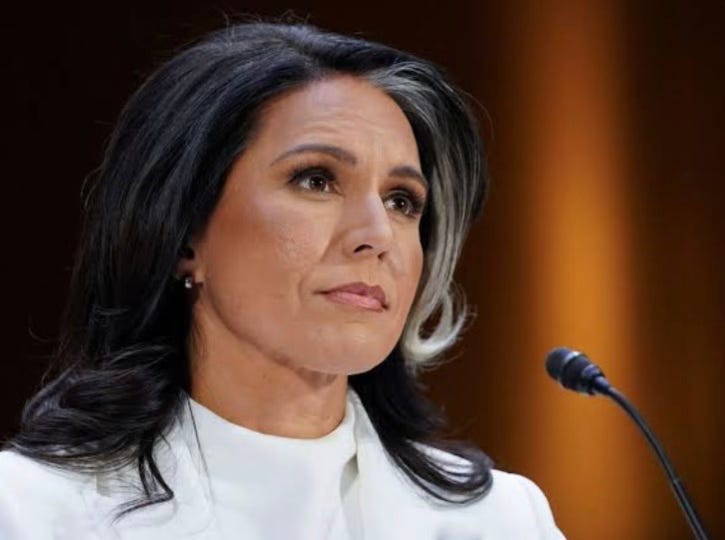
The Real Danger Behind Tulsi Gabbard’s Departure
When the person sitting at the center of America’s intelligence system suddenly walks away…you should pay attention to what could break next.
The Real Danger Behind Tulsi Gabbard’s Departure
When the person sitting at the center of America’s intelligence system suddenly walks away…you should pay attention to what could break next.
The Jack Hopkins Now Newsletter #904: Saturday,May 23rd, 2026.
There are moments in politics when a resignation is just a resignation.
And then there are moments when a resignation acts more like a flare shot into the night sky…
…revealing fractures most Americans weren’t supposed to notice yet.
Tulsi Gabbard stepping down as Director of National Intelligence is one of those moments.
Most headlines will frame this as a personal story.
Family health. Stress. Burnout. A difficult choice.
And…to be fair…those things may very well be true.
But…if you stop there…you miss the much larger story unfolding underneath the surface.
Because the Director of National Intelligence is not some symbolic figurehead position.
The DNI sits at the nerve center of the American intelligence apparatus.
Eighteen separate intelligence agencies.
Thousands of analysts.
Global surveillance systems.
Cyber threat detection.
Foreign espionage monitoring.
Terrorism assessments.
Nuclear threat analysis.
Satellite intelligence.
Military intelligence coordination.
The DNI doesn’t just “advise.”
The DNI determines what information…rises to the level of presidential action.
That means when a DNI suddenly exits during a period of global instability…
…the question isn’t merely “why did she leave?”
The real question is:
What kind of instability does her departure create?
And the answer may be far more serious than most people realize.
A Leadership Vacuum at the Worst Possible Time
Here’s the first thing most Americans don’t understand about national security systems:
Continuity matters almost as much as competence.
Intelligence systems rely on rhythm.
Relationships.
Trust chains.
Institutional memory.
Coordination between agencies…that often don’t naturally trust one another.
When leadership suddenly changes, those systems wobble.
And right now, the timing could hardly be worse.
The world is already sitting on multiple pressure points simultaneously:
Iran tensions
China-Taiwan escalation risk
Russian instability
Global cyber warfare
Domestic extremism threats
AI-driven information warfare
Economic fragility
Now imagine trying to coordinate all of that while the person overseeing America’s intelligence integration suddenly disappears from the chessboard.
That creates uncertainty.
And uncertainty inside intelligence systems is dangerous.
Because intelligence failures rarely happen from one gigantic mistake.
They happen from dozens of small disruptions piling on top of each other:
Delayed communication
Unclear authority
Internal distrust
Political second-guessing
Hesitation during fast-moving crises
This is how systems become brittle.
And brittle systems crack under pressure.
The Bigger Problem: Trust Inside the Intelligence Community
This is where things get even more complicated.
Tulsi Gabbard was never viewed as a traditional intelligence insider.
She entered the role carrying political controversy from the very beginning.
To her supporters, that made her an outsider willing to challenge entrenched bureaucracies.
To critics…it made her a destabilizing political figure inside institutions that depend on perceived neutrality.
That tension matters more than people realize.
Because intelligence agencies function largely on trust.
Analysts must trust leadership won’t distort findings.
Field operatives must trust intelligence won’t be weaponized politically.
Allied nations must trust shared intelligence won’t be manipulated or leaked.
Once trust starts eroding…
…the entire machine slows down.
And over the last several years…America’s intelligence apparatus has already been under enormous strain.
Political polarization.
Public distrust.
Accusations of bias.
Leaking wars between factions.
Competing narratives about “deep state” activity.
Internal morale problems.
Gabbard’s tenure existed inside that storm.
Her departure risks making those fractures even worse.
Why?
Because every abrupt leadership exit sends a message to the bureaucracy underneath:
“Something unstable is happening above you.”
That affects morale.
Retention.
Decision-making confidence.
And perhaps most importantly…
…it affects the willingness of professionals to speak uncomfortable truths upward.
That’s one of the most dangerous outcomes possible.
Because intelligence systems fail catastrophically when analysts become afraid to say what leadership doesn’t want to hear.
History proves this over and over again.
America’s Enemies Watch Moments Like This Closely
Here’s another uncomfortable reality:
Foreign adversaries study American instability obsessively.
They monitor leadership changes.
Internal conflict.
Cabinet turmoil.
Congressional dysfunction.
Public distrust.
And they constantly search for moments when America appears distracted…divided… or uncertain.
A sudden DNI resignation creates exactly that kind of perception.
Whether the reality matches the perception almost doesn’t matter.
Perception itself becomes strategic.
Russia watches for openings.
China watches for hesitation.
Iran watches for inconsistency.
Cyber actors watch for procedural confusion.
Authoritarian governments understand something many Americans forget:
Chaos creates opportunity.
And leadership transitions inside national security structures often create small operational vulnerabilities.
Nothing dramatic.
Nothing cinematic.
But enough uncertainty….to encourage probing behavior.
More cyber intrusions.
More espionage attempts.
More aggressive geopolitical testing.
More disinformation operations.
Because adversaries assume transitions are moments when detection systems weaken and response chains slow down.
That’s not paranoia.
That’s standard geopolitical behavior.
The Risk of a Politicized Intelligence System
Now we get to the truly dangerous part.
America’s intelligence system only works if the public believes its conclusions are grounded in reality rather than partisan loyalty.
The second intelligence becomes viewed as merely another political weapon…
…the country enters extremely dangerous territory.
And this is where the post-Gabbard landscape could become volatile.
Because her replacement matters enormously.
Will the administration appoint:
A career intelligence professional?
A military strategist?
A political loyalist?
An ideological enforcer?
That choice sends a massive signal.
Not just to the intelligence community…
…but to the entire world.
If the replacement is viewed primarily as a loyalist figure…critics will argue intelligence is becoming politicized.
If the replacement is viewed as hostile to the administration, internal conflict could intensify.
Either way, the risk is the same:
The intelligence apparatus becoming increasingly trapped inside partisan warfare.
And once intelligence agencies become perceived as partisan actors…
…public trust collapses.
That creates cascading dangers:
Citizens stop believing threat assessments
Lawmakers dismiss intelligence selectively
Conspiracy ecosystems explode
Foreign disinformation becomes more effective
Institutional legitimacy erodes
A country cannot maintain long-term strategic stability when its citizens no longer trust the institutions responsible for warning them about threats.
That’s how democratic systems become vulnerable from the inside out.
The Danger of Acting Leadership
There’s another issue most people overlook:
Acting officials are inherently weaker.
Temporary leaders often lack:
Institutional authority
Political backing
Long-term leverage
Operational confidence from subordinates
That matters during crises.
Because intelligence leadership sometimes requires making politically dangerous calls quickly.
An acting DNI may hesitate.
Agencies may resist.
Congress may delay cooperation.
Allies may wait for clarity.
And…adversaries…may exploit the uncertainty.
This becomes especially dangerous if confirmation battles for a permanent replacement drag on for months.
Washington dysfunction has a habit of turning temporary situations into prolonged instability.
And the longer intelligence leadership remains uncertain…
…the more operational risk accumulates underneath the surface.
The Psychological Impact Nobody Talks About
There’s also a softer but equally important dimension to all of this:
National confidence.
Americans underestimate how much institutional stability shapes collective psychology.
When people see constant resignations, firings, investigations, and turmoil surrounding national security leadership…
…it slowly changes how secure the country feels.
Even if most citizens can’t articulate it directly.
The cumulative effect becomes:
Rising anxiety
Declining institutional trust
Increased susceptibility to panic narratives
Growing political extremism
Broader social fragmentation
This is why stable democracies prioritize continuity inside intelligence and defense systems.
Not because leaders are irreplaceable…
…but because constant visible instability corrodes public confidence over time.
And confidence is one of the invisible pillars holding democratic systems together.
What Happens Next Could Matter More Than the Resignation Itself
Here’s the part that matters most:
Tulsi Gabbard’s departure itself may not be the primary danger.
The real danger lies in what follows.
Who replaces her.
How intelligence priorities shift.
Whether internal trust deteriorates further.
Whether Congress turns the process into partisan warfare.
Whether foreign adversaries interpret this as weakness.
Whether intelligence professionals begin self-censoring.
Whether institutional credibility continues eroding.
Those second-order effects are where the real risk lives.
Because America’s greatest vulnerabilities…rarely arrive as dramatic movie scenes.
They emerge slowly.
Quietly.
Through institutional weakening.
Trust erosion.
Fragmentation.
And…leadership instability accumulating over time…until the system becomes fragile enough that one real crisis suddenly exposes all the cracks at once.
That’s the danger worth watching here.
Not just one resignation.
But the broader pattern it may represent.
Final Thought
Healthy democracies require something increasingly rare in modern America:
Institutions capable of surviving political turbulence without losing public trust.
That trust is fragile.
Once citizens begin viewing intelligence systems as political weapons rather than national defense mechanisms…
…the entire democratic framework becomes more unstable.
And instability has a way of attracting opportunists.
Both foreign and domestic.
That’s why this moment matters.
Not because Tulsi Gabbard alone determines America’s future…
…but because leadership turmoil at the center of the intelligence system reveals how much strain the system may already be under.
And systems under strain don’t always fail immediately.
Sometimes they fail later…
…all at once.
#HoldFast
Back soon.
-Jack
Jack Hopkins
P.S. The most dangerous national security failures in history usually weren’t caused by one evil mastermind or one dramatic event.
They happened because institutions became fragmented, distrustful, politicized, and slow-moving long before the public realized how vulnerable things had become.
That’s the part smart observers are paying attention to now.
Sources
Tulsi Gabbard resigns as director of national intelligence — The Washington Post
Tulsi Gabbard is resigning as director of national intelligence — CNN Politics
Gabbard resigns as national intelligence director citing husband’s cancer diagnosis — NPR
Tulsi Gabbard resigns as director of national intelligence — NBC News
Tulsi Gabbard resigning as director of national intelligence — ABC News
Tulsi Gabbard resigns as Trump’s top US intelligence official — Al Jazeera


Jack there is so much in your post and I agree, though it is being presented as a “personal issue” there have been, for months now, rumors of her departure…either resignation, or being “fired” by Trump…but the very big concern, besides all the important issues you mentioned, is WHO will replace her…or will she be replaced, or will Marco Rubio take this task on as well (being a bit of smart aleck here). Every departure in this regime has resulted with a replacement equally as bad, or worse…Todd Blanche being the #1 prime example! I am certain Trump is waiting for Putin’s input on this subject, as he seems to have a lot of power in Donald’s decisions! Every single day seems to bring even more lunacy, even more things to worry about…I just want a peaceful life, and never imagined that at this point in my life I would feel like I was in a protracted battle for my country! Trying very, very hard to #HoldFast !!!
In January 2001, George W Bush was sworn in as President. The results of the November election leading to this were, in a way, determined by the Supreme Court (Bush v Gore).
On September 11, 2001, Osama bin Laden and his cronies had the day of their dreams.
Jack, in the section entitled ‘America’s Enemies Watch Moments Like This Closely’, you, while writing about the impact of Tulsi Gabbard’s departure, listed many things foreign adversaries study; some of these were leadership changes, internal conflict, cabinet turmoil, congressional dysfunction, and public distrust.
Could 2001 be repeating itself in 2026? Is this ripe for the picking?
Please know I’m only comparing the atmospheres of then and now and not comparing the 2001 President to today’s president. No one deserves that comparison.