


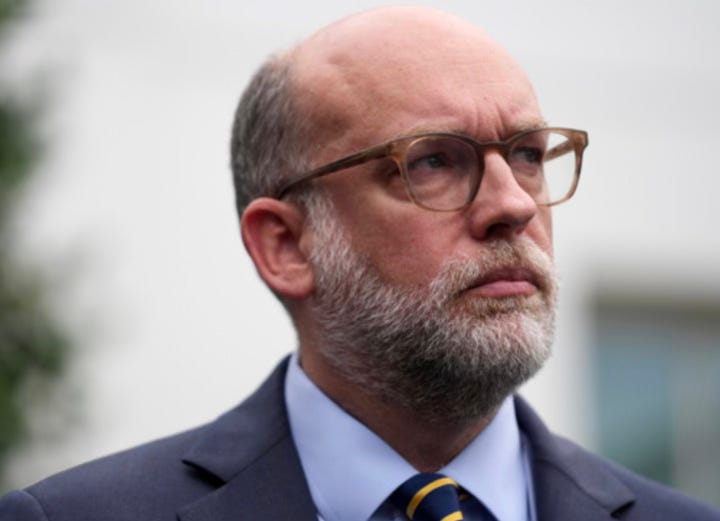
Russell Vought runs the Office of Management and Budget. That means he decides when, and whether, money Congress has already approved actually leaves the building. He has spent his career arguing that the law forbidding him from withholding it is unconstitutional.
The Quietest Power Grab in American History Is Happening on Schedule
A plan to govern without Congress. Its author made chief of staff. An attorney general threatening the overseers. Same nine days.
The Jack Hopkins Now Newsletter #1,080: Sunday, November 8th, 2026.
Last Tuesday, Americans fired the Republican Congress. Both chambers. Democrats projected above 250 House seats.
And in the West Wing, somebody opened a binder that had been sitting in a drawer since April.
That is not a metaphor. On Nov. 1, two days before the election, Reuters reported that Stephen Miller and Russell Vought had spent seven months working with administration lawyers on a detailed plan for exactly one scenario: Democrats win, and the White House keeps doing what it wants anyway.
Three sources told Reuters about it, including a White House official. Trump, they said, was personally involved.
Read that again. Before a single ballot was cast, the people who run the executive branch had already decided that the outcome of the election would not change how they govern.
You were supposed to have forgotten about it by now. Most people have. Here is why you shouldn’t.
What’s Actually in the Binder
Forget the vague phrase “govern without Congress.”
Here is what Reuters’ sources said the plan contains, item by item.
New tariffs, imposed by proclamation, on critical minerals and wind turbines. No vote required.
Tighter rules for foreign students and temporary workers. Again, no vote.
Russell Vought, the budget director and the intellectual engine of Project 2025, reviewing which programs Congress has already funded will actually receive their money.
Think about what that sentence means. Congress appropriates. The White House decides whether the check gets cut.
A rewrite of federal grant rules so that political appointees, not career staff, decide who gets federal dollars. Universities. Cities. Hospitals. Nonprofits. The people who sign those checks would answer to Miller and Vought.
And the piece that should make the hair on your neck stand up: White House counsel has been coaching officials on how to respond to congressional inquiries, document requests and subpoenas.
They were preparing for the investigations before the investigators were elected.
None of this is a leak from a disgruntled intern.
It is a sourced report…from the most cautious wire service in the world…published while Republicans still controlled every lever in Washington.
They built this plan while they held power…as insurance against losing it.
The Story That Drowned in the Wave
Then the wave hit, and the plan disappeared.
Not because it was debunked. Because it was outcompeted. Democrats at 253 House seats and climbing. Schumer facing a revolt from his own incoming senators.
A petition against Jeffries past 800,000 signatures. Hegseth facing impeachment. Rubio maybe quitting to run in 2028. Vance blaming the Iran war for the losses.
Every one of those is a real story. Every one of them…is about Democrats fighting Democrats, or Republicans fighting Republicans.
Not one of them is about what the executive branch is doing right now with the power it already has.
Turn on any Sunday show this morning…and you heard all of it. You did not hear the words “Vought” and “appropriated funds” in the same sentence.
That is not a conspiracy. It is how newsrooms work. The loud story eats the important one. But the binder…didn’t go anywhere.
Friday: The Author Gets the Keys
On Friday, Nov. 6, three days after the election, Trump announced that Susie Wiles was out as chief of staff and Stephen Miller was in. Effective today, Monday, Nov. 9.
Coverage treated it as a personnel story. Wiles was the grown-up. Miller is the hardliner. Trump is retreating to his base.
Look at it from the other direction. The man who co-wrote the plan to govern around Congress…now runs the building that has to execute it.
Every memo that reaches the president’s desk…goes through him. Every agency head answers to him. The lawyers coaching officials on subpoenas…work down the hall.
Wiles, whatever you think of her…was a political operative whose job was to win elections. Miller’s job…has never been to win anything at the ballot box. His job…is to use power.
The plan…has been staffed.
Sunday: The Attorney General Says the Quiet Part
Then came Sunday morning on CNN.
Todd Blanche, Attorney General of the United States, Trump’s former personal defense lawyer…narrowly confirmed by the Senate in August…was asked about House Democrats’ plans to investigate the administration.
Incoming Oversight chair Robert Garcia had just named Elon Musk and Stephen Miller as his first targets.
Blanche’s answer: there “could be” Justice Department investigations of Democratic lawmakers who conduct that oversight.
Let that land. The nation’s chief law enforcement officer…asked whether Congress will be allowed to do the one job…the Constitution gives it over the executive branch… declined to say no. He said the people doing the asking might themselves be investigated.
Any first-year law student can name the problem. Oversight is not a crime. Threatening to prosecute it is not law enforcement. It is intimidation with a federal seal on it.
Three Headlines. One Story.
Put the pieces on the table.
A plan to govern around Congress, written over seven months, with the president’s knowledge. Reported Nov. 1.
The plan’s co-author installed as chief of staff. Announced Nov. 6, effective Nov. 9.
The Attorney General warning that lawmakers who exercise oversight may be investigated. Said on national television Nov. 8.
Three stories. Three news cycles. Each one got its day. Not one major outlet I can find has written the sentence that connects them…so here it is.
A contingency plan to neutralize the result of a national election was drafted months in advance. It is now being staffed by the man who wrote it. And…it comes with an explicit threat…against the people whose constitutional job is to stop it.
That is not a prediction. That is a description of the last nine days.
You don’t have to believe the plan will succeed. Courts exist. Appropriations law exists. Career civil servants exist. But…you do have to notice that the plan exists…and that the people executing it…are not hiding.
What to Watch Before Thanksgiving
Here is the part of this newsletter that pays for itself. Three things to watch.
Watch OMB.
If Vought starts slow-walking apportionments of money Congress already appropriated, that is the plan in motion. It will show up as agencies quietly missing grant deadlines.
Watch the Federal Register.
A proposed rule changing who signs off on federal grants …would be the single clearest confirmation…that the Reuters report was accurate.
Watch the first subpoena.
House Democrats take their gavels Jan. 3. The administration’s response to the first Oversight subpoena will tell you whether Blanche was bluffing.
And watch who else connects these dots.
If the Sunday shows are still talking about Schumer’s job in two weeks…you will know the binder is working exactly as designed.
Ten Questions the Article Didn’t Answer
1. Isn’t it illegal for the White House to just not spend money Congress appropriated?
Yes, and that’s the point. Nixon tried it in the early 1970s, the Supreme Court ruled unanimously against him in Train v. City of New York, and Congress passed the Impoundment Control Act of 1974 to make sure it never happened again.
The law says a president who wants to cancel spending must ask Congress…and if Congress doesn’t agree within 45 days…the money must go out.
Vought has spent his career arguing that law is unconstitutional. In 2025 his OMB pioneered the “pocket rescission,” proposing cuts so late in the fiscal year…that the money expired before the 45 days ran out. The law exists. The question is who enforces it, and how fast.
2. So who does enforce it?
The Government Accountability Office can find a violation and, in theory, sue. Courts can order the money released. Agencies’ inspectors general can flag it.
But GAO findings have no teeth without a willing Justice Department…roughly a dozen and a half inspectors general were fired in the first weeks of 2025…and litigation runs on a timeline of years…while a fiscal year runs on a timeline of months.
A grant that arrives eighteen months late after a court victory is, for the school district or hospital that needed it…a grant that didn’t arrive. Delay is not a side effect of this strategy. Delay is the strategy.
3. The article mentions coaching officials on subpoenas. What actually happens if the White House just ignores one?
Less than you’d think. Congress has three tools. It can refer a witness for criminal contempt, but the referral goes to the Justice Department, meaning Todd Blanche decides whether to prosecute his own colleagues.
It can sue to enforce the subpoena in civil court, which is what the House did with Don McGahn in 2019; that case took two years…and ended in a negotiated deal…after the administration had already left office.
Or it can use “inherent contempt,” arresting the witness with the Sergeant at Arms, a power last exercised in 1935. In practice, an administration that is willing to absorb bad headlines can run out the clock…on nearly any subpoena. The lawyers in the counsel’s office know this.
4. Doesn’t the Constitution protect members of Congress from being investigated for doing oversight?
Partly. The Speech or Debate Clause shields members and their aides from prosecution for legislative acts…and courts have read oversight as legislative. But…the protection is a defense you raise after you’ve been investigated, not a wall…that stops the investigation.
A member can be subpoenaed…have phones seized…and spend a year in court establishing that the clause applies. For a committee staffer, a witness who cooperated or a donor, the protection is thinner still.
The damage of a politically motivated investigation is mostly done before it’s ever thrown out. Blanche didn’t need to promise indictments on Sunday. He only needed people to start thinking about their legal bills.
5. Democrats won the Senate too. Doesn’t that block the plan?
It closes some doors and opens others. A Democratic Senate can refuse to confirm nominees, which is why you should expect a surge in “acting” officials under the Vacancies Act and a fight over its 210-day limit.
It can hold pro forma sessions to block recess appointments, a tactic the Supreme Court blessed in 2014. And…because Democrats hold both chambers…the president can’t use his Article II power to adjourn Congress when the two houses disagree, a gambit Trump floated in 2020.
What the Senate can’t do is force the executive branch to spend money, answer subpoenas or follow the law. Confirmation power is a brake, not a steering wheel.
6. Can tariffs really be imposed with no vote at all?
They have been for years. Presidents can impose tariffs under Section 232 on national-security grounds, under Section 301 for unfair trade practices, and have claimed the power under the International Emergency Economic Powers Act…which is the authority the Supreme Court has been asked to rule on.
The constitutional problem is older than Trump: Congress has delegated so much trade power to the president over the last century that “tariffs by proclamation” barely counts as news anymore.
What’s new…is using them as an explicit substitute for legislation…after losing an election. That is the delegation…coming home to roost.
7. Why does the grant-rule change matter so much? It sounds like paperwork.
Because federal grants are the circulatory system of American public life. Roughly a trillion dollars a year flows to states, cities, universities, hospitals and nonprofits through them.
Today most of that money is distributed by career staff under formulas and peer review. Move the decision to political appointees…and you have created a lever that can be pulled…against any governor…mayor or university president…who resists the administration, with no statute needed and no vote taken.
The 2025 fights with Harvard and with so-called sanctuary cities were a preview. The grant-rule change would make that the normal operating procedure rather than the exception.
8. Haven’t other presidents governed by executive action? Obama had his “pen and phone.”
They have, and the comparison is worth making honestly. Obama’s deferred-action immigration orders, Bush’s signing statements and Clinton’s use of national monuments…all stretched executive power, and all drew legitimate criticism.
The differences here are three.
First, scale: this is a comprehensive plan across tariffs, immigration, spending and grants, not a handful of orders.
Second, timing: it was drafted specifically in anticipation of losing an election…as a way to make the loss…not matter.
Third, the threat: no previous administration paired its executive-action agenda…with an attorney general…publicly entertaining investigations of the legislators overseeing it. Any one of those is a story. All three together…is a different kind of story.
9. What’s the actual threat to democracy here? Nobody is canceling elections.
The threat is quieter than that, which is why it’s dangerous. Political scientists have a name for systems where elections are held…opposition parties exist…and the press is free…but…the results stop changing anything: competitive authoritarianism.
Elections are the mechanism by which voters change policy. If a party can lose both houses of Congress…and the policy keeps going exactly as planned because the plan was written in advance to make the vote irrelevant, the election has been reduced to a poll.
You still get to vote. You just don’t get to decide. The second quiet step is making oversight expensive enough…that nobody wants to do it. Together, those two moves hollow out the system without ever touching a ballot box.
10. Realistically, what can anyone do about it?
More than it feels like. State attorneys general have standing to sue over withheld grants and have won repeatedly.
Inspectors general and GAO still exist, even diminished…and their findings create a record courts use.
Career civil servants are legally required…to refuse unlawful orders to withhold funds.. and whistleblower protections…though under strain, still apply.
Congress can attach conditions to must-pass appropriations bills, forcing the president to veto funding for the whole government to protect one impoundment.
And the press…can do the one thing this article is asking for: treat the plan, the staffing and the threat as a single story and keep it on the front page. The plan depends on being boring. Do. Not. Allow. It. To. Be.
Here is the thing to hold onto when the next news cycle tries to pull your attention somewhere else.
Every authoritarian turn in modern history has been described, by the people living through it, as a series of unrelated headlines. A personnel change here. A budget dispute there. A prosecutor’s offhand remark on a Sunday morning.
Nobody woke up to a coup. They woke up, over and over…to things that each seemed survivable…and by the time the pattern was obvious…the pattern was the government.
You are not being asked to panic. Besides, you know my tolerance for panic…is almost non-existent; panic does NOTHING useful, but f*cks a lot of things up.
You are being asked to do something harder: to keep three ordinary-looking facts in your head at the same time…to say out loud what they add up to…and to refuse to let anyone tell you that noticing is hysteria.
The plan was written in April. It was staffed on Friday. It was defended on Sunday. The only thing it has not yet survived…is being seen clearly…by enough people…at once. That part…is up to you.
#HoldFast
Back soon.
-Jack
Jack Hopkins
P.S. The Reuters report was anonymously sourced. Three people, one a White House official. Treat it with that caveat. Then ask yourself why, nine days later…nobody at the White House has denied it.
Sources
The core story
Al Jazeera: Trump names Stephen Miller as new chief of staff, replacing Susie Wiles — Nov. 6, 2026
CBS News: Stephen Miller named Trump chief of staff as Susie Wiles departs
Impoundment and the power of the purse
House Budget Committee: The Impoundment Control Act of 1974 — what it is and why it matters
GAO: Impoundment Control Act — release of withheld amounts after the 45-day period
Train v. City of New York, 420 U.S. 35 (1975) — full opinion, GovInfo
Congressional Research Service: Pocket Rescissions and the Impoundment Control Act
PBS NewsHour: What you need to know about impoundment and how Trump vows to use it
Subpoenas, oversight and congressional immunity
NPR: Two years later, former White House counsel Don McGahn agrees to testify — May 2021
K&L Gates: The end of the McGahn litigation saga — House subpoena power vindicated, for now
Cornell Law / Constitution Annotated: Who can claim the Speech or Debate privilege
Gravel v. United States, 408 U.S. 606 (1972) — full opinion, GovInfo
Watchdogs, vacancies and appointments
PBS NewsHour: Trump fires more than a dozen independent inspectors general — Jan. 2025
Lawfare: Acting officers and the Federal Vacancies Reform Act
NLRB v. Noel Canning, 573 U.S. 513 (2014) — full opinion, GovInfo
Ballotpedia: NLRB v. Noel Canning (2014) — pro forma sessions and recess appointments
Grants as leverage
The democratic stakes
Jack,
Not panicking but where do we turn and what the hell are our options? It sounds like they’ve pretty much closed the doors and will do as the wish and we will be at their mercy! Outside of an armed revolt how do we neutralize these villains and save our country?
Christie