

The Question We’re Not Supposed to Ask About Starlink
Can a Private Satellite Network Influence an Election? Here’s What’s Real.

The Question We’re Not Supposed to Ask About Starlink
Can a Private Satellite Network Influence an Election? Here’s What’s Real.
The Jack Hopkins Now Newsletter #761: Tuesday, February 3rd, 2026
There’s a number that should stop you cold.
Not because it’s shocking on its face…but because of how casually it’s now discussed.
42,000.
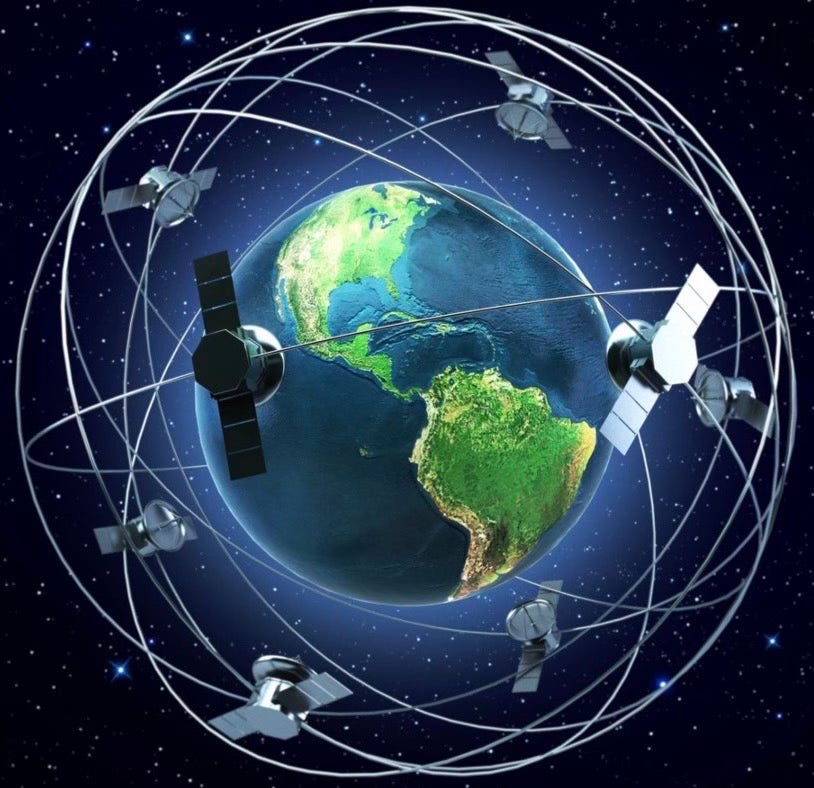
That’s roughly how many satellites Elon Musk has sought approval to place into low-Earth orbit through Starlink and related filings.
Tens of thousands more than existed in orbit just a decade ago. More than all other satellite operators…combined…by an order of magnitude.
We are talking about an infrastructure layer…above the country…that no government voted on…no electorate debated…and no democratic process meaningfully constrained.
And…yet…it’s increasingly woven into the daily functioning of communications… emergency services…rural connectivity…and…yes…public systems.
So it’s reasonable to ask a question that immediately makes people nervous:
Could a private satellite network of that scale be used to interfere in U.S. elections?
Not in the cartoonish way people argue about online.
Not “space lasers” or flipped vote totals.
But in the real world. The boring world. The systems world.
And…is there any meaningful connection between this satellite infrastructure…and the massive pools of data now being collected under the DOGE banner…data about movement…identity…behavior…and access?
Let’s slow this down…and separate signal…from noise.
First: What This Is Not
Before we go any further, let’s clear away the stuff that doesn’t survive even five minutes of scrutiny.
Satellites cannot:
Hack voting machines from orbit
Change vote tallies
Magically alter tabulation software
Beam instructions into ballot scanners
U.S. federal and state voting systems…whatever their other flaws…are designed so that tabulation is not connected to the internet. Paper ballots…air-gapped systems…audits. That part matters.
So if you came here looking for a sci-fi exposé…this isn’t it.
What follows is more unsettling…precisely because it’s mundane.
Where My Own Knowledge Lagged
I want to be transparent here.
My understanding of satellite systems…how they actually work…where they’re vulnerable…what they can and can’t realistically do…was…until recently, lagging behind the moment. Read that as, I didn’t know a damn thing more than the average person…and likely less.
College algebra gave me enough trouble that orbital mechanics were never exactly my playground.
So…rather than speculate, I did what you do when you’re serious about not embarrassing yourself:
I asked someone who actually knew.
A former client of mine spent many years working with NASA. Not a pundit. Not a Twitter personality. A systems guy. The kind who thinks in failure modes and redundancies, not narratives.
And I asked him the same questions…many of you have…even if today is the first time you’ve consciously formed them.
What follows is not rumor.
It’s orientation.
The Real Election Risk Isn’t the Vote. It’s the Environment.
If you’re looking in the wrong place, you’ll miss the risk entirely.
Elections aren’t just ballots and machines. They’re ecosystems:
Communications between election officials
Connectivity for voter check-in systems
Emergency backups when terrestrial networks fail
Information flows to and from rural or disaster-affected areas
Media distribution…narrative amplification…and suppression
Satellite internet doesn’t need to touch a single ballot to matter.
It only needs to become systemically relied upon.
And in certain parts of the country…it already is.
The Leverage Point No One Likes Talking About
Here’s the key insight my former NASA client emphasized:
Control doesn’t have to be malicious to be consequential.
When a single private network becomes the default fallback for connectivity—especially in rural areas, emergencies, or infrastructure stress—it creates leverage without touching legality.
That leverage includes:
Coverage decisions
Priority routing
Service availability under load
Dependency during outages or disasters
None of this requires flipping a switch labeled “Election Interference.”
It requires being the only working option when others fail.
And…that’s not theoretical. We’ve already seen satellite internet used as emergency infrastructure in wars…natural disasters…and state-level crises.
Once something becomes critical infrastructure…the rules change.
Disruption Beats Manipulation Every Time
Here’s another uncomfortable truth:
You don’t need to change outcomes to undermine confidence.
You just need:
Delays
Outages
Confusion
Contradictory information
Localized failures that feel intentional
Imagine a rural county relying on satellite connectivity for voter check-in after a storm knocks out fiber.
Now imagine:
Intermittent connectivity
Authentication failures
Slower throughput
No clear explanation
Nothing illegal has happened.
But trust erodes fast.
And in modern elections…confidence is half the contest.
Where DOGE Enters the Picture
Now let’s address the part people get jumpy about.
DOGE…whatever branding you prefer…is about data aggregation.
Movement data. Usage data. Behavioral data. Identity-linked metadata. Massive pools of it…stitched together across platforms and services.
On its own, that’s not illegal. It’s the modern economy.
Satellites, on their own…are just pipes.
The question is not whether satellites + data = evil.
The question is whether centralized infrastructure + centralized data + political incentives creates a systems risk.
And the honest answer is: yes…it can.
Not because someone presses a button.
But because:
Data informs influence operations
Influence operations shape information environments
Information environments affect turnout…trust…and legitimacy
That’s not a conspiracy. That’s 21st-century politics.
What My NASA Source Was Clear About
This matters, so I’ll quote the substance without dramatizing it:
Satellites are powerful distribution tools…not mind-control devices.
They are vulnerable to disruption…congestion…and interference, especially at scale.
Their greatest political impact is indirect…not direct.
Concentration of ownership is the real issue…not the technology itself.
In other words: the danger isn’t “Musk flips the election.”
The danger is a private actor…quietly becoming indispensable to public systems without democratic oversight.
That’s a governance problem…not a sci-fi one.
Why This Conversation Gets Shut Down So Fast
Notice how quickly this topic gets labeled:
“Conspiracy”
“Fearmongering”
“Technically illiterate”
That’s a tell.
Because serious systems thinkers don’t mock questions…they bound them.
They ask:
Under what conditions would this matter?
Where are the choke points?
What assumptions are we making?
What fails first under stress?
That’s what we’re doing here.
The Pattern That Should Concern You
This article isn’t about Elon Musk as a villain.
It’s about a pattern:
Private infrastructure becomes public necessity
Oversight lags adoption
Dependency precedes regulation
Politics arrives last
We’ve seen this movie before. Railroads. Telecom. Energy. Social media.
Satellites are just the next layer…literally above the rest.
Orientation, Not Alarm
So…where does this leave us?
Not panicked.
Not complacent.
Oriented.
The truth is:
Satellites are unlikely to directly manipulate U.S. elections
They can shape the conditions under which elections are experienced
Data aggregation amplifies influence…not control
Concentration of infrastructure is the long-term risk
That’s the signal.
And once you see it…you can’t unsee it. You just can’t. (Go ahead…and try.)
A Late-Breaking Development Worth Noting
Just as I was finishing up this piece…
…I became aware of a bombshell development that snaps the whole “satellites + data + leverage” question into sharper focus:
Multiple major outlets are now reporting that SpaceX has acquired xAI in a deal valuing SpaceX at roughly $1 trillion and xAI at roughly $250 billion…creating a combined entity around $1.25 trillion.
And…here’s the detail that matters for this conversation:
The stated ambition isn’t just “synergy” or some Silicon Valley buzzword soup. It’s the explicit push to scale AI compute by moving portions of data-center infrastructure into orbit…using SpaceX launch capacity and space-based power advantages as the long-term pitch.
My quick thought on how this could connect to the issue we’re tracking at JHN is simple:
This is the vertical integration play.
When you combine:
A massive satellite internet layer (distribution),
A major AI stack (processing and decision systems),
And a real-time mass communication platform ecosystem (amplification and narrative velocity),
…you’re not “building a company.”
You’re building an infrastructure organism…a pipeline where data flows in…models process it…and delivery systems push outputs back out at scale.
Now…to be clear: that doesn’t automatically mean “election interference.”
But…it does intensify the governance question we’re asking in this article:
How much of the country’s informational and connectivity environment…can become functionally dependent on privately owned systems…before democratic oversight even has a vocabulary for it?
And…if DOGE-style data aggregation is part of the wider environment…more data… more identity resolution…more behavioral mapping…then the strategic connection isn’t mystical. It’s mechanical:
Data → model → distribution.
That’s the shape of the future being proposed.
One Last Thing to Sit With
The most dangerous systems don’t announce themselves as threats.
They arrive as conveniences.
They solve real problems.
They become indispensable.
And…only later do we realize…we’ve handed over leverage…we didn’t mean to.
That doesn’t mean panic.
It means attention.
Steady as we go.
If this helped you separate signal from noise, read it in the app and leave a short comment. Even a sentence. That’s how these conversations stay grounded…and visible.
#HoldFast
Back soon.
-Jack
Jack Hopkins
P.S. If this piece felt calmer than the headlines…but more unsettling in a quiet way…that was intentional. The real risks aren’t the loud ones everyone argues about.
They’re the slow dependencies we barely notice until they’re already baked in. Staying oriented…means learning to spot leverage before it’s exercised. Steady as we go.
P.P.S. I stated 42,000 satellites associated with Elon Musk and Starlink. That figure needs a little unpacking.
Currently in orbit: As of early 2026, SpaceX has launched over 9,000 Starlink satellites, with several thousand operational at any given time.
Formally approved: U.S. regulators have authorized SpaceX to deploy roughly 15,000 satellites across multiple Starlink generations.
Long-term ambition: The widely cited 42,000 satellite figure reflects SpaceX’s ultimate constellation vision described in filings and planning documents, not an already fully approved or completed deployment.
In other words:
42,000 is the ceiling SpaceX has talked about.
15,000 is closer to what’s currently authorized.
9,000+ is what’s already up there.
Those distinctions matter…especially when discussing scale…dependency…and infrastructure risk.
Resources & Further Reading
Official Reporting on the SpaceX–xAI Merger
SpaceX merges with xAI in a roughly $1.25 trillion deal — this consolidation brings Musk’s space, AI, and communications ventures under one roof and explicitly mentions plans for space-based data centers.
SpaceX unifies Space, AI & social platforms into a vertically integrated tech powerhouse — highlights the merger, the inclusion of X (formerly Twitter), Grok AI, and intentions to scale AI compute among satellites.
SpaceX–xAI merger ahead of planned IPO — notes strategic motivation, potential for orbital compute, and how this fits Musk’s broader agenda.
The Verge on Musk’s stated goal of space-based AI compute — covers Musk’s rationale for shifting AI infrastructure into orbit to avoid terrestrial costs and constraints.
Contextual Background on Satellite & AI Infrastructure
Wikipedia: SpaceX — provides a concise history of SpaceX’s acquisition of xAI, its goals for orbit-based AI infrastructure, and its Starlink satellite system.
Wikipedia: xAI (company) — offers background on xAI, its merger into SpaceX, and its role in Musk’s ecosystem of AI, social media, and data assets.
TechRepublic coverage — describes how the SpaceX–xAI tie-up is pitched as a move to leverage satellites for AI workloads.
Ars Technica on orbital data center plans — mentions discussions of deploying large numbers of orbital data center nodes alongside satellites.
Satellite Infrastructure & Government Context
Starshield (SpaceX satellite network for government) — overview of a classified contract and deep-space capabilities that add another dimension to the discussion of private satellite systems and public use.
Jack, yes!
Vertical integration has been happening in other industries, too (think agriculture & meat) and it’s given me pause for a long time. If large corporations control the seeds (meaning they are modified so they don’t produce seed and you have to repurchase every year), it doesn’t take a lot of imagination to see where it could end. Hungry ppl are far more easily manipulated than well-nourished healthy folks. In the meat industry, it gets really easy to price fix and/or gouge.
Back to the tech. Having done tech for a living in the paleo era, I’ve been saying for a long time that our technological capabilities have far exceeded our ethical development as humans, meaning we have not stopped to think about implications and how to balance risk with privacy, monopoly, benefit, etc.
When I read within the last year or two just how far Musk has inserted himself into industries upon which our govt depends, my blood ran cold. As a foreign example, Ukraine’s dependence on StarLink for internet access to run their drones could be subject to the whims a man-child in love with ketamine that may or may not have a vested interest in a specific outcome.
I sure don’t know what the answer is since the horse is kind of out of the barn so to speak. I’m really glad to see this article! I’ve felt like Cassandra shouting into the wind and wondering if I was the only one seeing it.
Thanks for a great, if somewhat frightening and very sober, read!!
Starlink happened before our eyes, sanitized by filling a niche on the ground. Apathy and burnout are killing us.