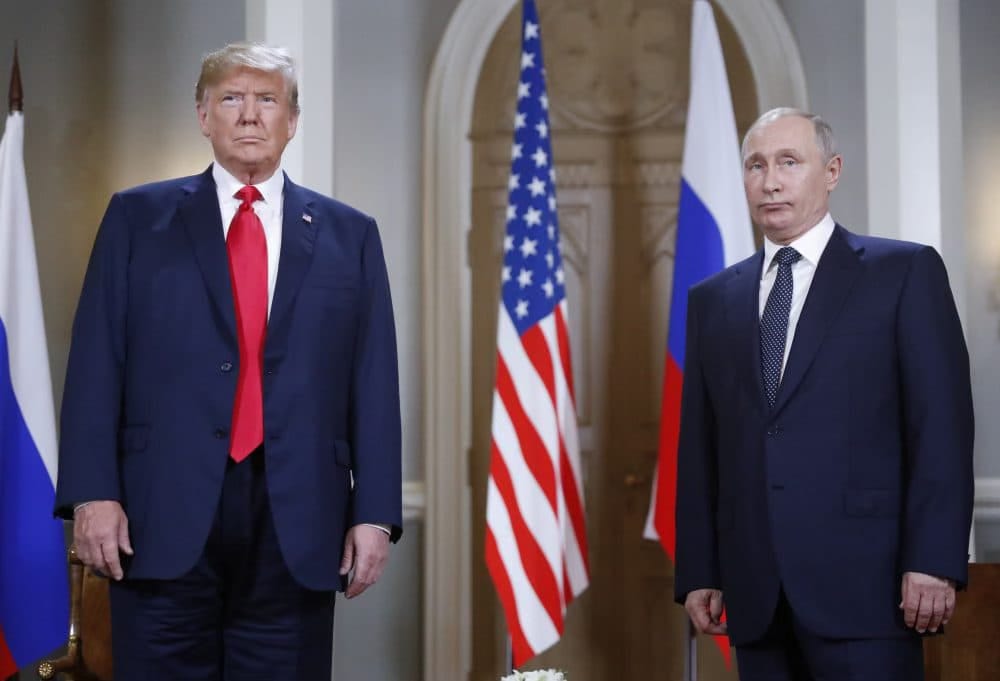
The Psychological Dynamic That Explains Trump’s Deference to Putin
What happens when a status-driven leader meets unconstrained power.
Author’s Note
I’ll be honest about something. Writing this piece required less searching than most. Not because it’s simpler…but because this is the terrain I’ve lived in for more than three decades.
Status dynamics. Dominance hierarchies. How power alters perception and decision-making. I’ve studied it academically…professionally…and…at times…uncomfortably up close.
When a pattern shows up often enough…you stop chasing sources and start recognizing shapes. This article came together that way…not as speculation, but as recognition.
(Estimated reading time, 5-6 min)
The Psychological Dynamic That Explains Trump’s Deference to Putin
What happens when a status-driven leader meets unconstrained power
The Jack Hopkins Now Newsletter #741: Monday, January 19th, 2026.
Let’s get one thing straight before we go any further.
This is not a conspiracy piece.
It’s not a kompromat fantasy.
It’s not amateur psychoanalysis.
It’s about observable behavior…incentives, and a psychological dynamic that shows up predictably when certain personality structures collide with certain kinds of power.
This dynamic doesn’t require malice…betrayal…or secret deals.
It only requires human behavior under hierarchical pressure.
And once you see it…you can’t unsee it.
Power Is Felt, Not Declared
People waste enormous energy arguing about words.
Who said what.
Who praised whom.
Who insulted whom.
That’s noise.
Real power dynamics reveal themselves somewhere else entirely:
Who is careful around whom
Who escalates…and who softens
Who seeks validation…and who withholds it
Who retaliates…and who absorbs
Who gets treated differently than everyone else
Apply that lens and one thing stands out immediately:
Trump talks about Putin differently than almost anyone else.
Not consistently hostile.
Not performatively dominant.
Not contemptuous.
Different.
And in dominance psychology…different is the tell.
This Is Not About Fear. It’s About Status
The wrong question gets asked over and over:
“Is Trump afraid of Putin?”
That’s a cartoon version of how dominance-oriented personalities work.
People like Trump…don’t experience fear the way most people do. They experience status threat and status recognition. It’s still fear…it’s just a different flavor.
The real question is:
Where does Putin sit in Trump’s internal hierarchy?
And…the answer is uncomfortable for anyone who believes American power automatically outranks all others.
Trump’s Core Engine: Externalized Status
Trump’s identity has never been internally regulated.
It’s built on:
Public admiration
Visible dominance
Loyalty signals
Crowds, ratings, attention
Wins that can be displayed
Humiliations that must be avoided
That’s not an insult. It’s a structure.
People with externally regulated status are exquisitely sensitive to:
Who humiliates them
Who resists them
Who ignores them
Who cannot be bullied
Now ask yourself:
Who, on the world stage…fits that description better than Vladimir Putin?
Putin Represents What Trump Cannot Fully Obtain
Putin embodies something Trump wants—but cannot fully have inside a democratic system:
Unconstrained power.
Putin does not need:
Approval ratings
Independent courts
Hostile media
Elections that threaten removal
Public humiliation without consequences
He doesn’t persuade.
He enforces.
To someone like Trump…that reads as real power.
Not moral power.
Not legitimate power.
But effective power.
And people who prioritize effectiveness…over legitimacy…tend to admire whoever gets away with the most.
The Asymmetry That Changes Everything
Here is the asymmetry that explains nearly everything:
Trump needs validation.
Putin does not.
Trump performs constantly.
Putin does not perform…at all.
Trump seeks affirmation.
Putin dispenses tolerance.
Trump knows how to dominate people who need something from him.
He does not know how to dominate people who don’t need him.
In dominance hierarchies…the person who can walk away quietly… wins.
Why Trump Is Harsher on Democratic Leaders
This is where people get confused.
They say: “If Trump admires strength, why does he attack allies?”
Because democratic leaders:
Criticize him publicly
Embarrass him openly
Don’t fear retaliation
Operate inside norms that allow disrespect
To someone with Trump’s psychology…that isn’t disagreement.
It’s humiliation.
So…he attacks.
Putin doesn’t humiliate him.
Putin doesn’t mock him.
Putin doesn’t correct him publicly.
Putin…treats him like a peer.
And…for a status-driven personality like Trump….that feels like respect.
This Is Deference, Not Friendship
Let’s be precise.
This is not friendship.
It’s not ideological alignment.
It’s not secret loyalty.
It’s psychological deference.
The kind that emerges automatically when someone encounters a figure they perceive as:
Untouchable
Immune to humiliation
Fully in control of their environment
Unconstrained by rules
When that happens…people soften.
They hesitate.
They rationalize.
They excuse.
Not consciously.
Mechanically.
This isn’t admiration.
It’s accommodation.
The Borrowed Status Effect
There’s another mechanism at work…and it’s subtle.
People with fragile status identities…often attach themselves to stronger figures to borrow power.
If someone powerful appears to respect me…
then I…must be powerful too.
This is why Trump often speaks warmly about authoritarian leaders…while attacking democratic institutions that constrain him.
Authoritarian approval stabilizes his ego.
Democratic accountability…destabilizes it.
Why This Is Dangerous
Not because Trump “likes” Putin.
But because deference shapes decision-making.
When you defer psychologically, you:
Avoid confrontation
Reinterpret aggression as strength
Downplay threat
Mistake restraint for goodwill
Delay decisions that require firmness
And in geopolitics…delay is leverage.
This isn’t betrayal.
It’s misjudgment.
And misjudgment…at the highest level…carries national consequences.
Putin Doesn’t Need Admiration…Only Hesitation
Putin doesn’t need Trump’s loyalty.
He only needs Trump to pause.
To soften.
To equivocate.
To “respect strength.”
Because silence…at the wrong moment…can be more valuable than agreement.
That’s how power is extracted…without force.
Why Democracies Are Psychologically Hard for Strongmen
Democracy humiliates dominance-oriented personalities.
It says:
You can be criticized
You can be checked
You can be removed
You are not absolute
Authoritarian systems…don’t do that.
They flatter dominance.
They reward loyalty.
They eliminate embarrassment.
Which is why someone like Trump…feels psychologically more comfortable around someone like Putin…than around leaders operating inside democratic norms.
The Real Risk Isn’t Blackmail
Everyone wants a smoking gun.
But…you don’t need one.
You only need:
Extreme status sensitivity
Admiration for unconstrained power
Discomfort with accountability
A lifetime of equating dominance with worth
The danger isn’t treason.
The danger is hesitation.
And hesitation…is how bad decisions get made quietly.
Final Reality Check
This isn’t about whether Trump is “good” or “evil.”
It’s about fit.
The presidency of the United States requires comfort with:
constraint
criticism
shared power
delayed gratification
institutional loyalty
Trump’s psychology is built for something else.
And…when someone with that structure encounters a figure who embodies absolute control…without consequence…
The dynamic writes itself.
Not because of fear.
Not because of blackmail.
But because power recognizes power…and sometimes mistakes it for legitimacy.
And when a status-driven leader…mistakes unconstrained power…for legitimacy…the risk isn’t betrayal.
It’s silence at the wrong moment.
#HoldFast
Back soon,
-Jack
Jack Hopkins
P.S. Later this evening, paid subscribers get the companion piece breaking down how authoritarian leaders exploit status psychology in democratic rivals…and the structural guardrails that actually work against it…and how this all plays out with Greenland threats.)


Seeing this, Jack, it makes sense, but what happens when you add in his progressive dementia?
As I understand it trump wants Greenland to protect us from Russia while he completes an agreement with Russia regarding energy projects in the Arctic.
trump makes the Mad Hatter look sane.
#HoldFast
Sue
Wow! You’ve surpassed yourself again Jack! Kudos my KC friend! Looking forward to reading more tonight! #HOLDFAST
