


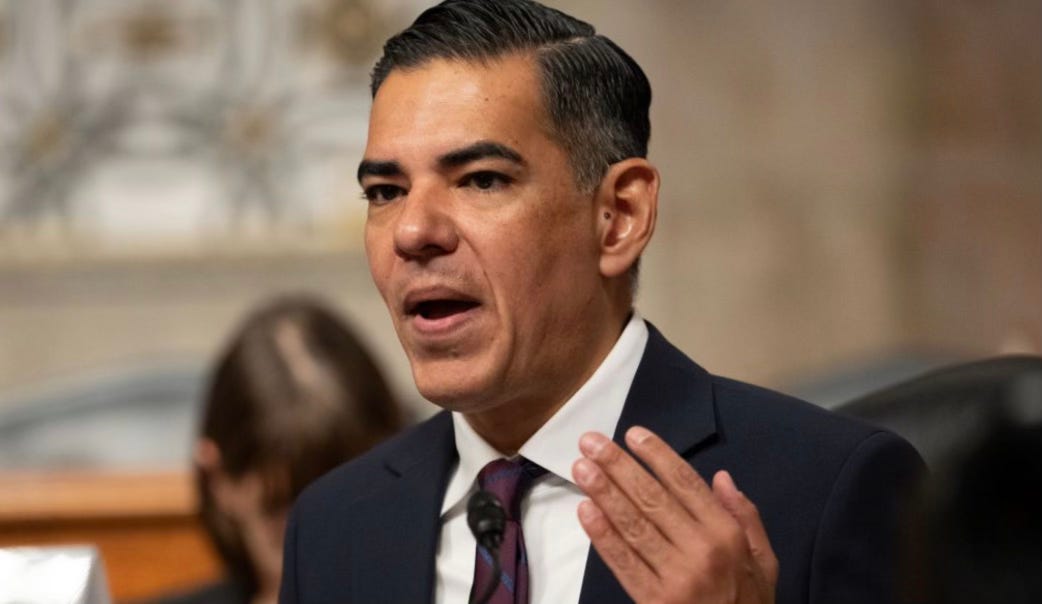
Rep. Robert Garcia (D-Calif.), expected to chair House Oversight, told the administration to “lawyer up” on election night. He’ll have the subpoenas. He won’t have the sheriff.
The Hard Truth About January 3: Democrats Can Expose, Defund, Block and Document. They Cannot Prosecute.
Promise the first four and you keep your customers; promise the fifth and you lose them.
The Jack Hopkins Now Newsletter #1,085: Thursday, November 12th, 2026.
Let me tell you about the dumbest business model I know.
A man owns a store. He suspects the manager is stealing. So he writes a stern letter describing the theft, hands it to the manager, and goes home to wait for justice.
That…is a congressional criminal referral.
If you are a Democrat counting the days to January 3, you had better understand it before you take a victory lap.
Here is the scoreboard. As of Nov 12, 1:22pm CT, the Associated Press count shows Democrats with 255 House seats won and Republicans with 169. As of 1:21pm CT, AP’s Senate count shows a Democratic total of 55 and a Republican total of 44. Those numbers may have changed since.
The results show “Majority reached” beside Democrats in the House and “Control reached” beside them in the Senate. Those labels are not a call by AP.
The incoming chairs are already posting “Lawyer up” and “Subpoenas.” Fine. Enjoy it. Now…look at the org chart.
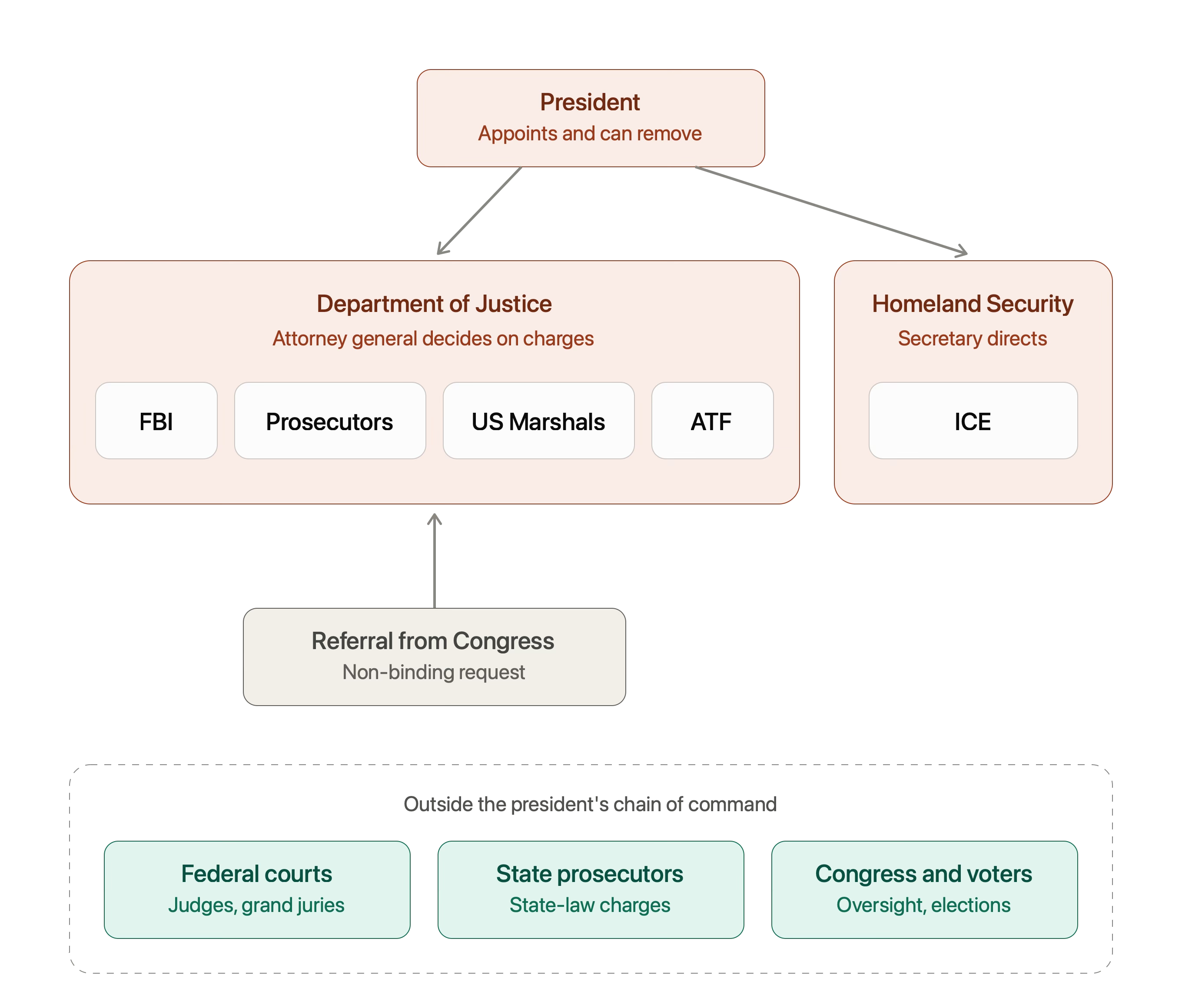
Every badge reports to one desk:
The FBI, the federal prosecutors, the US Marshals and ATF all sit inside the Department of Justice. The Attorney General runs it. ICE sits over at Homeland Security. Both departments answer to the President, who picks the bosses and can fire them.
One chain. One top.
A referral is a letter:
The Congressional Research Service calls it a “non-binding communication” that cannot force a prosecution. The Justice Department can read it…file it…or use it to level a wobbly table.
So…the party without the White House is always asking the other team’s appointees to charge the other team’s people.
This is not new, and it is not partisan. Republicans lived it under Biden. They sent over a referral to charge Merrick Garland, and his own department declined to act. Same machine. Different hands on the lever.
Three problems that start on January 3
Problem one: a subpoena with no sheriff:
A committee subpoenas an official. The official says no. Congress votes contempt and sends it to the Justice Department, which is the same chain of command the official works in.
CRS says history points to no prosecution when an executive official claims privilege. Even Fox News, covering the “lawyer up” posts, called the department’s role “a significant hurdle.”
Problem two: the clock:
You can sue instead. Then you wait. The House subpoenaed Don McGahn in spring 2019 and got his testimony in summer 2021, after the president he served had left office. A Congress lasts two years. Stalling is a strategy…and it works.
Problem three: the machine points both ways.
On November 9 the expected Oversight chairman got a letter from the White House counsel warning that Democrats’ investigation plans could cross into criminality.
Think what you like about that letter. Just notice who holds the badges…and who holds the letterhead.
And…behind all three sits the pardon power…which…can erase federal exposure for anyone the President chooses.
Seven levers that are not a referral
Stop asking the manager to arrest himself. Use what you actually own.
The checkbook. Congress funds every one of these agencies. It can attach strings. In 2025, Republican appropriators wrote spending language barring money for moving ATF’s functions into another agency. The catch: the President can veto, and then you are in a shutdown fight.
The Senate’s “no.” Attorneys general, FBI directors, US attorneys and judges need Senate confirmation. The catch: “acting” officials, who need nobody’s vote.
Courts, used like a sniper. Oversight lawyers expect selective litigation: narrow subpoenas, clear purpose, unprivileged records. Judges are outside the chain. The catch is Problem Two.
Inherent contempt. Congress has its own power to fine or arrest a defiant witness, and the Supreme Court blessed it in a unanimous 1934 ruling. The catch: nobody has pulled that lever since the 1930s. Executive branch lawyers dispute it, and the House sergeant-at-arms facing federal agents is not a picture anyone wants.
The states. State attorneys general and district attorneys answer to no president, and a federal pardon does not reach state crimes. The catch: state-law offenses only, and federal officers have immunity defenses.
The file. Hearings, sworn testimony, preserved documents. Former Justice employees are expected to talk once Congress is actually listening. Most federal crimes carry a five-year limitations period, and the next attorney general can read. The catch: pardons, again.
Impeachment. A House majority can impeach. Conviction takes two-thirds of the Senate, and no president has ever been convicted.
Notice what is missing. Not one of these puts handcuffs on anybody in 2027.
Or not
Now the other side, because a pitch that hides the objection loses the sale.
Defenders of this structure say it is the design, not a defect. The Constitution puts executive power in one elected president.
Prosecutors who answer to nobody are their own kind of danger…and both parties were glad to see the independent counsel law expire in 1999.
Republicans add…that the department was turned on Donald Trump first…and that what Democrats call oversight is harassment with a gavel. The White House letter calls the plans “abusive and capricious.” And voters have punished congressional overreach before, in both directions.
So…here is the honest offer. Democrats cannot prosecute. They can expose…defund… block…and document. Promise your customers the first…and deliver the second…and you will be explaining yourself for two years.
Sell what is actually on the truck.
“Yes, But...” Six Objections, Answered Straight
1. “Yes, but the contempt statute says the US attorney has a duty to take it to a grand jury.”
It does say that. A House contempt vote is the one referral that comes with a legal instruction attached.
But…the department has long read that duty as optional when the target is an executive official claiming privilege, and CRS expects no prosecution in that situation. A duty with no one to enforce it is a suggestion.
2. “Yes, but can’t they just get a special counsel appointed?”
Look at who does the appointing. Under the current regulations…the Attorney General picks the special counsel…sets the scope…and can remove him.
The old independent counsel law…where judges made the pick…expired in 1999. Congress could pass a new one, BUT…the President would have to sign it or be overridden.
3. “Yes, but the courts will force them to comply.”
Sometimes…eventually. Judges are outside the chain, and that matters. But…a court can order documents produced; it cannot order a prosecution.
Charging decisions belong to…yep…the executive branch, and judges have said so for decades. Add the appeals calendar and a two-year Congress, and “eventually” often means “after it matters.”
4. “Yes, but the inspector general can investigate from the inside.”
An inspector general can investigate and report. He cannot indict. His criminal findings go to the same Justice Department as everything else. And inspectors general serve at the President’s pleasure, as the mass firings in January 2025 showed.
5. “Yes, but in 2029 a new attorney general can charge all of it.”
That depends on three things that haven’t happened yet. Somebody has to win in 2028. The five-year limitations clock has to still be running.
And…the target must not be holding a pardon, which a president can issue on his way out the door. The Supreme Court’s 2024 immunity ruling also shields a president’s official acts. The file is worth building, but…it is not a guarantee.
6. “Yes, but isn’t this exactly what Democrats did to Trump, and now they want sympathy?”
That is the Republican case, and plenty of voters buy it. They point to the federal prosecutions of Trump under a Democratic attorney general and say the weaponizing started there.
Democrats answer that those cases went through a special counsel, grand juries and judges. Each side believes its own version. The org chart does not care who is right, and that is the point of the article: whoever holds the White House holds the badges.
None of this means oversight is pointless. It means it is a different product than the one being advertised.
A gavel buys you hearings, records, sworn testimony, budget leverage and a Senate veto over who runs these agencies. It does not buy you an indictment, and no amount of wanting it to will change the org chart.
So…judge the next two years by the right yardstick: what got exposed…what got blocked…what got preserved for the voters and for whoever sits in the Attorney General’s chair next.
And…remember that the same chart will be waiting for Republicans…the day the White House changes hands. Whoever tells you otherwise…is selling something that isn’t on the truck.
#HoldFast
Back soon.
-Jack
Jack Hopkins
P.S. The biggest lever is not on the list. In November 2028 somebody wins the right to appoint the next attorney general. Everything above is either building a file…for that person…or making the case to the voters who choose them.
Sources
How referrals and contempt work
Introduction to Criminal Referrals by Congress (Congressional Research Service). Congress’s own researchers explain why a referral can’t make the Justice Department prosecute anyone. everycrsreport
Congress’s Contempt Power and the Enforcement of Congressional Subpoenas (Congressional Research Service). The long version: criminal contempt, civil suits and inherent contempt, and why each one stalls against executive branch officials.
Jan. 6 committee’s criminal referrals: What they mean for Justice Department (AP via Indianapolis Business Journal). Law professors walk through what a referral is, and note that the 2018 Republican referral of Christopher Steele went nowhere. ibj
DOJ will not act on referral to charge Garland (Nordot). The Biden-era example: House Republicans referred the sitting attorney general, and his department passed. nordot
Can Congress lock people up? (Wake Up To Politics). A readable primer on the three kinds of contempt, including the rarest and oldest one. wakeuptopolitics
Democrats Could Escalate Their Fight Against Trump’s Stonewalling (HuffPost). Why lawmakers haven’t touched inherent contempt since the 1930s. HuffPost
Avoiding Another McGahn (Lawfare). The argument that Congress can enforce subpoenas without the courts, if it modernizes its old tools first. lawfaremedia
What Democrats are planning
What a Democratic Congress Means for Oversight in 2027 (Morrison Foerster). A law firm’s forecast: plenty of subpoenas, but only the strongest ones taken to court. mofo
Democrats Prep DOJ Subpoenas, Oversight Tools With Majority Win (Bloomberg Law). Former Hill investigators on the Justice Department targets, and on ex-employees who may now be willing to talk. bgov
Democrats to Use Committees as Trump Counter in Five Key Areas (Bloomberg Government). Covers the investigations plan and how appropriators intend to use the spending bills as guardrails. bgov
Congressional Investigations After the 2026 Midterms (Gibson Dunn). Lists the likely House and Senate chairs and explains why none of them is final yet. gibsondunn
Democrats Flip the House: Incoming Committee Chairs and Oversight Priorities (Jenner & Block). Committee-by-committee priorities, plus how the January rules package could change subpoena authority. jenner
Poised to head the House Judiciary Committee, Raskin considers impeaching Trump (The Banner). Raskin is open to impeachment while party leaders say affordability comes first. thebanner
Democrats vow subpoenas and Pete Hegseth scrutiny after midterm win (Fox News). The “lawyer up” coverage, including the point that the Justice Department still decides whether contempt gets prosecuted. Fox News
The White House response
White House threatens to investigate congressional Democratic investigators (The Hill). The Scharf letter to Garcia, and Raskin’s suggestion that a restraining order would be fair game. The Hill
White House threatens Democrats over new Epstein investigation plans (The Telegraph via Yahoo). More on the November 9 letter and who is reportedly first on the Democrats’ list. yahoo
Agency structure
Spending bills reject Trump plans for DOJ overhaul (Roll Call). How appropriators of the President’s own party used funding language to block the ATF merger. rollcall
Bondi defends Justice Department proposal to end standalone ATF (Roll Call). The attorney general’s case for the merger, and the statute that puts ATF inside the Justice Department. rollcall
Jack,
You laid out what Congress can't do. I want to add how to make the courts work as hard as they can for it, because I think this is where Democrats will either look smart or waste two years.
Pick a few fights and make them airtight. Every time a lawyer walks into court with a sprawling, messy demand, the other side gets to argue about how messy it is and the judge never gets to the point. A short, clear request wins faster: here is the document, here is why Congress needs it, and here is the one reason the White House has for refusing. Judges love a case they can decide in a paragraph. Hand them ten of those, not one giant tangle.
Go in early and ask for speed. You wrote about the clock, and the clock is the other side's best friend. Every request should come with a plea to move quickly, and a team that treats the first week as urgent will beat a team that treats it as a warm-up. A ruling that arrives after the next election is a nice footnote and nothing more.
Don't overlook the quiet win. A judge ordering records kept safe doesn't make headlines, but it stops the shredder, and the file you described is only as good as what survives. Ask for that early and often.
The best historical reminder is the Nixon tapes. The Supreme Court told a sitting president he had to hand over his own recordings, and he lost his presidency within weeks. Nobody went to a cell because of that ruling. The paper told the story, and the country read it. Courts can do that again if the case in front of them is clean.
Last, expect to be sued first. The White House letter you described reads like groundwork for exactly that, so build every request as if a hostile judge will read it. If it holds up under that, it holds up anywhere.
You're right that this ends in 2028. Courts decide how much is waiting on the desk when that day comes.
#HOLDFAST
Jack,
Thanks for your post…disappointing to say the least…but Congress does have the “power of the purse” and that is at least something! It also has the power to expose, as was done during the Watergate hearings, the vast level of corruption, and potentially even worse, of the Trump Administration. Not being able to prosecute them come January makes fielding great candidates, then electing Democrats in 2028 vitally important, thus setting up the ability to hold to account this corrupt President, his family, his cronies and anyone else that needs to be checked!
Thanks Jack, I always learn something new reading your posts!
#HOLDFAST…HOLDING ON TIGHTLY!
Christie