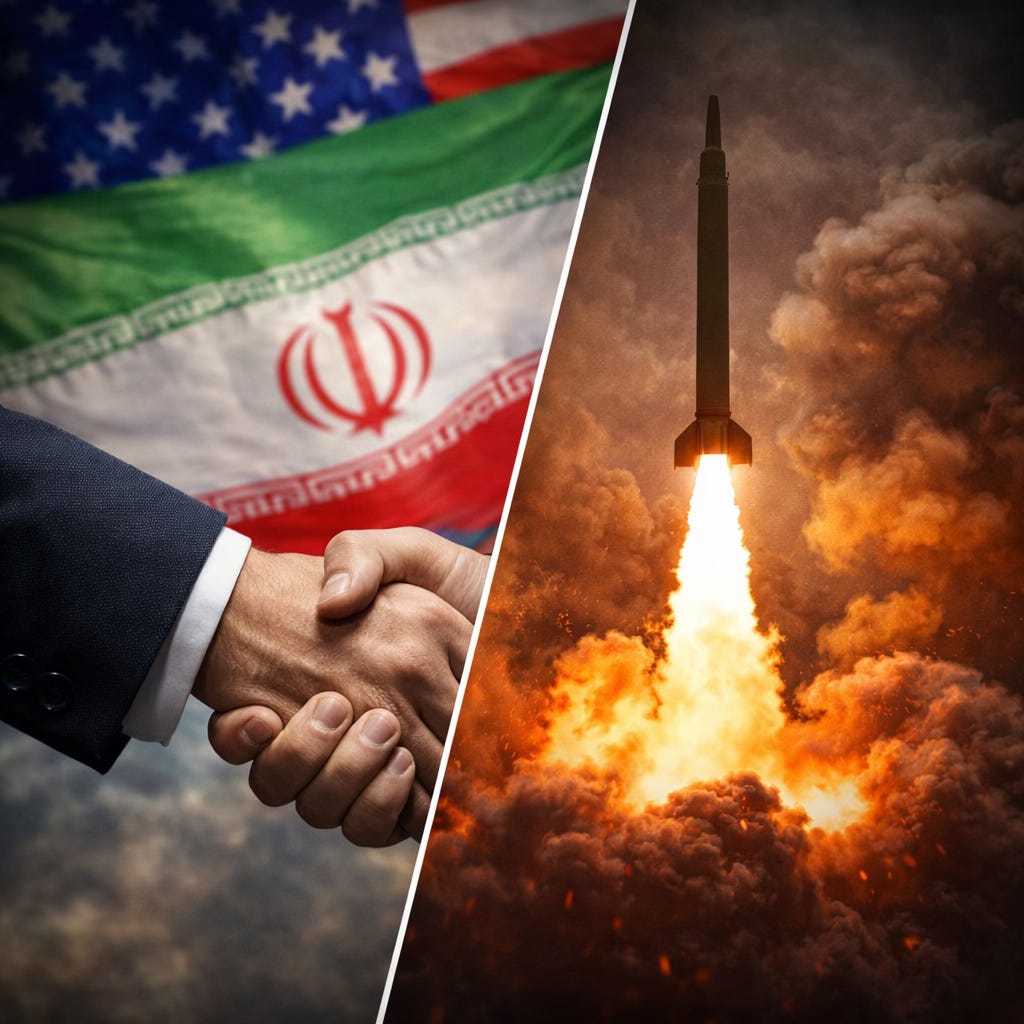
The Fatal Psychology Behind Trump’s Iran Strategy
From “Dealmaker” to Deadlock: The Iran Problem Trump Can’t Solve
The Fatal Psychology Behind Trump’s Iran Strategy
From “Dealmaker” to Deadlock: The Iran Problem Trump Can’t Solve
The Jack Hopkins Now Newsletter #831: Thursday, March 26th, 2026.
There’s a pattern here.
And…once you see it…you can’t unsee it.
Trump calls it “diplomacy.”
Iran calls it something else entirely.
And that difference…is exactly why this keeps failing.
Not because the stakes aren’t high enough.
Not because the incentives aren’t clear.
But…because the psychology is fundamentally broken.
1. The Core Problem: Coercion Disguised as Negotiation
At the center of Trump’s approach is a simple belief:
Pressure creates deals.
Sanctions. Threats. Deadlines. Military buildup.
Push hard enough… and the other side caves.
That works in real estate.
It does not work with a regime built on resistance.
Because Iran’s entire political identity is rooted in not bending to American pressure.
And that creates a psychological mismatch that makes real diplomacy nearly impossible.
During recent negotiations, U.S. tactics followed a familiar script:
Issue demands (often maximalist)
Impose deadlines
Escalate sanctions…even during talks
Signal willingness for military action
From a negotiation psychology standpoint, this does one thing very effectively:
It destroys trust.
And…once trust is gone…negotiation stops being about agreement…
…and becomes about survival.
2. The Trust Collapse That Never Recovered
If you want to understand why Iran doesn’t take Trump seriously as a negotiating partner, you have to go back to one moment:
2018
When the U.S. walked away from the nuclear deal.
From Iran’s perspective, the lesson was simple:
Agreements with the United States are temporary at best…and traps at worst.
Iran’s leadership has said outright that negotiating again is “not intelligent” after what happened last time.
So…now every move Trump makes…is filtered through that memory.
Which leads to a dangerous dynamic:
The U.S. believes pressure creates leverage
Iran believes pressure confirms bad faith
And both sides double down.
3. Incompatible Demands (A Deal That Can’t Exist)
Even if trust wasn’t broken, the structure of the negotiations itself is flawed.
Because the demands aren’t just different.
They’re incompatible.
The U.S. position:
End uranium enrichment
Dismantle nuclear infrastructure
Halt regional influence and proxies
Iran’s position:
Keep nuclear capability (at some level)
Get sanctions relief
Receive security guarantees
That’s not a gap you “negotiate.”
That’s a gap you fight over.
And…that’s exactly what’s happening.
Recent reports show proposals being rejected outright…with Iran accusing the U.S. of essentially “negotiating with itself.”
Because from their perspective…
There’s no real offer on the table.
Only demands.
4. The Deal-Maker Illusion
Here’s where the psychology gets even more dangerous.
Trump approaches foreign policy like a dealmaker.
Big moves. Big pressure. Big wins.
But…geopolitics isn’t a business deal.
It’s not about closing.
It’s about credibility…over time.
And that’s…where the illusion breaks down.
Because when negotiation becomes performative…designed to project strength rather than build agreement…other actors stop engaging seriously.
Even U.S. allies are showing skepticism.
Gulf states have openly questioned whether current “talks” are real or just political theater…citing past experiences where diplomacy was followed by escalation.
And once that perception spreads…
You’re no longer negotiating.
You’re posturing.
5. The Self-Sabotage Loop
Put it all together, and you get a loop that keeps repeating:
The U.S. escalates pressure
Iran resists and hardens its stance
Talks stall
The U.S. increases pressure further
Conflict becomes more likely
This isn’t accidental.
It’s structural.
Experts have described it as a “cycle of coercion and confrontation” that escalates tensions instead of resolving them.
And…the most important part:
Neither side believes backing down is an option.
Because politically… it isn’t.
6. Why This Will Likely Continue
Nothing about this system is changing.
Not the incentives.
Not the psychology.
Not the leadership dynamics.
If anything, recent developments suggest it’s getting worse:
Recycled proposals that Iran already rejected
Ongoing military threats alongside negotiation claims
Growing distrust from allies and regional players
And…here’s the key insight:
Diplomacy requires both sides to believe a deal is possible.
Right now…
Neither side actually believes that.
7. What This Leads To: The Real Risk
When diplomacy fails, something else fills the vacuum.
And in this case, that something is already visible.
Escalation.
We’ve already seen:
Military strikes following stalled negotiations
Retaliatory attacks across the region
American casualties in the early stages of the conflict
And that’s just the beginning.
Because once you enter this cycle…
It doesn’t stop at limited exchanges.
It expands.
Targets widen.
Alliances get pulled in.
And the cost…inevitably…lands on soldiers, bases, and civilians.
Including Americans.
BONUS: The Most Dangerous Miscalculation in This Entire Situation
There’s one assumption sitting quietly underneath all of this.
And it’s the one that gets people hurt.
The belief that escalation will stay controlled.
That it will be “limited.”
Predictable.
Manageable.
But…history doesn’t support that.
Because once diplomacy collapses…and pressure replaces it…decision-making shifts from strategy…
…to reaction.
And reaction…is where mistakes happen.
Not calculated mistakes.
Emotional ones.
Misread signals.
Overreactions.
Retaliations that go further than intended.
We’ve seen this pattern before:
A strike meant as a warning becomes a provocation
A response meant as deterrence becomes escalation
A “message” becomes a cycle
And…once that cycle starts, nobody is fully in control anymore.
Not Washington.
Not Tehran.
Not even the people giving the orders.
Because…at that point, the system runs itself.
And systems like this…don’t de-escalate on their own.
They accelerate.
That’s what makes this moment…different than most people realize.
It’s not just that diplomacy is failing.
It’s that the fallback option isn’t stability.
It’s momentum.
And momentum…in this context…only moves in one direction.
And once you understand that… the outcome stops looking uncertain…and starts looking inevitable.
The Bottom Line
This isn’t just a policy failure.
It’s a psychological one.
A system built on pressure…trying to force compliance…from a regime built on resistance.
A negotiation style that prioritizes dominance…over trust.
A strategy that confuses leverage…with legitimacy.
And until that changes…
The outcome won’t change either.
More failed talks.
More escalation.
And…a growing risk that what starts as “diplomacy” ends in something far more permanent.
#HoldFast
Back soon.
-Jack
Jack Hopkins
P.S. Most people are still thinking about this like it’s a negotiation problem.
It’s not.
It’s a perception problem.
And the side that controls perception… controls what happens next.
That’s exactly where I’m going next.


So essentially, over the years other countries have learned that U.S. leaders & diplomats are a bunch of bullies / liars with no integrity / shitweasel opportunists with big guns, a lot of planes & nuclear weapons (which we've proven we were willing to use once-upon-a-time.) So now, they don't trust us. What a surprise!!!
Jack has identified the psychological mechanism. Let me name the historical one.
What he describes has a name: escalation dominance failure. It is how wars begin that no one intended to fight.
August 1914 is the cleanest example. Every major power believed pressure would produce a short, manageable conflict. Each escalation was meant to signal resolve. The system ran itself anyway. Four years. Industrial slaughter. No one intended it. Everyone enabled it.
Jack is right that neither side believes backing down is an option. That is always the tell. When political survival and national survival become the same calculation, the space for rational decision-making disappears. Not because leaders are irrational. Because the incentive structure makes rationality indistinguishable from surrender.
One word is missing from the analysis: legitimacy. Trump does not seek a deal. He seeks a demonstration. Demonstrations do not end. They escalate until they produce an image strong enough to declare victory — or until the costs become impossible to conceal.
The P.S. is correct. This is a perception problem. And the side that controls perception in an escalation loop is rarely the side that fired first. It is the side that best defines what firing first meant.
#HOLDFAST
