Discussion about this post

User's avatar
HKJANE's avatar

Jack is correct.

The framework he has built here — election interference as an operating system rather than a discrete event — maps onto a pattern that historians of democratic erosion recognize across the twentieth century. The mechanism is not novel. What is novel is the American context, because the United States has not previously had to apply this pattern to itself with any seriousness. The assumption of immunity is the vulnerability.

The historical analysis requires one addition that Hopkins gestures toward without fully naming: this particular operating system did not emerge from a movement, a party, or an ideological project in the conventional sense. It emerged from a specific behavioral pattern in a specific individual — and that distinction matters for how we read the history.

Ideological authoritarians have programs. They can be negotiated with, moderated, occasionally redirected. What the historical record shows about leaders who are constitutionally incapable of accepting electoral loss is a different and in some ways more unstable dynamic. Mussolini had a program. So did Orbán. What each also had, and what accelerated their consolidation of power beyond what their ideological programs alone would have produced, was a psychological relationship to legitimacy that made the result of any given election simply a variable to be managed rather than a fact to be accepted. File that pattern. It predates Trump by a century. What it produces, consistently, is not a single dramatic seizure of power but an incremental renegotiation of what counts as a legitimate outcome — conducted in public, normalized over time, until the renegotiation itself becomes the system.

This is the origin point of everything Hopkins has mapped. The fraud narrative did not produce the election denial. The election denial produced the fraud narrative. The behavior came first. The operating system was built to explain and justify a prior psychological refusal — and once built, it became available as infrastructure for everyone downstream of that refusal who had their own uses for it.

File the date: January 6, 2021. Note which institutions held, and which required individual acts of courage that should not have been necessary. Note also which actors who held in that moment have since been removed, marginalized, or replaced. The question Hopkins raises — not what will he do but who would stop him — is the correct historical question. It is the question that distinguished Weimar Germany from Czechoslovakia in 1938, and it is the question that distinguished Hungary in 2010 from Poland in 2023. Institutions do not hold themselves. People hold institutions, and people can be replaced.

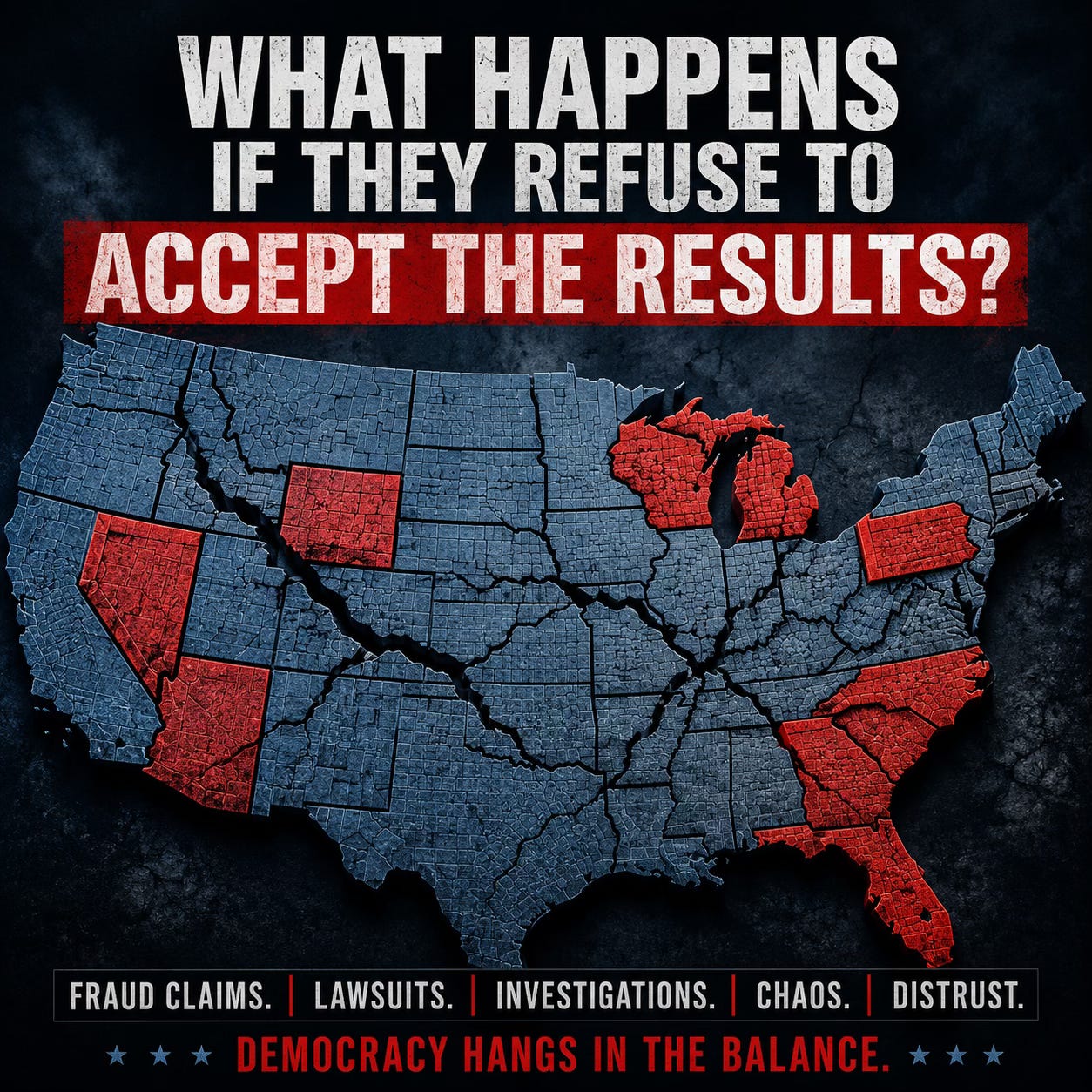
The specific innovation Hopkins identifies — manufacturing suspicion in advance of an election rather than contesting results after the fact — deserves more attention than it has received. Pre-positioning a legitimacy crisis is harder to resist than contesting a specific outcome, because it has no single moment of failure. There is no one court ruling to overturn, no one official to refuse to sign. The strategy works through accumulation, but accumulation of a particular kind: it works by exhausting the observers before the crisis arrives. By the time the certification challenge comes, the public has been living with the ambient suspicion for months. The argument feels old. The emergency feels routine. This is normalization as a tactical instrument, not merely a side effect.

Jack is correct that the decentralized structure of American elections is a genuine defense. He is also correct that it is imperfect. What he describes in Stage Two — administrative disruption through conflicting instructions, litigation timelines, and data demands — is precisely the technique by which a decentralized system can be selectively paralyzed. You do not need to corrupt every county clerk. You need to create enough uncertainty in enough jurisdictions in enough swing states that local officials, facing personal legal exposure, make conservative decisions about which ballots to count. That is not a tank in the street. That is a bureaucratic outcome that produces the same result.

Now follow Hopkins’s escalation ladder to where it ends — because he stops one step short of naming the declared destination.

Steve Bannon, the chief architect of the MAGA strategic framework, has stated publicly and repeatedly that Trump will run and win a third term in 2028, in direct defiance of the 22nd Amendment. When asked how this would be accomplished, Bannon said “we’re working on it” and described having “a couple of alternatives” without specifying them.  When pressed directly on whether this scenario involved insurrection or revolution, Bannon declined to answer. He did not say no.  He changed the subject, invoked his belief in democracy, and moved on. That non-answer is the data point historians will mark.

What this means for the operating system Hopkins has described is that the pre-positioned suspicion, the administrative disruption, the targeted investigations, the election-night narrative capture, the certification pressure — these are not only tactics for surviving 2026 or contesting 2028. They are the infrastructure for a claim that constitutional term limits do not apply when one faction’s definition of the popular will supersedes them. The psychological origin of the project is a leader who has demonstrated, across a decade and two elections, that he will not accept an adverse result. The political destination, as announced by his own strategist without retraction, is permanent power. Hopkins has mapped the road accurately. What he has not yet labeled is where the road goes.

Note which countries in the last twenty years have recovered democratic norms after a period of this kind of erosion. Note which ones have not. The recoveries — Georgia in 2020, Poland in 2023 — required sustained civic mobilization that preceded the moment of crisis. The losses occurred where mobilization came after the moment had passed. The sequence matters. Citizens who wait to see whether the worst happens have already conceded one of the most important advantages.

The deeper historical observation is this: when a leader has demonstrated across multiple elections that he will not accept losing, and when his chief strategist has announced a plan to circumvent the Constitution’s term limits while refusing on camera to rule out the means, the question is no longer whether the intent exists. The question is whether the capacity to stop it does.

The most dangerous sentence a democracy can produce is not a declaration of emergency. It is the sentence that begins: surely they would not go that far.

Mary Jo Winter's avatar

Jack, isn't it odd that, before 2020, America went 244 years with no daily accusations of "rigged elections?"

2 more comments...

No posts

Ready for more?
