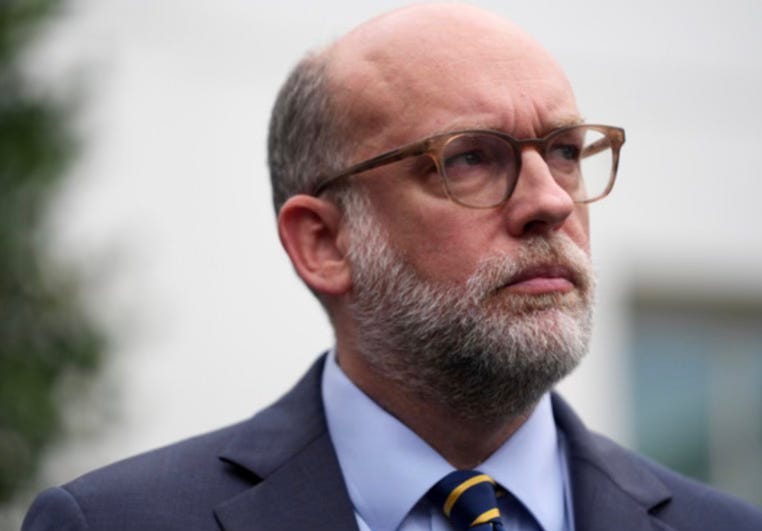
The Day Politics Replaced Science
Why Russell Vought’s New Plan Could Cost America Its Future—and Human Lives
The Day Politics Replaced Science
Why Russell Vought’s New Plan Could Cost America Its Future—and Human Lives
The Jack Hopkins Now Newsletter #917: Tuesday, June 3rd, 2026.
Imagine If This Had Happened 70 Years Ago
Imagine if politicians had been allowed to veto research into vaccines because it wasn’t politically fashionable.
Imagine if bureaucrats loyal to a president…had blocked funding for early cancer research…because it didn’t align with the administration’s priorities.
Imagine if MRI technology…weather forecasting systems…GPS navigation… semiconductor development…or the internet itself…had been forced through a political loyalty test before scientists could pursue them.
Many of the technologies that now define modern life emerged from decades of federally funded research whose practical value wasn’t obvious at the beginning.
That is precisely the point.
Scientific discovery almost never arrives with a giant sign that says:
“This will change the world.”
It begins with questions.
Experiments.
Failures.
Dead ends.
And occasionally…after years or even decades…breakthroughs.
Now…imagine a system where every one of those questions…must first receive approval from political operatives.
Because that appears to be exactly where the United States is heading.
The Quiet Story That Should Terrify Every American
Most Americans have never heard of Russell Vought.
That’s understandable.
The people who pose the greatest threats to institutions rarely dominate cable news.
They work in offices.
They write regulations.
They alter procedures.
They change rules.
And…suddenly the machinery of government starts operating differently.
Vought, Trump’s Director of the Office of Management and Budget…has become one of the most powerful figures in Washington.
Recently, the administration released a sweeping 412-page proposal…that would fundamentally alter how federal grants are awarded across government.
The proposal would give political appointees…authority to review research grants…and determine whether they align with presidential priorities before funding can proceed. Scientific peer review would remain, but only in an advisory capacity.
For decades, scientists reviewed science.
Experts evaluated expertise.
Peer review wasn’t perfect.
But it was designed to answer one question:
Is the research good?
Now another question would be inserted:
Does the research serve the political interests of the administration?
And that changes everything.
The Difference Between a Democracy and a Regime
Every democracy eventually confronts the same test.
Will power submit itself to facts?
Or will facts be forced to submit themselves to power?
Healthy democracies understand something simple:
Reality does not care who occupies the White House.
Gravity doesn’t vote.
Viruses don’t vote.
Cancer cells don’t vote.
Climate systems don’t vote.
Scientific institutions exist partly to create a zone where evidence matters more than politics.
That separation is not a luxury.
It is a safeguard.
Because once political leaders gain the ability to decide which facts deserve funding and which facts deserve extinction, truth itself becomes vulnerable.
That is how democracies begin losing their bearings.
Not overnight.
Gradually.
One institution at a time.
One rule change at a time.
One justification at a time.
The Human Cost Is Not Theoretical
Some people will hear this story and think:
“Who cares? It’s just research grants.”
That’s exactly the mistake.
Research grants are not paperwork.
Research grants are future medicines.
Future treatments.
Future technologies.
Future discoveries.
Federal funding helped create many of the innovations Americans now take for granted, from advanced computing and internet technologies to medical breakthroughs and weather forecasting systems.
The benefits often arrive years later.
Sometimes decades later.
Nobody knew exactly where semiconductor research would lead.
Nobody knew where early internet research would lead.
Nobody knew where mRNA research would lead.
Yet those investments changed the world.
The problem with political control is that politicians think in election cycles.
Science thinks in generations.
A politician wants results before the next campaign.
A scientist may spend ten years proving a theory wrong before finding something useful.
Those incentives are fundamentally incompatible.
Fear Is the Real Goal
Even more dangerous than outright censorship is self-censorship.
Researchers are smart people.
They pay attention.
If they know a political appointee can kill their grant application because it touches race, gender, public health, environmental issues, or any other politically sensitive topic, many won’t even apply.
Universities will adapt.
Departments will adapt.
Research agendas will adapt.
The chilling effect begins long before the first grant is denied.
Scientists start asking themselves:
“Will this get funded?”
Instead of:
“Is this true?”
And when that shift happens, science stops serving humanity.
It starts serving power.
This Is Bigger Than Science
The story isn’t really about laboratories.
It’s about control.
Authoritarian movements throughout history share a common characteristic:
Independent institutions become targets.
Universities.
Courts.
Journalists.
Civil service professionals.
Scientists.
Anyone capable of producing information outside political control eventually becomes a problem.
Not because they are partisan.
But because reality itself can become politically inconvenient.
Independent research creates independent facts.
Independent facts create independent conclusions.
Independent conclusions limit political power.
That is why the struggle over science funding matters far beyond academia.
America’s Greatest Competitive Advantage
The United States became a scientific superpower because it created a system that rewarded discovery.
Not loyalty.
Discovery.
The American research model attracted the world’s brightest minds because it offered something rare:
Freedom to pursue questions wherever evidence led.
That system produced extraordinary returns.
It helped build the strongest economy in human history.
It fueled technological leadership.
It improved life expectancy.
It transformed medicine.
It strengthened national security.
Now we’re watching political actors experiment with replacing that model.
And the rest of the world is paying attention.
China is paying attention.
Europe is paying attention.
Every nation competing for scientific talent is paying attention.
The message being sent is simple:
America may no longer be a place where scientific merit determines scientific opportunity.
That should alarm every citizen regardless of political affiliation.
The Real Danger
The greatest danger isn’t that one administration gains control over research funding.
The greatest danger is that the precedent survives.
Because once a power exists, future administrations inherit it.
Today’s supporters may cheer when their side controls the machinery.
Tomorrow they may discover someone else inherited it.
The founders understood this principle.
That is why democracies are built around limiting power, not trusting power.
The question isn’t whether you trust this president.
The question is whether you want any president deciding what scientific truth deserves permission to exist.
A Country That Stops Asking Questions
Scientific progress begins with curiosity.
Democracy begins with curiosity too.
Both systems require people to ask difficult questions.
Both systems require evidence.
Both systems require a willingness to discover things we don’t expect.
When politics becomes the gatekeeper for inquiry, both systems weaken.
A country that punishes uncomfortable questions eventually stops asking them.
A country that stops asking questions eventually stops learning.
And a country that stops learning eventually stops leading.
That’s why this fight matters.
Not because of paperwork.
Not because of grants.
Not because of bureaucratic procedures.
Because somewhere in America right now, a young researcher is working on a question that could save lives twenty years from now.
The question is whether that research will be judged by scientific merit—
or by political usefulness.
The answer may determine far more than the future of science.
It may determine the future of American democracy itself.
If you’ve found value in this analysis, consider becoming a paid subscriber.
The biggest threats to democratic institutions rarely arrive with tanks in the streets. They arrive disguised as administrative reforms, technical changes, and procedural updates that most people never notice until the damage is already done.
Paid subscribers get the deeper analysis connecting these seemingly isolated developments into the larger pattern that’s reshaping American institutions in real time.
Because understanding the pattern is how you protect the future.
BONUS SECTION: The Innovation Graveyard America Never Sees
Here’s the uncomfortable truth:
Most scientific breakthroughs look completely useless when they begin.
When Alexander Fleming discovered penicillin…nobody knew it would launch the antibiotic revolution.
When physicists explored quantum mechanics…nobody knew it would eventually help create computers…MRI machines…lasers…and GPS.
When researchers studied obscure strands of messenger RNA for decades…many critics dismissed it as academic curiosity.
Then COVID arrived.
And that “useless” research helped save millions of lives.
The problem with political gatekeepers…is that they almost always ask the wrong question.
They ask:
“What is this useful for right now?”
Science asks:
“What can we learn?”
History overwhelmingly favors the second question.
The tragedy is that we’ll never know which discoveries were lost because they were never funded.
We’ll never know which future cancer treatment died in a grant application.
We’ll never know which energy breakthrough was abandoned because it didn’t fit a political narrative.
We’ll never know which life-saving technology never made it out of a laboratory proposal.
That’s the cruel math of political interference.
The cost isn’t measured by the research that gets rejected.
The cost is measured by the future that never gets built.
And…unlike a bridge collapse or a market crash…those losses are invisible.
No headlines.
No breaking news alerts.
Just a slower…weaker…less innovative America…one missed discovery at a time.
That may be the most dangerous part of all.
Because when a nation starts deciding which questions are allowed to be asked…it eventually discovers there are answers it will never find.
#HoldFast
Back soon.
-Jack
Jack Hopkins
P.S. History shows that democracies rarely collapse because citizens failed to notice dramatic events. They collapse because citizens ignored the boring ones. This may be one of those “boring” stories we’ll be talking about for decades.


Thank you, Jack 🙏
All of our nations scientists are leaving their positions here in the US and going to other countries to do their research. As with the DOJ'S top attorneys, are leaving public office to practice in State's Attorneys offices and nonprofit organizations. Your article today is Spot On, Jack, and should scare the hell out of people ( it does me ) what this regime is planning for this country,is nothing short of Putin's Russia. Thank You, for another great read and will reStack ASAP 💯👍