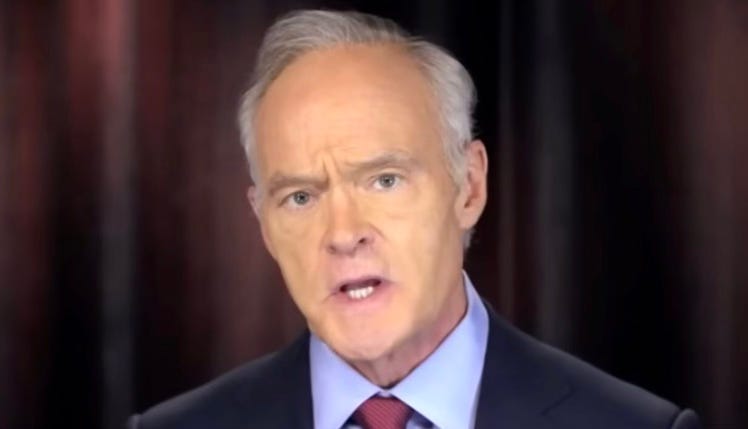
The Day CBS Fired Scott Pelley, It Fired a Piece of Its Soul
Bari Weiss Didn’t Just Inherit a Newsroom. She Set Fire to One
The Day CBS Fired Scott Pelley, It Fired a Piece of Its Soul
Bari Weiss Didn’t Just Inherit a Newsroom. She Set Fire to One.
The Jack Hopkins Now Newsletter #916: Tuesday, June 2nd, 2026.
Scott Pelley spent nearly four decades building a reputation as one of the most respected journalists in American television.
Then, according to multiple reports…he stood up in a meeting…defended journalism… criticized the direction of CBS News…accused Bari Weiss of “murdering” 60 Minutes...
...and shortly thereafter found himself out of a job.
If the reports are accurate, as it appears they are…that should terrify anyone who still believes journalism exists to challenge power rather than serve it.
Because this story is bigger than Scott Pelley.
It’s bigger than 60 Minutes.
And…it’s sure as hell bigger than Bari Weiss.
This is about what happens when institutions that once prided themselves on independence begin treating dissent as a firing offense.
Scott Pelley Said What A Lot Of People Were Thinking
Let’s start with the obvious.
Scott Pelley isn’t some random disgruntled employee.
He isn’t a rookie reporter throwing a tantrum.
He isn’t a political activist masquerading as a journalist.
He’s Scott freaking Pelley.
A man who has spent decades reporting wars…presidential campaigns…disasters…corruption scandals…and some of the biggest stories on earth.
A man whose credibility was built over tens of thousands of hours of actual journalism.
And…according to reports…he looked around CBS News and decided he could no longer stay quiet.
He allegedly accused Bari Weiss of “murdering” 60 Minutes.
Strong words?
Absolutely.
But…let’s look at the context.
Veteran producers were gone.
Veteran correspondents were gone.
Longtime editorial leaders were gone.
Questions about editorial interference were everywhere.
Several prominent journalists…were publicly warning…that something fundamental had changed inside CBS News.
Pelley wasn’t reacting to one decision.
He was reacting to a pattern.
And…apparently…speaking that pattern aloud became unacceptable.
Bari Weiss Keeps Calling This “Modernization”
That’s the word we always hear.
Modernization.
Transformation.
Reinvention.
Evolution.
Every corporate executive who destroys an institution uses the same language.
They never say they’re dismantling something.
They say they’re improving it.
They never say they’re silencing dissent.
They say they’re creating alignment.
They never say they’re replacing journalism with branding.
They say they’re preparing for the future
*Bari Weiss.
We’ve heard this script before.
The newspaper industry heard it.
Local television news heard it.
Radio heard it.
Digital media heard it.
And…the result is almost always the same:
Less reporting.
More management.
Less independence.
More messaging.
Less journalism.
More content.
What Exactly Was Broken?
That’s the question nobody seems eager to answer.
What exactly was broken at 60 Minutes?
The show has been one of the most successful and respected news programs in American history.
For decades.
Not months.
Not years.
Decades.
The brand was built on skepticism.
Aggressive reporting.
Fact-finding.
And…a willingness to make powerful people uncomfortable.
So…what was the emergency…requiring such dramatic intervention?
Who exactly was demanding that Scott Pelley be replaced?
Who was demanding that veteran journalists disappear?
Who was demanding that newsroom culture be rebuilt from the ground up?
The audience wasn’t.
The reporters weren’t.
The journalists weren’t.
The pressure came from somewhere else.
And that’s…where this story gets interesting.
The New Rule In American Media
Here’s the new rule.
You can challenge presidents.
You can challenge Congress.
You can challenge billionaires.
You can challenge corporations.
But increasingly…you cannot challenge the people who own the microphone.
The modern media executive isn’t primarily concerned with journalism.
They’re concerned with risk.
Regulatory risk.
Political risk.
Advertising risk.
Corporate risk.
Reputation risk.
The mission becomes managing exposure….rather than pursuing truth.
And when that happens…journalists become liabilities.
Especially journalists with enough credibility to speak out.
Especially journalists who have audiences.
Especially journalists whose names carry weight.
People like Scott Pelley.
The Irony Is Almost Too Perfect
For years, Bari Weiss built a reputation around criticizing ideological conformity.
She became famous for arguing that dissenting voices were being pushed out of institutions.
She warned repeatedly about intellectual monocultures.
She condemned censorship.
She criticized gatekeepers.
She portrayed herself as a champion of open debate.
And now?
One of America’s most respected journalists publicly criticizes her leadership.
Soon afterward…he’s gone.
Again, CBS has cited workplace issues and insubordination surrounding the confrontation. That’s their explanation.
But from the outside…the optics are devastating.
The message many journalists will hear is simple:
Speak up at your own risk.
Every Institution Eventually Faces This Test
There comes a moment when institutions reveal what they truly value.
Not what they say they value.
What they actually value.
When pressure arrives.
When money is on the line.
When politics become uncomfortable.
When powerful people get nervous.
That’s when the mask comes off.
And right now…CBS News appears to be going through exactly that kind of test.
Because firing Scott Pelley doesn’t communicate strength.
It communicates fear.
Fear of criticism.
Fear of dissent.
Fear of internal resistance.
Fear that the emperor might not be wearing any clothes.
What Happens Next
The most dangerous part isn’t that Scott Pelley lost his job.
The dangerous part…is what everyone else learns from watching it happen.
Young reporters learn to keep their heads down.
Producers learn which questions not to ask.
Editors learn which fights aren’t worth having.
Executives learn that purges work.
And institutions…become quieter.
Safer.
More obedient.
Less honest.
The decline rarely happens all at once.
It happens one warning shot at a time.
One firing at a time.
One resignation at a time.
One act of self-censorship at a time.
Until…eventually…people look around and wonder where all the truth-tellers went.
The Real Legacy Of This Moment
Years from now, most Americans won’t remember the specifics of the meeting.
They won’t remember the memos.
They won’t remember the corporate explanations.
What they’ll remember is simpler.
Scott Pelley stood up.
Scott Pelley spoke out.
Scott Pelley challenged leadership.
Scott Pelley got fired.
Whether that sequence was justified…or not will be debated for years. (Although, personally, I think the entire f*cking thing was a low-rate circus shit-show, and Bari Weiss is the one whose ass needs to be moved on down the road. But CBS hasn’t asked me what I think. I wish they would, though.)
But the symbolism is already written.
Because…when one of the most respected journalists in America…says a newsroom is losing its soul…and is shown the door shortly thereafter…the story stops being about one employee.
It becomes a story…about the institution itself.
And…right now, CBS News looks less like a newsroom defending journalism...
...and more like a corporation defending management.
That should concern every American who still believes journalism’s highest duty is speaking truth to power…even when the power is sitting in the corner office.
BONUS: How I Really Feel About Bari Weiss and CBS
Let me drop the polite journalist voice for a minute.
Because…if I’m being honest…this whole thing pisses me the f*ck off.
What infuriates me isn’t simply that Scott Pelley got fired.
It’s that we’re watching one of the most respected names in American journalism…get tossed aside while a bunch of highly paid executives and consultants undoubtedly congratulate themselves for being “innovative.”
Give me a Goddamn break.
American journalism isn’t dying because reporters suddenly forgot how to do their jobs.
It’s dying…because corporate cowards keep replacing journalism with brand management.
And CBS has become Exhibit A.
As for Bari Weiss?
My issue isn’t ideological.
I don’t care whether someone is conservative, liberal, libertarian, independent, or politically homeless.
My issue is hypocrisy.
For years…Bari Weiss built an entire reputation around defending dissent.
Around defending free expression.
Around defending people…who spoke uncomfortable truths to powerful institutions.
Fantastic.
I agreed with a lot of that.
But…if the first response to criticism inside your own institution…is to get rid of the critic…then what the hell was all that rhetoric worth?
Because principles don’t mean jack-shit…when they only apply to people who agree with you.
The real test comes when someone challenges YOU.
The real test comes when YOU become the authority figure.
The real test comes when YOU are the institution.
And…from where I’m sitting…CBS and Bari Weiss appear to have failed that test spectacularly. No..scratch that; they f*cked things up in a way that is usually only f*cked up that way…when it’s intentional.
What makes this even more maddening…is that they seem completely oblivious to how bad this looks.
They think this is a personnel issue.
A management issue.
An HR issue.
It’s not.
It’s a trust issue.
Every time a respected journalist disappears after speaking out…ordinary people become a little more cynical.
A little more suspicious.
A little more convinced that nobody is telling them the truth anymore.
And frankly?
Can you blame them?
Because what message are viewers supposed to take away from this?
That courage is rewarded?
That speaking honestly is valued?
That journalism matters?
Bullshit.
The lesson looks more like this:
Keep your head down.
Stay in your lane.
Don’t challenge management.
Don’t rock the boat.
And if you do, don’t be surprised when the boat sails away without you.
That’s the Goddamn lesson.
And it’s a disgrace.
Scott Pelley didn’t build the credibility of CBS News.
Thousands of journalists did.
Over decades.
Through wars.
Through scandals.
Through investigations.
Through administrations of both parties.
That credibility was earned one story at a time.
But…credibility is easy to destroy.
It only takes a handful of arrogant executives…who think they’re smarter than the institution they inherited.
And that’s what concerns me most.
Because this isn’t just about one firing.
It’s about a culture.
A culture…that increasingly values obedience over truth.
Optics over substance.
Management over journalism.
And I’m sick of watching it happen.
The people running these organizations keep acting like audiences are stupid.
We’re not.
We can see exactly what’s happening.
And…every time they pull some bullshit like this…they lose a little more of the trust they can never fully get back.
Maybe that’s the part that makes me angriest.
Not the firing.
Not the politics.
Not the personalities.
The waste.
The absolute…mind-numbing waste of institutions that once stood for something.
And…watching them burn down their own credibility…while pretending they’re saving it is enough to make anyone say:
What the hell are you people doing?
#HoldFast
Back soon.
-Jack
Jack Hopkins
P.S. The most revealing question isn’t why Scott Pelley spoke up.
The revealing question is why so many journalists inside CBS reportedly applauded him when he did.


Bari Weiss is burning CBS to the ground. I think firing Scott Pelley will lead to other journalists quitting. At least his integrity is intact. He is highly regarded in the news industry.
Jack is correct. Note which institution fired its most credible voice the moment that voice named what was happening. This is not a personnel matter. It is a pattern. When an organization replaces journalism with alignment, it does not announce the change. It announces modernization. It announces transformation. The language of improvement covers the mechanics of control. CBS did not lose Scott Pelley. It revealed what it had already become. Bari Weiss built a public reputation defending dissent — specifically, the dissent of people whose speech powerful institutions wished to silence. Note which test she failed the moment she became the institution. Principles applied only to allies are not principles. They are positioning.
Consider the foundation being dismantled. CBS News was not built on branding. It was built on Edward R. Murrow, who looked into a camera in 1954 and told the American people the truth about Joseph McCarthy when no one else in broadcasting would. It was built on Walter Cronkite, who told a nation its president had been killed, and two decades later told another nation its war was lost — and was believed, both times, because he had earned that belief across thousands of hours of honest work. It was built on Mike Wallace, who spent decades making powerful people profoundly uncomfortable in ways they could not easily dismiss or discredit. These men did not create a legacy. They created a standard. A standard that said: this institution exists to tell you what is true, even when the truth is inconvenient for the people who own the microphone. That standard is what CBS is now burning. File the date it began.
File the date: June 2, 2026. But the dismantling did not begin that day. It began when Stephen Colbert — the most-watched late night host in America, leading in the ratings — was canceled three days after he called the Trump-Paramount settlement what it plainly was: a bribe. CBS said it was financial. The audience was not confused. Then came the purge of 60 Minutes itself: executive producer Tanya Simon, gone. Correspondents Sharyn Alfonsi and Cecilia Vega, gone. Senior producers with decades of institutional knowledge, gone without cause or explanation. Then Scott Pelley, gone within twenty-four hours of naming it publicly. Each removal announced separately. Each framed as routine. But note the accumulation. Note the direction. Note who remains and who does not. What every journalist still inside that building learned across these weeks will not appear in any memo. It will live in every story they choose not to pursue, every question they decide not to ask, every uncomfortable truth they conclude is not worth the cost. This is how editorial courage dies — not in a single dramatic moment, but in the accumulated weight of watching what happens to people who speak.
Jack is correct. The personal note he added is worth sitting with: he is angry not at the politics, not at the ideology, but at the waste. The deliberate, unnecessary waste of something that took decades to build and hours to hollow. Murrow’s legacy. Cronkite’s standard. Wallace’s fearlessness. Pelley’s thirty-seven years. Colbert’s decade. Alfonsi’s investigations. Vega’s reporting. All of it assembled across generations into something that a particular kind of audience trusted in a particular kind of way — and all of it now being redirected toward a different project entirely. Consider what fills the space. If the whispers are accurate — that the new 60 Minutes makes room for voices like Joe Rogan while removing the Scott Pelleys — then we have watched something precise occur: a trust infrastructure built over fifty-eight years, quietly transferred to a purpose its builders would not recognize. That is not modernization. That is acquisition. The institution’s credibility, detached from the institution’s purpose, and pointed elsewhere. History has a name for this. The country that produced Murrow and Cronkite and Wallace has seen it before. We should not pretend we do not recognize it now. We should not pretend we do not know how it ends.
#HOLDFAST
