


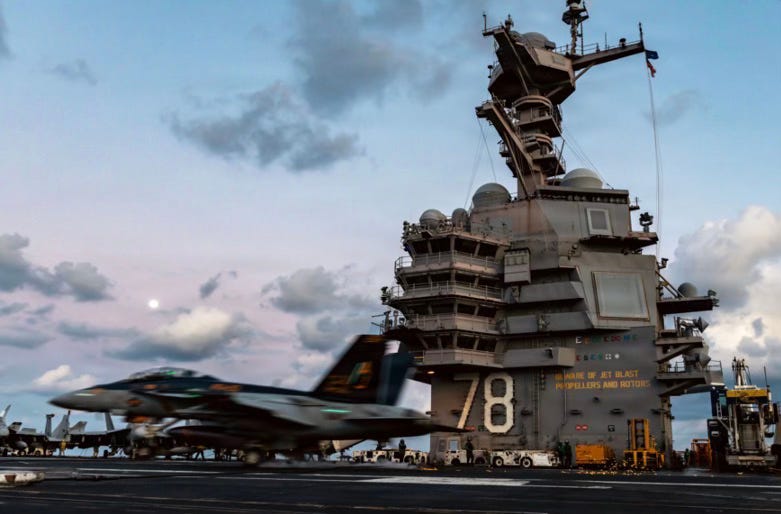
The Blockade Is Real. Here’s What Happens Now.
The Jack Hopkins Now Newsletter #864 Paid Subscriber Edition: Monday, April 13th, 2026
The free article told you this was a structural shift.
It is.
But now…the blockade is no longer an announcement.
It’s operational.
10 a.m. Eastern Time this morning…the United States Navy began enforcing a blockade of all maritime traffic entering and exiting Iranian ports.
Not a threat. Not a warning.
A live naval operation.
And the world just changed…again.
Here is what paid subscribers need to understand that the free article couldn’t cover.
What Actually Happened Between Sunday Night and Monday Morning
The gap between what Trump announced…and what CENTCOM actually implemented…is the first signal worth locking onto.
Trump said…on Truth Social and on Fox News…“all or none.” Every ship. Every direction. Complete blockade of the entire Strait.
What CENTCOM actually implemented is more specific.
A blockade of all maritime traffic entering and exiting Iranian ports. Not the entire Strait. Ships transiting the Strait between non-Iranian ports are…according to CENTCOM…not impeded.
That distinction matters enormously.
It means…the US military quietly walked back the most aggressive version of Trump’s announcement…before the ink was even dry. The president said total shutdown. The generals implemented a targeted port blockade.
That gap between presidential rhetoric and operational reality is itself a signal. The military is managing Trump’s announcement rather than executing it literally.
That has happened throughout this conflict. It is happening again…today…at a moment when the stakes for miscalculation are higher than at any previous point.
Signal
Here is the signal to lock onto right now.
Britain said no.
Not “we’ll consider it.” Not “we need to consult our partners.”
Keir Starmer told BBC radio this morning…on the record, unambiguously…“We are not supporting the blockade.”
Then France said no.
Spain’s defense minister called it something that “makes no sense.”
Turkey said no.
China condemned it.
And Australia…which Trump implied would participate…said nobody asked them.
The free article identified China as the variable that determines everything.
This signal tells you something more immediate:
Trump announced a blockade that virtually every US ally has refused to join.
He is enforcing it alone.
That is not a coalition operation. That is a unilateral US naval action in the world’s most critical energy corridor…opposed by NATO allies…condemned by China…and actively resisted by Iran…with the US military quietly moderating the president’s own stated terms.
Pattern
The pattern operating here is one we have documented throughout this conflict.
Maximum pressure announcement. Gap between announcement and implementation. Allies refuse to follow. Iran absorbs and threatens rather than concedes. The next move becomes harder to execute than the previous one.
Here is what the pattern tells you specifically about today.
Oil just crossed $104 a barrel. The blockade went live and within hours crude jumped 8%. OPEC reported last month that Middle East production fell 27%…7.9 million barrels per day….due to Strait disruption. That was before a formal US blockade targeting Iranian ports.
The domestic political math is now brutal.
This conflict was sold as short…controlled…and minimally painful for American consumers.
Gas was $3.12 when the war started. It is approaching $4.50 now. The blockade does not reduce that number. It increases it. Every additional day of port blockade…is another day of tightening supply…in an already disrupted market.
Iran’s response pattern is equally documented. Iranian army spokesman said this morning that if Iranian port security is threatened “no port in the Persian Gulf and Arabian Sea will be safe.”
That is not rhetorical bluster. Iran has demonstrated throughout this conflict the capability and willingness to strike Gulf infrastructure. Saudi pipelines. Abu Dhabi gas facilities. Kuwait terminals.
A US blockade of Iranian ports gives Iran political and strategic justification for attacking Gulf infrastructure it might otherwise have avoided targeting during a nominal ceasefire period.
