


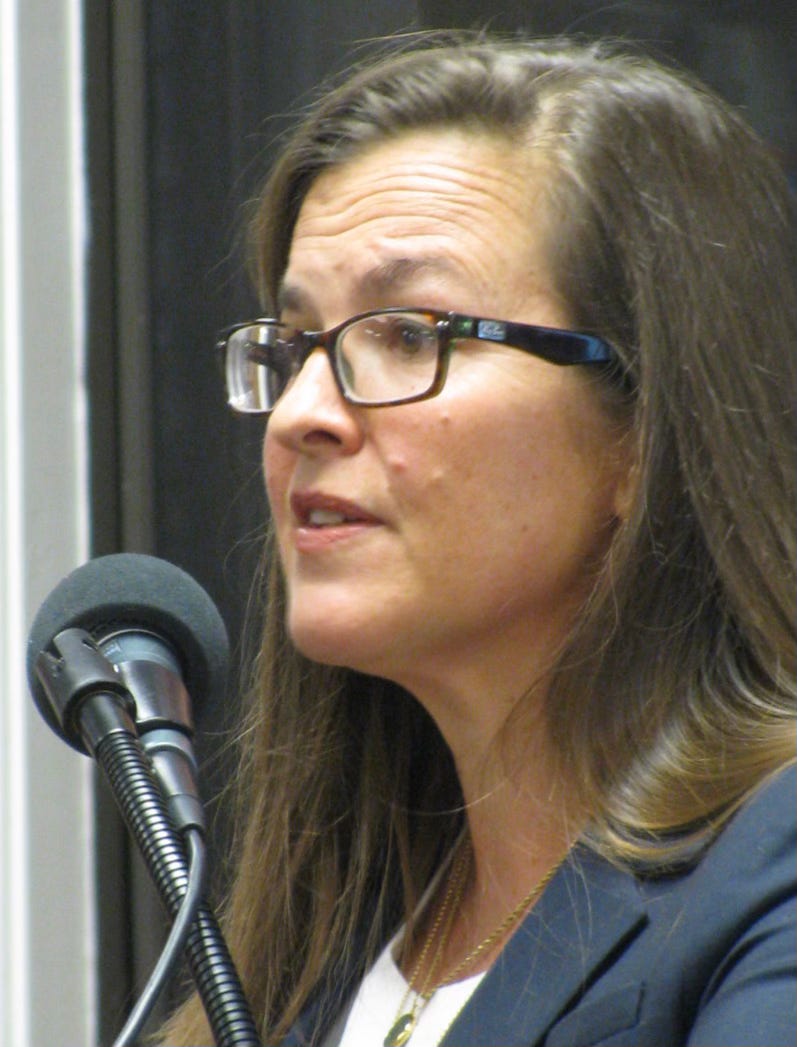
Annie Jacobsen, Pulitzer Prize finalist and bestselling author of The Pentagon's Brain and Nuclear War: A Scenario, has spent her career exposing the secrets of America's national security establishment.
Author’s Note: A Warning Before You Read
What follows covers some genuinely unsettling subject matter: biological weapons, theoretical attacks on human cognition, and what happens when fear spreads faster than facts. If you are prone to anxiety, please read this note before going any further.
I’ll be upfront about why I write about topics like this.
I believe one of the best things anyone can do to stay grounded is to educate themselves about the things that frighten them.
Fear thrives in the dark. When we understand what a threat actually is, and just as importantly what it isn’t, we’re far better equipped to cope with it.
We’re not caught off guard. We can separate real risks from rumors. And we’re far less likely to absorb the version of the story told by someone who has no idea what they’re talking about and who leaves people more frightened than before.
In my experience, knowledge is calming. Clear facts, careful sourcing, and honest acknowledgment of what remains unknown give people something solid to stand on.
But I also know that isn’t true for everyone.
Some people experience anxiety at a level where more information doesn’t settle the mind. It feeds the worry, and reading about worst-case scenarios, even carefully framed ones, can trigger days of distress.
That isn’t a weakness or a failure of logic. It’s simply how anxiety works for some people, and it deserves respect.
So if you recognize yourself in that description, please read on at your own risk. There’s no shame in closing this page, skipping ahead, or coming back another time when you feel steadier.
Protecting your peace of mind is a perfectly good reason not to read something.
If you do continue and find these ideas lingering longer than you’d like, step away, talk it through with someone you trust, or reach out to a professional if it starts to weigh on you.
Nothing in these pages is meant to frighten you. It’s meant to inform you. But only you know which of those it will do.
Read wisely, and take care of yourself.
She's Spent 20 Years Investigating Nukes, Bioweapons, and CIA Kill Teams. This Is What Finally Scared Her.
It's not a weapon you can see. It's an idea about the one thing you can't afford to lose: your mind.
The Jack Hopkins Now Newsletter #1,041: Thursday, October 1st, 2026.
Let me tell you about a woman who doesn’t scare easily.
Annie Jacobsen has spent twenty years digging through the basement of American national security. Eight books. A Pulitzer Prize finalist.
She has interviewed the men who designed the hydrogen bomb, the CIA operatives who hunted terrorists from inside garbage bins, and the Secret Service legends who once let Delta Force parachute onto the White House lawn just to prove it could be done.
She’s written about nuclear war, a full scenario from launch to nuclear winter in 72 minutes. She’s written about engineered plague, about Nazi scientists, and about killing up close and from the sky.
So when a woman like that sits down on a podcast, gets quiet, and says this:
“It’s the darkest thing I have come across in all of my reporting.”
…you should probably pay attention.
What she was talking about wasn’t a missile, a virus, or a bunker. It was a concept, discussed openly in Chinese military literature, called the brain as a battlespace.
Here’s What Nobody Is Telling You
For decades, the cognitive arms race has run in one direction: up.
DARPA studied how bears hibernate so special operators might go days without sleep. It put a chip in a rat’s brain and steered the animal through a maze by remote control. That was around 2002. The dream was always the super soldier: sharper, faster, tireless, enhanced.
Then, according to Jacobsen, somebody flipped the equation.
What if, instead of making your soldiers smarter, you made the other side’s civilians dumber?
She put it in a single sentence, and I want you to sit with it for a second:
“Imagine if you could make people so dumb that they couldn’t create plans to destroy you.”
No invasion, no mushroom cloud, no declaration of war. Just a slow, quiet erosion of a nation’s ability to think, plan, remember, and respond.
Where This Came From (And Why It Matters Who Wrote It)
This isn’t something Jacobsen dreamed up in a Hollywood writers’ room, though she does write television.
She says she learned about it from former CIA weapons-of-mass-destruction officials, and that the source is a paper by Dr. Robert Kadlec.
If you don’t know that name, you should. By Jacobsen’s account, Kadlec is a former Air Force surgeon who has advised presidents on biodefense going back to the era of that rat experiment, and he’s now back in government in a top biodefense role.
Before he returned to government service, he co-authored a heavily sourced paper examining whether COVID-19 might have come from a lab. According to Jacobsen… a big chunk of the back of that paper is source notes…including documents translated from Chinese.
And buried in that material, she says, is publicly released Chinese military writing that treats the human brain as a battlespace…with the implication that biotechnology could someday be used to degrade the thinking of Americans and the West.
Now Here’s the Part the Fear-Mongers Will Leave Out
If you’ve read this far expecting me to tell you “China did it, COVID was the weapon, your foggy memory is proof,” stop right there.
That is not what Jacobsen said…and it’s not what I’m saying.
She was careful, more careful than most people talking about this stuff on the internet.
She stressed that Kadlec’s paper does not claim there’s proof China is doing this, only that the Chinese military has discussed the possibility. When she was pressed directly on whether COVID was part of such a program…her answer was simple: “I have no idea.”
She even admitted something personal. Since COVID, she sometimes can’t pull up a person’s name; it’s right on the tip of her tongue. She counts traffic lights until it comes back. Sometimes two or three. Sometimes a mile.
Is that “COVID brain”? Is it age? Is it stress? She doesn’t know. Nobody does.
And that is exactly why she calls this the darkest thing she’s found.
Why the Idea Itself Is the Weapon
Most weapons announce themselves. A bomb goes off and you know. A missile hits and you know.
But a weapon aimed at cognition is, in Jacobsen’s words, “completely a hidden hand operation.” If it worked…you might never know it happened. You’d just feel a little slower…a little foggier…a little less sure of yourself…and you’d blame yourself.
That creates a lose-lose trap.
If the Chinese military is merely talking about it, maybe it’s posturing, a message along the lines of “look what we could do.”
But inside the American intelligence world…there are people whose literal job is to assume the worst. To them, if an adversary is talking about it…they’re doing it.
So whether the threat is real or not, the result is the same: suspicion bleeds into paranoia.
And…paranoia, Jacobsen argues…is the single most destructive force she’s encountered in two decades of reporting.
The Lesson the KGB Taught Us
Jacobsen traces this back to the Soviet playbook.
She calls making people paranoid the most grotesque thing an intelligence service can do…because it destroys trust…which she calls her personal north star.
She points to a Soviet bioweapons concept described by defector scientists: plague engineered so that taking the standard antibiotic would trigger a horrific brain disease instead.
The goal, she says, was that a dying American’s last thought would be that their own doctors and government had failed them.
That’s a weapon designed not just to kill you, but to make you distrust everyone who could help you.
Now look around. Families split over vaccines. Neighbors who won’t speak over the origins of a virus.
People asking “does this help my side?” before they ask “is this true?” Jacobsen, who refuses to share her politics publicly…says she can’t help but see that fracturing and think: that was the KGB’s intention, starting 70 years ago.
You don’t need a pathogen to degrade a nation’s thinking…if fear and tribalism will do the job for free.
Going Deeper: 10 Questions About “The Brain as a Battlespace”
1. What exactly does “the brain as a battlespace” mean?
It means treating human cognition (memory, attention, judgment, the ability to plan) as territory to be fought over…the same way militaries talk about land…sea…air…space… and cyberspace.
Analysts who study the Chinese military have written for years about what the People’s Liberation Army calls “cognitive domain operations.” Much of that concept is about information: propaganda, psychological operations…shaping what people believe.
What disturbed Jacobsen was the biological edge of the idea, the suggestion that biotechnology might someday be used to physically degrade how a population thinks. Information warfare tries to change your mind. This version goes after the brain itself.
2. Who is Robert Kadlec, and why does his name carry weight?
Kadlec is a former Air Force physician who served Assistant Secretary for Nuclear Deterrence, Chemical, and Biological Defense Policy and Programs…sworn in in late December 2025…the office responsible for responding to biological threats.
Jacobsen describes him as having advised presidents on biodefense for decades and as now being back in a top biodefense role.
That matters because this isn’t an anonymous blogger or a YouTube theorist. It’s someone who has spent a career inside the system that would have to respond if a biological threat were ever real.
3. Is there proof that China is actually doing this?
No, and this is the most important answer on this page.
Jacobsen was explicit: Kadlec’s paper does not claim proof that China is pursuing this. It documents that the concept has been discussed in Chinese military writing.
Discussion is not development, and development is not deployment. Militaries everywhere, including ours…write about ideas that never leave the page.
Anyone who tells you otherwise is selling something, and it isn’t the truth.
4. So was COVID part of a program like this?
Jacobsen was asked almost exactly that question on air. Her answer: “I have no idea.”
Kadlec’s paper examines whether COVID may have originated in a lab…which is a separate question from whether it was designed as a cognitive weapon.
A lab accident, if that’s what happened, would be just that: an accident. Jacobsen did not connect COVID to any brain-warfare program, and you shouldn’t either without evidence.
She did share her own experience of struggling to recall names since COVID. But…she offered it as an example of how this idea gets inside your head, not as evidence of anything.
5. Why would she call a theory darker than nuclear weapons or engineered plague?
Because of how it would work if it ever did.
A nuclear strike is unmistakable. Even a pandemic eventually reveals itself. A weapon aimed at cognition could be what Jacobsen calls a “hidden hand” operation: the victims might never know they were attacked. They’d simply feel duller…slower…less capable…and blame themselves or their age.
No one would rally a defense…because no one would know there was something to defend against. That invisibility is what makes it…in her words…more sinister than anything she’s thought about in twenty years.
6. Isn’t this just the flip side of what DARPA has been doing?
In a sense, yes, and that’s part of what makes it unsettling.
For decades the U.S. pursued cognitive enhancement: research into sleepless soldiers, brain-computer interfaces…and the rat steered through a maze by a brain implant. The goal was always to make our people sharper.
The brain-as-battlespace concept turns that ambition around. Once a country believes cognition can be enhanced with technology…the obvious next question is whether it can be reduced.
Every capability creates its own countermeasure question, which is the “sword and shield” logic Jacobsen describes throughout her work.
7. If it’s only theoretical, why should an ordinary person care at all?
Because the theory alone can do damage.
Jacobsen describes a lose-lose situation. If an adversary is merely talking about cognitive warfare…perhaps as posturing…then defense planners whose job is to assume the worst will treat it as real.
The public…hearing fragments of this…starts wondering whether their forgetfulness…their kids’ attention spans…or their neighbors’ strange beliefs…are evidence of an attack.
That’s how a weapon that may not exist can still erode trust. The fear is a weapon in its own right.
8. What’s the real difference between suspicion and paranoia?
Suspicion asks questions and waits for evidence. It says, “That’s worth looking into.” It can be satisfied, and it can change its mind.
Paranoia has already decided. It treats every new fact as confirmation and every lack of evidence as proof of a cover-up. It can’t be satisfied…because it was never really asking.
Jacobsen points to CIA legends like James Jesus Angleton and Frank Wisner, brilliant men who…by many accounts…crossed from one to the other with devastating results. If trained intelligence professionals can lose that line…everyone else should take it seriously.
9. How does the old Soviet plague program connect to all this?
It shows the mindset behind weapons designed to attack trust.
Jacobsen cites Soviet defector scientists who described a 1980s concept for engineered plague in which the standard antibiotic treatment would trigger a fatal brain disease instead of a cure.
As she tells it, the intent was that a victim’s last thought would be that American doctors and the American government had failed them.
That’s the throughline. The most sinister weapons don’t just harm bodies. They turn people against the institutions and each other that might save them.
Whether the target is the brain or the bonds between people, the goal is the same: a society that can’t think or act together.
10. What should I actually do with this information?
Jacobsen’s advice is refreshingly practical:
Go to the source.
Read Kadlec’s paper and its notes yourself rather than relying on summaries, including this one.
Keep your “tribe.”
Have people you trust who can pull your thinking back to center when dark ideas start taking hold.
Trust, then verify.
Not blind faith, not reflexive cynicism. Precisely because an adversary would want you to trust less, choose to trust carefully and check your facts.
Apply pressure, not panic.
Her line: “The point is not panic. It’s pressure.” Informed citizens can push for real accountability, like basic international tracking of the thousands of high-containment labs around the world, which she notes doesn’t currently exist.
So, Again, What Do You Actually Do About It?
This is where most writers would leave you scared. I won’t, and neither did she.
Jacobsen’s answer is almost stubbornly old-fashioned:
Read.
Not headlines, not clips, not some stranger’s thread. Go to the primary source and look at the notes. She says Kadlec’s paper “should be read by all,” and that’s a lot better than taking my word, or anyone’s, for what’s in it.
Separate suspicion from paranoia.
Suspicion asks questions and waits for evidence. Paranoia assumes the answer and stops thinking. One protects you; the other is the attack. (Yes, I know. But, repetition is the mother of learning.)
Keep a tribe.
She leans on family, friends, and mentors who can “move your thinking back to center” when the dark stuff gets into your head. Everybody needs people like that.
Trust, then verify.
Not blind trust, and not reflexive cynicism either. The reporter who has seen the worst our species has dreamed up says the answer is to trust more, carefully, precisely because the enemy wants you to trust less.
Her motto for all of this fits on an index card:
“The point is not panic. It’s pressure.”
You can’t fix what you won’t face. But you can fix what you’re willing to face, and that starts with a public that’s informed, alert, and still able to think clearly.
Which, if you think about it, is exactly the thing this theoretical weapon would be designed to take away.
So…don’t hand it over for free.
Paid subscribers will be getting the follow-up article regarding something else Annie has discovered.
#HoldFast
Back soon.
-Jack
Jack Hopkins
Remember, Jack's got your back.
P.S. If you want the full context, listen to Annie Jacobsen’s interview on the Dalton Fischer podcast, or pick up her book Biological War: A Scenario. Then find Kadlec’s paper and read the notes yourself.
P.P.S. Notice how you feel right now. A little uneasy? Good. Hold onto the curiosity and let go of the dread. That’s the difference between suspicion and paranoia…and you just practiced it.
P.P.S. Here’s what nobody else is telling you. Annie Jacobsen has turned up something else, something that hasn’t made the headlines yet and may never make the mainstream ones. I’ve seen it. I can’t stop thinking about it. I’m putting the full follow-up together right now…and it’s going exclusively to paid subscribers. Free readers won’t see it. Not a teaser, not a summary, not a word.
And right now, getting in costs considerably less. Until 11:59 p.m. Sunday, the regular $227 annual subscription drops to just $175. That’s $52 off. After that, the price goes back up. No extensions, no exceptions.
👉[Lock In $175 Now →]
Sources & Further Reading
Primary Sources
A Critical Review of COVID-19 Origins: “Hidden in Plain Sight” (full PDF) by Robert P. Kadlec. This is the paper Jacobsen refers to. Part II covers Chinese military-civil fusion and COVID-19’s neurological effects, including a section on concerns about Chinese military brain-control research and another on precedent for developing non-lethal neuro-incapacitating agents as weapons. tamu
Texas A&M announcement of the Kadlec report. The university’s summary notes that Chinese military strategists have expressed interest in the brain as a new combat domain and created a military medical specialty devoted to brain science. tamu
Reactions to the Kadlec report (Scowcroft Institute PDF). A collection of outside experts responding to the paper, including Alina Chan.
Dalton Fischer Podcast (Apple Podcasts). The show where Jacobsen made the “darkest thing” remarks.
Biological War: A Scenario by Annie Jacobsen (Penguin Random House)
Annie Jacobsen on The Joe Rogan Experience #2534 (Spotify). Another long-form interview about the new book.
About Robert Kadlec
Robert Kadlec (Wikipedia). He assumed office on December 29, 2025 as Assistant Secretary of Defense for Nuclear Deterrence, Chemical, and Biological Defense Policy and Programs, and earlier served as Director for Biodefense and Special Assistant to President George W. Bush for Biodefense Policy from 2007 to 2009. WikipediaWikipedia
Kadlec’s official congressional witness biography (PDF). Confirms he serves as Nuclear Weapons Council Staff Director and Executive Secretary to the Biodefense Council, and that he served as Assistant Secretary for Preparedness and Response from August 2017 to January 2021. congresscongress
Senate Armed Services Committee confirmation hearing transcript, Nov. 4, 2025
Kadlec’s Advance Policy Questions to the Senate. His own account of his career, in which he describes serving as the OSD representative to the Biological Weapons Convention and as a United Nations Special Commission weapons inspector. senate
Sen. Elizabeth Warren’s letter on Kadlec’s nomination (PDF). A critical perspective focused on conflict-of-interest concerns.
Chinese Military Writing on the “Cognitive Domain”
RAND: Chinese Next-Generation Psychological Warfare (PDF) by Nathan Beauchamp-Mustafaga. RAND organizes PLA brain-science research around four categories, including better understanding the brain and externally controlling it, and quotes PLA writing that the brain may become the main battlefield for future wars. randrand
NATO Innovation Hub: Cognitive Warfare report (PDF) by François du Cluzel. The report states that China has adopted a broader definition of cognitive warfare that includes the systematic use of cognitive science and biotechnology to achieve “mind superiority.” innovationhub-act
Irregular Warfare Initiative: “We’re WEIRD and Our Adversaries Know It”. Cites a September 2022 PLA Daily definition in which cognitive domain operations take the human brain as the main combat space and aim to weaken and dismantle the enemy’s will to fight by exploiting psychological weaknesses. irregularwarfare
Jamestown Foundation: Cognitive Domain Operations Against Vietnam. Notes that, per the Defense Department, the PLA is interested in leveraging AI, big data, and brain science for cognitive operations because it perceives these technologies will lead to profound changes in the ability to subvert human cognition. jamestown
Cognitive warfare (Wikipedia overview). A general introduction to the concept and its competing definitions.
Critical Perspectives and Counterpoints
Accountability Journalism Institute: “A Dazzling Tower of Inference” by Wendy Orent. A skeptical review of Kadlec’s work arguing that his analysis rests on assumptions, including that coronavirus research was aimed at producing a biological weapon that causes brain damage. The reviewer adds that COVID’s ability to cause brain fog is certain, but whether the Chinese military really wants neurological weapons she does not know. accountabilityjournalismaccountabilityjournalism
City Journal: “Was Covid a Chinese Bioweapons Research Project?”. A more sympathetic overview of the report’s evidence and its most contentious claims.
Annie Jacobsen (Wikipedia). Includes past criticism of her work; for example, Richard Rhodes criticized one of her earlier books for its reliance on a single source. Worth including so readers can weigh her reporting fairly. Wikipedia
Background on Topics Referenced in the Article
Talwar et al., “Rat navigation guided by remote control,” Nature (2002). The original “ratbot” study, published May 2, 2002.
Guided rat (Wikipedia). Explains that the rats were developed in 2002 by Sanjiv Talwar and John Chapin at SUNY Downstate Medical Center. Wikipedia
Statement by Dr. Kenneth Alibek on the Soviet bioweapons program. The former Biopreparat deputy chief testified that for agents that could be treated, such as plague with antibiotics, the Soviets sought antibiotic-resistant or immunosuppressive variants. lsu
MIT Technology Review: “The Knowledge”. Features defector Sergei Popov, who described a Soviet strategy for hiding viral genes inside a milder bacterium so that treating the first infection would trigger the second. technologyreview
Global Biodefense: Explosion confirmed at Russia’s Vector lab (2019). The real event behind the opening of Jacobsen’s scenario.
James Jesus Angleton (Wikipedia). On Angleton’s hunt for a Soviet mole, where whether it was a destructive witch hunt or appropriate caution remains a subject of intense historical debate. Wikipedia
Excellent and compelling piece. Unsettling, yes. Timely and balanced, definitely yes. Paranoid ideas are among the most corrosive to the self and to society. The loss of trust takes only a short time; regaining that trust takes far longer. Part of the paranoid mindset is to attribute enormous competence to the opposition, but most things are more cockup than conspiracy, and your balanced take of this is if anything the big take-home message of your piece - at least as I read it. Also, as you imply, you can’t be too well informed. Comparing sources, even (especially) when you strongly agree or strongly disagree with one opinion. Echo chambers are far easier to create than to avoid. This piece goes a long way to avoiding the echo chamber. Harder and unglamorously painstaking; but fundamentally necessary. Thank you for this
Trust, then verify… I’ve used this for years, call me a sceptic.
Great piece Jack.