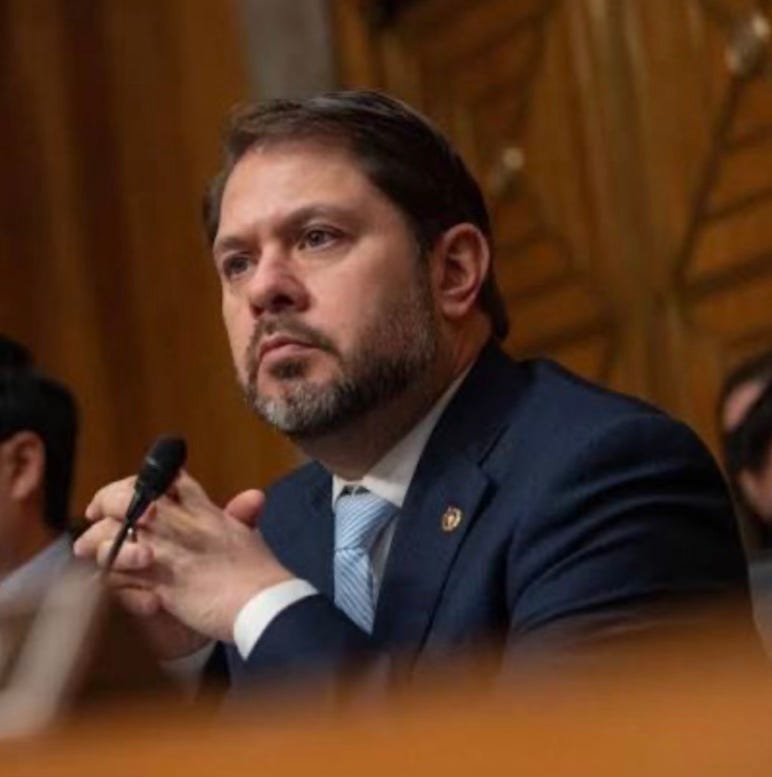
Senator Ruben Gallego: If They Touch the Vote, We Touch the Economy
Senator Ruben Gallego.
Senator Ruben Gallego: If They Touch the Vote, We Touch the Economy
The Jack Hopkins Now Newsletter #785: Thursday, February 19th, 2026.
Senator Ruben Gallego floated an idea that made a lot of people sit up straight.
I first read about what he was proposing in this article from February 5th, 2026:
If a White House ever attempted to interfere with national elections…if counts were halted, if federal muscle was used to intimidate voters, if the process itself was bent…then the response, he suggested, shouldn’t be hashtags.
It should be a national shutdown.
Pilots don’t show up.
Train operators don’t show up.
Teachers don’t show up.
We grind it all to a halt.
And…then he said the quiet part out loud: economic stability does not exist without democratic stability.
That’s not rhetoric. That’s leverage.
I really like Senator Gallego. I also respect the hell out of him for his military service.
I think he’s a smart guy…and…I see how what he proposed can work.
Let’s be disciplined…and look at why that idea would be effective.
Let’s also examine what would make it work…even better.
Why a General Strike Threat Works
First, because it shifts the center of gravity.
Election interference thrives on two assumptions:
That normal life will continue.
That economic elites will tolerate chaos as long as markets stay open.
A credible nationwide shutdown breaks both assumptions instantly.
The moment credible sectors signal, “If you break the vote, we break the economy,” you introduce a second battlefield. And this battlefield is not ideological. It’s financial.
Markets price risk.
Boardrooms hate instability.
Major donors loathe unpredictability.
If political interference suddenly carries the threat of grounded flights, frozen ports, empty classrooms, and halted logistics, the pressure shifts upward…fast.
Second, it nationalizes consequences.
Election administration is largely state-driven. Interference often works through confusion, intimidation, or procedural choke points.
A general strike says: “You may try to localize the interference, but we will nationalize the response.”
That changes the calculus for anyone considering pushing procedural boundaries.
Third, it breaks the fog strategy.
Interference often depends on narrative chaos…multiple explanations, legal ambiguity, competing claims.
A unified economic stoppage is clarity.
It’s a line.
And clarity under pressure…is destabilizing for people trying to blur the line.
Fourth, it activates elite constraint.
Authoritarian moves rarely collapse because of outrage. They collapse…because people with leverage decide the cost is too high.
If a strike threat becomes credible…governors…CEOs…investors…insurers…and legislative leaders suddenly have a reason to apply quiet pressure.
And quiet pressure is often more effective than loud protest.
So…yes…Gallego’s instinct is strategically sound.
But.
A true nationwide general strike in the United States is extraordinarily difficult to execute.
Coordination challenges. Legal constraints. Uneven protections for workers. Risk of backlash if it appears partisan or premature.
If it fizzles…it strengthens the very forces it was meant to deter.
So the real question isn’t “Is it powerful?”
It’s:
How do we make it credible?
How to Make It Even More Effective
1. Define Clear, Observable Triggers
The biggest weakness in a mass shutdown concept is ambiguity.
You don’t say, “We might strike if we don’t like what’s happening.”
You define red lines:
Federal agents interfering with state vote counts.
Direct orders to halt certification without lawful cause.
Intimidation operations at polling locations.
Unlawful seizure of election materials.
Executive attempts to override state-certified results.
Clear triggers do three things:
They prevent overreaction.
They preserve legitimacy.
They strengthen unity.
People are far more likely to participate in a defense of process than a protest of personality.
2. Start With Procedural Constraint First
Before a shutdown, you escalate through institutional friction.
Immediate litigation.
Emergency injunctions.
State attorney general actions.
Public documentation timelines.
Rapid investigative reporting.
Procedure creates paper.
Paper creates liability.
Liability creates hesitation.
The strike becomes the final rung…not the first.
When procedural remedies are clearly being ignored or overridden…a broader economic response becomes far more defensible.
3. Use Targeted Economic Choke Points Before “Nationwide”
Instead of “everyone everywhere,” think leverage concentration.
Ports.
Air travel hubs.
Rail corridors.
Strategic consumer boycotts.
Corporate investor pressure campaigns.
Targeted disruption is often more effective than diffuse disruption.
It signals seriousness…without requiring universal participation.
And…it reduces backlash among people who might otherwise agree with the principle …but…fear total collapse.
4. Frame It as Defense of Stability
Messaging matters.
“Destroy the stock market” sounds reckless.
“Protect the stability that markets require” sounds responsible.
This isn’t about vengeance.
It’s about defending the precondition of economic order: legitimate elections.
No bank, no pension fund…no Fortune 500 board wants to operate in a country where vote counts can be altered by executive whim.
That’s not partisan.
That’s systemic.
The framing must be calm…procedural…and disciplined.
This is not a tantrum.
It’s a firewall.
5. Build Cross-Ideological Anchors
Election integrity is not owned by one party.
Veterans groups.
Small business associations.
Faith communities.
Agricultural coalitions.
Local chambers of commerce.
The broader the coalition defending the vote…the harder it is to caricature the response as partisan hysteria.
Autocracy thrives on isolation.
Defense thrives on coalition.
6. Make the Time Horizon Explicit
Indefinite shutdowns create fear.
Time-bounded, goal-specific actions…create leverage.
Example:
“If certification is obstructed unlawfully, we halt for 48 hours pending restoration of lawful procedure.”
Specific demands.
Specific duration.
Specific exit criteria.
That is strategic pressure.
The Real Power: Credible Consequence
The most important insight is this:
The strike does not have to happen to be effective.
It has to be credible.
Credibility comes from:
Clear triggers.
Escalation ladder.
Institutional backing.
Cross-sector alignment.
Calm, disciplined framing.
When those elements exist, the mere possibility of shutdown can deter interference.
Authoritarian impulses thrive when they believe resistance will be chaotic, fragmented…and reactive.
They falter…when resistance is structured, predictable, and prepared.
The Bottom Line
Senator Gallego is right about one thing that matters deeply:
Economic stability depends on democratic stability.
If a White House…or anyone…tries to bend or break election procedures…the response cannot be limited to tweets and televised outrage.
It must create cost.
But the smartest way to create cost is not spontaneous combustion.
It’s strategic sequencing.
Define the line.
Document the breach.
Engage procedural constraint.
Concentrate leverage.
Escalate only if necessary.
And…do it calmly.
Because the real advantage…in moments like that…does not belong to the loudest faction.
It belongs to the side that understands systems.
If interference ever comes, the goal isn’t chaos.
It’s restoration.
And the most powerful shutdown…is the one that makes interference impossible before it even starts.
#HoldFast
Back soon.
-Jack
Jack Hopkins


Thank God there are people out there willing to step up and do the right thing still. Bravo Senator Gallego.
This is great news! There are some heroes out there afterall!
