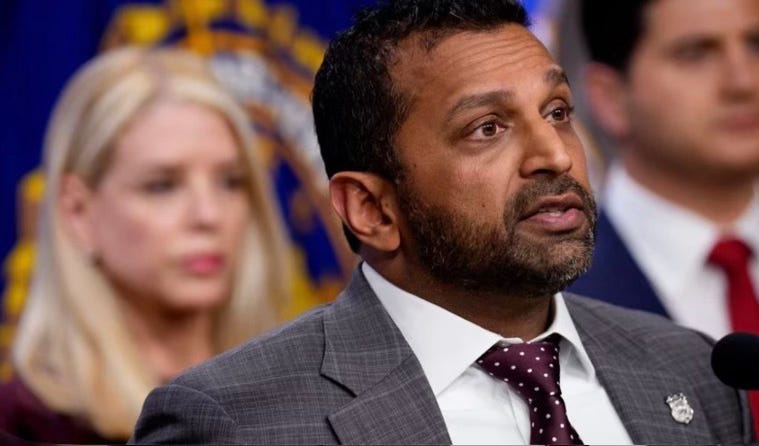
Patel Fired the Iran Experts. Then He Lit the Match.
The Jack Hopkins Now Newsletter #802: Tuesday, March 3rd, 2026.
In the final week of February 2026, FBI Director Kash Patel carried out a tightly targeted purge inside the Bureau.
Not a budget trim.
Not a retirement wave.
Not routine discipline.
A purge.
Over roughly 48 hours, at least a dozen FBI personnel were removed…several directly tied to the Mar-a-Lago classified documents investigation.
But…buried beneath that headline…was the part that actually matters:
Among those pushed out were individuals connected to counterintelligence operations…specialists in handling classified material cases, foreign intelligence tradecraft, and threat analysis…including personnel linked to the Bureau’s Iran-focused counterespionage lane.
That is not interchangeable work.
That is not “HR reshuffling.”
That is the immune system of the country.
And…Patel knew exactly what he was cutting into.
He knew these weren’t paper shufflers. He knew they handled complex foreign intelligence threats. He knew they understood Iran’s asymmetric retaliation patterns… the cyber intrusions..the proxy networks…the recruitment efforts, the influence ops, the sleeper chatter.
He knew they were part of the machinery that detects retaliation before it becomes blood on pavement.
And…he fired them anyway.
Days later…February 28…the President launched Operation Epic Fury, a sweeping strike campaign against Iran that killed Ayatollah Khamenei and hit hundreds of strategic targets.
Let’s remove all theater from this.
When you strike Iran at that scale, retaliation is not a possibility.
It is a certainty.
It may be delayed.
It may be indirect.
It may be cyber instead of kinetic.
But…it comes.
Every serious counterintelligence professional on earth knows that.
Which brings us to the question no defender can answer cleanly:
Why would you degrade Iran-focused counterintelligence capacity days before triggering the very escalation that makes that capacity indispensable?
There are only three explanations.
One:
Catastrophic incompetence.
Two:
Personal grievance prioritized over national security.
Three:
Intentional degradation.
There is no fourth option.
Let’s eliminate the comfortable lies.
“Incompetence” does not survive scrutiny.
Patel is not ignorant of geopolitical realities. The strike rhetoric was public. The tension was public. The possibility of military action was not hidden inside classified channels. Escalation was openly discussed.
You do not need clairvoyance to anticipate blowback from a strike on Iran’s leadership.
Any Director who cannot see that should not hold the job.
So if incompetence is off the table, what remains?
Grievance.
The firings were publicly framed as retaliation for alleged investigative overreach connected to the Trump documents case.
Even if we grant that narrative at face value…it makes the situation worse.
Because…it means the Director of the FBI knowingly subordinated operational readiness to score-settling…at the exact moment when readiness mattered most.
That is not reform.
That is capture.
But…here is where the argument gets uncomfortable.
Because even grievance…does not fully explain the timing.
If your goal is revenge…you can wait a month.
You can wait a quarter.
You can phase personnel changes gradually.
Instead, this happened in a compressed burst….immediately before escalation.
That is not how responsible leaders behave when war clouds gather.
Responsible leaders stabilize.
They lock down personnel continuity.
They protect expertise.
They reinforce interagency coordination.
They do not create turbulence…inside the Bureau…while lighting a geopolitical fuse.
Unless…turbulence is useful.
Let’s speak plainly.
Chaos creates gaps.
Gaps create missed signals.
Missed signals create surprise.
And surprise…creates narrative control.
If retaliation occurs…you blame the adversary.
If retaliation doesn’t occur…the purge fades into memory.
Either way, the internal power consolidation stands.
This is how institutions are hollowed out.
Not abolished.
Hollowed.
You remove seasoned personnel who know too much…saw too much…or handled politically inconvenient cases.
You replace competence…with loyalty. You create fear inside the ranks. You teach everyone watching…that career survival depends on alignment…not merit.
The external damage becomes collateral.
And collateral damage, if useful…is not a bug.
It’s leverage.
Now…let’s talk about what was actually lost.
Counterintelligence against Iran is not generic law enforcement.
It requires:
• Deep familiarity with Iranian intelligence tradecraft
• Understanding of proxy networks and cut-outs
• Years-long source cultivation
• Contextual memory of prior retaliation cycles
• Pattern recognition that cannot be learned from a memo
When you remove experienced CI personnel abruptly…you lose tempo.
You lose nuance.
You lose the subtle warning indicators that tell you something is about to move.
You don’t replace that overnight with a reassignment order.
You don’t rebuild it with a press statement about “robust operations.”
And here is the core point that defenders cannot evade:
Intent does not require a secret memo.
Intent exists when foreseeable consequences are understood and accepted.
If you understand that firing specialized counterintelligence personnel will weaken detection capacity during a high-risk escalation window…and you do it anyway…you are accepting that weakness.
At minimum.
At worst…you are creating it on purpose.
No serious FBI Director would make that trade.
None.
You do not cut into your immune system before exposing the body to infection.
You do not destabilize your counterespionage lane before striking a regime known for asymmetric retaliation.
You do not do that unless protecting the institution is no longer your primary objective.
And that is the real fear here.
Because this is not a one-off decision in a vacuum.
In recent months, dozens of experienced officials have been forced out or sidelined. Senior personnel churn. Lawsuits alleging retaliation. Public criticism from within.
The pattern is clear:
Competence leaves.
Loyalty rises.
Fear spreads.
That environment does not produce sharper intelligence.
It produces silence.
It produces hesitation.
It produces institutional fragility precisely when strength is required.
So when a reasonable person looks at this sequence…purge, then strike…they are not irrational to ask whether the damage was intentional.
They are applying basic cause-and-effect reasoning.
When harm is predictable…
When timing is precise…
When the beneficiaries of chaos are the same people consolidating power…
Suspicion is not hysteria.
It is the first sign that you are still capable of independent thought.
The burden of proof is not on the public to prove sabotage.
The burden is on leadership to explain why degrading specialized counterintelligence capacity immediately before escalation was necessary.
And…so far…no explanation survives daylight.
Not incompetence.
Not grievance.
Not coincidence.
When you remove the Iran experts and then launch the strike, you don’t get the benefit of naïveté.
You get scrutiny.
Because at some point…repeated institutional damage stops looking accidental. (It reached that point for me long ago.)
And starts looking like design.
BONUS: 10 Rock-Solid Reasons This Looks Intentional to Me
I don’t use that word lightly.
“Intentional” is heavy. It implies forethought. It implies awareness. It implies that consequences weren’t an accident….they were weighed and accepted.
Here are ten reasons I cannot dismiss that possibility.
1. The Timing Was Compressed-Not Gradual
This wasn’t a slow leadership transition.
It wasn’t phased restructuring.
It wasn’t a months-long reorganization plan.
It happened in roughly 48 hours.
When personnel moves occur in a compressed burst…immediately before a predictable escalation event…that’s not bureaucratic drift. That’s a deliberate window.
Compression signals urgency.
Urgency signals purpose.
2. The Strike Was Not a Surprise
The rhetoric was public.
The tension was escalating openly.
Strike chatter was not buried in classified whispers.
Any Director with access to basic intelligence assessments would anticipate retaliation planning inside Iran’s networks.
Removing Iran-focused counterintelligence specialists…days before a strike…is not something you do accidentally.
You do it knowing escalation is imminent.
3. These Were Specialized Roles-Not Generic Seats
Counterintelligence isn’t plug-and-play.
You don’t swap in a white-collar crime analyst and call it a day.
Iran tradecraft expertise takes years to build…source handling…pattern recognition… cultural fluency…prior retaliation memory.
The individuals removed were not interchangeable line agents.
They were part of the detection architecture.
That architecture was deliberately weakened.
4. Responsible Leadership Does the Opposite Before Escalation
Before major military action, serious institutions:
• Lock down experienced personnel
• Reinforce continuity
• Increase interagency coordination
• Expand analytic capacity
They do not create internal turbulence.
If the goal were stability…the purge would have waited.
It didn’t.
5. Revenge Could Have Waited
Even if we grant the grievance narrative…
Why now?
If the motive were purely retaliatory over past investigations…there was no operational deadline forcing a February window.
Revenge has no expiration date.
But escalation windows do.
That overlap matters.
6. The Predictable Consequence Was Weakened Detection
This isn’t theoretical.
When you remove experienced CI personnel, you:
• Lose contextual memory
• Lose source trust
• Slow signal processing
• Increase analytic blind spots
Those consequences are obvious to anyone who has run counterintelligence operations.
Foreseeable consequences accepted = intent.
7. The Beneficiary of Chaos Is Internal Power Consolidation
If retaliation occurs?
Blame Iran.
If retaliation doesn’t occur?
The purge fades into administrative history.
In both scenarios, experienced personnel are gone and loyalty pressure increases.
That asymmetry benefits the consolidator.
That is not random.
8. The Pattern Extends Beyond One Event
This did not occur in isolation.
Recent months have seen:
• Senior departures
• Public retaliation allegations
• Loyalty signaling from leadership
• Institutional churn
When a pattern of hollowing precedes a high-risk decision…it strengthens the inference of design.
Patterns are how intent reveals itself.
9. No Coherent Operational Justification Has Been Offered
If degrading Iran-focused counterintelligence capacity was necessary…where is the operational rationale?
Where is the articulated risk tradeoff?
Where is the “here’s why this improves readiness” explanation?
Silence in the face of predictable scrutiny suggests the move wasn’t about readiness at all.
10. The Risk Was Asymmetric and Known
Iran does not retaliate symmetrically.
It retaliates through:
• Cyber intrusion
• Proxy violence
• Sleeper networks
• Influence operations
Those threats are precisely what counterintelligence lanes monitor.
Weakening that lane before triggering those exact threat vectors…is not a neutral act.
It is a directional one.
Let me be clear.
I am not claiming possession of a secret memo.
Intent rarely arrives on letterhead.
Intent reveals itself through timing…pattern…beneficiary analysis…and acceptance of predictable harm.
When:
• The harm is foreseeable
• The timing is precise
• The expertise removed is directly tied to the coming threat
• The consolidation benefits the same leadership making the decision
It stops looking like coincidence.
It starts looking like design.
And…if I’m wrong, the explanation should be easy.
Transparent.
Detailed.
Operationally coherent.
Until then…skepticism isn’t paranoia.
It’s pattern recognition…and smart as hell.
#HoldFast
Back soon.
-Jack
Jack Hopkins
P.S. If retaliation unfolds in the weeks ahead…cyber disruptions, proxy violence, “isolated” security breaches…unexplained intelligence misses…remember this sequence.
The purge came first.
The strike came second.
Read events in order.
Because…once narrative management kicks in…you’ll be told everything is disconnected. Random. Unrelated. Impossible to predict.
It wasn’t unpredictable.
The risk was visible.
The expertise was known.
The timing was deliberate.
History doesn’t just record explosions.
It records what was dismantled…right before them.
And…I’m going to be watching….like a hawk.
Stay oriented.
P.P.S.
Everything in this piece came from publicly available reporting. Court filings. Official statements. Open-source analysis. Nothing whispered in a parking garage. Nothing “inside.”
And…I want to say something gently here.
The advantage you get from reading this newsletter isn’t secret access.
It’s sequencing.
It’s filtration.
It’s pattern recognition…applied to information that’s already sitting in plain sight.
There’s a cognitive illusion most people don’t realize they’re living inside:
When information is everywhere, it feels like understanding is everywhere.
It isn’t.
Raw data creates noise.
Noise creates confusion.
Confusion creates passivity.
What changes your sense of clarity isn’t more information. It’s structure.
When you finish reading and think, “Okay. Now I see it. Now I understand how these pieces fit.”…that moment isn’t accidental.
That’s orientation.
It’s the difference between looking at puzzle pieces scattered across a table… and seeing the picture on the box.
Most platforms compete on access.
Very few compete on integration.
And integration is rare…because it requires slowing down long enough to ask:
What happened first?
What happened next?
Who benefits from the sequence?
What was foreseeable?
What changed inside the institution before the external event?
That kind of framing doesn’t shout. It doesn’t sensationalize. It doesn’t rely on “insider” mystique.
It simply connects.
There’s research in cognitive psychology showing that when people encounter information arranged in coherent narrative order…their comprehension deepens and their retention increases…even if every individual fact was already known to them.
In other words: clarity feels like discovery.
And when clarity arrives…it often feels like your own insight.
That’s not an accident either.
If you’ve found yourself reading here and thinking, “This makes more sense now than it did before,” that’s the work.
Not secret sourcing.
Not theatrics.
Just disciplined pattern recognition…applied consistently.
There are thousands of places to get headlines.
There are very few places designed to help you leave with orientation.
If that difference matters to you…and if finishing a piece feeling steadier, clearer, more grounded in cause-and-effect matters…then you already understand what this space is.
And…why it’s built the way it is.
Pause with that…for a moment.
-Jack
Sources / Further Reading
At least 10 FBI staffers who worked on Mar-a-Lago documents case are fired, sources say (CBS News)
U.S. and Israel launch “Operation Epic Fury” military campaign against Iran (Rolling Stone)
Death toll climbs to six US troops in Operation Epic Fury (Military.com)
From Karachi to Beirut, Khamenei’s death sends shockwaves across the Shiite world (Associated Press)
Sixth American service member killed in Iran operation (The Guardian)
How Cyber Command contributed to Operation Epic Fury against Iran (Nextgov/FCW)
Iran Update, February 25, 2026 (Critical Threats Project / ISW)


In a time crunch now, I must read you message late tonight. Meanwhile, here is another important petition.
🚩Here is a petition. Whether or not the war is deemed legal or illegal, Common Cause has this petition. Please sign
🚩A PETITION AT COMMON CAUSE TO STOP THE ILLEGAL WAR
This petition at the Common Cause site is to ask Congress to stop the illegal war. There is a place to add a comment. Usually petitions carry more weight when they contain comments.
🚩https://act.commoncause.org/petitions/tell-congress-no-illegal-war-with-iran?
Jack, Your analysis of whether or not Republican Senators and Representatives are more likely to defy Trump now vs earlier this year? Are they like frogs in a slowly heated pot, or can they still jump?
