


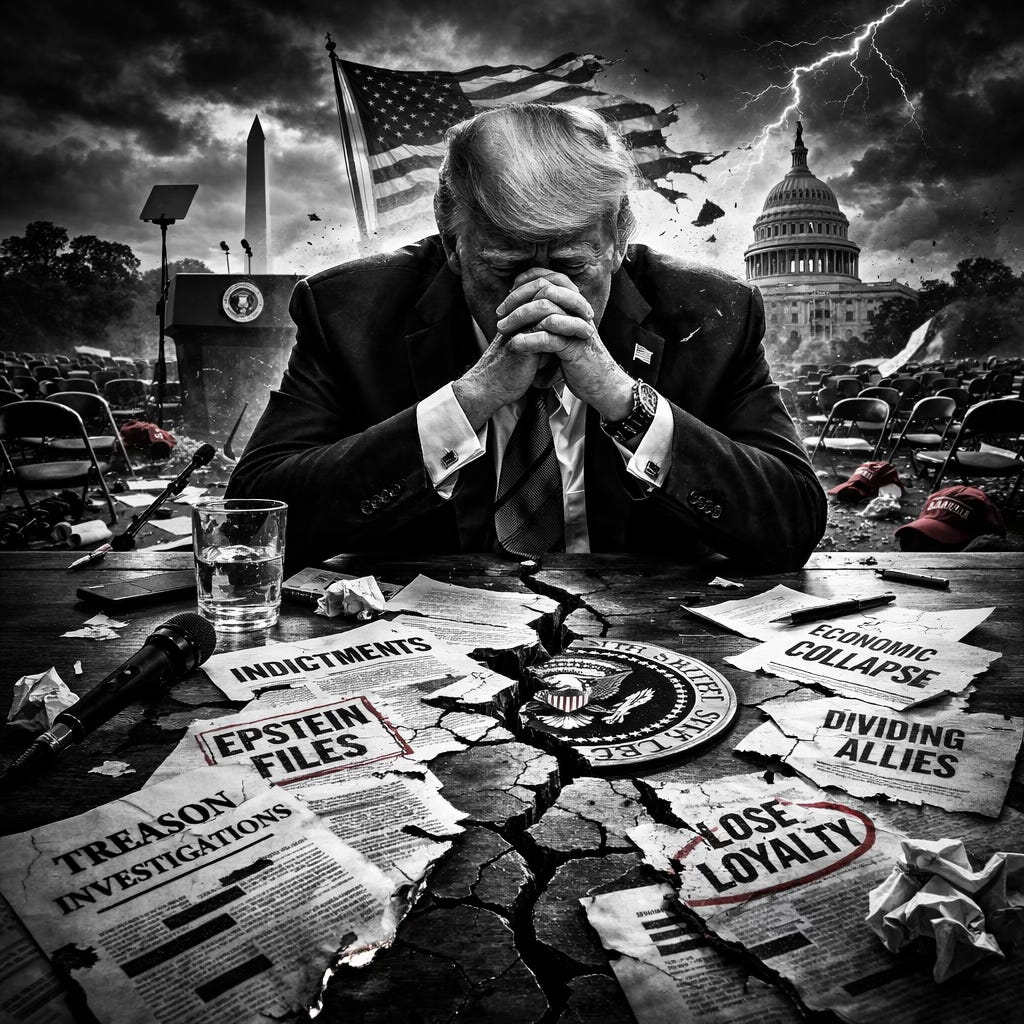
Paid Followup: The Pressure Point Trump Can’t Control
The Jack Hopkins Now Newsletter #784: Wednesday, February 18th, 2026.
Earlier today, I walked you through pressure.
Not rumor.
Not outrage.
Not headlines.
Pressure.
We mapped what happens neurologically when dominance feels threatened. We looked at status threat…humiliation conversion…loyalty tightening…narrative flooding… procedural edge-testing. We built the framework before the noise spikes.
If you read that piece carefully, you probably felt something shift.
Escalation stopped looking random.
Rhetoric stopped feeling surprising.
The chaos started looking patterned.
That was intentional.
Because once you can see pressure behavior clearly…you stop being emotionally yanked around by it.
But orientation is only the first layer.
Tonight is the second.
If the free piece explained what pressure does to powerful men under siege…
This one explains how pressure becomes leverage against them.
Because here’s the part most people miss:
Pressure doesn’t just produce reaction.
It exposes wiring.
And once wiring is exposed, strategy becomes possible.
You are not just watching events unfold.
You are watching predictable reflexes fire in real time.
And when reflexes become predictable…they become exploitable.
That’s where we’re going tonight.
Not panic.
Not despair.
Not adrenaline.
Leverage.
Let’s begin.
The Three Reactions That Feel Like Strength (But Create Weakness)
Dominance-driven leaders under sustained threat tend to default to three moves. They feel stabilizing. They feel like control. They often work short-term.
They also create predictable failure conditions.
1) Overclaiming
They don’t merely deny. They insist on total victory: exonerated, vindicated, perfect call, total hoax, everyone loves it.
Why it feels good: it eliminates uncertainty inside the self.
Why it backfires: overclaims create receipts. The more absolute the claim, the easier it is to disprove with one document, one recording, one timeline mismatch. Overclaiming narrows the escape hatch.
2) Loyalty Inflation
They raise the cost of neutrality. They reward obedience and punish hesitation.
Why it feels good: it replaces “Who’s with me?” anxiety with “I control who eats.”
Why it backfires: it pushes competence out and fear in. And fear looks like loyalty…until the consequences become personal. Then fear becomes flight.
3) Procedural Shortcutting
They treat rules as obstacles rather than guardrails. They test boundaries: agencies, courts…elections…permits…procurement…enforcement discretion…emergency authorities.
Why it feels good: it creates fast wins and dominance theater.
Why it backfires: shortcuts leave paper trails, standing, and jurisdiction. They create plaintiffs. They create injunctions. They create whistleblowers. They create internal dissent framed not as ideology…but as “I’m not going to prison for this.”
If you want a single sentence:
They stabilize themselves by narrowing reality…then reality narrows them.
