


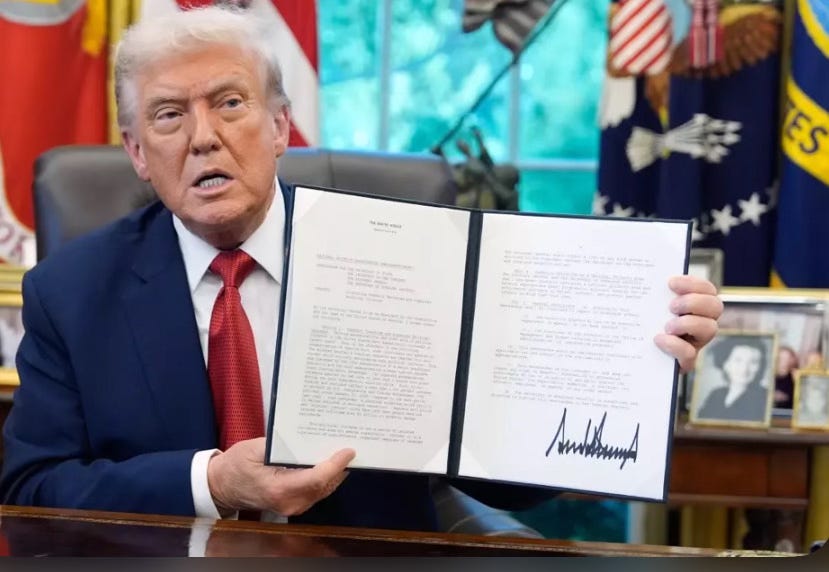
NSPM-7: The Quiet Memo That Could Muzzle a Nation
Why a new “counter-terrorism” order could quietly turn civic life inside out…and what every free citizen needs to understand before it’s too late.
The Jack Hopkins Now Newsletter # 607: Sunday, October 19th, 2025.
You’re not supposed to notice memos.
They’re dry…procedural…filled with lawyer-language nobody reads.
That’s the beauty of them.
Power doesn’t always seize the steering wheel in public. It writes a memo.
On September 25, 2025, one appeared on the White House website:
National Security Presidential Memorandum 7-“Countering Domestic Terrorism and Organized Political Violence.”
No headlines screamed. No primetime hearings aired. But inside that carefully worded directive sits a framework that…if used aggressively…could reshape the relationship between the federal government and civil society.
What NSPM-7 Actually Says
Let’s start with the document itself.
The memo instructs the Secretaries of State, Treasury…Justice…and Homeland Security to coordinate a national strategy against what it calls “domestic terrorism and organized political violence.”
It describes those threats broadly:
“Sophisticated, organized campaigns of intimidation, radicalization, threats, and violence designed to silence opposing speech, limit political activity, change or direct policy outcomes, and prevent the functioning of a democratic society.”
On its face, who could disagree? Nobody wants assassinations, threats, or intimidation.
But the power of any law…or memo…lives in its definitions.
And this one defines its targets with phrases elastic enough to stretch around almost any political activity.
It doesn’t just name violent actors; it ropes in those who “aid and abet,” “sponsor,” or “finance” them.
It specifically orders the Treasury to track financial networks and the IRS to make sure tax-exempt organizations aren’t indirectly supporting such acts.
That means nonprofits…donors…and advocacy groups…anyone participating in public life…can be pulled into scrutiny…even if their only “crime” is funding controversial speech.
Why This Matters
Here’s the constitutional tension:
The United States already has laws against terrorism…conspiracy…and material support for violence. What NSPM-7 adds is coordination of investigative and financial power around an undefined concept of “organized political violence.”
It doesn’t create new crimes; it repurposes old tools…financial surveillance, intelligence sharing…tax enforcement…and points them inward.
That’s exactly how expansive power grows: not through sudden coups…but through administrative creep.
The Historical Echo
We’ve seen this movie before.
Every generation writes its own version of the same script:
The Espionage Act of 1917…meant for wartime spies…was used to jail peaceful dissenters.
The McCarthy era used “subversive” lists to ruin careers and muzzle academia.
The Patriot Act…born of genuine fear…gave birth to two decades of domestic data dragnet.
Each began as a temporary necessity to protect the nation. None fully went away.
NSPM-7 follows that lineage: a well-intentioned idea dressed in the armor of national security. The problem isn’t the fight against violence. The problem is who defines it…and how quietly that definition can expand.
How Power Hides Behind Language
A single paragraph in the memo names ideological sources of threat:
“Anti-Americanism, anti-capitalism, anti-Christianity; support for the overthrow of the United States Government; extremism on migration, race, and gender; and hostility toward those who hold traditional American views on family, religion, and morality.”
Those words read like a cultural Rorschach test.
Depending on who’s in charge…they could point to radicals on either side of the aisle.
That’s the danger. Elastic categories create selective enforcement.
Once language blends moral disapproval with criminal suspicion…oversight becomes impossible.
The Money Trail
Treasury and IRS provisions may prove the most consequential.
When the Treasury is told to identify “financial networks that fund domestic terrorism,” and the IRS to ensure “tax-exempt entities do not directly or indirectly finance such activities,” enforcement naturally targets the financial lifeblood of civil society.
Every large nonprofit…from religious charities to human-rights groups…handles money that crosses ideological lines.
One audit letter…one Suspicious Activity Report… and they’re fighting reputational fire instead of fulfilling the mission.
Even if no charges stick…the process becomes the punishment.
Mission Creep in Real Time
Here’s how it could unfold over 12 months if history holds true:
Phase 1 – Compliance.
Agencies issue new “guidance.” Banks and payment processors over-report to avoid risk.
Phase 2 – Overreach.
A handful of advocacy organizations find their donors flagged. Investigations leak. The chilling effect spreads.
Phase 3 – Normalization.
“Enhanced screening” becomes routine. Public speech trims itself to stay off watchlists. The loudest watchdogs fall silent first.
Nobody declares martial law.
They don’t have to. Fear of misclassification does the work.
Democracy’s Immune System
Democracy doesn’t die because voters stop caring.
It dies when they self-edit out of caution.
The Founders anticipated foreign invasion…not bureaucratic overreach.
They built safeguards…separation of powers…congressional oversight…judicial review.
But those safeguards depend on citizens who read beyond headlines and demand transparency before authority hardens into habit.
