Now You See It
Everyone's arguing about the Kennedy Center. That's the point.
Now You See It
Everyone's arguing about the Kennedy Center. That's the point.
The Jack Hopkins Now Newsletter #913: Saturday, May 30th, 2026.
There are political stories.
There are culture-war stories.
And…then…there are stories so absurd they feel like they were written by a Netflix screenwriter three Red Bulls deep at 2:00 a.m.
This is one of those stories.
A federal judge reportedly told Donald Trump he couldn’t simply rename the Kennedy Center after himself.
And just like that...
The internet caught fire.
Again.
Because apparently…the nation that landed men on the moon…split the atom…and built the most powerful economy in human history…is now spending its Saturday debating whether a sitting president can slap his own name on a memorial dedicated to John F. Kennedy.
You couldn’t make this up.
Actually, correction.
You could make it up.
But…if you pitched it to a Hollywood producer they’d tell you it was too unrealistic.
“Nobody would believe that.”
And yet…here we are.
The Real Story Isn’t the Kennedy Center
The real story isn’t a building.
It isn’t a legal ruling.
And it certainly isn’t a sign out front.
The real story is what happened afterward.
Within hours…social media exploded.
Cable news panels appeared.
Political influencers raced to their keyboards.
Think pieces multiplied like rabbits exposed to radioactive waste.
Everyone suddenly became an expert on federal memorial naming conventions.
A sentence I never imagined writing.
Meanwhile…Americans are trying to pay mortgages…afford groceries…survive medical bills…and figure out whether their retirement accounts are going to resemble retirement accounts or archaeological sites.
But sure…
Let’s spend the weekend arguing about a performing arts center.
The Trump Formula
Here’s something I’ve noticed over the years.
Donald Trump has a remarkable ability.
Not necessarily to control events.
But to control attention.
The formula is simple.
Step 1:
Something embarrassing happens.
Step 2:
Create something louder.
Step 3:
Watch everyone chase the shiny object.
It works…because modern politics isn’t really politics anymore.
It’s theater.
The Kennedy Center story isn’t a governance story.
It’s a content story.
A viral story.
A story designed for screenshots…outrage…memes…reaction videos…and algorithmic dopamine.
And…the machine loves it.
Every platform rewards emotional reactions.
Every influencer wants engagement.
Every cable network wants ratings.
So everyone jumps in.
The circus tent expands.
And another news cycle…disappears.
America’s New National Pastime
Remember baseball?
Forget baseball.
America’s national pastime is now political outrage.
We don’t watch games anymore.
We watch meltdowns.
We don’t discuss policy.
We discuss posts.
We don’t debate legislation.
We debate screenshots.
The Founders probably imagined fierce arguments over constitutional principles.
Instead…we’re conducting forensic analysis of Truth Social posts…like Vatican scholars decoding ancient manuscripts.
“What do you think he meant by this emoji?”
“Let’s bring in six experts.”
The Ego Trap
Here’s what makes this story fascinating.
Every empire eventually develops a leadership problem.
The bigger the institution becomes…the more it begins revolving around personalities instead of principles.
History is full of examples.
Leaders begin believing the institution exists for them.
Instead of the other way around.
That isn’t a Republican problem.
It isn’t a Democratic problem.
It’s a human problem.
Power has a way of convincing people…that every building should bear their name.
Every achievement should trace back to them.
Every criticism becomes betrayal.
Every disagreement becomes an attack.
The story isn’t about one politician.
The story is about what happens…when politics becomes personality worship.
And America…has become addicted to personality worship.
The Media Can’t Quit
Of course, none of this works without an audience.
And…the audience…keeps showing up.
The media says it hates these stories.
Then runs them for 72 straight hours.
Political influencers say they’re exhausted.
Then publish twenty-seven posts about it.
Everyone claims they want serious discussions.
Then clicks on the circus.
Again.
And again.
And again.
Because outrage sells.
Attention sells.
Drama sells.
The Kennedy Center story isn’t viral because it’s important.
It’s viral because it’s irresistible.
What Should Actually Worry You
Here’s the part nobody wants to talk about.
The danger isn’t that some politician wants his name on something.
Politicians have wanted that since politicians were carving their names into rocks.
The danger…is what happens when symbolism completely replaces substance.
When every news cycle becomes performance.
When every political fight becomes content.
When citizens become spectators.
Because spectators stop asking harder questions.
Questions like:
Who’s making decisions?
Who’s benefiting?
What policies are changing?
What powers are expanding?
What institutions are weakening?
Those questions require effort.
The Kennedy Center story…requires a smartphone and a pulse.
Guess which one gets more engagement?
The Bottom Line
The Kennedy Center drama will disappear.
The memes will fade.
The outrage merchants will move on.
The algorithms will demand fresh meat.
And…next week there will be another spectacle.
There always is.
The challenge…isn’t figuring out which circus act comes next.
The challenge…is refusing to confuse the circus with the country itself.
Because while everyone is staring at the spotlight...
The important stuff is usually happening backstage.
And that’s where smart people keep their eyes.
Not on the performance.
On the people running the show.
That’s the story worth paying attention to.
BONUS: The Political Magic Trick Most People Never Notice
Want to know why stories like the Kennedy Center fight explode across the internet?
Because they are the perfect political magic trick.
Not because they’re fake.
Not because they aren’t real.
Because they’re emotionally irresistible.
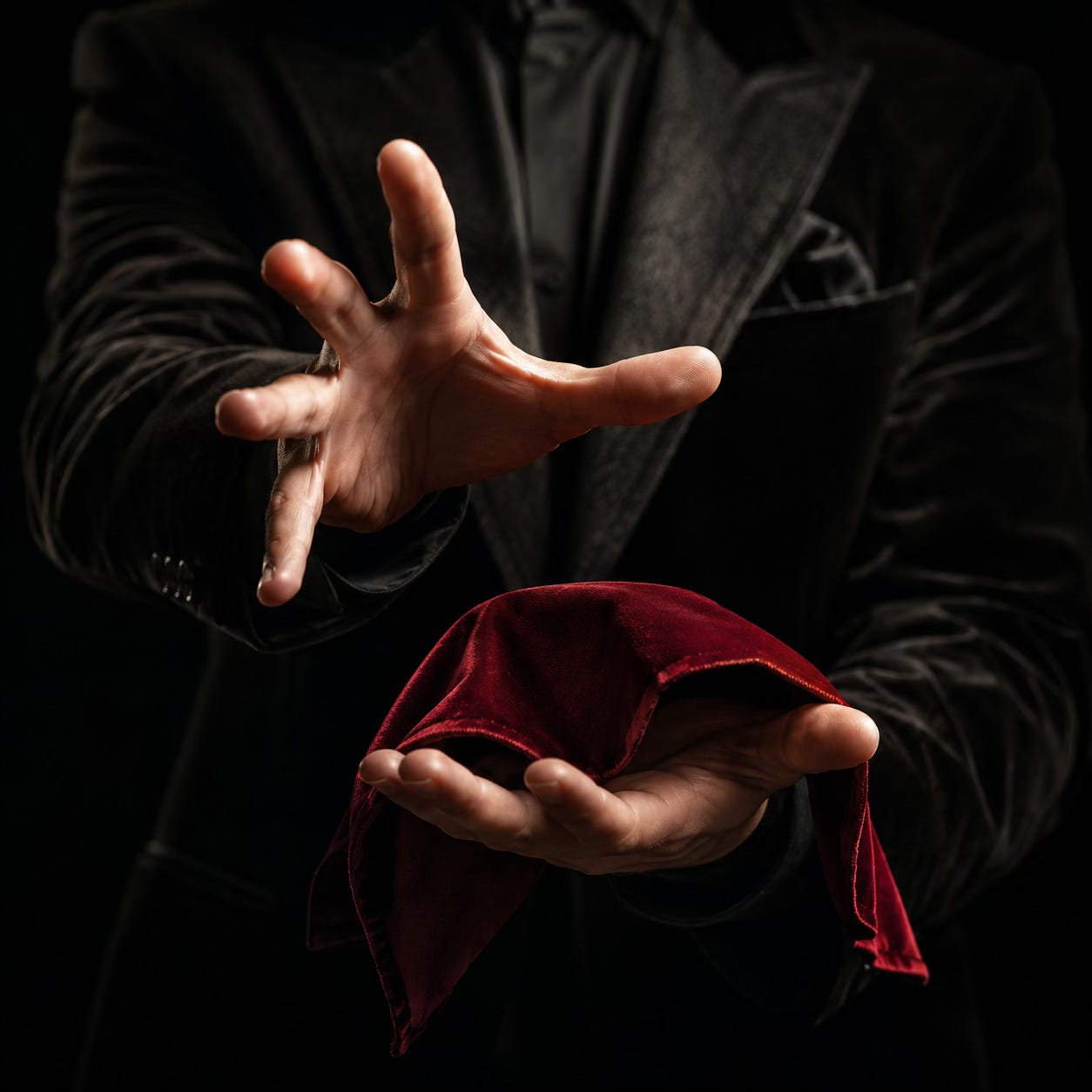
Magicians have known for centuries…that if you want someone to miss what’s happening in your left hand…you make sure they’re staring at your right hand.
Politics works exactly the same way.
The public believes power is exercised through speeches.
Through tweets.
Through press conferences.
Through viral moments.
But experienced political operators…know something different.
Real power usually moves through paperwork.
Appointments.
Budgets.
Agency rules.
Court filings.
Personnel decisions.
Contract awards.
Administrative orders.
The boring stuff.
The stuff nobody clicks on.
The stuff nobody memes.
The stuff that doesn’t trend.
While millions of Americans were debating whether Trump should have his name on a building...
Somewhere in Washington lawyers were drafting regulations.
Political appointees were making staffing decisions.
Agencies were implementing policy.
Committees were negotiating legislation.
Federal judges were issuing rulings.
Career officials were being hired.
Career officials were being fired.
The machinery kept moving.
It always does.
And here’s the uncomfortable truth:
The most powerful people in Washington often prefer it that way.
They understand something the average voter doesn’t.
The public’s attention is finite.
Every minute spent arguing about symbolism…is a minute not spent examining systems.
Every hour spent fighting over headlines…is an hour not spent studying power.
And power loves darkness.
Not because of conspiracy.
Because obscurity is efficient.
The less attention people pay to process…the easier process becomes to manipulate.
That’s why the smartest political observers don’t just ask:
“What is everyone talking about?”
They ask:
“What is nobody talking about?”
Because that’s often where the real story lives.
Not in the viral clip.
Not in the outrage cycle.
Not in the latest social-media explosion.
But…in the quiet administrative decisions…that almost nobody notices until years later when the consequences arrive.
The next time a story completely dominates every timeline…every cable network…and every political conversation...
Pause.
Ask yourself a simple question.
If I were trying to keep the public from paying attention to something important… what would I want them looking at instead?
You won’t always find an answer.
But…you’ll start seeing politics differently than 95% of the country.
And that’s…when the game becomes much easier to understand.
#HoldFast
Back soon.
-Jack
Jack Hopkins
P.S. Most people will spend this weekend arguing about whether Trump should have been allowed to put his name on the Kennedy Center.
A month from now they’ll barely remember the story.
What they won’t remember…are the quieter developments that happened while everyone was staring at the spectacle.
That’s one of the reasons I write this newsletter.
Not to help you keep up with every outrage cycle.
To help you see what those cycles are distracting people from.
The goal isn’t to be the most informed person in the room.
The goal is to be the least manipulated.
If you find value in that mission…consider becoming a paid subscriber. Because the biggest advantage in politics today isn’t having more information.
It’s knowing where to look…when everyone else…is looking somewhere else.
SOURCES & FURTHER READING: The Psychology Behind the Spectacle
The argument in this issue rests on a handful of well-documented ideas from cognitive science, media theory, and political psychology. Here are the primary sources behind each one, grouped by the principle they illuminate.
1. Attention Is a Finite Resource
The foundation of the whole piece: the mind can only attend to so much at once, so every minute spent on the spotlight is a minute taken from everything else.
Is Attention Really Effort? Revisiting Kahneman’s Attention and Effort (Frontiers in Psychology): https://www.frontiersin.org/journals/psychology/articles/10.3389/fpsyg.2018.01133/full
Working Memory and Attention: A Conceptual Analysis and Review (National Library of Medicine): https://www.ncbi.nlm.nih.gov/pmc/articles/PMC6688548/
Brain Drain: The Mere Presence of One’s Own Smartphone Reduces Cognitive Capacity (Journal of the Association for Consumer Research): https://www.journals.uchicago.edu/doi/full/10.1086/691462
2. The Attention Economy
When information is abundant, attention becomes the scarce, valuable thing — and platforms, advertisers, and political operators all compete for it. The idea I describe as “the machine.”
The Attention Economy (overview, sourced to Davenport, Beck, and Crawford): https://en.wikipedia.org/wiki/Attention_economy
“A Wealth of Information Creates a Poverty of Attention” — Herbert A. Simon’s 1971 observation that anticipated the entire dynamic: https://noisydeadlines.net/wealth-of-information-creates-poverty-of-attention
3. Misdirection — The Magician’s Trick
The right hand draws the eye while the left hand does the work. The central metaphor is also a real, studied cognitive mechanism: attention can be steered while critical events go entirely unseen.
The Psychology of Magic and the Magic of Psychology (Frontiers in Psychology): https://www.ncbi.nlm.nih.gov/pmc/articles/PMC5025437/
A Psychologically-Based Taxonomy of Misdirection (National Library of Medicine): https://pmc.ncbi.nlm.nih.gov/articles/PMC4260479/
Blinded by Magic: Eye-Movements Reveal the Misdirection of Attention (National Library of Medicine): https://pmc.ncbi.nlm.nih.gov/articles/PMC4269107/
4. Moral Outrage & Why Spectacle Goes Viral
Why “emotionally irresistible” stories spread. Outrage and moral-emotional language are rocket fuel for sharing — and platform design amplifies the effect.
Emotion Shapes the Diffusion of Moralized Content in Social Networks (PNAS, Brady et al.): https://www.pnas.org/doi/10.1073/pnas.1618923114
The MAD Model of Moral Contagion (Perspectives on Psychological Science): https://journals.sagepub.com/doi/10.1177/1745691620917336
How Social Learning Amplifies Moral Outrage Expression Online (Science Advances): https://www.science.org/doi/10.1126/sciadv.abe5641
5. When Symbolism Replaces Substance
The warning that “every news cycle becomes performance” and citizens become spectators has a name in media theory: the spectacle, where representations of life crowd out the thing itself.
The Society of the Spectacle — Guy Debord’s 1967 work: https://en.wikipedia.org/wiki/The_Society_of_the_Spectacle
An Illustrated Guide to Debord’s The Society of the Spectacle (Hyperallergic): https://hyperallergic.com/an-illustrated-guide-to-guy-debords-the-society-of-the-spectacle/
6. Personality Worship & Parasocial Bonds
The “personality worship” described here maps onto decades of research on parasocial relationships — one-sided emotional bonds with public figures that can shape political judgment.
When Politics and Parasocial Relationships Clash (Psychology Today): https://www.psychologytoday.com/us/blog/reel-relationships/202405/what-happens-when-politics-and-parasocial-relationships-clash
Parasocial Relationships & Mental Health (Simply Psychology): https://www.simplypsychology.com/articles/parasocial-relationships-mental-health
Moral Outrage Predicts the Virality of Petitions, But Not Signatures (Social Psychological and Personality Science): https://journals.sagepub.com/doi/10.1177/19485506251335373
Sources selected for the psychological principles discussed in this issue. Primary research and original works are favored where available.


The analogy of the magician's "slight of hand" is perfect. It's manufactured "slight of SLIGHT" to divert attention due to emotional attachment to FEELING "slighted" - not inappropriately so, but at the expense of paying attention to practical realities.
I understand the point here, but some of us have been putting major effort into fighting what was happening at the Kennedy Center. For me it isn't just a social media blitz. I won't take my attention and efforts away. This is a major pushback on Trump’s attempt to make all American History about him, including the takeover of a living memorial to another president.
The naming of the Kennedy Center is very revealing. It started out under Eisenhower as The National Cultural Center. President and Mrs. Kennedy took over the planning. After JFK's assassination, Johnson and Congress decided to make it the living memorial to JFK while keeping a focus on culture. The Congressional Act reads that there can be no other memorial to JFK within Washington DC. So. No. His name cannot be added. Period.
Since the Trump takeover their marketing has started to include emphasis back on the National Cultural Center. There have been other things done inside that detract from the living memorial and the gifts that nations donated to honor JFK. For example, the African Lounge that had textiles and artwork was closed. No one knows where the artifacts went. There was talk of selling off the rest of the artwork. The new design completely eliminated the third floor terrace.
I spent several days documenting and taking photos and videos in case the whole thing was torn down like the East Wing.
I wish we could get a win like this on everything the regime is doing to our country and people. I have learned that I can't focus on everything. I have been focusing on one or two things, like the Kennedy Center, and hope that others can tackle some of the other things.
