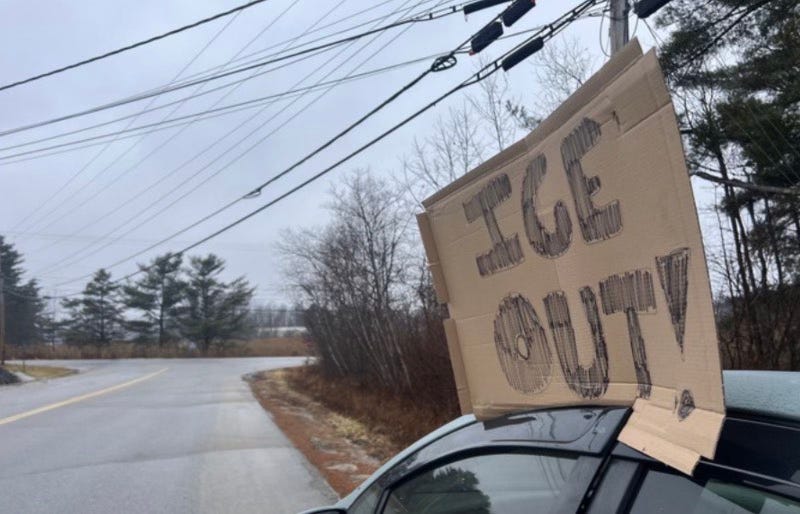
Maine Is the Test Run for a National ICE Playbook
A named operation, a repeated phrase, and a PR frame built to widen the net quietly.
Maine Is the Test Run for a National ICE Playbook
A named operation, a repeated phrase, and a PR frame built to widen the net quietly.
The Jack Hopkins Now Newsletter #749: Saturday, January 24th, 2026.
Maine isn’t the headline by accident…it’s a proving ground. ICE surged in…branded it like a product launch…and wrapped the whole thing in a single phrase…designed to shut down debate: “worst of the worst.”
The problem is…that court records and local reporting complicate that clean story… and the confusion is exactly what makes the tactic scalable.
If you want to understand where this goes next, don’t start with ideology. Start with mechanics. Signal → meaning → move.
Paid members: you’ll get the Action Desk version: 3 targets, a rapid checklist, and copy/paste language to push for documentation and transparency fast.
“Worst of the Worst” (and Other Stories We’re Being Sold)
I want to start with something simple.
When a government agency has to name an operation like it’s launching a new energy drink…and when they have to repeat a phrase like “worst of the worst” like a slogan… that’s not law enforcement.
That’s narrative management.
This week, ICE surged into Maine in what it called “Operation Catch of the Day,” claiming more than 100 people were detained in a few days…and framing the sweep as a “hunt for monsters.”
And then reporters did the annoying thing that PR slogans hate:
They checked court records.
What they found, according to AP reporting…is not a clean “we caught the worst people alive” story. It’s a mixed bag…including some serious offenders and people whose records don’t match the public claims…plus people who appear to have no criminal record at all.
That mismatch matters…not because anyone is claiming “no one should ever be arrested,” but because the slogan is doing work.
It’s meant…to make you stop asking questions.
And if you stop asking questions…they can expand the operation…normalize it…and keep moving the goalposts until the only thing left is fear and paperwork.
So let’s do what they don’t want us to do:
Signal → Meaning → Move.
The signal
ICE and DHS are running enforcement like a branding campaign.
The operation has a catchy name: “Operation Catch of the Day.”
They’re pushing a repeated phrase: “worst of the worst.”
DHS has even launched a searchable website literally branded “Worst of the Worst” (“wow.dhs.gov”) to showcase arrests under that theme.
That’s not accidental.
When an institution uses the same phrase everywhere…press releases…TV hits…and a dedicated website…it’s a coordinated attempt to set the frame…before anyone sees the facts.
And…Maine is a useful test market: smaller…easier to flood with agents…and politically easier to label “sanctuary” in order to justify escalation.
The meaning
1) “Worst of the worst” is a permission slip
It’s a rhetorical tool that does two jobs at once:
Job #1: Pre-approval.
If you hear “child abusers and hostage takers,” you’re supposed to pre-approve anything that happens next.
Job #2: Confusion.
If the details don’t match later…most people won’t follow up. The slogan already landed. The correction won’t.
That’s why the AP detail is so important: it documents that at least some of the public justification…doesn’t neatly match the underlying records…and that attorneys and officials are questioning how ICE is categorizing people.
AP highlighted examples where ICE lists an arrest under a serious-sounding label but court records show something different (including a dismissed minor violation in one case), and notes local officials questioning whether some charges (like a DUI) justify the “worst of the worst” framing.
This is the play: use the scariest category label available to cover a broader operation.
2) The transfers are part of the pressure
Maine doesn’t have a dedicated immigration detention center…and advocates and local leaders have described people being moved out of state quickly…which makes it harder for families to locate them and for attorneys to intervene fast.
Speed and distance don’t just “happen.”
They function as friction.
Friction drains resistance.
3) The fear is the feature, not the bug
Local reporting and advocacy accounts describe communities freezing up: kids missing school…workplaces understaffed…families unsure where loved ones are being taken.
And then you get stories like the one People reported out of Biddeford: a man says he recorded ICE agents at his door and one agent is heard threatening, “We’re gonna come back for your whole family.”
Whether every detail of every account proves out in court later is not the point here.
The point is this: when your enforcement approach generates broad community fear well beyond “dangerous criminals,” you’re not just removing individuals…you’re sending a message to everyone else.
And the message is: keep your head down.
Before you keep reading
If you’re reading this in the Substack app:
Comment with one word that describes what you think “worst of the worst” is really being used for here.
One word. That’s it.
What Maine tells us about where this is going
This isn’t just about Maine.
Maine is a preview of a national tactic:
Make enforcement psychologically contagious.
Not contagious like a virus…contagious like a rumor that changes behavior even before it reaches you.
You don’t need to arrest everyone.
You need enough highly visible actions that everyone starts self-policing.
That’s why governors and mayors are demanding transparency and warning about community impacts…because “lack of communication” isn’t just rude…it increases danger and chaos at the local level.
And that’s why…you’re seeing political leaders take different tacks…some calling for warrants and details…others focusing on de-escalation and telling residents not to interfere.
But here’s what matters for you and me:
The “worst of the worst” slogan is designed to shut down the middle.
To make ordinary people feel like asking for due process is the same thing as defending monsters.
That’s the psychological lever.
And if it works…it becomes portable.
So what do we do with this?
You already know I’m not interested in “awareness” as an endpoint.
If you read this newsletter…you’re already aware.
The real question is: what reduces uncertainty and produces a move you can complete quickly?
Here’s the free version…simple, lawful, and doable.
The 10-minute checklist (free version)
Verify the claim before you repeat it.
If you share “worst of the worst,” share the fact that court records reporting has raised doubts about the sweep matching that label.Separate “arrested” from “convicted.”
A charge isn’t a conviction; a label isn’t a fact pattern. (AP’s reporting is a case study in why this distinction matters.)Track the pattern, not just the headline.
Are the targets described as violent criminals…or are communities reporting indiscriminate stops…legal-status detainees…and broad fear effects?Demand transparency from your local officials.
Even when locals can’t control federal operations…they can document…request information…and establish protocols. (Maine leaders are already pushing on this.)Support legal infrastructure, not just outrage.
When people are transferred quickly…attorneys need speed. Communities need hotlines…legal aid…and rapid-response coordination.
That’s the free version.
It’s not enough…but it’s real.
New for members: Action Desk + Signal Alerts (starting next week)
Now I’m going to be blunt…because this is the moment where most newsletters get cute, talk too long…and lose the conversion.
Paid members aren’t paying for “more writing.”
They’re paying for less guessing.
Starting next week, paid members get:
The Action Desk (every Friday):
3 moves • 3 targets • 3 copy/paste scripts • 1 checklistSignal Alerts (as needed, especially around ICE):
signal • meaning • move + a 10-minute checklist + one script
That’s it. Tight. Operational. Built to finish.
Free subscribers will still get the core reporting and analysis…plus a short preview of what the Action Desk is focused on each week.
But the checklists + scripts + targets…the “do this now” version…live behind the paywall because that’s where the uncertainty gets crushed into an actual plan.
If you’ve been waiting to upgrade, don’t frame it as “support me.”
Say it plainly:
You’re buying the part you keep missing…the move.
The deeper point nobody wants to say out loud
There’s a reason DHS is pushing “worst of the worst” so aggressively…even building a branded site around it.
Because the real battle isn’t just deportations.
It’s legitimacy.
If they can keep “worst of the worst” sticky enough…they can expand the net while keeping the public psychologically sedated.
And in a climate like this…sedated is another word for manageable.
The goal is to make you tired…confused…and quiet.
That’s why I’m shifting into operator mode…because the season we’re in does not reward hot takes.
It rewards:
Clarity you can repeat
Tools you can use
Action you can finish
Vote in the comments
If you want me to aim next week’s first Action Desk at Maine, Minnesota, or a broader national “worst of the worst” playbook…vote in the comments with just the word:
MAINE
MINNESOTA
PLAYBOOK
No essays. One word.
Here’s the bottom line:
When someone sells you a slogan, it’s because they’re trying to sell you a policy you wouldn’t buy if you saw the receipt.
This week, Maine gave us the receipt…and it didn’t match the slogan cleanly.
Tomorrow, it’ll be another state.
So we’re going to do what they don’t want:
We’re going to stay clear.
We’re going to stay concrete.
We’re going to keep moving.
Coming Up
Starting next week: paid members get Action Desk (every Friday) + Signal Alerts (as needed)…the operational layer that turns the signal into a move.
Free subscribers will still get the full analysis and a preview of each week’s focus.
Paid members get the checklist + script.
Before you go: if you want the “do this now” version…upgrade today so you’re in for the first Action Desk drop.
Back soon,
-Jack
Jack Hopkins
Resources
Reporting & receipts (Maine crackdown)
AP: Court records raise doubts ICE is detaining the “worst of the worst” in Maine
https://apnews.com/article/maine-ice-immigration-d948bce8712d009b90e77175c7d5ded9The Guardian: ICE arrests 100+ people three days into Maine crackdown (DHS claim; local fallout)
https://www.theguardian.com/us-news/2026/jan/23/maine-immigration-crackdown-ice-arrests
Official tools (locate someone detained / understand the government frame)
ICE Online Detainee Locator System (ODLS)
https://locator.ice.gov/odls/USA.gov: How to locate someone detained by ICE (detention facility info)
https://www.usa.gov/detained-by-iceDHS announcement of the “Worst of the Worst” (WOW) database/site
https://www.dhs.gov/news/2025/12/08/dhs-unveils-wowdhsgov-new-searchable-website-lets-you-find-criminal-illegal-aliens
Maine-specific help (legal support + rapid resources)
Maine Immigrant Resource Hub & Hotline (MIRC)
https://maineimmigrantrights.org/mirc-resource-hub/Immigrant Legal Advocacy Project (ILAP) — Maine statewide immigration legal services https://ilapmaine.org/
ILAP Know Your Rights
https://ilapmaine.org/know-your-rightsACLU of Maine: Preparing for and responding to immigration enforcement activity in Maine
https://www.aclumaine.org/preparingforice/
Know Your Rights (national, practical, printable)
Immigrant Legal Resource Center (ILRC): Know Your Rights library
https://www.ilrc.org/community-resources/know-your-rightsACLU: Immigrants’ Rights / Know Your Rights
https://www.aclu.org/know-your-rights/share-your-rights-immigrants-rightsNational Immigration Law Center (NILC): “Everyone has certain basic rights”
https://www.nilc.org/resources/everyone-has-certain-basic-rights/National Immigrant Justice Center (NIJC): Know Your Rights if you encounter ICE
https://immigrantjustice.org/for-immigrants/know-your-rights/ice-encounter/Immigrant Defense Project: Know Your Rights with ICE (home raids + documenting arrests)
https://www.immigrantdefenseproject.org/know-your-rights-with-ice/


“Worst of the worst” is a slogan, not a standard.
If the label mattered, DHS wouldn’t need a product launch, a catchphrase, and a branded website—they’d show warrants, charges, and outcomes.
Maine is the test because it’s small enough to flood, loud enough to scare, and easy enough to scale.
You wrote:
“designed to shut down debate: “worst of the worst.” “
As was “Big Beautiful Bill”
Like “worst of the worst” which research indicates is not that, “Big Beautiful Bill” is anything but.
