If I Wanted To Buy Influence In The White House...
I’d Skip K Street. I’d Skip Lobbyists. I’d Buy Crypto.
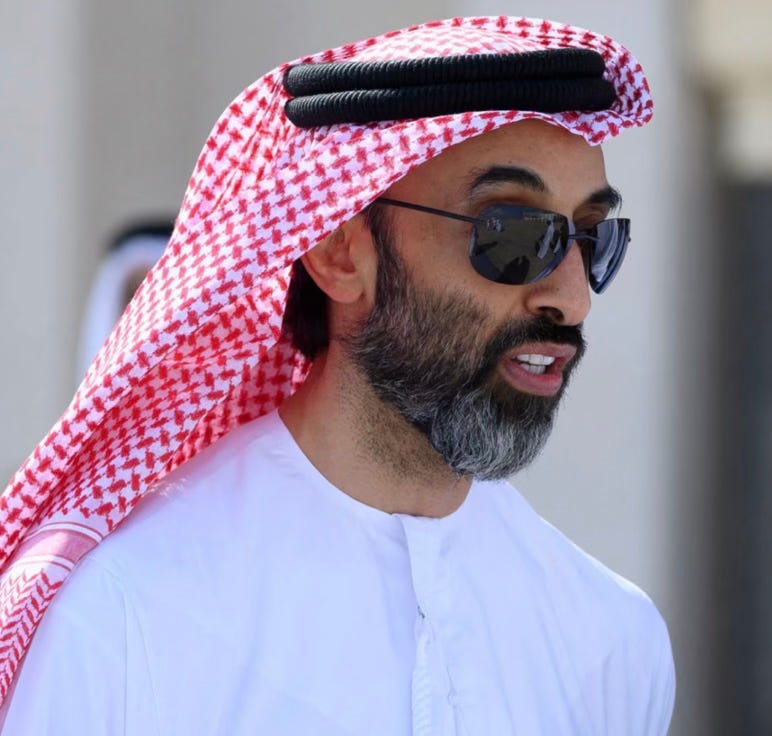
-Sheikh Tahnoon bin Zayed Al Nahyan, a powerful Abu Dhabi royal and UAE national security figure. Reporting says a fund linked to him bought a major stake in Trump’s crypto venture, World Liberty Financial, generating large payments tied to Trump-family entities.
If I Wanted To Buy Influence In The White House...
I’d Skip K Street. I’d Skip Lobbyists. I’d Buy Crypto.
The Jack Hopkins Now Newsletter #958: Monday, July 6th, 2026
Here’s a thought experiment.
Let’s say I’m sitting in Beijing.
Or Moscow.
Or Tehran.
Or Riyadh.
I’m not looking to invade America.
I’m looking to influence it.
I don’t need classified documents.
I don’t need spies.
I don’t even need hackers.
I simply want America’s leaders to see me...
...as someone whose interests are worth protecting.
Twenty years ago, that was hard.
Today?
It may be easier than ever.
Not because cryptocurrency is corrupt.
But because cryptocurrency has created entirely new ways to move wealth…create financial relationships…and obscure who ultimately benefits.
And…if you don’t think every foreign intelligence service on Earth…is studying those possibilities...
You’re kidding yourself.
Forget Left Versus Right.
This Is About Incentives.
Great investigators all preach one lesson over and over:
Follow the money.
Not the speeches.
Not the press conferences.
Not the hashtags.
Money.
Because money tells the truth…long before politicians do.
An early mentor of mine understood something similar.
People rarely wake up intending to become corrupt.
Most simply respond to incentives.
They protect what makes them richer.
They defend what benefits them.
They rationalize what rewards them.
That’s human nature.
It isn’t Republican.
It isn’t Democrat.
It’s human.
Which is exactly why our Founders worried so much about foreign influence.
America Has Built A Twenty-First Century Economy...
With Twentieth-Century Guardrails.
Imagine this.
A foreign sovereign wealth fund.
A government-connected billionaire.
An overseas investment vehicle.
A maze of shell companies.
Digital assets.
Multiple wallets.
Several jurisdictions.
None of that automatically means wrongdoing.
But it can make answering one simple question incredibly difficult:
Who actually provided the money?
That’s the question every counterintelligence professional wants answered.
Because foreign governments rarely hand over suitcases full of cash anymore.
Sophisticated governments build relationships.
Quietly.
Patiently.
Legally.
Until influence…begins to look like ordinary business.
You Don’t Have To Bribe Someone...
You Only Have To Make Them Wealthier.
This is where movies have misled us.
Corruption isn’t usually a cigar-filled room.
It’s rarely someone saying...
“I’ll give you ten million if you vote my way.”
Real influence is subtler.
Far more dangerous.
People naturally become protective of relationships that enrich them.
Businesses don’t like upsetting major investors.
Organizations avoid offending their biggest financial supporters.
That’s not necessarily criminal.
It’s simply predictable.
Which is why ethics rules exist in the first place.
Not because every relationship is corrupt...
But because the public should never have to wonder.
Here’s The Part That Keeps Me Awake At Night
National security isn’t only about missiles.
It’s about leverage.
Every intelligence service asks the same question:
How do we create leverage?
Sometimes it’s blackmail.
Sometimes it’s recruitment.
Sometimes it’s cyberattacks.
And increasingly...
It may simply be money.
Not illegal money.
Strategic money.
Money that creates access.
Money that creates relationships.
Money that creates hesitation.
Money that causes powerful people…to think twice before upsetting the source.
That’s how influence works.
Not with explosions.
With incentives.
Crypto Didn’t Create The Problem.
It Made The Problem Bigger.
Let’s be fair.
Banks have always been used to hide money.
Real estate has been used to hide money.
Art has been used to hide money.
Shell companies have been used to hide money.
Crypto didn’t invent financial secrecy.
What it did was dramatically increase the speed...
The complexity...
And in some circumstances…the difficulty of identifying the real parties behind transactions or tracing funds across borders.
Technology moved.
Oversight is still trying to catch up.
Our adversaries know that.
You can bet they’re exploiting every legal gap they can find.
Because that’s what adversaries do.
Stop Thinking Like A Voter.
Start Thinking Like A Foreign Intelligence Officer.
If your job were weakening America...
Wouldn’t this look attractive?
No risk of military confrontation.
No diplomatic crisis.
No missiles.
No headlines.
Just money.
Relationships.
Investments.
Patience.
Intelligence agencies play the long game.
They don’t think in election cycles.
They think in decades.
The question isn’t whether they’d exploit financial vulnerabilities.
The question is why they wouldn’t.
This Isn’t About One President.
If your favorite politician were in office...
I’d still be writing this article.
Because systems…matter more than personalities.
The loophole doesn’t care whose picture hangs in the Oval Office.
Every administration.
Every Congress.
Every political family.
Every future president.
Every future cabinet.
Every future billionaire.
The same incentives remain.
Build a system weak enough...
Eventually someone will exploit it.
History says they always do.
So What Do We Do?
Not panic.
Not demonize cryptocurrency.
Not assume guilt without evidence.
We do something much harder.
We demand systems worthy of the country we’re trying to preserve.
Require stronger disclosure of financial interests.
Require meaningful transparency around foreign financial relationships.
Modernize ethics laws for the digital age.
Give investigators the tools to trace sophisticated financial structures.
Support independent journalism that follows complex money trails instead of chasing viral outrage.
And perhaps most importantly...
Stop excusing ethical gray areas simply because the person involved wears your team’s jersey.
The Constitution isn’t partisan.
National security isn’t partisan.
Foreign influence certainly isn’t partisan.
Here’s My Bottom Line
The danger isn’t cryptocurrency.
The danger is pretending our adversaries aren’t creative.
America’s enemies don’t spend billions building intelligence services because they’re unimaginative.
They adapt.
They innovate.
They look for cracks…before anyone else notices them.
So should we.
Because every generation inherits a different battlefield.
Our grandparents defended beaches.
Our parents defended airspace.
Our generation may have to defend financial transparency itself.
And if we fail...
The greatest damage won’t come from a hacked computer.
Or a stolen secret.
It will come from something far more dangerous.
A nation that slowly loses confidence that its government…belongs exclusively to the American people.
That is a loss no cryptocurrency can ever repay.
#HoldFast
Back soon.
-Jack
Jack Hopkins
P.S. The greatest victories in espionage rarely make headlines.
The best operations…are the ones no one notices until years later…when investigators piece together the money trail and ask, “How did we miss this?”
I’m not asking you to assume anyone is guilty without evidence. I’m asking you to recognize…that our adversaries don’t stop looking for new ways to gain leverage over the United States…simply because we stop looking for them.
Whether the money comes through cryptocurrency…shell companies…real estate…or some technology that hasn’t even been invented yet…the principle is the same: No foreign government should ever be able to purchase even the appearance of influence over the President of the United States.
If that principle becomes negotiable...
Everything else eventually becomes negotiable, too.
Recent ethics debates surrounding presidential crypto ventures underscore why transparency…and strong safeguards…remain a matter of national security…regardless of who occupies the Oval Office.