

ICE Isn’t Just Enforcing Immigration Laws: It’s Building a Data Machine That Can See You, Too


ICE Isn’t Just Enforcing Immigration Laws Anymore: It’s Building a Data Machine That Can See You, Too
The Jack Hopkins Now Newsletter #760: Monday, February 2nd, 2026
Not to scare you… but to inform you.
Because there’s a childish kind of “calm” that comes from ignorance.
And there’s an adult kind of calm that comes from seeing the terrain clearly…especially when the terrain is being reshaped underneath your feet.
That’s what this is.
ICE isn’t just knocking on doors and running names anymore. In the modern era, ICE is operating inside a sophisticated data ecosystem…a stack of tools…vendors…databases… and analytics that can locate people…predict patterns…prioritize targets… and move quickly.
And once an agency builds an infrastructure like that…it doesn’t stay neatly inside the boundaries people imagine.
That’s not a political statement.
That’s how systems behave.
So…here’s the breakdown: what the tools are…how they work…what they collect…and why it matters that you understand it…whether you think you’re “the target” or not.
1) The Backbone: “Integration” Is the Superpower
Most people picture surveillance as a single scary gadget.
That’s outdated.
The real power isn’t one tool. It’s integration…the ability to pull data from many sources into one operational picture.
Think of it like this:
A single database is a filing cabinet.
An integrated system is a search engine for human lives.
When data from separate places gets stitched together…government records… biometrics…travel data…commercial data…local records…the question stops being “Do they have your data?”
The question becomes:
Can they connect your data to someone else’s, fast enough to act on it?
That’s the game now.
2) Analytics Platforms: When Software Turns Data Into Targets
A huge portion of “modern enforcement” is software…
…platforms that let investigators search…correlate…score…and prioritize.
These platforms can:
Ingest tips (from the public, from partners, from internal sources)
Summarize and categorize information
Cross-reference across datasets
Surface “relationships” (people, addresses, phones, vehicles)
Flag patterns that are invisible to a human skimming spreadsheets
This is where many people misunderstand the danger.
The danger…is not that a human investigator is sitting there obsessed with you.
The danger is the opposite:
The system doesn’t need obsession. It needs inputs.
If the inputs exist, the system can generate leads at scale…quietly…efficiently… “rationally.”
And if you’ve ever watched a bureaucracy operate, you know what comes next:
More inputs
More “efficiency”
More “operational necessity.”
More exceptions
Fewer meaningful guardrails
3) Biometrics: The Body as the Password
Biometrics are the most consequential shift because…
…they turn identification into something you can’t easily change.
You can change:
Your email
Your phone number
Even your address
You cannot easily change:
Your face
Your fingerprints
Your iris patterns
Modern biometric systems allow field agents…depending on the tools deployed and the databases accessible…to capture identifiers and attempt matches in real time.
Here’s what that means in practice:
A photo becomes a query.
A fingerprint becomes a lookup.
A match can pull up a history of prior encounters or linked records.
And once biometrics are normalized, you get two second-order effects that matter:
False positives become operational problems (not philosophical ones).
Identity becomes “datafied”…you are no longer a person; you are a record that can be moved…flagged…or routed.
This is not about whether you “trust” an agency.
It’s about whether you trust the whole chain of tools…vendors…policies, and incentives that make the system run
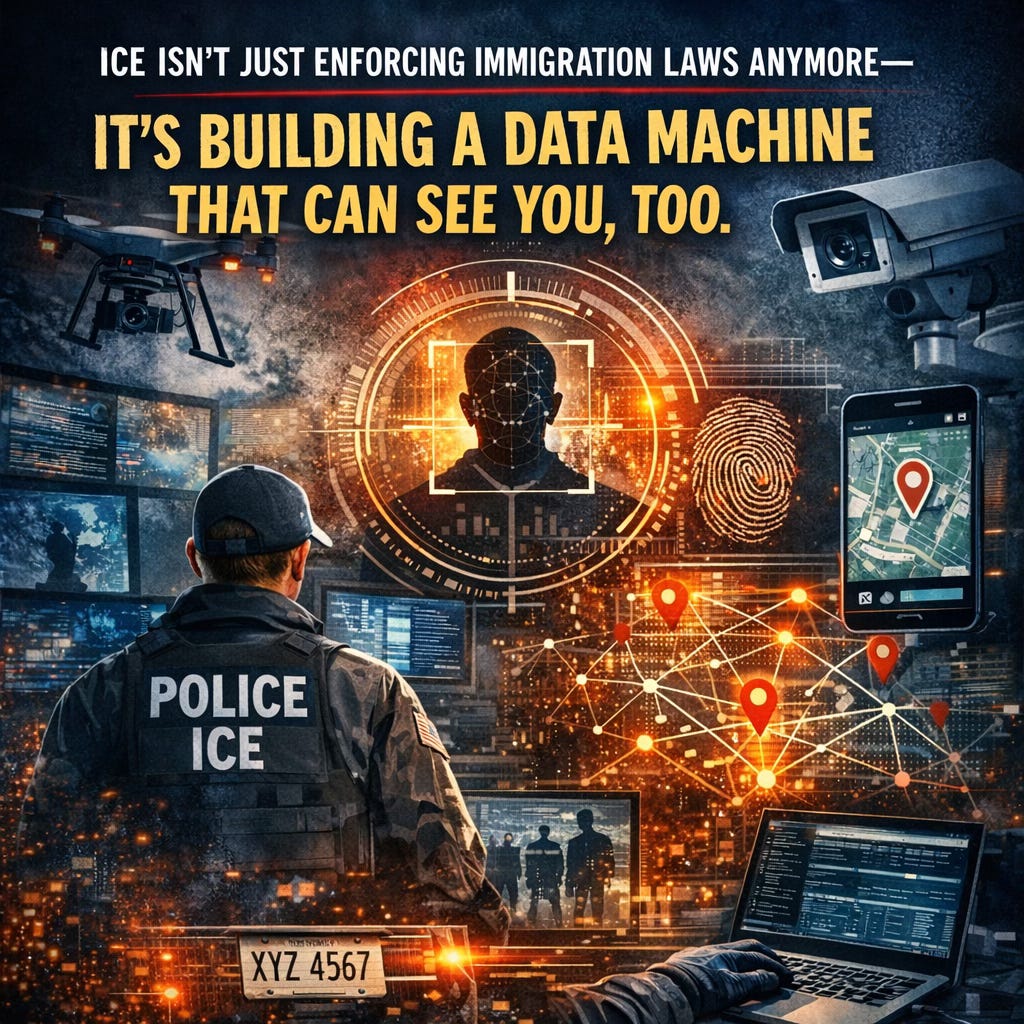
*The message can’t be emphasized enough to people living in the United States of America.
4) Mobile Identification: Enforcement in the Pocket
Once biometric and identity tools become mobile, the tempo changes.
Instead of:
Capture → paperwork → delayed lookup → later decision
You get:
Capture → lookup → decision now
Speed sounds good… until you understand what speed does to caution.
Speed creates:
Fewer second looks
More reliance on automated matches
More “good enough” decision-making
And…the faster a machine can produce “confidence,” the less likely anyone is to slow down and ask if the confidence is deserved.
5) Databases: Records You Didn’t Know You Had
The modern enforcement world runs on records.
Some are obvious:
Arrest records
Immigration files
Detention history
Others are less obvious:
Travel and passenger data
Address histories
Employment fragments
Local government records
“Public” commercial records packaged for resale
The key point is this:
You don’t have to be the intended subject of surveillance to be pulled into the system.
If you:
Share an address
Share a phone plan
Share a family network
Co-sign something
Drive a vehicle associated with someone
Appear in someone else’s contact list
Show up in someone else’s photos
Post in the same online spaces
…you can become adjacent data. And adjacency is often enough to generate attention.
Most people only think about “data collection” as direct collection.
But…modern systems thrive on relational data…who is connected to whom…where… when…and how often.
Mid-Article Pause
Before you keep going, take ten seconds and finish this sentence in the comments:
“The part of this I wish weren’t true is _______.”
(One short sentence is enough.)
6) Location Data: The Quiet Map of Your Life
Location is one of the most revealing forms of data…
because it doesn’t just show where you are.
It shows:
Where you sleep
Where you work
Who you spend time with
What routines you follow
What places you return to under stress
And the modern environment is saturated with location signals:
Phone pings
App data
Geofenced advertising ecosystems
License plate reader networks (in many jurisdictions and private networks)
Commercial data brokers
Here’s the hard truth:
The difference between “marketing” and “enforcement” is often just who gets access.
When location data becomes easily purchasable…or easily shared…the barrier to building movement profiles drops dramatically.
And once movement profiling is possible, it’s not a leap to:
Pattern detection
Network inference
Prioritization decisions
“Risk scoring” logic
Even if a particular agency claims narrow use…the infrastructure is what matters.
Infrastructure outlives intentions.
7) Phone and Device Extraction: Your Life in a Bag
When agencies have legal authority to seize or access a device…
…(through warrants or other legal processes), modern forensic tools can pull:
Contacts
Messages
Photos
Location history
App artifacts
Deleted data remnants (sometimes)
Social graphs and metadata
The important point isn’t “can they do this to everybody at will.”
The important point is:
When they can do it…the yield is massive.
And that yield…encourages a particular mindset: once you’ve tasted that kind of informational advantage…everything else feels slow and incomplete.
That’s how “rare” tools become routine.
8) Outsourcing: When Private Companies Become the Enforcement Perimeter
One of the most underappreciated dynamics is vendor dependence.
Government agencies increasingly rely on contractors for:
Data integration
Analytics tooling
User interfaces
Data brokerage
Surveillance tech
That introduces a set of problems the public rarely sees:
Incentives misaligned with restraint
Proprietary systems resistant to oversight
“Black box” logic in scoring and prioritization
Vendor lobbying for expansion (“more features,” “more access,” “more integration”)
Even if every individual actor is “well-intentioned,” the structural incentives push one direction:
More data. More speed. More reach.
9) Why It’s Critical to Know This
If you’re waiting for the moment when “they announce it,” you’re already late.
These systems don’t arrive with a press conference. They arrive as “administrative modernization.” They arrive as “efficiency.” They arrive as “public safety.” They arrive as “data-driven decision-making.”
And then one day you look up and realize:
The infrastructure is built
The tools are normalized
The public is numb
The oversight is thin
The exceptions have multiplied
and the line between targeted enforcement and generalized surveillance…is blurry
Knowing this isn’t fear. It’s orientation.
Because when you understand the machinery, you stop arguing about slogans and start asking the only questions that matter:
What are the limits?
Who enforces them?
What is retained, and for how long?
What is shared, and with whom?
What recourse exists when errors occur?
What happens when political priorities change?
The first step in protecting a society from excess is not outrage.
It’s literacy.
There’s a limit to what I can responsibly unpack in a free piece.
In the free piece, I showed you what ICE’s data machine looks like from the outside.
The paid article goes inside it.
How the tools actually work.
How data moves once it’s collected.
Where it’s routed, who can touch it, how long it’s kept, and what happens when systems built for “efficiency” start talking to each other.
This isn’t speculation. It’s architecture.
If you want to stay oriented, this is the part you need to understand.
#HoldFast
Back soon.
-Jack
Jack Hopkins
P.S. Systems like this don’t require bad intentions to become dangerous. They only require momentum…convenience…and public inattention. Orientation means refusing to give any of those away for free.
Final in-app action
If you restack this, add a one-line note starting with:
“The detail most people don’t understand is _______.”
Can we sue Elon & Trump because DOGE stole our data and shared it. Isn't that the same as Trump suing the IRS for his tax info being shared?
I always try to think historically when I read your articles.
The recent ICE operations in Minnesota, which led to the deaths of Renée Nicole Good and Alex Pretti, are not isolated events. They follow a long pattern in U.S. history where law enforcement has been used to project power over certain communities — from the Fugitive Slave Act to Jim Crow policing and the militarization of cities. What is framed as “enforcing the law” is often more about asserting authority than protecting people, and the use of militarized federal agents in American cities is the latest example.
Immigration enforcement has always been a political tool: by portraying certain groups as threats, the government makes extreme measures appear necessary. The result is predictable — escalating force, often with deadly consequences. Minneapolis shows us what happens when enforcement is unchecked: citizens are threatened in their own neighborhoods, and the state operates without accountability. Demanding transparency and limits on this power is not radical; it is defending the basic rules that keep democracy alive.
Exceptional writing and coverage, Jack!
#HOLDFAST #FUCKICE