


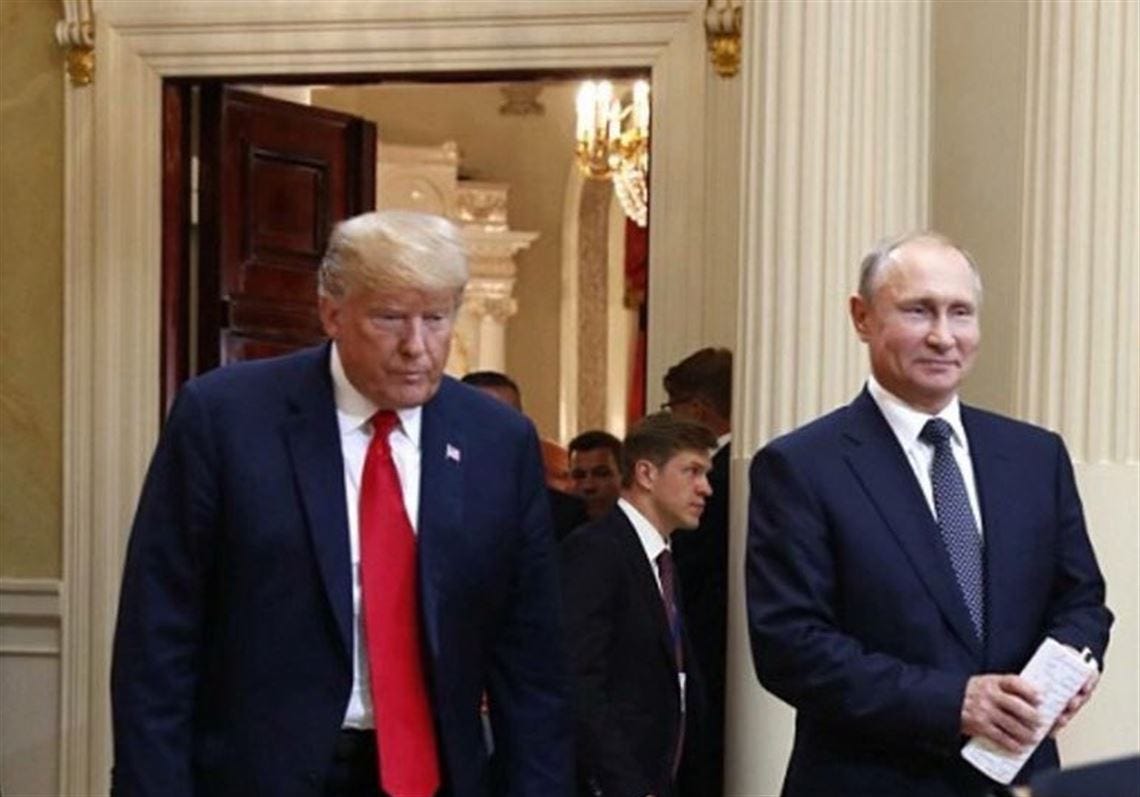
Donald Trump and Vladimir Putin, Helsinki Summit, 2018.
I Ranked Eight of Trump’s Weaknesses the Way a KGB Recruiter Would. One Scored a Perfect 10.
How I built a scale for Trump’s weaknesses–and why the one at the top should keep you up at night. (And, I had a personal conversation with a former KGB agent about this)
The Jack Hopkins Now Newsletter #1,052: Saturday, October 10th, 2026.
As usual, I’m going to be blunt with you…because these days…it seems that relatively few people will.
I spent the better part of a month reading what former KGB officers, two bipartisan Senate investigators, a special counsel, and a couple of ex-National Security Council staffers have said about Donald Trump.
Not what the cable hosts said. What the people who actually ran recruitment operations said.
And, I also spent time on Zoom, speaking directly to a former KGB member about today’s content.
I kept running into the same problem. Everyone has a list of Trump’s weaknesses. Nobody has a ranking.
Nobody has bothered to ask the only question that matters:
Which one would a professional have used?
So…I built a scale. Here’s how it works, and here’s what it shows.
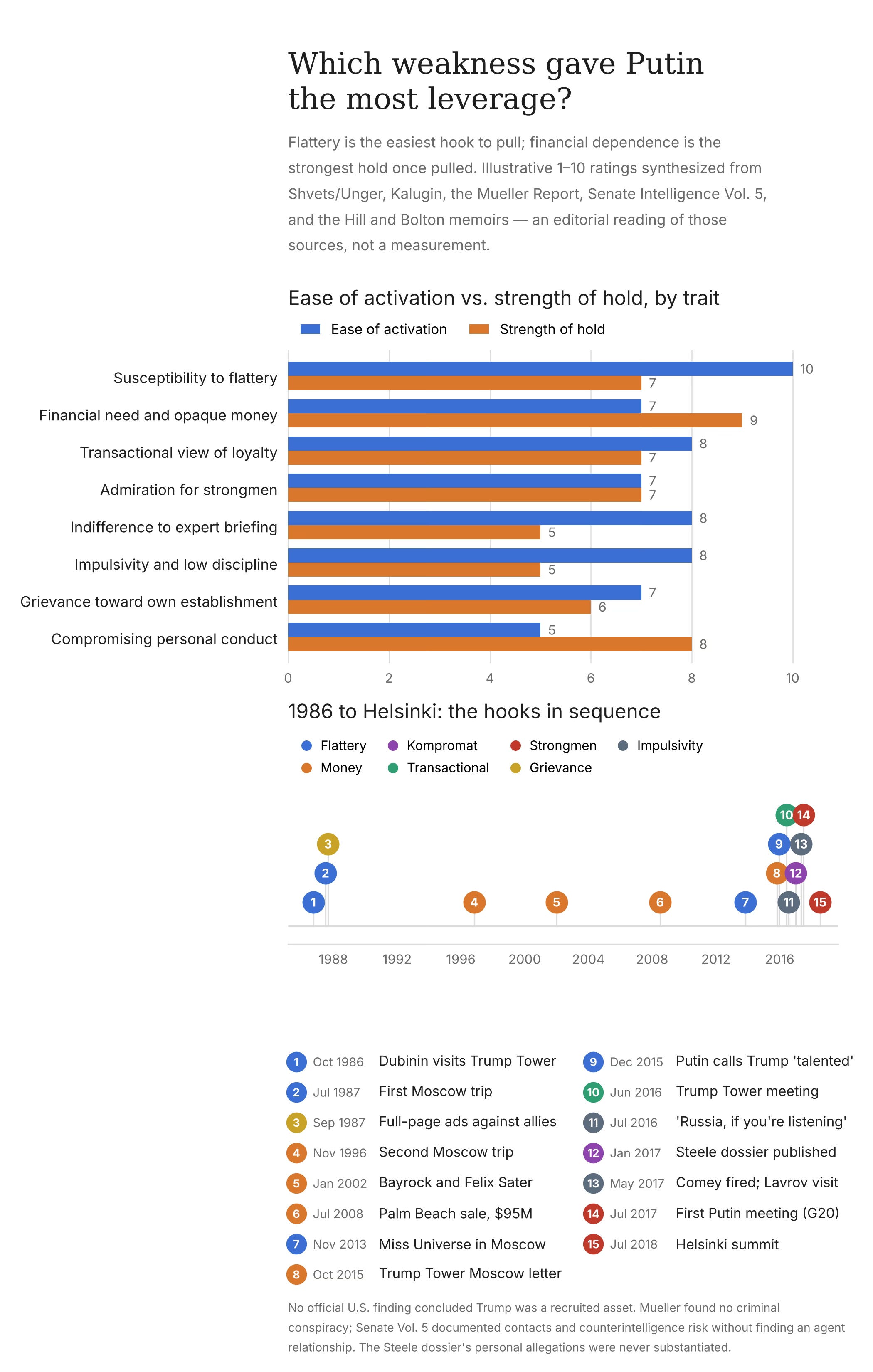
Two numbers, not one
Old-school intelligence officers taught recruits a four-letter acronym: MICE. Money. Ideology. Compromise. Ego.
Those are the four handles on a human being. Every recruitment in history pulled on at least one of them.
But here’s what the acronym doesn’t tell you…and what took me a while to see.
A handle has two separate properties:
How easy it is to grab. Can you pull it on day one, with no secret, no debt, no threat? Or…do you need years of setup?
How hard it holds. Once you’ve pulled it, can the target walk away? Or…does he have to keep cooperating?
Those are different things. A hook that’s easy to set may slip. A hook that holds like iron may take a decade to plant. So…I scored eight documented Trump traits on both, 1 to 10…and plotted them.
I’ll say plainly: these are my numbers. They’re an editorial reading and a conversation with the sources, not a measurement. Argue with them. That’s the point of showing the work.
Where he lands
Seven of the eight traits cluster in the middle.
Transactional loyalty, admiration for strongmen, grievance toward his own establishment, indifference to briefings, impulsivity. All real. All useful to a handler. None of them the main event.
Two traits break out of the pack, and they break out in opposite directions.
Susceptibility to flattery: 10 out of 10 on ease. The highest score on the chart. Nothing else is close.
Financial need and opaque money: 9 out of 10 on hold. The strongest grip…once established.
Now…watch what happens when you put the timeline underneath the chart.
The first three events…the Soviet ambassador’s visit to Trump Tower in 1986, the Moscow trip in 1987, the full-page ads attacking America’s allies two months later…are all flattery and grievance.
Not a dollar changes hands. Yuri Shvets, a former KGB major, has said the 1987 trip was run as a textbook charm operation on a man his service rated “extremely vulnerable intellectually and psychologically.”
Then, from 1996 to 2015, the dots turn orange.
Second Moscow trip. Bayrock and Felix Sater. The $95 million Palm Beach sale to a Russian billionaire.
The Trump Tower Moscow letter of intent…signed in the middle of a presidential campaign. That’s the money phase…and it’s nearly twenty years long.
And…then…in 2017 and 2018, the dots turn red:
Hamburg, then Helsinki, where he stood next to Putin and said he didn’t see any reason why Russia would have interfered. His own intelligence chiefs had told him otherwise, under oath.
Ego opened the door. Money kept it open. The strongman worship is what it looked like from the outside once the thing was finished.
Why flattery is the one
People push back on me here. “Money is the stronger hold. You said so yourself. Doesn’t that make money the real leverage?”
Here’s the thing. Leverage you have to enforce is expensive. A loan can be refinanced. Kompromat has to be believed to work…and the famous allegations in this story were never substantiated.
Every coercive hook carries a cost: the target resents you, looks for the exit, and eventually finds one.
Flattery costs nothing. It never has to be enforced, because the target enforces it on himself. He will walk toward the compliment the way water runs downhill.
In December 2015, Putin called him “talented” at a press conference. Trump’s response, on the record: it was “a great honor to be so nicely complimented by a man so highly respected within his own country and beyond.” That is the sound of a hook setting itself.
A 10 on ease…is the cheapest operation an intelligence service can run. And “cheapest” is what professionals choose.
If it turns out to be true
I’m not going to insult your intelligence by pretending this is settled. It isn’t.
The Mueller Report found no criminal conspiracy. The Senate Intelligence Committee’s Volume 5…written by Republicans and Democrats together… documented extensive contacts and a serious counterintelligence risk, but it did not find that he was an agent.
The former KGB officers are giving testimony, not handing over files. Trump and his defenders reject the entire premise.
So…treat what follows as a conditional.
If it turns out he was selected, groomed, and run…if there’s a file in a Moscow archive with a 1986 date on the cover…then this chart isn’t a curiosity. It’s the explanation.
It would mean the single most consequential political career of our lifetimes didn’t begin with an escalator in 2015. It began with a compliment about a building, thirty years earlier.
It would mean the thing we read as a personality quirk…the hunger for praise, the inability to hear a hard truth, the way he melts in front of men who flatter him…was never a quirk at all. It was the handle…and somebody found it…before the rest of us did.
And…it would mean every institution that was supposed to catch this…the banks, the party, the press, the intelligence community that briefed him anyway…was looking for a check or a photograph, when the actual hook was a sentence.
That’s what a 10 on the ease scale means. Not that he was weak. That he was easy. And…that there’s a difference.
Read the chart below. Look at where the colors change. Then…ask yourself how long we’ve had the answer sitting in plain sight.
#HoldFast
-Jack
Jack Hopkins
P.S. I want to hear where you’d move the numbers. If you think money belongs on top, or that kompromat is underrated…hit reply. Make your best arguments…and if you change my mind, I’ll say so.
Sources
Official investigations
Report on the Investigation into Russian Interference in the 2016 Presidential Election (Mueller Report), U.S. Department of Justice, 2019 — Vol. 1 covers Trump Tower Moscow, the June 2016 Trump Tower meeting, and the campaign’s Russia contacts.
Senate Select Committee on Intelligence, Russian Active Measures Campaigns and Interference, Volume 5: Counterintelligence Threats and Vulnerabilities, August 2020 — the bipartisan report; press release.
Grand Jury Indicts 12 Russian Intelligence Officers for Hacking Offenses Related to the 2016 Election, U.S. Department of Justice, July 13, 2018 — the indictment that places the GRU’s first attempt on Clinton’s personal office on July 27, 2016.
The former-KGB accounts
Craig Unger, American Kompromat (Dutton, 2021) — the author’s own excerpt on the 1987 Moscow trip and Yuri Shvets’s account of it.
“‘The perfect target’: Russia cultivated Trump as asset for 40 years – ex-KGB spy,” The Guardian, January 29, 2021 — Shvets’s interview; summarized and fact-checked at Snopes.
Timeline events
1987 ads: “That Time Trump Spent Nearly $100,000 On An Ad Criticizing U.S. Foreign Policy,” BuzzFeed News; full text of the September 2, 1987 open letter
2008 Trump Jr. “disproportionate cross-section” remark: eTurboNews, September 2008
2008 Palm Beach sale: “Why did a Russian oligarch pay so much for a mansion owned by Trump?” Tampa Bay Times
2013 Miss Universe: “How a beauty pageant led to Trump son’s meeting with Russian lawyer,” Anchorage Daily News / Washington Post
December 2015 Putin praise and Trump’s “great honor” reply: ABC News; PolitiFact on what Putin actually said
June 2016 Trump Tower meeting emails: Fox News on Trump Jr.’s release of the chain
January 2017 dossier publication: BuzzFeed News, January 10, 2017
May 2017 Lavrov meeting: NPR, “Report: Trump Told Russians He Fired ‘Nut Job’ Comey Because Of Investigation”
July 2017 Hamburg second conversation: Reuters via FT.lk
July 2018 Helsinki: full transcript, NPR; Foreign Policy, “Here’s What Trump and Putin Actually Said in Helsinki”
Memoirs cited
Fiona Hill, There Is Nothing for You Here (Mariner, 2021)
John Bolton, The Room Where It Happened (Simon & Schuster, 2020)
Michael Cohen, Disloyal (Skyhorse, 2020)
His hunger for praise was instilled in him during his childhood due to his parent’s never giving him any. A needy child looking for affirmation from his father, he learned from watching his father’s treatment of his brother, Fred Jr’s refusal to mirror himself to their father’s image. Donald then wanted Fred Sr’s attention so much he learned to be a bully and get attention that way. His mother basically ignored the children and left them with nannies and to their own devices, as niece, Mary Trump, wrote in her book.
A needy child who was always seeking attention and praise forever more, which all other foreign and domestic players have used to their advantage. A needy man who is still seeking praise and glory even though he has done nothing to earn it.
#HOLDFAST #OUTLAST #STANDFAST
Compelling. Probably understates the facts. Trump associates may want to avoid hotel balconies.