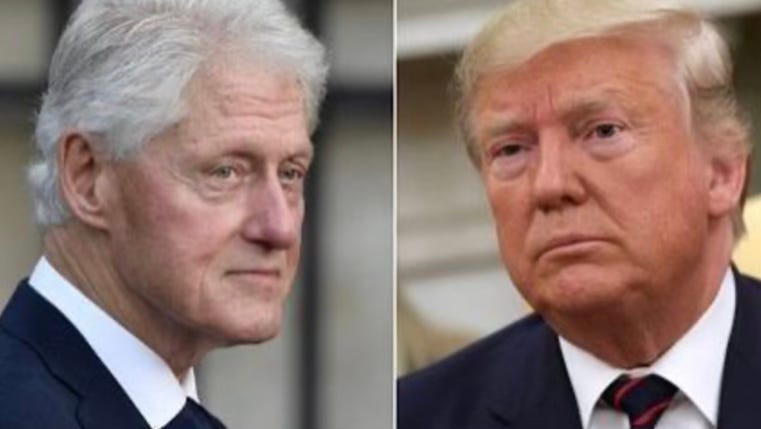
“I like Bill Clinton. I’ve always gotten along with Bill Clinton. I’ve been nice to him. He’s been nice to me.”
That’s Donald Trump, speaking at Mar-a-Lago-claiming not just cordiality, but mutual respect. Not rivals. Not frenemies. Friends.
“I like Bill Clinton. I’ve always gotten along with Bill Clinton. I’ve been nice to him. He’s been nice to me.”
That’s Donald Trump, speaking at Mar-a-Lago-claiming not just cordiality, but mutual respect. Not rivals. Not frenemies. Friends.
The Jack Hopkins Now Newsletter #700: Tuesday, December 23rd, 2025.
“We’ve always gotten along. I respect him.”
If that were the full record, you’d expect a pattern of restraint. Maybe silence. Maybe a quiet distance when Clinton’s name comes up.
But that’s not what happened.
Because for years…on debate stages, at rallies…on social media…and even from the Oval Office…Trump didn’t treat Bill Clinton like a respected acquaintance.
He treated him like a weapon.
A prop.
A shield.
A moral punching bag hauled out whenever Trump needed to deflect…distract…or dominate the narrative.
Trump didn’t just criticize Clinton.
He humiliated him.
He accused him.
He re-litigated his scandals for sport.
He put his accusers on display.
He called for investigations.
He used Clinton’s name as a political solvent…to dissolve accountability for his own behavior.
And that raises a simple question:
What does “respect” mean when every public action says the opposite?
Because when you line up what Trump has actually said and done…repeatedly, deliberately, and in the most public forums possible…the claim that he “likes” Bill Clinton doesn’t just look thin.
It collapses.
What follows are the 50 clearest, documented indicators…from Trump’s own mouth and conduct…
…that obliterate the idea that Bill Clinton was ever treated like a respected friend.
Not once.
Not consistently.
Not when it mattered.
And certainly not…when Trump had something to gain.
Why I Decided to Write This Issue of JHN-And Why It’s Different
This isn’t the kind of issue I usually write.
Not because the subject is unfamiliar…but because the approach is.
For years now…covering Trump has meant playing a kind of exhausting shorthand. He says something demonstrably false. We note it. We move on.
He’s lying.
He’s distorting.
He’s projecting.
Rinse. Repeat.
And after a while, something dangerous happens.
The lie becomes background noise.
You stop reacting to the scale of it. You stop pausing to measure just how far from reality the statement actually is. You stop lining up the evidence because…well…of course it’s not true. Everyone knows that. There’s no need to relitigate it again.
Except… there is.
Because that reflex…“He’s lying, next story”…has quietly trained all of us to underestimate how unmoored from reality his statements really are.
This issue exists to break that spell.
I studied with some of the best to refine my writing style. My favorite teacher used to hammer one brutal truth:
People don’t understand something because you told them once. They understand it…because you showed it so clearly they can’t unsee it.
That’s the logic behind this issue.
Trump didn’t just make one offhand comment about Bill Clinton. He didn’t slip once. He didn’t exaggerate in the heat of a moment.
He constructed an entire alternate narrative…one in which he is a respectful friend, a gentleman observer, a reluctant bystander watching “Democrats” unfairly drag a poor former president through the mud.
And if you don’t stop and lay his own record next to that claim, the statement can slide by unchallenged. It can sound… plausible. Mild. Reasonable. Even magnanimous.
That’s how the con works.
It’s what some have called “the normalization of absurdity.” When someone repeats enough outrageous claims…the audience stops evaluating truth and starts evaluating tone.
Does he sound calm?
Does he sound reasonable this time?
Does it feel familiar?
And suddenly…statements that would once have triggered disbelief are waved through with a shrug.
This issue is different because it refuses to do that.
Instead of saying “he’s lying” and moving on, we do something far more dangerous to a con artist:
We document.
We stack quote against quote.
Action against action.
Public behavior against private claims.
Not one counterexample.
Not two.
But dozens. Upon dozens. Upon dozens.
Because when you put 50 concrete…undeniable contradictions in one place… something clicks in the reader’s mind:
This isn’t spin.
This isn’t exaggeration.
This isn’t “politics as usual.”
This is a man who will say anything…even things obliterated by years of his own words and conduct…if it buys him five minutes of narrative control.
And here’s the part that matters most:
If we keep responding to that behavior with shorthand…“he’s lying”…we actually help him. We compress the offense. We dull the impact. We let the audience forget just how extreme the detachment from reality has become.
So this issue slows the tape down.
It forces the comparison.
It refuses to let the claim float free of its consequences.
It makes the reader confront the pattern…not the headline.
Because once you really see how casually Trump discards reality…how easily he says things refuted by dozens…sometimes hundreds…of counterexamples…you stop arguing with him.
You start recognizing the tactic.
And once that recognition sets in…the spell breaks.
That’s why this issue exists.
That’s why it’s different.
And that’s why it matters more than another drive-by fact check ever could.
So what you’re about to read isn’t a stunt to grab your attention.
Although…it will.
That’s not the real point.
The real point is to give you something solid to hold onto in conversations where everything else feels slippery.
Because if you’ve tried talking to a family member…a friend…or a coworker who still sort of supports Trump, (as you might over the holiday season) you already know how this goes.
You point out something outrageous he just said.
You mention the contradiction.
You raise an eyebrow.
And almost immediately, the escape hatch appears:
“Oh, that’s just Trump.”
“He exaggerates.”
“He didn’t mean it literally.”
“You’re taking it too seriously.”
That phrase…“that’s just Trump”…isn’t an argument…
It’s a sedative.
It’s the rhetorical move that ends the conversation by dissolving responsibility. It turns a provable falsehood into a personality quirk. It shrinks behavior that would disqualify anyone else into a shrug.
And here’s the problem I would flag instantly:
When everything is dismissed as “just Trump,” nothing is examined.
So this list exists for a different reason.
Not to convince you…you’re already paying attention.
Not to shock you…you already know he lies.
But to give you real…concrete…quotable examples you can mentally reach for when someone tries to wave it all away.
Not abstractions.
Not vibes.
Not “he lies a lot.”
Specifics.
Moments where Trump said one thing…
after saying the opposite…
after doing the opposite…
after building an entire public record that contradicts him.
Because the power move in these conversations isn’t outrage.
It’s calm recall.
It’s being able to say, “Actually, no…this isn’t ‘just Trump.’ He publicly did X, Y, and Z. Repeatedly.”
You don’t need all 50.
You don’t need to memorize them.
You just need a few anchors.
A couple of moments that make it impossible to pretend this is harmless exaggeration or friendly bluster. A couple of examples that expose how casually he invents reality when it suits him.
That’s what follows.
Think of this list less as an article…and more as a reference shelf.
You may never cite it out loud.
You may never forward it.
You may never bring it up at Christmas.
But when someone tells you, “Oh come on, he respects Clinton. They’re friends,” you’ll know…instantly…that you’re not dealing with a misunderstanding.
You’re dealing with a pattern.
And once you see the pattern laid out…cleanly…methodically…without hysteria…it becomes much harder for anyone to pretend it’s just noise.
So here are the counterexamples.
Not to shout.
Not to scold.
But to pin reality to the wall…long enough…that it can’t be waved away with a shrug.
Personal attacks and character assassination
Called Clinton a “rapist” in a media interview (a direct “this man is a criminal” attack). Inside Edition
Repeated the “rapist” framing by amplifying an accuser’s “rapist” claim via retweets. The Independent+1
Said “Bill Clinton has actually abused women” (not “flawed,” not “made mistakes”—“abused”). PolitiFact
Publicly labeled Clinton a “predator” and the “worst abuser of women” to occupy the Oval Office. www.ndtv.com+1
Claimed Clinton “sexually assaulted innocent women” as a rally talking point. Business Standard
Framed Clinton as “far worse” than Trump, using Clinton as his comparative villain. debates.org
Claimed “there’s never been anybody in the history of politics so abusive to women” (maximal condemnation). debates.org
Used Clinton as a moral shield: “mine are words, his was action,” explicitly contrasting himself to Clinton. debates.org
Said Clinton’s conduct toward women is what Clinton “did,” not alleged, not disputed—presented as settled fact. debates.org
Said Hillary should be “ashamed” for bringing up Trump’s words—because Clinton is worse (turning Clinton into a bludgeon). debates.org
The “public humiliation” strategy (maximum disrespect)
Staged a pre-debate event with women who accused Clinton of sexual misconduct—designed to embarrass and weaponize. PBS+1
Put those women on display hours before a presidential debate as a spectacle. ABC+1
Paid for at least some of their travel to the debate (active orchestration, not passive commentary). Wikipedia
Ensured the accusers were in the debate venue/audience to create a live confrontation atmosphere. Wikipedia+1
Used the debate stage to point out “four of them here tonight” as a prop in his argument. debates.org
Highlighted Paula Jones “who’s also here tonight” as part of the attack script. debates.org
Used a specific story (Kathy Shelton) to morally indict the Clintons, tying Bill’s alleged conduct to Hillary’s legal work. debates.org
Turned the entire Clinton scandal ecosystem into campaign theater, not private friendship behavior. debates.org+1
Re-litigating impeachment as a cudgel
Publicly invoked Clinton’s impeachment at rallies: “An impeachment for lying… Remember that? Impeach.”Centralmaine.com
On the debate stage, emphasized “he was impeached” as proof Clinton is disqualified morally. debates.org
Added that Clinton “lost his license to practice law”—another reputational strike. debates.org
Added the $850,000 fine detail (a “look at this disgrace” flourish). debates.org
Used impeachment as a shield against criticism (“don’t tell me about words”). debates.org
Policy blame campaigns tied directly to Bill Clinton
Targeted Bill Clinton personally over NAFTA: “single worst trade deal ever approved in this country.”PolitiFact
Repeated the NAFTA framing as “worst” (turning Bill Clinton into the symbol of economic betrayal). PolitiFact
Connected Clinton to trade grievances more broadly (NAFTA as shorthand for “Clinton ruined your job”). Wharton Magazine+1
Blamed Bill Clinton for pushing China trade integration/WTO in the same “they sold you out” narrative. Wharton Magazine
Ongoing “investigate Clinton” posture (not “friend” posture)
As president, said he’d ask DOJ/FBI to investigate Epstein’s relationship with Bill Clinton (explicitly punitive). The Wall Street Journal
Framed Clinton as a target in an official law-enforcement escalation, not as a respected friend. The Wall Street Journal
Smear-by-association with Epstein
Pushed claims about Clinton and Epstein in public discourse as part of political counterattack. The Wall Street Journal
Claimed Clinton visited Epstein’s island “28 times,” according to reporting—then his own chief of staff said there’s “no evidence.” People.com
Even having your own team publicly walk back your Clinton-Epstein claims shows the posture was attack-first, evidence-later. People.com
Repeatedly using Clinton as the “worse-than-me” foil
Built a signature defense: “I said crude things… but look at Bill Clinton” (making Clinton his go-to scapegoat). PolitiFact+1
Cast Clinton as the standard for “real abuse” versus “just words.” debates.org
Used Clinton’s alleged conduct to invalidate criticism of Trump’s own behavior. debates.org+1
“Respect” rhetoric that conflicts with his actions in the same breath
In the debate, Trump said he is someone with “great respect for people”… immediately followed by “Bill Clinton… abusive to women.” debates.org
That juxtaposition isn’t friendship—it’s public moral indictment while claiming the mantle of respect. debates.org
Amplification tactics (he didn’t just “mention” — he platformed)
Selected specific accusers and elevated them in peak-viewership moments. PBS+1
Used social media amplification (retweets) to push the harshest label possible (“rapist”). The Independent+1
Continued circulating these themes well after they were politically useful (a hallmark of rivalry, not friendship). The Wall Street Journal+1
“Friend” behavior vs. “enemy” behavior: a checklist of hostility
Publicly tried to make Clinton a national symbol of abuse. www.ndtv.com+1
Publicly tried to make Clinton a national symbol of corruption/lying via impeachment framing. Centralmaine.com+1
Publicly tried to make Clinton a national symbol of economic betrayal via NAFTA scapegoating. PolitiFact
Publicly tried to make Clinton a national symbol of elite sexual scandal (debate-stage staging + accusations). PBS+1
Concrete “this is not how you treat a friend” moments
Turning Clinton’s alleged victims into campaign props is not “respect,” it’s exploitation. PBS+1
Bringing up Clinton’s legal penalties (license/fine) to shame him is not “good friends” behavior. debates.org
Calling for federal investigation of a “friend” is not “good friends” behavior. The Wall Street Journal
Publicly asserting a dramatic Epstein-island statistic and getting publicly corrected by your own chief of staff is not “respect” behavior. People.com
The “pattern” (the big obliterator)
Across years, Clinton is one of Trump’s most reliable attack props: sex scandal, impeachment, trade blame, “worse than me.” debates.org+2PolitiFact+2
Put simply: Trump’s repeated posture toward Clinton has been instrumental hostility—using Clinton’s name to damage, distract, and delegitimize—far more than anything that looks like “great respect” or “good friends.” The Wall Street Journal+3debates.org+3PBS+3
After having read through those 50 examples, one thing should be clear.
This wasn’t a slip.
It wasn’t hyperbole.
It wasn’t “just Trump being Trump.”
It was a pattern of behavior…repeated over years…in public…on the biggest stages possible…where reality was treated as optional and contradiction carried no cost.
And that’s the point worth sitting with.
Because when someone can say “I respect him, we’re friends” in one moment…and leave behind dozens of statements and actions that obliterate that claim…the issue isn’t inconsistency.
It’s detachment.
Detachment from truth.
Detachment from record.
Detachment from the idea that words…are supposed to correspond to reality at all.
You don’t need to argue about motive.
You don’t need to speculate about intent.
The evidence is already there…stacked neatly in his own words and actions.
All this issue does is remove the fog.
Once you’ve seen it laid out this way…the next time someone shrugs and says, “Oh, that’s just Trump,” you’ll know exactly why that explanation doesn’t work.
Not because you’re angrier.
Not because you’re louder.
But because you’re clear.
And clarity…quiet…documented…unshakeable…is the one thing this kind of performance can’t survive.
#HoldFast
Back soon,
-Jack
Jack Hopkins


Impressive piece, Jack. I believe many of us know that orange poupon would throw anybody under the bus to save himself. This is more of the same and impossible to ignore the intent between orange p and DOJ and Bill Clinton.
This piece nails the uncomfortable truth: Trump’s selective “respect” for Bill Clinton isn’t admiration — it’s transactional revisionism. It exposes how power worship replaces principle, how history gets laundered when it’s useful, and how the right pretends to value institutions only after spending years tearing them down. Clear-eyed, incisive, and necessary.