

Here’s What Happened at the DOJ…and What It Means for America
The Case of the Missing Investigation the Case of the Missing Investigation

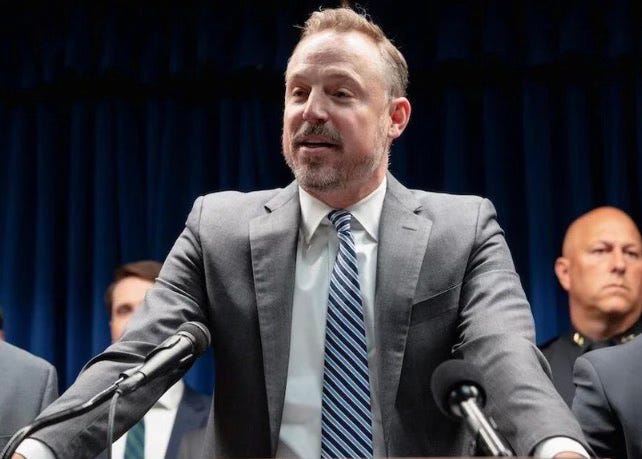
**Assistant U.S. Attorney Joseph H. Thompson, a prosecutor in Minnesota, was among the prosecutors who quit.
Author’s Note: My grandfather was big on critical thinking. When I was growing up, he handed me the kinds of books that didn’t just entertain you…they trained you to think: to follow evidence…spot contradictions…and resist the easy story.
One of my favorites was Agatha Christie and her detective mysteries. So, just for fun…and because I think we need that kind of clear-eyed thinking more than ever…I’m going to walk through this story the way I suspect Christie would have approached it: structured…methodical…and obsessed with the details that everyone else skims past.
Here’s What Happened at the DOJ… and What It Means for America
The Case of the Missing Investigation
The Jack Hopkins Now Newsletter #733: Tuesday, January 13th, 2026
In a proper mystery…the first shock isn’t the body.
It’s the moment you realize the detective isn’t coming.
That’s the chill hanging over the Department of Justice right now…because after Renée Nicole Good, 37, was shot and killed by an ICE officer in south Minneapolis on January 7, 2026, the normal “who investigates what” machinery didn’t just grind… it shifted lanes.
And then people started leaving.
Not one dramatic resignation. Not one disgruntled exit.
A cluster…in Minnesota and in Washington…by lawyers whose entire careers are built around one thing: being the adults in the room when power…is accused of abusing power.
Agatha Christie would ask:
Exactly what happened (as best as public reporting allows)
Who’s who
Where the case went
When the resignations hit
How a case can be “steered” without anyone admitting it
And the part that matters most: what this signals about America’s rule-of-law weather
Because if you’re feeling that strange…sour unease…like something in the system just blinked…there’s a reason.
READ THIS WITHOUT SPIRALING (Resilient Exposure Box)
Before we go into the ugly truth, do this:
Check your body: jaw / chest / belly
Two physiological sighs (inhale… tiny extra inhale… long exhale)
Say: “Information received.”
Ask: “What’s one lawful next action…if any?”
You are building the rarest form of resilience: full exposure, zero hijack.
The Incident: Minneapolis, January 7
What happened:
Renée Nicole Good was shot and killed during a confrontation involving federal agents and vehicles near 34th Street & Portland Avenue in Minneapolis.
Who shot her (as identified in reporting):
Court records and reporting have identified the ICE officer as Jonathan Ross.
What ignited the national reaction:
Video and dueling narratives spread quickly, and the city saw protests and heavy attention from federal authorities.
Now here’s where the mystery begins.
In the classic American expectation…whether it’s always met or not—the next steps should look something like:
Evidence secured
Jurisdictions coordinate
The relevant DOJ components engage
Investigators follow the facts wherever they go
Instead, multiple reports describe something else: a narrowed circle of access…and a Civil Rights Division lane that was told to stand down.
The Door That Closed: “FBI took control” and Minnesota says it was frozen out
Minnesota reporting describes state authorities being pushed out after the FBI took the lead…
…state investigators and officials complaining they could not access evidence and materials they normally would.
That matters for one reason: control of evidence is control of reality.
The more a case gets funneled through one pipeline, the fewer independent professionals can contest:
What was collected
What was prioritized
What was interpreted
What gets said publicly
Again: not a conspiracy. A structural fact.
The Missing Detective: Why DOJ Civil Rights Division Matters
Here’s the part most people don’t know, and it’s the hinge of this whole thing:
DOJ’s Civil Rights Division has a Criminal Section that…by DOJ’s own description…is the component that investigates and prosecutes criminal civil-rights violations (including deprivations of rights under color of law).
So…when a federal officer kills a civilian and civil-rights questions are swirling…many Americans assume: “Surely the Civil Rights Division would be involved.”
But CBS reported that prosecutors in DOJ’s Civil Rights Division were told they would not play a role in the investigation into the Minneapolis shooting.
In Christie terms, this is the moment the inspector arrives at the manor and the butler says:
“I’m sorry. The master has asked that you not enter.”
That’s when the reader leans forward…because you don’t keep the detective out unless you’re afraid of what the detective will notice.
The Exodus: who resigned, where, and why it hit so hard
Now the departures.
Minnesota: prosecutors resign
Multiple reports say six prosecutors in the Minnesota U.S. Attorney’s Office resigned amid the turmoil.
Local reporting identifies Joe Thompson (described as acting U.S. attorney / senior federal prosecutor in Minnesota in various coverage) as among those resigning.
Washington: Civil Rights Division supervisors resign
Bloomberg Law reported that at least five senior lawyers in DOJ’s Civil Rights Division unit tasked with police-misconduct prosecutions were leaving…including Jim Felte, identified as the chief of the Criminal Section.
And remember: DOJ itself lists Jim Felte as chief of that Criminal Section.
That’s the part that should sober anyone…regardless of politics.
Because when senior, career civil-rights prosecutors walk away from the very table they’ve spent decades earning a seat at…they’re not sending a tweet.
They’re sending a flare.
How a case gets “steered” without anyone saying the quiet part out loud
If you want to understand modern institutional power, stop looking for villains.
Look for process moves.
Move 1: Narrow the circle
If Minnesota investigators say they can’t access evidence after a federal takeover… you’ve narrowed the set of eyes on the file.
Move 2: Control the lane
If DOJ Civil Rights prosecutors are told they won’t be involved…you’ve shifted the case away from the unit explicitly built to handle criminal civil-rights enforcement.
Move 3: Let time do what force can’t
Time is the oldest tool in the justice toolbox.
Delay doesn’t need to “win” forever. It just needs to outlast attention.
And here’s the Christie trick: you don’t have to declare your intention. You simply manage the calendar…until the public stops asking.
What it means for America (the part that’s bigger than one case)
This isn’t just about Minneapolis. It’s about whether Americans believe we still have one justice system.
Because there’s a difference between:
a messy system struggling toward accountability…and
a system that quietly begins to behave like accountability is optional when it’s inconvenient
When people conclude the second is happening…three consequences follow fast:
1) Trust drains out of the system
People stop believing in process. And when process loses legitimacy…everything becomes narrative warfare.
2) Extremes gain leverage
If normal accountability mechanisms are perceived as blocked…the loudest voices win…because the quiet institutions no longer feel credible.
3) The country’s nervous system becomes permanently inflamed
When reality feels illegible…when it looks like “the fix is in”…the public either spirals into anxiety or hardens into cynicism.
Both are forms of civic paralysis.
And that is why you’re feeling a “worry hurdle” here: not because you can’t face ugly truth…but because ugly truth + helplessness is what creates chronic arousal.
Your antidote is clarity + lawful action.
Which brings us to the question list.
The 10 questions every reporter, lawmaker, and citizen should demand answers to
Who decided DOJ Civil Rights Division prosecutors would not be involved?
What written rationale supports that decision (emails, memos, briefings)?
Who has custody of all key evidence (weapon, ballistic materials, devices, full video chain-of-custody)?
Why did Minnesota officials say they were cut off from evidence access after the FBI took over?
What investigative predicate is DOJ using if not a criminal civil-rights lane?
What statutes are being evaluated, and which are explicitly off the table?
What is the official timeline…minute-by-minute…of the confrontation and shots fired?
What does court-record reporting say about the officer identified as Jonathan Ross, and how is that relevant to training/standard-of-care?
What precipitated the wave of resignations in Minnesota and DOJ Civil Rights leadership lanes?
What transparency commitments will DOJ make (public updates, redacted findings, independent review)?
If you want the full 25-question “Case File”, plus the scripts and the 7-day pressure plan…here you go:
The Case File Toolkit
The Full 25 Unanswered Questions (print/screenshot this)
Decision chain and authority
Who specifically decided Civil Rights Division prosecutors would not participate?
What written rationale supports that decision?
Was it reviewed by the Deputy AG/AG office? When?
Was DHS/ICE consulted before DOJ made that call?
Did any DOJ official recommend a “color of law” review—and what happened to that recommendation?
Scope of investigation
What is the formal investigative predicate (civil-rights, officer-as-victim, other)?
Is DOJ treating this as a potential civil-rights offense at all—now or later?
What triggers escalation into a civil-rights criminal lane (if ever)?
What statutes are being evaluated, and which are excluded?
Who is the case agent / supervising AUSAs, and what are their mandates?
Evidence control and access
Why did Minnesota officials say they couldn’t access evidence after FBI takeover?
Who has custody of physical evidence (ballistics, weapon, vehicle evidence)?
Who has custody of electronics and any device footage?
What is the full chain-of-custody log for all video?
Were any materials classified/compartmentalized, and under what authority?
Use-of-force specifics
What was the officer’s stated justification, and how does it compare to full footage?
What commands were issued and when?
What distance and time elapsed between first contact and shots fired?
Was less-lethal force available and attempted?
What policies governed this operation and how were they applied?
Victim-focused inquiry and potential bias
What is the factual predicate for probing the victim’s or family’s associations, and how is relevance justified? (If DOJ disputes this framing, publish the investigative plan.)
What steps were taken to avoid confirmation bias in framing the incident?
Internal DOJ consequences and transparency
Which roles resigned in Minnesota, and what reasons were recorded (if any)?
Which senior Civil Rights Division prosecutors resigned, and what reasons were recorded?
If DOJ declines a civil-rights criminal probe, will it publish the reasons so the public can judge legitimacy?
The 7-Day Pressure Plan (lawful, effective, no drama)
Day 1: Call your U.S. Rep + both Senators: “I want transparency and an independent civil-rights review lane.”
Day 2: Email your state AG + county attorney: “Publish what access you do/do not have, and what you’re requesting.”
Day 3: Submit a short letter to the editor (local paper): focus on process transparency, not partisan heat.
Day 4: Call local news assignment desks: “Here are the 10 questions you must ask.”
Day 5: Show up (peacefully) to a public meeting, ask one question on record.
Day 6: Donate/volunteer one hour with a credible civil-rights or legal-defense org (local ACLU chapter, etc.).
Day 7: Recruit one friend: send them the question list + one action to take this week.
Templates:
30-second call script (Congress)
“Hi—my name is ____ and I’m a constituent in _____. I’m calling about the Minneapolis ICE shooting of Renée Nicole Good. I’m asking the Senator/Representative to demand transparency on who controls evidence, why Minnesota officials report being frozen out, and why DOJ Civil Rights prosecutors were reportedly told they would not be involved. I want oversight hearings or a formal inquiry. Can you tell me what the office is doing and who is tracking this?”
Email to your Senator/Rep (short)
Subject: DOJ transparency and oversight request (Minneapolis ICE shooting)
Hello—
I’m a constituent in _____. Please demand transparency in the investigation into the killing of Renée Nicole Good in Minneapolis, including: evidence custody, chain-of-custody for all video, why Minnesota officials report being frozen out after FBI takeover, and why DOJ Civil Rights Division prosecutors were reportedly told they would not be involved. I’m requesting oversight and a public explanation of the investigative lane and decision chain.
Thank you,
Name
City/ZIP
Message to a newsroom assignment desk
“I’m writing with 10 concrete questions your reporters should ask today about the Minneapolis ICE shooting investigation—decision chain, evidence custody, and why civil-rights prosecutors were reportedly excluded. If you want them, reply and I’ll send the list.”
Tracker Begins (what I’m watching next)
Any official DOJ statement clarifying investigative lane
Any court filings naming supervisory chain or evidentiary details
Any confirmation of the scope of resignations and roles
Any documentation of Minnesota/state access requests and denials
Paid offer
If this helped you stay clear-headed while staring straight at the ugly truth: become (or stay) a paid subscriber.
You’re not just supporting the work…you’re getting ideas…strategies and concepts you can effectively use in your life; including the scripts that turn anxiety into lawful pressure.
#HoldFast
Back soon,
-Jack
Jack Hopkins
P.S. If you do nothing else after reading this, do this one thing: become the calmest person in your circle. Not the most informed. Not the loudest. The steadiest. Because steadiness is contagious…and right now, it’s a form of resistance.
Pick one friend who’s spiraling. Call them. Walk them through the 60-second kill switch. (From the earlier article today) Help them turn “what if” into “if/then.” Help them choose one small action they can actually take this week. Then do it again with someone else tomorrow.
That’s how you build a country that doesn’t freeze when it’s threatened. One regulated nervous system at a time. One clear-headed citizen at a time. One small…lawful… stubborn act at a time.
This thread nails it: the DOJ and Minnesota officials being frozen out of the Renée Nicole Good investigation is not just “mismanagement”—it’s a structural warning.
Career civil-rights prosecutors resigning? That’s the signal flare: the system’s checks aren’t just strained—they’re sidelined. When the lane for accountability is closed, the public is left with narrative, not justice.
Control of evidence is control of reality. Excluding the Civil Rights Division is the modern Christie twist: the detective isn’t coming because someone doesn’t want the truth exposed.
This isn’t about theory. It’s about whether America still has a functioning rule-of-law system. Right now, that trust is bleeding.
I’d wager the evidence went the same route as the missing JFK stuff they claim never existed.