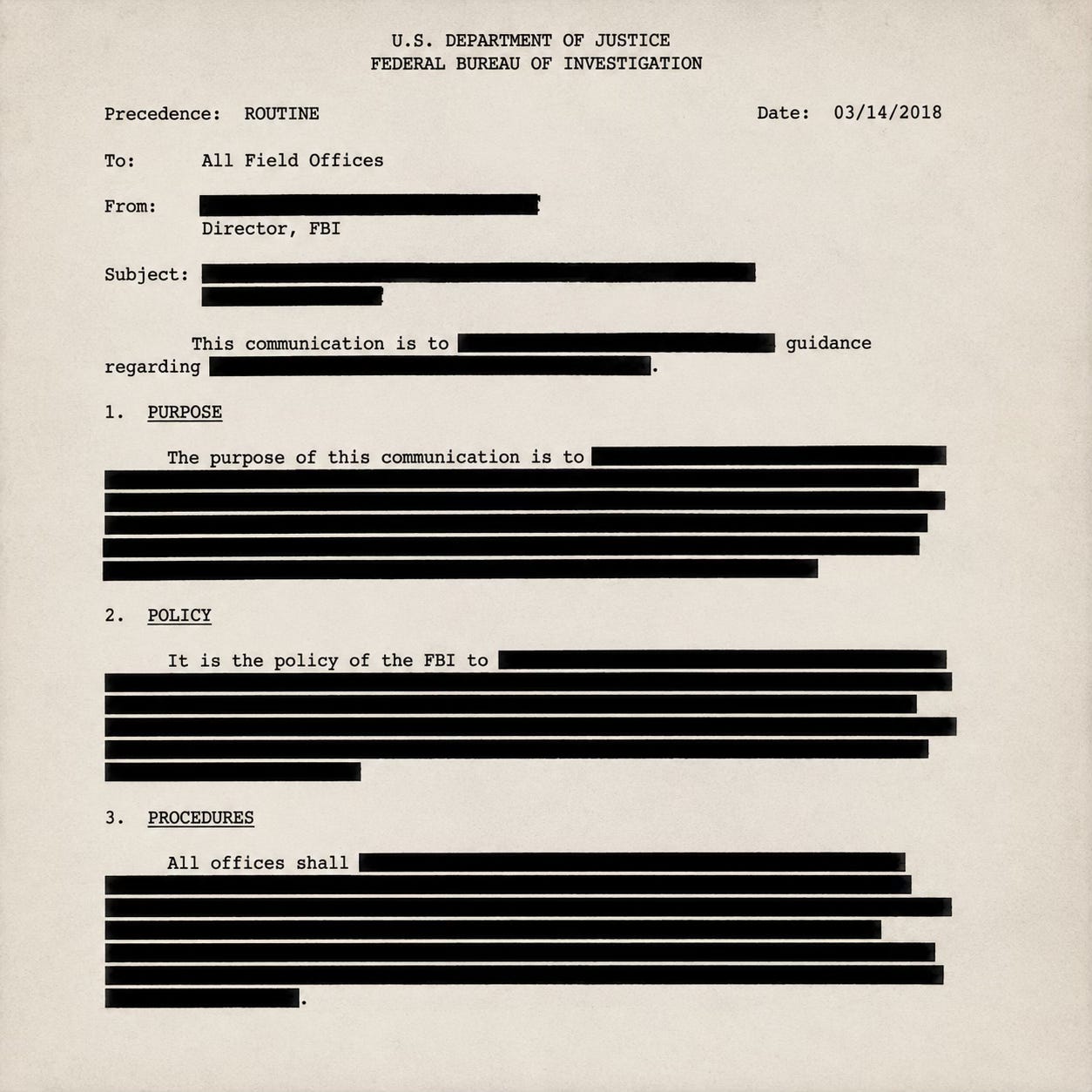
Epstein: The Files We’ll Never See
Everyone is arguing about what’s inside the Epstein documents. The more revealing story is the fight over whether we ever get to see them at all.
Epstein: The Files We’ll Never See
Everyone is arguing about what’s inside the Epstein documents. The more revealing story is the fight over whether we ever get to see them at all.
The Jack Hopkins Now Newsletter #920: Friday, June 5th, 2026.
For years…the promise has been the same: just wait. Wait for the next filing…the next release…the next witness…the next investigation.
And…every time a fresh batch of records lands…the ritual repeats itself. People rush to search names. The feeds ignite. Outlets publish their summaries. Each political camp extracts the fragments…that flatter what it already believed.
Then, within a few days…the conversation quietly drains away…not because the questions were answered…but because everyone realizes the ones that matter weren’t.
I’ve come to think the real story isn’t in the files we’ve seen. It’s in the files we won’t. And, more than that…in why we won’t.
You don’t have to believe in a single grand conspiracy to find that interesting. Whether you’re certain there’s a cover-up…or…certain there isn’t…the struggle over the information…itself…has become one of the most revealing political stories of the decade, because it exposes how power actually behaves when it’s cornered.
Most people are chasing content. Power is managing perception.
We tend to approach a scandal the way an archaeologist approaches a dig.
We assume the truth is buried down there somewhere…and that with enough artifacts …enough documents…enough testimony…the picture will finally resolve.
That instinct is reasonable. It’s also incomplete. Powerful institutions don’t simply possess information; they manage it. Those are very different verbs.
The citizen asks what happened. The institution asks what happens if people believe a particular version of what happened.
The citizen wants to know which records exist. The institution wants to know the cost of releasing them.
One side is focused on facts…the other on consequences.
Once you internalize that gap…a great deal of otherwise baffling behavior…the redactions…the sealed exhibits…the documents dumped at 5 p.m. on a Friday…the years that pass between a promise and a page…stops looking like incompetence…and starts looking like strategy.
Secrecy isn’t proof of guilt. But transparency isn’t anyone’s default.
Here is where people go wrong in both directions.
The first error is assuming that because something is hidden…something is damning. Sometimes a redaction protects a victim…a witness…a live investigation…or a person who was never charged with anything. Secrecy is not a confession.
The opposite error is more comfortable and just as wrong: imagining that institutions want to tell you everything…and only fail to out of carelessness. They don’t.
Governments protect themselves. So do agencies…parties…prosecutors…universities… and…yes…newsrooms.
This isn’t cartoon villainy. It’s the ordinary survival instinct of any organization with a reputation…a budget…and legal exposure to lose.
Which is exactly what makes it predictable. When information threatens an institution’s standing…the reflex is almost never radical openness. The reflex…is containment: delay, narrow, negotiate, control.
And that pattern…is far bigger than any one case.
The thing being destroyed isn’t a reputation. It’s trust.
The largest casualty here was never going to be a name.
It’s trust…the invisible infrastructure everything else runs on.
Courts need it. Elections need it. Policing needs it. Journalism needs it. Each one depends on enough people…believing the rules get applied…roughly the same way to everyone.
Pull enough of that belief out from under the system…and something quiet but corrosive happens.
Every missing page reads as a hidden one. Every delay reads as a stall. Every redaction reads as a name being protected. The question stops being what’s in the file and becomes why should I believe you…and that second question is far more dangerous…because trust is so much slower to rebuild than it is to lose.
The gap itself is now the story.
Count the years. The investigations, the journalists, the lawyers, the lawsuits, the promises. And public confidence sits lower than ever. Why?
Because the uncertainty became the content.
People can absorb bad news. They can absorb ugly truths and real disappointment. What they can’t sit with is open-ended ambiguity.
The mind hates an unresolved story and reaches for closure. When the closure never arrives…people manufacture their own…some of it sober…some of it speculative…some of it unmoored from reality entirely.
But…all of it grows from the same soil: a vacuum. And vacuums…don’t stay empty. They never have.
The question I keep circling
What if the files no longer matter as much as we think they do…because the larger damage is already done?
Run the experiment. Suppose every remaining document dropped tomorrow. Every gap filled…every mystery resolved. Would trust come flooding back? Would half the country simply believe the institutions again? I don’t think so.
The injury stopped being purely informational a while ago. It’s psychological now. Cultural. Institutional. The fight over the files has outgrown the files. It has become a referendum…on whether powerful systems can still command belief at all.
The pattern matters more than the names
This is why the story refuses to die. People sense…correctly…that the names are the smaller half of it.
The pattern is the larger half: the suspicion that there’s one set of rules for ordinary people…and another for those with enough wealth…status…or connection to bend the machinery.
Whether that suspicion holds in every instance is almost beside the point. Legitimacy doesn’t run on what’s true…so much as on what people believe is true.
And…once enough of them conclude that accountability is a function of who you are…rather than what you did…legitimacy begins to drain…slowly, then all at once.
By the time the people in charge notice the level dropping…refilling it has become almost impossible.
Now…Let’s Go Deeper
If trust has already been damaged, the question that actually matters is the one almost nobody is asking: who has the power to rebuild it…and is anyone genuinely trying?
That’s where this gets less abstract.
Below, I lay out which institutions are still capable of restoring public confidence and which have quietly stopped trying; why the usual “we’ll be more transparent going forward” gestures so often backfire; the credibility death spiral organizations build for themselves without meaning to; what history actually shows happens afterlegitimacy collapses; and the specific signals worth watching over the next few years to tell whether American trust is slowly recovering…or hardening into something permanent.
The Files We’ll Never See — Deeper Still
The first half argued that trust, not information…is the real casualty. Here’s the part almost nobody is asking: if trust is already broken…who can actually rebuild it…and why do the obvious fixes keep making it worse?
Let me start with the uncomfortable answer.
Most of the institutions promising to restore your confidence are structurally incapable of doing it…and a few of them are quietly making the problem permanent.
The good news…is that the mechanisms that can rebuild trust still exist. The bad news…is that we keep choosing not to use them.
The three institutions that can still rebuild trust
Trust isn’t restored by sincerity. It’s restored by structure.
An institution earns belief back…only when it submits to a process it can’t control and lets the result stand in public.
By that test, three institutions still have the machinery…whether or not they use it.
The first is the courtroom… but only when it actually holds a trial.
A trial…is the single most powerful trust-manufacturing device…a society has…because it forces evidence into the open…subjects it to cross-examination…and produces a finding anyone can inspect and argue with.
The problem is that the powerful…almost never go to trial. They settle. They seal. They sign agreements that exchange money for silence and call it resolution.
Every sealed exhibit and quiet plea…is a court choosing the trust-destroying option over the trust-building one. The capacity is real. The willingness is what’s missing.
The second is genuinely independent oversight…inspectors general, auditors, special counsels… but only when their findings can’t be buried.
A watchdog rebuilds trust precisely to the degree that it can reach a conclusion the institution it’s investigating…doesn’t want reached…and publish it anyway.
The moment its report has to be “reviewed,” “coordinated,” or released in fragments by the very body under examination…it converts from a check into a laundering service.
Independence on paper…isn’t independence. The test is whether the watchdog can bite…not whether it exists.
The third is the local and the proximate…juries…local reporting…the neighbor in a position of judgment.
Here’s a pattern worth sitting with: trust collapses with distance.
People who say they don’t believe “the media”…still believe the reporter they went to high school with.
People who say the system is rigged…still serve on juries and take the duty seriously.
Confidence in distant…abstract power is gone…but…confidence in people like you, placed in a role with real stakes…is surprisingly intact. Whatever rebuilding happens will likely start there…close to the ground…where trust can still be verified by sight.
Why “we’ll be more transparent” almost always backfires
When an institution gets caught in a credibility gap, its instinct is to promise more openness.
This rarely works…and the reasons are worth understanding…because they’re not obvious.
A promise of future transparency is a pledge made by the same body that lost your trust, about behavior you can’t yet observe. It has no collateral. You’re being asked to trust them to prove they’re trustworthy.
Worse is the partial release…the curated dump…the redacted file…the document drop that answers the third question…while ignoring the first.
People imagine partial transparency reassures. It does the opposite.
A redaction doesn’t hide the shape of what’s behind it; it advertises it. Now you can see exactly where the institution decided you shouldn’t look.
Silence at least leaves the question open. A redaction confirms there’s an answer…and announces that you’re not allowed to have it.
And the deepest problem is this: trust is rebuilt by binding…not by output. “Here are some documents” is output…and output the institution selected..timed…and packaged is…by definition…controlled.
Control is the very thing the audience suspects. So the more visibly an institution manages its own disclosure…the more it confirms that disclosure is something it manages. The PR-perfect release defeats itself.
The credibility death spiral
Put those dynamics together and you get a loop that organizations build for themselves without ever deciding to.
It runs like this. Suspicion rises, so the institution releases something to calm it.
Total release is genuinely costly…there are victims…live cases…lawyers…real liabilities …so the release is partial. The partiality reads as a tell…so suspicion rises further.
The next release is scrutinized harder…so the institution becomes more cautious and discloses less. Each loop tightens.
And here’s the trap: every single move in that spiral is locally rational.
Lawyering up, controlling the message…declining to comment…releasing only what you must…each is sensible advice in isolation.
It’s only when you step back…that you see the cumulative behavior is identical to what a guilty party would do…which is exactly how a low-trust audience reads it.
The mechanism underneath is a quiet shift in what the institution is optimizing for.
It stops trying to be trusted…and starts trying to not be blamed.
Those two goals feel similar from the inside…but…they point in opposite directions. Avoiding blame means saying less…conceding nothing…and controlling every release.
Earning trust means doing the reverse. An institution in the spiral has chosen self-protection…over confidence…and usually can’t tell that it has.
What history says happens after legitimacy collapses
Here is the part that should worry you most, because the historical pattern is consistent.
Trust does not return to the institution that lost it. It migrates.
When people stop believing official channels…their need to make sense of the world doesn’t disappear…it goes shopping. And what it tends to buy is certainty.
The vacuum left by a hollowed-out institution…gets filled…not by careful truth-telling …but…by whoever offers the most confident story: partisan media that tells a clean tale…rumor networks that never have to prove anything…and above all the figure who promises to walk in and blow the whole thing open.
Legitimacy vacuums are reliably filled by certainty-merchants…and certainty-merchants are almost always worse…than the ambiguity they replace…because their power depends on the suspicion never actually resolving.
The other historical pattern is quieter…and arguably more corrosive: not rage…but exit.
People stop expecting fairness and simply withdraw…they stop cooperating…stop participating…stop assuming the rules apply at all.
A society can survive loud distrust. The dangerous state…is the one where everyone privately assumes the official story is a managed fiction…and has stopped being surprised by it.
That’s not a crisis. It’s a settling. And it’s far harder to reverse than anger, because nobody’s even arguing anymore.
What to watch for next
So how do you tell, in real time, which way this is going? A few signals are worth more than the headlines.
Watch whether cases go to trial or get sealed and settled…the seal rate is the real measure…of whether the powerful are being held to the same process as everyone else.
Watch whether oversight findings come out intact…or…pre-spun by the bodies they indict. Watch whether the people losing faith are still arguing…protesting…organizing… demanding reform…or whether they’ve gone quiet…and simply stopped showing up; voice is recoverable, exit is the dangerous sign.
Watch for the rise of the certainty-merchants…the figures whose entire appeal is the promise of total exposure…because their popularity is a thermometer for how much trust has already drained.
And…watch whether institutions start competing on openness…or…close ranks and protect one another. The first is the beginning of a recovery; the second is the spiral locking in.
The fight over these particular files will end…the way these things always do…in a slow fade…rather than a verdict.
But the larger contest…whether powerful systems in this country can still command belief…is only getting started.
The next few years won’t settle who did what.
They’ll settle something bigger: whether Americans decide their institutions can be trusted again…or…quietly conclude that they can’t…and stop asking.
That second outcome wouldn’t announce itself. It would just become the weather. And that is the thing…actually worth watching for.
#HoldFast
Back soon.
-Jack
Jack Hopkins
P.S. Here's a test you can run on yourself.
The next time a batch of documents drops and you feel that flicker of finally…now we'll know, notice how fast it fades. Then notice that…you weren't surprised when it did.
That reflex…the one that's quietly stopped expecting an answer…is the whole essay in miniature.
So I'll ask the question I don't have a clean answer to myself: is there anything that would restore your trust at this point…a single thing…or…are we already past that? Tell me in the comments. I'm genuinely unsure.
Sources & Further Reading
This is an article of analysis and opinion, not a reported investigation into any specific case. The links below support the broader empirical and theoretical claims it rests on — about the state of public trust, what actually rebuilds legitimacy, and how people respond when faith in institutions runs out.
On trust being “lower than ever”
Pew Research Center — Public Trust in Government: 1958–2025 — the long view, showing trust falling from roughly 70%+ in the late 1950s to around 17% in 2025, with the Vietnam War and Watergate as the original inflection point. pewresearch.org
Pew Research Center — Public trust in government near historic lows (chart) — the interactive time series, 1958 to present. pewresearch.org
The Pew Charitable Trusts — Americans’ Deepening Mistrust of Institutions — a readable overview of how confidence has eroded across institutions, not just government. pew.org
Gallup — Trust in Media at New Low of 28% — confidence in the press, tracked since the 1970s, when it sat near 70%. Supports the point that the “fourth estate” is caught in the same trust collapse. news.gallup.com
Gallup — Five Key Insights Into Americans’ Views of the News Media — additional detail on how media confidence has fallen faster than confidence in the three branches of government. news.gallup.com
On why trust is rebuilt by process, not by disclosure
Tom R. Tyler — Why People Obey the Law (Princeton University Press) — the foundational work on procedural justice and legitimacy. Tyler’s core finding: people accept authority when they judge the process to be fair, not merely when they like the outcome. This is the research behind the essay’s claim that trust is restored by binding, contestable procedure rather than by curated output. press.princeton.edu
Tom R. Tyler — Legitimacy and Procedural Justice (Police Executive Research Forum, PDF) — a concise, applied summary of the same theory, framing legitimacy as something institutions earn through fair treatment. policeforum.org
On how people respond when faith runs out
Albert O. Hirschman — Exit, Voice, and Loyalty (Harvard University Press) — the classic framework underpinning the members’ section. Hirschman argues the dissatisfied either raise their voice (protest, push for reform) or exit (withdraw and disengage) — and that quiet exit, not loud voice, is the more corrosive signal for any organization in decline. hup.harvard.edu


Hey all...my daughter is getting married tomorrow...and I have a wedding rehearsal in a bit. I will be back later this evening...to reply to your comments. Thank you for your patience!
-Jack
I don’t say it’s a good thing or a bad thing, but a major change has been the proliferation of unfiltered information and opinion, so one person’s opinion, informed or not, is seen as being as valid as anyone else’s. The immediacy of the news cycle and the need to fill it with something - anything - means little time for reflection. You’ve given us a clear route map for what is an extraordinarily complex subject, and provided, as usual, a great service. I’d also add a further rule of thumb - don’t believe anything until it’s been officially denied. As you say, find the patterns.