


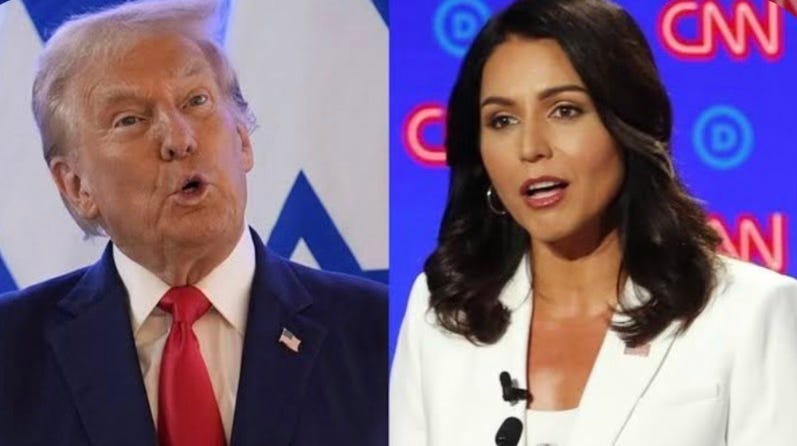
Donald Trump’s Emergency Lever: What Happens If He Actually Pulls It
The Jack Hopkins Now Newsletter #797 (Paid Edition-Extended Briefing)
Thursday, February 26th, 2026
In the free edition, I showed you the outline of the weapon.
Tonight, we’re walking through the firing mechanism.
Not emotionally.
Not rhetorically.
Mechanically.
Because if someone declares a national emergency tied to elections, this country does not descend into chaos overnight.
It enters a process.
And…process is where power hides.
You’re paid subscribers. You don’t get vibes. You get structure.
I. The Legal Doorway: How an “Emergency” Becomes Authority
The National Emergencies Act (1976) does not itself grant sweeping power.
It unlocks power already sitting in statute.
Think of it like a breaker panel. The declaration flips switches that activate authorities Congress previously wrote into law.
As of today, there are more than 130 statutory provisions that can be triggered by an emergency declaration.
Most are irrelevant to elections.
But some become relevant the moment elections are reframed as national security infrastructure.
Here’s the maneuver:
Define election systems as vulnerable to foreign interference.
Argue that foreign interference constitutes an ongoing national security threat.
Declare a national emergency tied to that threat.
Activate statutes that allow executive action in the name of national security protection.
This is not fantasy. This is legal engineering.
II. Election Infrastructure Is Already Classified as Critical
In 2017, election infrastructure was designated as “critical infrastructure.”
That designation placed election systems…machines, storage facilities, digital networks…inside the same conceptual bucket as energy grids and water systems.
Why does that matter?
Because once something is critical infrastructure…the Department of Homeland Security gains an expanded coordination role.
Under emergency conditions, DHS can issue protective directives…advisory bulletins, and threat-based guidance.
Those advisories are technically “guidance.”
But in practice? They influence funding, vendor behavior, and liability exposure.
No governor wants to be accused of ignoring DHS emergency warnings about election vulnerabilities.
Pressure doesn’t have to be mandatory…to be effective.
III. The Vendor Leverage Strategy
This is where things get sophisticated.
Voting machine manufacturers operate nationally.
If an emergency declaration frames certain machines as foreign-risk vectors, vendors face three choices:
Continue supplying states and risk federal scrutiny
Suspend operations temporarily
Seek federal compliance certification under emergency terms
Even without outright bans…emergency framing can generate hesitation in supply chains.
Mail ballot vendors.
Signature verification software.
Ballot printing firms.
Uncertainty becomes a tactical advantage.
You don’t need to outlaw something.
You just need to make it feel unstable.
