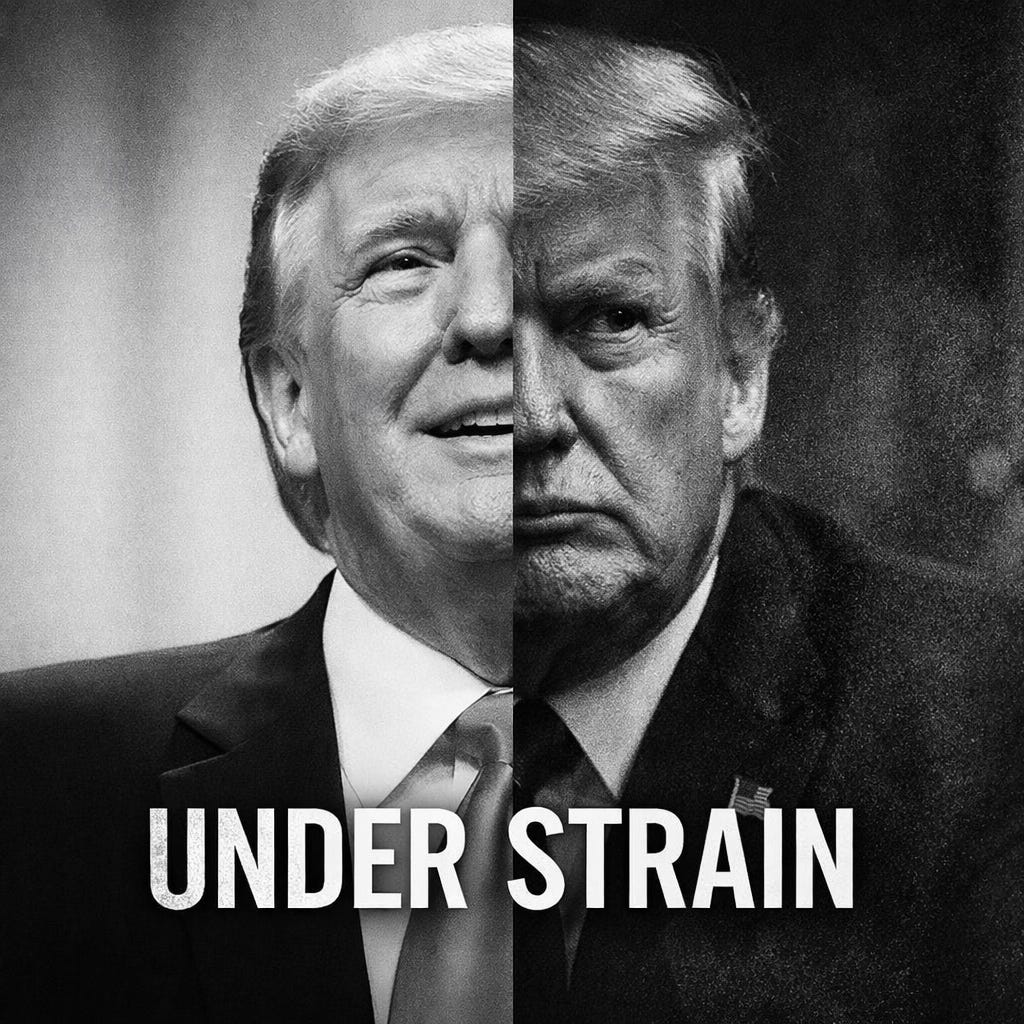
Donald Trump Under Strain: What Happens When Dominance Feels Threatened
How Pressure Rewires Power, Tightens Loyalty, and Sets the Stage for Overreach
Author’s Note
This is longer than what I’ve been posting lately.
That’s intentional.
I’ve been working on this one for a while…rewriting it, tightening it…pressure-testing it…because it isn’t meant to chase a headline.
It’s meant to prepare you.
Here’s why the length matters: none of us experience events the way we think we do.
We don’t store life like a video file.
We build our memory of what happened from pieces…what we heard first…what got repeated…what carried the strongest emotion…what our brains decided was “the point,” what our friends echoed back to us…what we scrolled past ten times before breakfast.
In other words: the story around events often becomes the event in our minds.
That’s not a small detail right now.
Because the months ahead…even if we’re confident about where this ends…and…I am…may be loud…chaotic…and psychologically exhausting by design.
When the rhetoric spikes and the narratives collide…the real danger isn’t just what happens.
It’s what it does to your nervous system, your clarity…your stamina…and your sense of reality over time.
This piece exists to give you a framework before the noise arrives.
Not to alarm you.
To inoculate you.
So when escalation happens, you don’t interpret it as personal danger…you recognize it as pressure behavior.
So when the story shifts three times in 48 hours, you don’t lose your footing…you keep your orientation.
So when your body starts carrying stress…like it’s a backpack you can’t put down…you have a plan to set it down…recover…and keep moving.
I’m confident we will prevail.
But confidence…is not the same thing as being prepared for what we may have to endure between now and then.
There may be volatility. There may be tests. There may be moments that are designed to wear you out…make you doubt your own perception…and tempt you into fatigue and resignation.
That’s why I wrote this.
Not to make you scared.
To make you steady.
Read it like you’re building a mental posture…one that holds under pressure.
And…if it felt longer than usual, good. That’s the point. This isn’t “content.” It’s conditioning.
Because the people who make it through the loudest seasons…aren’t the loudest.
They’re the most regulated.
They keep their clarity. They keep their bodies. They keep their pace.
And…they press on.
When you finish, I want you wanting the next layer…because…there is one.
Donald Trump Under Strain: What Happens When Dominance Feels Threatened
How Pressure Rewires Power, Tightens Loyalty, and Sets the Stage for Overreach
The Jack Hopkins Now Newsletter #783: Wednesday, February 18th, 2026.
You don’t need to read his mind.
You don’t need insider leaks.
You don’t need anonymous sources.
You only need to understand what pressure does to human beings who are wired for dominance.
Because when powerful men feel the walls inching inward, they behave in patterns that are almost boringly predictable.
Different country.
Different ideology.
Different decade.
Same psychology.
And…if you want to understand what Donald Trump is likely experiencing right now …not in a gossip sense, but in a structural, predictive sense…this is where you start.
Not with rumor.
With human nature.
First: We Can’t Know His Emotions
Let’s be disciplined.
I cannot diagnose him.
I cannot see his internal state.
I cannot assert what he “feels.”
What we can do is examine four variables:
• The psychology of dominance-oriented leaders
• The stress physiology of prolonged public threat
• Historical behavior of leaders under investigation
• The reaction patterns of supporters when their leader is cornered
When those four converge, a probability map appears.
Not certainty.
Probability.
And probability…is enough to forecast behavior.
Status Threat Is Neurological
This is the piece most people underestimate.
Research in social psychology shows that for high-status individuals, loss of status activates pain circuits in the brain similar to physical pain.
Status isn’t abstract.
It’s biological.
If someone’s identity is fused with:
I win.
I dominate.
I never lose.
I control the narrative.
Then sustained legal scrutiny…does not feel procedural.
It feels existential.
And humiliation…real or perceived…is one of the most destabilizing psychological experiences a human being can endure.
But dominance-oriented personalities don’t metabolize humiliation quietly.
They convert it.
Shame becomes anger.
Anxiety becomes aggression.
Uncertainty becomes absolutism.
Vulnerability becomes contempt.
Because anger…feels powerful.
Shame…feels powerless.
And…under threat, the nervous system chooses power.
What Chronic Siege Does to the Body
Political combat isn’t just rhetorical.
It’s physiological.
Sustained high-conflict environments are associated with:
• Elevated cortisol
• Increased adrenaline cycling
• Reduced sleep quality
• Shortened emotional regulation windows
• Heightened threat detection
• Reduced tolerance for nuance
Over time, chronic stress narrows cognition.
The brain under pressure prefers simple narratives.
Enemy.
Witch hunt.
Corrupt system.
They’re coming for you.
These aren’t just talking points.
They’re neurologically efficient.
They reduce ambiguity.
And ambiguity…is intolerable under siege.
History Is Blunt About This
You don’t have to speculate about Trump personally.
History gives you the template.
Nixon
As Watergate tightened:
• His circle shrank
• His suspicion grew
• His fixation on enemies intensified
• Loyalty became paramount
• Risk tolerance increased
He shifted from governing…to surviving.
Berlusconi
Under repeated scandals:
• He attacked the judiciary
• Framed prosecutions as political warfare
• Turned personal jeopardy into loyalty theater
• Flooded media space with spectacle
He escalated instead of retreating.
Netanyahu
Under legal pressure:
• Scrutiny was reframed as national sabotage
• Coalition loyalty tightened
• Institutional friction became “corruption”
Pressure hardened posture.
Across systems and ideologies, the pattern repeats:
When powerful leaders feel threatened, they fortify.
They rarely soften.
The Control Reflex
Here’s the key concept.
When uncertainty rises, powerful individuals don’t seek reflection.
They seek control.
Control restoration becomes the central psychological reflex.
And…control gets restored in three primary ways:
Narrative control
Loyalty control
Procedural control
If you want to understand what someone in Trump’s position is likely experiencing, watch where he is trying to restore control.
Before we go further…
If you’re reading this in your email, tap “View in app.”
The comments matter here.
Drop a quick response:
Which do you think is the strongest pressure signal right now…narrative, loyalty, or procedural?
I’m curious what you’re seeing.
What This Likely Feels Like Internally (Probability, Not Diagnosis)
A dominance-oriented leader under sustained scrutiny is likely experiencing:
• Elevated baseline agitation
• Heightened betrayal sensitivity
• Stronger fixation on loyalty
• Shorter fuse
• Greater urgency to dominate the story
• Increased comfort with escalation
• Reduced tolerance for ambiguity
The daily emotional oscillation likely swings between:
Anger (energizing)
Defiance (stabilizing)
Suspicion (defensive)
Urgency (activating)
Fear may exist.
But…when it does…it rarely presents as fear.
It presents as attack.
Because attack…restores control.
The Siege Narrative as Armor
When scrutiny comes from multiple directions…
…legal institutions, media cycles, international commentary…leaders often consolidate around a siege frame:
“They’re not after me. They’re after you.”
This accomplishes three things instantly:
Converts personal peril into collective battle
Turns anxiety into mobilization
Creates moral insulation
If the system is corrupt…fighting it becomes righteous.
Righteousness stabilizes.
And stability under threat…is addictive.
What Happens to Supporters
This part matters just as much.
When followers fuse identity with a leader…attacks on the leader feel like attacks on the self.
That produces:
• Moral defensiveness
• Hostility toward messengers
• Migration toward in-group sources
• Increased loyalty signaling
• Reduced tolerance for dissent
Under pressure, groups often become more purity-driven.
Moderation feels like betrayal.
Nuance feels like weakness.
Conspiratorial thinking rises…because it reduces uncertainty quickly.
The group shifts from persuasion mode…to protection mode.
Protection mode is far less patient.
Five Observable Tells Pressure Is Rising
You don’t need speculation.
Watch behavior.
Language compression
More “always,” “never,” “enemy,” “traitor,” “total hoax.”Loyalty as headline
Public emphasis on loyalty. Visible punishment of dissent.Institutional delegitimization
Courts, agencies, prosecutors framed as inherently corrupt.Narrative flooding
Multiple controversies at once. Overwhelm replaces clarity.Symbolic dominance plays
Moves that signal power more than policy.
When two of these cluster…pressure is increasing.
When three converge…you’re watching fortification.
We’ve been watching three or more converge for a long time.
The Three Escalation Tracks
Here’s how pressure translates into action.
Track One: Paper Escalation
Document drops. Investigation announcements. Headline maneuvers.
Purpose: change narrative terrain.
Track Two: Personnel Escalation
Loyalty placements. Removal of friction actors. Empowerment of enforcers.
Purpose: tighten internal control.
Track Three: Operational Escalation
Procedural pressure. Enforcement shifts. Real structural moves.
Purpose: convert rhetoric into consequence.
The most volatile moments occur when Personnel and Operational tracks converge.
That’s when pressure moves from performance…to structure.
So…What Is He Likely Experiencing Daily?
Strip the politics away.
Imagine any executive whose identity is fused with dominance facing:
• Legal exposure risk
• Constant media scrutiny
• Loyalty uncertainties
• International pressure
The likely internal environment:
• Constant threat scanning
• Sensitivity to betrayal
• Urge to reassert dominance
• Aversion to concession
• Focus on survival positioning
Even if projected publicly as calm, the underlying nervous system is unlikely to be relaxed.
Calm is associated with security.
Siege produces vigilance.
And vigilance…is exhausting.
Why This Matters
This isn’t about guessing feelings.
It’s about recognizing patterns.
When you understand what pressure does to powerful men:
You stop reacting emotionally to rhetoric spikes.
You start reading them as stress signals.
You stop being surprised by escalation.
You start anticipating it.
You stop asking, “Why is he doing this?”
And start asking, “What pressure is this responding to?”
That shift alone changes how you interpret everything.
If this framework helped clarify what you’re seeing, leave a comment with one behavioral tell you’ve noticed recently.
Let’s compare notes.
BONUS: The Pressure Paradox No One Talks About
Most people think pressure weakens powerful men.
It doesn’t.
It clarifies them.
Pressure doesn’t create personality.
It reveals it.
And here’s the part that should make you sit up:
When a dominance-oriented leader feels existential threat…escalation is not always a mistake.
Sometimes it’s the most psychologically rational move available.
Let me explain.
The Hidden Math of Escalation
When you’re under investigation or reputational siege, you have two broad options:
De-escalate and absorb scrutiny.
Escalate and change the battlefield.
For personalities wired around dominance, de-escalation feels like surrender.
Escalation feels like agency.
And agency regulates fear.
Now here’s where it gets interesting:
If you escalate hard enough, you can actually change the incentive structure around you.
You can:
• Make loyalty more valuable than neutrality.
• Make silence safer than dissent.
• Make ambiguity more tolerable than confrontation.
• Make institutions hesitate.
Escalation creates risk…but it also creates deterrence.
That’s not emotional.
That’s strategic psychology.
The Dominance Feedback Loop
Here’s the loop most analysts miss:
Pressure rises →
Leader escalates →
Supporters rally →
Opponents harden →
System polarizes →
Leader feels more justified →
Escalation becomes identity →
Backing down becomes impossible.
At that point, it’s no longer about the original issue.
It’s about survival and dominance.
And survival mode has a different moral operating system than governance mode.
The Loyalty Conversion Effect
Under threat, something fascinating happens inside movements.
Neutral actors are forced to choose.
Ambiguity collapses.
Moderates shrink.
And the leader’s inner circle…becomes more aligned…not necessarily because everyone believes more deeply…but because the cost of dissent rises.
Pressure can purify a movement.
Not ethically.
Structurally.
The more intense the external attack, the tighter the internal cohesion.
Which means, paradoxically…that legal and reputational pressure…can temporarily strengthen a dominance-driven leader inside his base.
That’s the part most people misunderstand.
They assume exposure equals collapse.
Sometimes exposure equals consolidation.
The Physiological Edge
Here’s another uncomfortable truth:
Some personalities thrive under siege.
High-adrenaline environments feel normal to them.
Conflict sharpens them.
Chaos energizes them.
Routine bores them.
If someone has spent decades operating in competitive, combative arenas, a high-pressure political environment might not weaken them.
It might activate them.
And…if escalation restores their internal sense of control…they may escalate simply because it feels stabilizing.
Not because it’s optimal long-term.
Because it works short-term.
The Real Danger Signal
The real signal isn’t anger.
It isn’t rhetoric.
It isn’t even defiance.
The real danger signal…is when escalation becomes strategic doctrine…rather than emotional reaction.
You know you’re there when:
• Institutional friction is treated as illegitimate by default.
• Loyalty becomes a prerequisite for proximity.
• Rules are reframed as optional obstacles.
• Narrative dominance becomes more important than procedural legitimacy.
That’s when pressure has reshaped behavior.
The Constraint Variable
Everything hinges on one variable:
Constraint.
If institutions remain firm…escalation hits walls.
If institutions bend…escalation compounds.
If supporters demand results…escalation intensifies.
If supporters tolerate rhetoric without structural change…escalation plateaus.
Pressure alone does not determine outcome.
Constraint does.
The Quiet Prediction
Here’s the prediction embedded in all of this:
If pressure continues, behavior will not soften.
It will likely:
• Intensify loyalty demands.
• Increase enemy framing.
• Expand narrative warfare.
• Test procedural boundaries.
• Seek symbolic dominance moments.
Not because of evil.
Not because of madness.
Because that’s what dominance under threat does.
It fortifies.
The Psychological Point Most Miss
We keep asking:
“What is he feeling?”
The smarter question is:
“What does he need to feel stable?”
If stability comes from:
• Winning
• Dominating
• Controlling
• Being obeyed
Then anything that disrupts those signals will be countered.
Aggressively.
And that aggression will feel justified internally.
That’s the piece that makes people underestimate what comes next.
The Strategic Insight
If you want to predict behavior under pressure, don’t track emotion.
Track control.
Where is control being tightened?
Where is loyalty being enforced?
Where is narrative being flooded?
Where are procedural edges being tested?
Pressure reveals priorities.
And under existential stress…the top priority becomes:
Do not lose.
The Cold Conclusion
Power under threat rarely becomes reflective.
It becomes defensive.
Then offensive.
Then entrenched.
The real question isn’t what he’s feeling.
It’s how much constraint exists around him.
Because pressure…without constraint…escalates.
Pressure with constraint…stabilizes.
And that…more than personality…more than scandal…more than rhetoric… determines the trajectory.
If that made something click, say so in the comments.
#HoldFast
Back soon.
-Jack
Jack Hopkins
P.S.
What Comes Next (And Why It Matters)
Everything you just read explains pressure.
Tonight’s paid piece explains leverage.
Because here’s the shift most people aren’t seeing yet:
Pressure doesn’t just produce reaction.
It exposes wiring.
And when you understand someone’s wired-in reactions…the way they predictably convert threat into escalation…humiliation into attack…scrutiny into domination… you can design strategy around it.
That’s exactly what’s beginning to happen.
Democratic leadership, slowly and unevenly, is starting to pivot away from reactive outrage and toward structural exploitation of those pressure reflexes.
Not louder rhetoric.
Not emotional counter-punching.
Exploitation.
The paid article going up later tonight breaks down:
• The three predictable reactions dominance-driven leaders default to under sustained stress
• Why those reactions feel stabilizing in the short term — but create long-term vulnerability
• How institutional constraint quietly compounds against escalation cycles
• Why the movement surrounding him becomes more brittle, not stronger, at peak intensity
• And why authoritarian surges often burn hot before they burn out
Here’s the part I want you to sit with:
You already understand half of it.
You felt it reading this piece.
When I walked you through the pressure pattern…the control reflex…the loyalty tightening, the narrative flooding…you weren’t just reading analysis.
You were building a mental map.
And once a mental map is built…it’s hard to erase.
Even if someone tries to shout over it.
Even if someone tries to reframe it.
Even if someone tries to make you doubt what you already recognized.
That’s how perception works: once you see the pattern…you can’t unsee it.
Tonight’s article simply completes the map.
It shows you where the weak points are.
It shows you why escalation eventually overreaches.
It shows you why movements built on permanent siege…eventually fracture under their own rigidity.
And…it shows you…calmly, structurally…why this current wave, no matter how loud, is not the end of the story.
It is the midpoint of it.
There’s a reason authoritarian movements tend to throttle themselves at peak aggression.
There’s a reason dominance-based systems struggle in prolonged institutional environments.
There’s a reason reaction-based leadership eventually collides with structural constraint.
And there’s a reason I remain confident about where this ultimately lands.
That full explanation goes up tonight for paid subscribers.
Not because it’s sensational.
Because it’s strategic.
And…by stepping into that deeper layer, you’re not just gaining the blueprint…you’re strengthening the kind of independent journalism that refuses to flinch, refuses to panic, and refuses to surrender narrative ground.
That’s what the Jack Hopkins Now Newsletter exists to do.
And it only works because readers like you decide it should.
I’ll see you there.
-Jack


Yea, my panic button clicked. I live in Iowa, a farming state, and today fearless leader threatened massive tariffs on Canadian potash. Our farmers, coming off a killer year where they barely broke even are ordering their ammonia and potash now and will start to be in the fields in six weeks. They rely on potash. Sure there are huge corporation farms here, but there’s also Larry and John and LeRoy, some sitting on Century Farms. They are friends and neighbors, many may have voted for Trump but it’s still a betrayal and hardship. Our compromised Supreme Court still hasn’t ruled on the legality of tariffs and I have no confidence they will find their way to truth.
Jack, I hope your Part Two will sprinkle some hope and credible logic on Part One. And, as always thank you.
I studied mental maps as an undergrad years ago, and I APPRECIATE your careful design and contribution to fortify my understanding of events. What stands out the most to me is the constant desperate attempt of the regime to control the narrative. I am so grateful that we aren’t forced to rely on mainstream media to tell the story. Thanks, Jack.
