Before You Declare Democracy Dead, Read This.
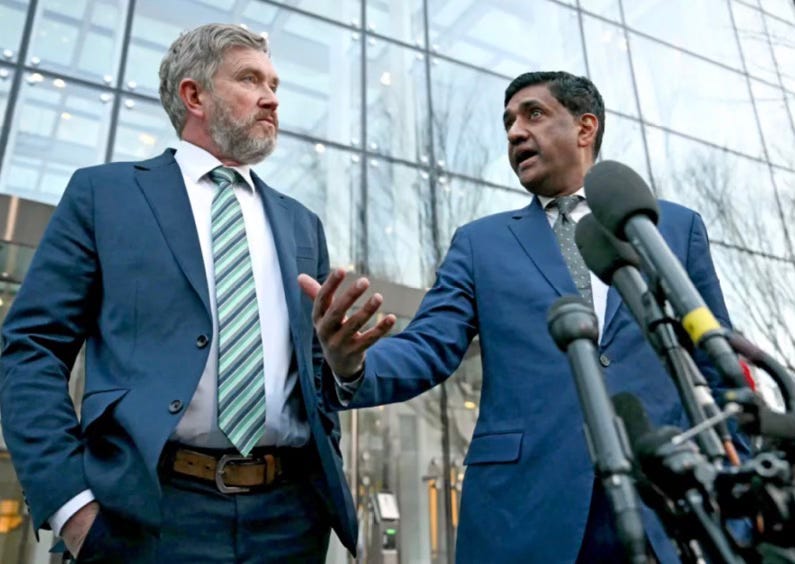
Rep. Thomas Massie (R-KY) and Rep. Ro Khanna (D-CA) speak to reporters as they press for full public release of the federal government’s Jeffrey Epstein files.
Before You Declare Democracy Dead, Read This.
The Jack Hopkins Now Newsletter #777: Sunday, February 15th, 2026.
There is a certain kind of despair that feels intelligent.
It sounds informed.
It sounds hardened.
It sounds like, “I’ve seen enough.”
You hear it everywhere now:
“It’s over.”
“The system failed.”
“Democracy won’t survive this.”
And if you live inside the headlines long enough, that conclusion can feel inevitable.
But inevitability is not evidence.
So before you decide the American experiment is finished…let’s do something radical:
Let’s look at the receipts.
Not vibes.
Not Twitter threads.
Not worst-case hypotheticals.
Evidence.
Here are seven hard…documented reasons democracy is wounded…but not dead.
1. The Courts Refused to Break
After the 2020 election, more than 60 lawsuits were filed attempting to overturn the results across multiple states.
They failed.
Judges appointed by both Republicans and Democrats dismissed them for lack of evidence. Some rulings were blunt. Some were scathing. None handed over the republic.
Authoritarian movements require institutional cooperation. Courts are a pressure valve. When the system was pushed to its limits, that valve held.
That’s not theory.
That’s history that already happened.
2. Election Infrastructure Withstood Direct Assault
One of the most overlooked facts in modern politics:
Despite relentless attacks, the core mechanics of American elections continue to function.
A major Kettering Foundation–Gallup study found that while Americans are deeply dissatisfied with how democracy is working…they report significantly more confidence in the actual administration of elections.
Think about that.
People may distrust politicians.
They may distrust Congress.
They may distrust parties.
But…they still largely believe ballots are being counted.
That belief is oxygen. Lose it, and the fire spreads. Keep it, and reform remains possible.
3. Voters Rejected Election Denialism in Key Races
In the 2022 midterms, candidates who ran explicitly on overturning election results…
…lost pivotal statewide contests…especially in battleground states where offices like Secretary of State directly oversee voting systems.
Those are not symbolic roles.
They are structural chokepoints.
When voters were given a clear choice about who would control election machinery, many chose stability over sabotage.
That matters.
Because democracy often survives…in quiet offices…no one talks about on cable news.
4. The United States Is Still Rated “Free”
Freedom House…which tracks global democratic conditions…continues to classify the United States as “Free.”
That does not mean perfect.
It means the institutional capacity for civil liberties…political competition…and opposition still meaningfully exists.
You can still organize.
You can still publish.
You can still litigate.
You can still vote.
Authoritarian systems shut those doors entirely.
We are not there.
5. Civil Society Has Not Collapsed
Independent journalism still publishes investigations.
Nonprofits still litigate civil rights cases.
Grassroots organizations still mobilize voters.
Even reports warning about democratic backsliding consistently acknowledge something crucial:
Media and civil society remain resilient, though under pressure.
Autocrats thrive when watchdogs are neutralized.
Ours are bruised…but they’re still biting.
6. Democratic Decline Is Not a One-Way Street
Globally, we are in a period of democratic strain. That’s real.
But the same comparative democracy research that documents backsliding also identifies countries currently moving in the opposite direction…democratization episodes happening right now.
Political systems can degrade.
They can also rebound.
History is not a straight line toward darkness.
It is cyclical, volatile, and responsive to public action.
Decline is possible.
So is recovery.
7. Most Americans Still Prefer Democracy
Perhaps the most important data point of all:
Despite frustration, despite polarization, despite exhaustion…roughly two-thirds of Americans continue to say democracy is the best form of government.
Not perfect government.
Not efficient government.
Democracy.
Authoritarianism becomes unstoppable when the public decides the alternative is preferable.
That threshold has not been crossed.
And that…is everything.
Now let’s be honest.
None of this guarantees safety.
None of this suggests complacency.
Democracy does not survive because people feel hopeful.
It survives…because institutions hold long enough for voters to reassert control.
It survives…because courts refuse to rubber-stamp lies.
It survives…because civil society refuses to shut up.
It survives…because enough citizens…even frustrated ones…still believe it’s worth preserving.
Despair feels sophisticated.
But surrender…is not analysis.
If you are convinced it’s over, ask yourself:
Have the courts collapsed?
Have elections stopped?
Has civil society been outlawed?
Has the public embraced authoritarian rule?
No.
The system is stressed.
It is polarized.
It is under attack.
But…it is not dead.
And…history shows something else that doomscrolling never mentions:
Authoritarian movements often look strongest right before they fracture.
Democracies often look weakest right before they mobilize.
The question is not whether the moment is dangerous.
It is.
The question is whether the structural guardrails are still present.
They are.
And…as long as they are…the story is not finished.
Not. Even. Close.
If this helped steady your thinking, tap the ❤️ so more people see it inside Substack.
And in the comments, tell me honestly:
Do you believe the system can still correct itself…or do you think we’re past that point?
Let’s talk about it.
#HoldFast
Back soon.
-Jack
Jack Hopkins


I still believe democracy is possible.
I live in Indiana, where legislation is on the precipice of turning us into a maga police state and immigrant-free zone.
ICE is renting commercial office space down the road in affluent Carmel.
We're fighting hard against SB76 and HB1343.
It feels like we're closer to autocratic consolidation than some other states. But maybe not. We defeated redistricting, and we might win the fight against these bad bills.
We're calling and writing the associated pillars, mayors, local police- and asking to meet with them. We want them on record- do they support the fascist state leaders, or are they willing to call and express disapproval.
So no it's not over yet, and maybe we're just getting started.
